
Bioremoval of Cadmium using the Bacterial Strain, Pseudomonas Oleovorans MTCC 617 (Pseudomonadales, Pseudomonadaceae)
Biosorption can be an effective technique for the treatment of heavy metal bearing waste water resulting from human and industrial activities. Several Gram positive and negative bacteria have the ability to remove the heavy metals, thereby making water contaminant free. The present work has been designed to test the efficiency of the bacterium in the removal of cadmium from aqueous solutions. Experiments were also designed to study the effect of sugars on the biosorption of cadmium ions. Pseudomonas oleovorans MTCC 617 procured from IMTECH, Chandigarh was used in the present study. The tolerance of the strain for cadmium was found out by plating onto Nutrient agar containing different concentrations of cadmium. P. oleovorans was exposed to different concentrations of cadmium (250, 500, 750 and 1000 ppm) for a period of eight days. Dead cells of P. oleovorans were also employed to study the biosorption of cadmium. AAS analysis was carried out for the sample at intervals of two days. Highest cadmium removal was found to be at 750 ppm concentration for ten minutes with dead cells of P. oleovorans.
Introduction
The release of heavy metals into our environment is still large and they cause environmental pollution problems because of their unique characteristics. Our air, food and water often contain heavy metals [1]. Heavy metal cations play an important role in many biochemical reactions due to their ability to form complex compounds [2, 3, 4, 5, 6, 7, 8, 9, 10, 11, 12, 13].
Heavy metals play an important role in biological life as essential and micronutrients, yet high concentration might be threat to human’s health and biological life. The sources of heavy metal pollution are mining, milling and surface finishing industries, discharging a variety of toxic metals such as Cd, Cu, Ni, Co, Zn and Pb into the environment [2].
The levels of metals in environment, including air, water and soil are increasing to toxic levels with contribution from variety of industries and domestic sources. Anthropogenic emission of lead, cadmium, vanadium and zinc exceeds that of natural sources by up to 100-fold. Cadmium is a non- essential and non-beneficial element to plants and animals.
Cadmium is recognized to produce toxic effects on humans. Long term occupational exposure can cause adverse health effects on the lungs and kidneys.
The major sources of cadmium release into the environment by waste streams are electroplating, smelting, alloy manufacturing, pigments, plastics, batteries, mining and refining processes. The cadmium uptake through human gastrointestinal tract is approximately 5% of ingested quantity of cadmium.
Unlike most organic pollutants which can be destroyed, toxic metal ions released into the environment often constitute a serious health hazard due to their non-degradability, toxicity, accumulation, and magnification throughout the food chain, which has human at its top. Therefore, removal and recovery of toxic metal contaminants from waste water is one of the most important environmental issues today [1].
The commonly used procedures for removing metal ions from aqueous streams include chemical precipitation, lime coagulation, ion exchange, reverse osmosis and solvent extraction [5].
Reverse osmosis is a process in which heavy metals are separated by a semipermeable membrane at a pressure greater than osmotic pressure caused by the dissolved solids in waste water. The disadvantage of this method is that it is expensive. In electro dialysis, the formation of metal hydroxides which clog the membrane is a disadvantage; generation of sludge in ultrafiltration limits its usage. High cost and partial removal of certain ions are disadvantages of ion-exchange method and the main disadvantage in chemical precipitation is the production of large amount of sludge containing toxic compounds during the process [4].
Phytoremediation is yet another process used for the removal of heavy metals. It is the use of certain plants to clean up soil, sediments and water contaminated with metals. The disadvantages include that it takes a long time for the removal of metals and the regeneration of the plant for further biosorption is difficult [6]. Hence the disadvantages like incomplete metal removal, high reagent and energy requirements, generation of toxic sludge or other waste products that require careful disposal have made it imperative for a cost-effective treatment method [7].
Biosorption can be an effective technique for the treatment of heavy metal bearing waste water resulting from human and industrial activities. Several Gram positive and Gram negative bacteria have the ability to remove the heavy metals, thereby making water containment free [9]. A wide variety of biological materials have been exploited for their metal biosorption capacities. Among the various sources, both live and inactivated biomass of organisms exhibit increasing metal binding capacities [10]. Biosorption methods can be an alternative to the common industrial methods of removal of heavy metals due to being environmentally friendly and sustainable for use [12].
Various factors like nature of adsorbents and biosorbate, adsorbate concentration, solution pH, temperature, ionic strength, biosorbent dosage, biosorbent size and agitation rate affect the performance of living biosorbents [8]. The major advantages of biosorbents over conventional treatments include low cost, high efficiency, minimization of chemical and biological sludge, no additional nutrient requirement, and regeneration of biosorbents and possibility of metal recovery.
Hence in the present study an attempt has been made to study the biosorption of cadmium ions by P.oleovorans (MTCC 617). Experiments have also been designed to study the effect of dead cells, and sugars on the biosorption of cadmium ions.
Materials and Methods
The present study was designed to study the cadmium removal efficiency by P.oleovorans. Various concentrations of cadmium were prepared by dissolving cadmium chloride (CdCl2) in sterile distilled water.
Strain Procurement and Maintenance
The bacterial strain used in the present study, Pseudomonas oleovorans was obtained from Microbial Type Culture Collection, IMTECH, and Chandigarh, India. The obtained culture was maintained onto nutrient agar slants and stored at 4oC.
Estimation of Metal Tolerance
The concentration of cadmium tolerance for bacterial growth was determined by inoculation of the selected bacterial strain onto the nutrient agar medium containing wide range of cadmium concentrations (50, 100, 500, 1000, 2000, 3000 and 4000 ppm). The plates were incubated at 37oC and observed for growth after 24 hours.
Sample Preparation
The organism from the overnight culture maintained in nutrient broth was inoculated into nutrient broth containing different concentrations of cadmium (250, 500, 750, 1000 ppm). The flasks were incubated at room temperature on a shaker for intermittent mixing and the samples were then subjected for the estimation of residual cadmium concentration after every two days up to eight days.
Estimation of Optical Density
Two ml of the sample from the culture flask was taken and with the help of colorimeter optical density values were taken at 450 nm. It was performed from two to eight days of treatment.
Determination of PH
The pH of the broth after treatment was determined using pH meter and pH 7 was observed throughout the treatment.
Estimation of Residual Metal Concentration
Ten ml of the sample from the culture flask was taken in a centrifuge tube and subjected to centrifugation at 2500 rpm for fifteen minutes. The supernatants were collected in sterile bottles and subjected to Atomic Absorption Spectrophotometric (AAS) analysis and the readings were recorded.
Biomass Estimation
Pellet from the above step was collected and poured in a Petri dish. Then the Petri dish containing the pellet dried in a hot air oven at 80o C for three hours. The final dried biomass was weighed.
Preparation of Autoclaved Cells
For obtaining autoclaved cells, the bacterial culture (24 hours) in nutrient broth was autoclaved at 121°C for thirty minutes and used for the study. For testing the biosorption of dead cells 100 ml of minimal broth containing 250, 500, 750 and 1000 ppm of cadmium in 250 ml Erlenmeyer flasks were prepared. To such flasks different preparations were inoculated individually and samples were taken after 5 minutes up to 80 minutes for AAS analysis.
Supplementation of Sugars
The efficiency of the bacterium for the sorption of cadmium was tested by supplementing different carbon sources like dextrose, fructose, glucose, lactose and sucrose at 10% concentration in minimal broth containing 500 ppm concentration of cadmium and the inoculum (109 cells). The flasks were incubated at 37°C on a shaker. Optical density and biomass were estimated after two days by performing centrifugation at 2500 rpm for fifteen minutes, followed by drying in hot air oven at 80°C for three hours.
Statistical Analysis
Two way analysis of variance (ANOVA) was performed on the factors like residual cadmium concentration, percent removal of cadmium and biomass of P.oleovorans during cadmium treatment for the two variables namely cadmium concentration and treatment period. It was also performed on the factors like residual cadmium concentration and percent removal of cadmium for autoclaved cell preparations with two variables namely treatment period and cadmium concentration, using Microsoft MS- Excel Package
Results and Discussion
The bacterial strain P.oleovorans was tested for metal tolerance with wide range of cadmium concentrations (50, 100, 500, 1000, 2000, 3000 and 4000 ppm). The results indicated that after 24 hours incubation, the strain grew well up to 1000 ppm concentration of cadmium. Based on the metal tolerance level, the strain was subjected to different concentrations of cadmium (250, 500, 750, 1000 ppm) for sorption up to eight days.
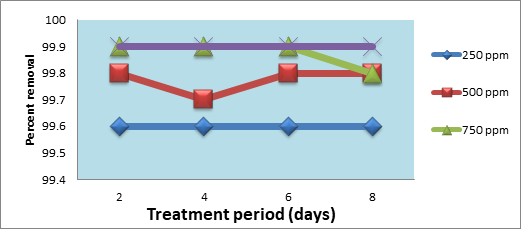
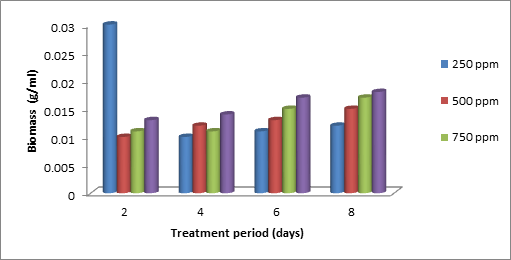
(Tables 1 & 2) divulges the residual concentration of cadmium after treatment with P.oleovorans. The residual concentrations of cadmium after treatment with P.oleovorans seem to be fluctuating. The minimal value of residual concentration of cadmium was observed at 500 ppm after four days of treatment, while the maximum value was observed at 250 ppm after four days of treatment Figure 1 illustrates the percent removal of cadmium after treatment with P. oleovorans. It indicates that among all treatments, the highest percent removal was for 1000 ppm concentration of cadmium throughout the treatment period Figure 2 illustrates the biomass of P.oleovorans during cadmium treatment. It shows that for eighth day, the highest biomass was observed with 1000 ppm concentration of cadmium. It indicates that cadmium concentration and biomass are directly proportional to each other.
| Treatment period (days) | Cadmium concentration (ppm) | |||
|---|---|---|---|---|
| 250 | 500 | 750 | 1000 | |
| 2 | 0.821 | 0.482 | 0.293 | 0.61 |
| 4 | 0.944 | 0.293 | 0.293 | 0.863 |
| 6 | 0.806 | 0.549 | 0.293 | 0.293 |
| 8 | 0.755 | 0.761 | 0.293 | 0.889 |
| Treatment period (Minutes) | Cadmium concentration (ppm) | |||
| 250 | 500 | 750 | 1000 | |
| 5 | 1.043 | 0.972 | 1.023 | 1.011 |
| 10 | 1.021 | 1.004 | 0.042 | 1.082 |
| 20 | 1.013 | 1.069 | 1.013 | 1.077 |
| 40 | 1.026 | 1.01 | 1.027 | 1.103 |
| 80 | 1.043 | 0.825 | 1.053 | 1.149 |
Table 1: Residual concentration of cadmium (ppm) after long term treatment with Pseudomonas oleovorans.
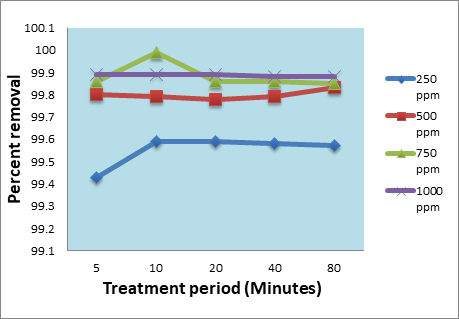
The residual concentrations of cadmium after treatment with dead cells of P.oleovorans are shown in the residual concentration of cadmium after treatment with P.oleovorans seems to be fluctuating. The minimal value of residual concentration of cadmium was observed at 750 ppm for ten minutes and maximum was observed at 1000 ppm after eighty minutes of treatment Figure 2 illustrates the percent removal of cadmium after treatment with dead cells of P. oleovorans. It indicates maximum percent removal for 750 ppm concentration of cadmium after ten minutes. Influence of sugars at 10 % concentration on the biomass of P.oleovorans during cadmium treatment is exhibited in the Figure 4. It indicates that the biomass being highest in the case of sucrose followed by glucose, lactose, fructose and dextrose. The biomass decreased in the case of fructose and dextrose Figure 3 shows the optical density values obtained during treatment with P.oleovorans after two days of cadmium treatment. The highest value was obtained for sucrose followed by glucose, dextrose, lactose and fructose. Table 3, shows the two way analysis of variance for the residual concentration of cadmium with the variables treatment period and cadmium concentration for P.oleovorans. The variations in the residual concentrations due to treatment period were statistically not significant while for cadmium concentrations, they were statistically significant.
The variation in the percent removal of cadmium due to treatment period were statistically not significant but significant for cadmium concentration. The two-way analysis of variance for the biomass (g/ml) of P. oleovorans with the variables, treatment period and cadmium concentration. The variations in the biomass due to treatment period and cadmium concentration were not statistically significant. The two-way analysis of variance for the residual concentration of cadmium with the variables treatment period and cadmium concentration for dead cells of P. oleovorans. The variations in the residual concentration due to treatment period and cadmium concentrations were not statistically significant. The two-way analysis of variance for the percent removal of cadmium with the variables, treatment period and cadmium concentration. The variations in the percent removal due to treatment period and cadmium concentration were statistically not significant.
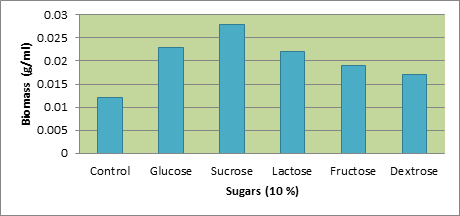
Bioremediation is an ecologically sound natural process where natural strains of bacteria breakdown organic waste most effectively. Microorganisms have been used in a number of biological treatment processes for remediation [6]. In the present study, P. oleovorans was employed to remove cadmium. The highest OD value of P. oleovorans was obtained during cadmium treatment at 1000ppm concentration after eighth day of treatment. The highest biomass of P.oleovorans during cadmium treatment obtained was in sucrose followed by glucose.
The results obtained from Oyewole, et al. [11] revealed that the ability of Pseudomonas aeruginosa to biosorb copper and chromium and also A. niger and P. notatum to biosorb cadmium and nickel from the environment and can be developed for the biosorption of soils polluted with copper, chromium, cadmium and nickel.
The present study was conducted under laboratory conditions. Therefore, in future studies, P.oleovorans can be tested with industrial waste and in natural environment, because microorganisms which are able to remove cadmium from metal solutions may sometimes fail to function when they are inoculated into a sludge system of industry and natural environments. They may be susceptible to toxins or other heavy metals present in the environment. Genetic engineering of P.oleovorans may be conducted in order to improve bio sorption.
References
-
Bajwa I, Pandey A (2005) Biosorption of heavy metals by microbes (A Review). Biotechnological applications in environmental management pp: 151-167.
-
Malik A (2004) Metal bioremediation through growing cells. Environ Int 30(2): 261-278.
-
Nies DH (2000) Heavy metal resistant bacteria as extremophiles 4(2): 77-82.
-
Parvathi K, Nagendran R, Radhakrishnan N (2007) ERSP Lead Biosorption onto Waste Beer Yeast By- Product, A Means to Decontaminate Effluent Generated from Battery Manufacturing Industry, Anna University, Chennai, India 10(1): 2-14.
-
Rich G, Cherry K (1987) Hazardous Waste Treatment Technologies, pudvan publishers, New York, USA, pp: 545-587.
-
Costa da AC, Duta FP (2001) Bioaccumulation of copper, zinc, cadmium and lead by Bacillus sp; Bacillus cereus, Bacillus sphaericus and Bacillus subtilis. Brazilian J Microbiol 32(1): 1-5.
-
Vieira RHSF, Volesky B (2000) Biosorption: a solution to pollution. Int Microbial 3(1): 17-24.
-
Vijayaraghavan K, Yun YS (2007) Utilization of fermentation waste (Corynebacterium glutamicum) for biosorption of Reactive Black 5 from aqueous solution. J Hazard Mater 141(1): 45-52.
-
Tarangini K (2009) Biosorption of Heavy Metals using Individual and Mixed cultures of Pseudomonas aeruginosa and Bacillus subtilis Master of technology (research) in chemical engineering, Department of Chemical Engineering, National institute of technology, rourkela-769008 Orissa, India pp: 1-91.
-
Hussein H, Ibrahim SF, Kandeel K, Moawad H (2004) Biosorption of heavy metals from wastewater using Pseudomonas sp. Electronic Journal of Biotechnology 7(1): 38-42.
-
Oyewole OA, Zobeashia SSLT, Oladoja EO, Raji RO, Odiniya EE, et al. (2019) Biosorption of heavy metal polluted soil using bacteria and fungi isolated from soil. SN Appl Sci 1(857): 1-8.
-
Redha AA (2020) Removal of heavy metals from aqueous media by biosorption. Arab Journal of Basic and Applied Sciences 27(1): 183-193.
-
Rossbach S, Kukuk ML, Wilson TL, Feng SF, Pearson MM, et al. (2000) Cadmium-regulated gene fusions in Pseudomonas fluorescens. Environ Microbiol 2(4): 373- 382.
- Natural Decline to Extinction of A New Zealand Rabbit Population
- Mitochondrial Bio-Logistics: Steering Co-Enzyme Q10 and Lycopene Synergies within the Science 4.0 Bio-OS Framework
- Hymenoptera Specimens from the Caño Negro Wetland, of the National Museum Collection, Costa Rica
- Science 4.0: Comprehensive Architecture of the Biological Operating System (Bio-OS) A Framework for Systemic Resilience and Industrialized Bio-Governance
- Rabbit on, or Hare Back? Understanding Climate Change
- Clinical Validation of Science 4.0: Flow Steering and Epigenetic Drift Inversion on a 76-Year-Old Hybrid System