
Ecological and Biological Adaptations of Triturus vittatus vittatus (Urodela) to an Unstable Habitat
We present ecological, biological and behavioral aspects of the newt Triturus vittatus vittatus in an unstable, semidry habitat at the southern border of its distribution. In the first rains of November–December (2020), adult male and female newts migrate into ponds that have not yet filled with water and find hiding places under the stones for about 1 month under tartaric conditions. About 2 weeks after the pond has filled with water, the newts transition to their aquatic phase, and sexual behavior and mating occur. No differences in body measurements were found between the terrestrial and aquatic phases. At the same time, there is intense growth of the common water-crowfoot (Ranunculus peltatus) in the pond. Newt eggs appeared on these plants 1 month after the pool had filled with water. Between February 15th and March 14th (2021), eggs and embryos were found on the common water-crowfoot. In the first 2 weeks of March, freshly hatched newt larvae appeared. On March 21st, only small tadpoles, immediately after hatch, were found. A summary and qualitative model of various reproductive stages of T. v. vittatus in a semiarid habitat on the southern border of its distribution are presented.
Introduction
The banded newt (Triturus vittatus) is one of seven newt species found in Israel. It is found at the southern border of their distribution, and is adapted to extremely unstable conditions [1, 2]. This unique species differs from the other six species in that at sexual maturity, it lives in two phases, terrestrial and aquatic [3]. The banded newt is distributed throughout Lebanon, Syria, Israel, and Iraq [4]. According to Litvinchuk et al. (2005) [4], the banded newt consists of two species, T. ophryticus and T. vittatus, based on trunk vertebra count, genome size and allozyme data. The northern taxon, T. ophryticus, is subdivided into two geographical fragments: “western group” populations from western Anatolian Turkey; and “eastern group” populations distributed in the remaining area of Turkey and Western Caucasus. The species T. vittatus is found in Israel [5]. The banded newt species or T. vittatus (the difference is not clear) is an endangered subspecies in Israel [5, 6], found at the southern limit of the species’ distribution. Adaptation of T. vittatus to the southern border of newt populations in Israel has been scarcely described [7]. On the other hand, many aspects of T. vittatus in Israel have been investigated: its life cycle [8, 9], ecological conditions during larval growth [10, 11, 12, 13, 14, 15], environmental hiding-place- seeking behavior after metamorphosis [10], and genetic differentiation of the larvae in various breeding places [16, 17, 18, 19]. The development of the newt Triturus carnifex, which is very similar to T. vittatus, has been described from egg deposition to hatch and illustrated with the use of photographs of living embryos by D’amen, et al. [20]. Embryogenesis is divided into five major phases (cleavage, gastrulation, neurulation, and organogenesis, the latter split into two phases—tail bud and ‘larva’) and into a sequence of 42 stages.
The life cycle of T. vittatus in Israel has been described in several studies [3]; in northern Israel and the Upper Galilee by Degani et al. [15] and in central Israel by Geffen et al. [8]. T. vittatus in the aquatic phase reproduces mainly in unpredictable habitats such as winter pools that generally contain water only until the beginning of the summer, although occasionally these pools contain water throughout the year.
Like other newts, T. vittatus requires a water body surrounded by an adequate terrestrial habitat to support both terrestrial and aquatic life phases. Terrestrial adult newts reach the pond area at the beginning of the rainy season, before the ponds fill up with water, and transition to the aquatic phase in the filled ponds. In the Upper Galilee, males inhabit the ponds from January to March, and leave them after mating. Females may remain in the water until May, when they deposit 18–68 eggs on plant or rock surfaces, and then transition to the terrestrial stage. The larvae hatch 19–29 days later, depending on water temperature [12]. Egg-laying by the adult newt on plants, hatching of the larvae from eggs, and larvae in their early stages of growth, have only been described in general terms in natural Israeli habitats. However, the development of embryos and of the larvae immediately after hatch has been described in other species of newts, for example, Triturus carnifex [20]. The growth and complete metamorphosis of tadpoles have been well-studied around water bodies [9, 15, 21]. The limnological conditions in the Israeli water ponds in which the tadpole newts grow and develop have been studied and described in detail [21]. Pond water temperatures range between 5 and 30ºC, pH varies from 6.5–10, and dissolved oxygen ranges between 2 and 27 mg/L, generally between 5 and 10 mg/L. Electrical conductivity varies from 150–800 μS, due to ammonia and nitrite.
The aims of this study were to expand our knowledge of the life cycle of T. vittatus, which is not described in detail in its unstable habitat at the southern border of its distribution, where the pond fills up about 1 month or more after the rains begin, and remains filled with water for only a relatively short time. Specific aims were to: (1) study the behavior of the adults when they arrive at the breeding area under unstable winter conditions, and determine their location in the pool area and the waiting time for the pool to fill with water; (2) study the period of spawning, embryo development and larval growth immediately after hatch; (3) examine the relationship between vegetative growth in the pond and egg-laying by the newts; (4) measure the time taken for the embryos to develop in this habitat, and the size of the larvae immediately after hatch in the wild. None of these variables have been described in detail in this unpredictable habitat [15].
Material and Methods
Study Area
Nahalit Pool is a winter pool located on the slopes of an agricultural settlement (springs) in the Upper Galilee mountains, among grazing areas for cattle and horses that are rich in annual vegetation (longitude 35°27’48’’E, latitude 33°04’56’’N, altitude 665 m above sea level) [9, 18]. The pools are filled with runoff water and in some of them, water seeps in from the settlements’ barns and coops. The pool is divided into a deeper part, about 2 m in depth, covering a total area of about 50 m2 (Figure 1). This part holds water from around January to May [21]. In the larger and shallower part of the pool, the depth reaches about 80 cm at the center and the total area covers about 1000 m2. This part holds water from January to June. In both parts of the pool, aquatic vegetation develops in the water: the common water-crowfoot (Ranunculus peltatus) and the common spike-rush (Eleocharis palustris) [9].
Terrestrial and Aquatic Newts
The pool area and its surroundings were explored from October to May. While the pool was dry, the entire area was examined once a week for newts hiding under stones. After the pond filled with water, plant height was monitored by random sampling of 20 plants per week. Samples were collected from the water body using a round hand net— 40 cm in diameter with a mesh size of 0.1 cm. The net was immersed 40 cm into the water and 3–4 rotational movements of about 1 m from side to side were performed. All tadpoles were released back into the water after being measured, photographed, and identified to the species level [9].
Results
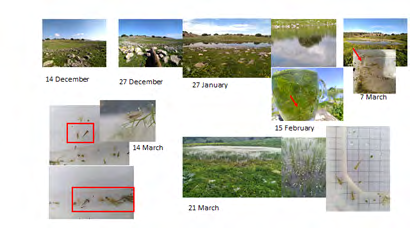
The terrestrial newts moved to the pond area in November and were found in the pond in December (Figure 1). The first rains did not fill the pond, and annual vegetation covered the pond area. The newts found hiding places in the center (deep part) of the pond. The newts were found for about 1 month (December) in the dry pond and did not transition to the aquatic phase. The transition from the terrestrial phase to the aquatic phase occurred only after the pool had been filled with water, and the newts were then found in the water (Figure 2).
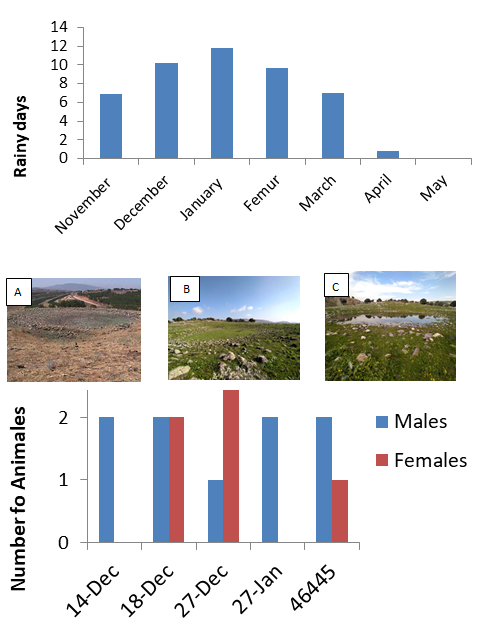
Figure 1: Number of rainy days in the area of the winter pool and the three main seasonal changes in the pool. (A) Pool during the summer before the rains. (B) Pool when the rain starts; pool is still empty and only annual vegetation covers the area. (C) Pool full of water. The terrestrial newt stage is found in the pool in December and the aquatic newt stage in January and February.
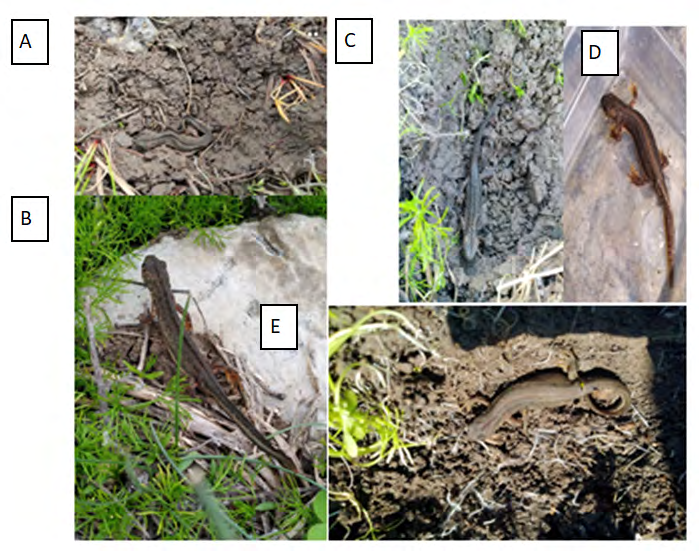
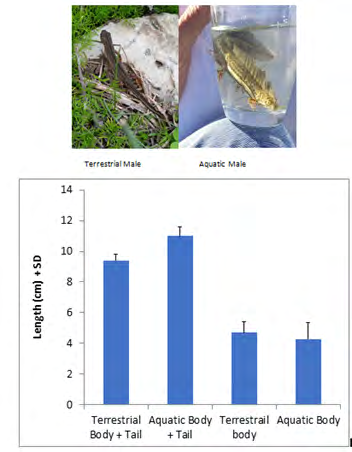
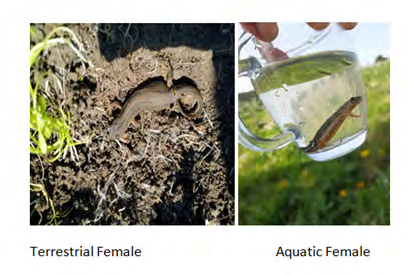
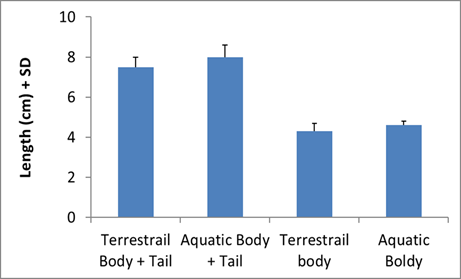
No difference was found between body measurements for the terrestrial phase and aquatic phase (Figures 3 & 4). In contrast, there was a large difference in body color for both males and females, with the largest difference for the male. In particular, variations were found in the dorsal fin along the male’s body and the tail between aquatic and terrestrial phases.
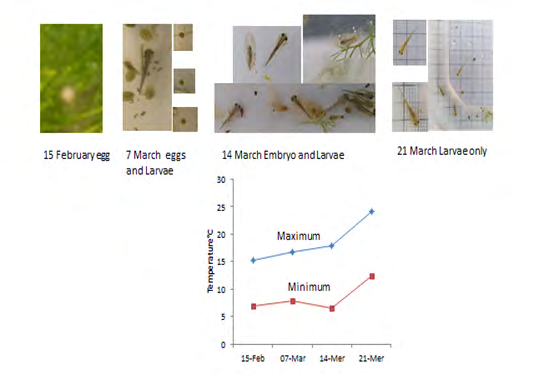
After 2 weeks, the pool was filled with water, and a large number of common water-crowfoot (Ranunculus peltatus) began to grow (Figure 5). Newt eggs appeared on the plants 2 weeks to 1 month after the pool had filled with water. Between February 15th and March 14th, eggs and embryos were found on the common water-crowfoot. In the first 2 weeks of March, freshly hatched newt larvae also began to appear. The embryos and larvae were seen attached to the plants on around March 14th (Figure 6). On March 21st, only small tadpoles, immediately post hatch, were found.
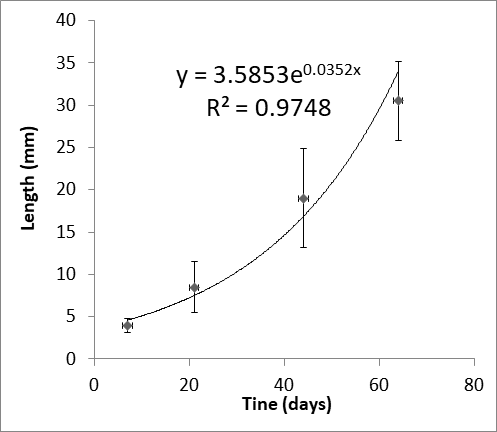
The larval growth until metamorphosis is presented in Figure 7. Regression conducted on data of larval size that had been recorded for the winter pond was y = 3.5853e0.0352X, R2 = 0.9748. The duration of growth in the winter pond (Nahalit) was about 2.5 months. The SD of the larvae increased as the age of the tadpoles increased. The growth rate clearly shows an exponential curve.
Discussion
Although many aspects of T. vittatus biology, ecology, systematics and behavior on the southern border of its distribution in Israel have been investigated [2, 3] the data collected in the present study have never been described. These data provide information on the newts’ adaptations to unstable habitats. The adult newts reach the pool area when the rains start, but the pool has yet to fill with water. Once the pool is filled, it takes time for sexual behavior, egg- laying and embryo development to hatch. To adapt to this situation, adult T. vittatus in their terrestrial stage migrate to the pool about a month before it fills with water. This environmental behavior and the factors influencing it, as described here in their habitat, were previously investigated under controlled conditions in the laboratory, where their selection of hiding places was shown to be driven by soil moisture and negative phototoxicity [22]. In the laboratory, significant differences were found in the newts' choice of hiding places between those covered with black paper and those covered with papers of different colors. Moreover, the response to moisture was stronger than that to light. Juvenile T. vittatus chose moist soil in hiding places [11] covered by black or transparent paper, and the difference between these choices and other combinations of light and moisture was significant [22]. In the present study, the adult newts were found hiding under the stones in the deepest places in the pond where the rains drained before the pond was filled. This supports results from other studies about their life cycle, but adds additional aspects that show their adaptability [9, 15, 17]. During the rainy season, before the pool fills with water, the newts move into the dry pool. Since in the rainy season, it will take a month or more until the pond fills up (Figure 1), the mature male and female gonads of T. vittatus in the terrestrial phase mainly contain mature sperm and oocytes [2, 23]. This long period—1 month—during which the terrestrial newts are found in dry ponds has not been described in the natural habitats at the southern border of their distribution. The pond filled with water at the end of January and on February 15th, newt eggs were found on the plants growing in the pond. Sexual behavior is initiated a short time after the pond fills with water and is immediately followed by egg-laying, which occurs over a short time. The whole process takes about 1 or 2 weeks under these conditions [17]. Sexual behaviors of these newts have been described in detail in the laboratory but not in their habitat [24]. The common water-crowfoot takes only a few weeks to reach a size that is suitable for egg-laying, in agreement with previous studies. However, this study is the first to describe embryo development. Between February 14th and March 15th, both embryos inside the eggs and hatched tadpoles could be found. After March 21st, only tadpoles and green toads were seen [25].
The period of tadpole growth in Nihalit winter pond has been described in previous studies but, with no description of the period between the territorial adult newts’ entry into the pond, initiation of sexual behavior, egg-laying, embryo development, and tadpole hatching. All of the measurements were performed only on tadpoles. Figure 8 summarizes the reproductive stages of T. vittatus in a semiarid habitat at the southern border of its distribution.
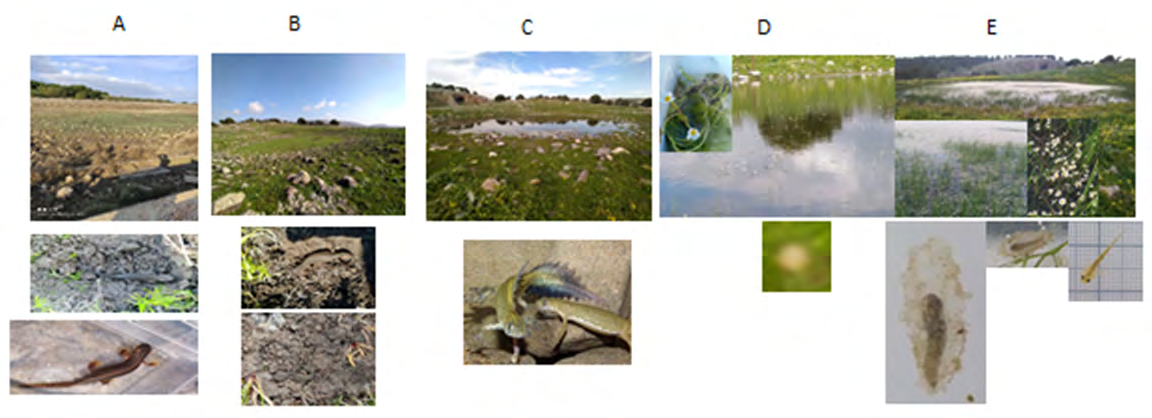
Figure 8: Suggested qualitative model of T. vittatus reproduction based on the results of the present study and the literature. (A) With the onset of winter rains, the adult newts move to their breeding place (Degani and Mendelssohn, 1983). (B) The newts are in the dry pool, hiding under stones while they wait for the pool to fill up. (C) The pond fills with water, the newts transition to the aquatic phase, sexual behavior is initiated and the male transfers the spermatophores to the female (D'amen et al., 2006; Degani, 2019b). (D) Laying eggs on plants, (E) embryos and tadpoles develop in a pond.
References
-
Degani G (2019a) Ecological and Genetic Variation of the Distribution of Various Species of Amphibians at the Southern Border of their Distribution. Int J Plant Anim Environ Sci 9: 21-41.
-
Degani G (2019b) The Fire salamandra (_Salamandra_ _infraimmaculata_) and the Banded newt (Triturus vittatus) along the southern border of their distribution. Published by Scientific Research Publishing Inc. ISBN, 978-971-61896-61693-61893.
-
Degani G (2017b) Ecological, Biological, Behavioral and Genetic Adaptation to Xeric Habitats of Triturus Vittatus Vittatus (Urodela) on the Southern Border of its Distribution. J Marine Sci Res Dev 7: 9910-2155.
-
Litvinchuk SN, Zuiderwijk A, Borkin LJ, Rosanov JM (2005) Taxonomic status of Triturus vittatus (Amphibia: Salamandridae) in western Turkey: trunk vertebrae count, genome size and allozyme data. Amphibia- Reptilia 26: 305-323.
-
Olgun K, Tok V, Arntzen JW, Turkozan O (1997) The taxonomic status of the Banded Newt (Triturus vittatus) in southern Turkey. The Herpetological Journal 7: 169- 171.
-
Pearlson O, Bluestein L, Snir S, Goldberg D, Degani G (2010) Molecular variation in Triturus vittatus vittatus (Urodela) from breeding sites near the southern extremity of its distribution revealed by DNA sequencing of mitochondrial cytochrome b gene and control region. Current Herpetology 29: 11-22.
-
Degani G (2018) Genetic Variation in Xeric Habitats of Triturus vittatus vittatus (Urodela) Using Mitochondrial DNA of 12S and16S, and Nuclear Gene, Rhodopsin, on the Southern Border of its Distribution. Intern J of Zool Invest 4: 31-40.
-
Geffe E, Gafny S, Gasith A (1987) Contribution to the knowledge of the biology of the banded newt, Triturus vittatus vittatus, in rainpools in Israel. Israel Journal of Zoology 34: 213-223.
-
Pearlson O, Degani G (2008) The life history of Triturus v. vittatus (Urodela) in various habitats. Asiatic Herpetological Research 11: 91-95.
-
Degani G (1982a) Amphibian tadpole interaction in a winter pond. Hydrobiologia 96: 3-8.
-
Degani G (1982b) The response to substrate moisture of Triturus v. vittatus (Jenys) (Amphibia, Urodela). Biol Behav 3: 215-220.
-
Degani G (1986) Growth and behavior of six species of amphibian larvae in a winter pond in Israel. Hydrobiologia 140: 5-10.
-
Degani G, Kaplan D (1999) Distribution of amphibian larvae in Israeli habitats with changeable water availability. Hydrobiologia 405: 49-56.
-
Degani G, Mendelssohn H (1983) The habitats, distribution and life history of Triturus vittatus vittatus (Jenyns) in the Mount Meron area (Upper Galilee, Israel). British Journal Of Herpetology 6: 317-319.
-
Pearlson O, Degani G (2007b) Triturus v. vittatus (Urodela) larvae at various breeding sites in Israel. Progrese şi Perspective in Medicina Veterinară - Lucrări ştiinţifice 50: 214-226.
-
Degani G (2017a) Ecological, Biological and Genetic Adaptation to Xeric Habitats of Salamandra infraimmaculata on the Southern Border of Its Distribution Open Journal of Animal Sciences 7: 70-92.
-
Pearlson O (2011) Ecology and genetic variance of the Banded Newt Triturus vittatus vittatus in northern Israel, Department of Evolutionary and Environmental Biology. University of Haifa, Haifa pp: 1-127.
-
Pearlson O (2012) Ecology and Genetic Variance of the Banded Newt Triturus vittatus vittatus in Northern Israel DOCTOR OF PHILOSOPHY, University of Haifa, Supervised by Prof. Gad Degani, Hebrue and English summary pp: 1-135.
-
Pearlson O, Degani G (2007a) Molecular DNA variations among Triturus vittatus vittatus (Urodela) from different breeding sites at the southern limit of its distribution. Acta Herpetologica 2: 69-77.
-
D’amen N, Virmoli L, Bologna M (2006) The normal development and the chromosome in Triturus carnifex carnifex (Caudata, Salamandridae). Ital J Zool 73: 325- 333.
-
Pearlson O, Degani G (2011) Water and ecological conditions of striped newt, Triturus v. vittatus (Urodela), breeding sites at various altitudes near the southern limit of its distribution. Herpetol. Romanica. Herpetol. Romanica 5: 27-42.
-
Degani G (2015) The Effect of Light and Soil Moisture on the Environmental Behavior of Newts (Triturus vittatus vittatus, Urodela). Open J Ani Sci 5: 411-417.
-
Pearlson O, Jackson K, Degani G (2007) The gonadal cycle in males and females of Triturus vittatus vittatus (Urodela) from the southern limit of Its distribution, Progressses and perspective in veterinary medicine pp: 227-233.
-
Raxworthy CJ (1989) Courtship, fighting and sexual dimorphism of the Banded Newt, Triturus vittatus ophryticus. Ethology 81: 148-170.
-
Degani G (2015) The Effect of Light and Soil Moisture on the Environmental Behavior of Newts (_Triturus vittatus_ _vittatus_, Urodela). Open J Ani Sci 5: 411-417.
- Natural Decline to Extinction of A New Zealand Rabbit Population
- Mitochondrial Bio-Logistics: Steering Co-Enzyme Q10 and Lycopene Synergies within the Science 4.0 Bio-OS Framework
- Hymenoptera Specimens from the Caño Negro Wetland, of the National Museum Collection, Costa Rica
- Science 4.0: Comprehensive Architecture of the Biological Operating System (Bio-OS) A Framework for Systemic Resilience and Industrialized Bio-Governance
- Rabbit on, or Hare Back? Understanding Climate Change
- Clinical Validation of Science 4.0: Flow Steering and Epigenetic Drift Inversion on a 76-Year-Old Hybrid System