
New Records for the Fluvial Ichthyofauna in Varadero, Cuba
Millions of people suffer from infections transmitted by arthropod vectors. Among them, culicidae are undoubtedly those of greatest hygienic-sanitary importance, especially in tropical and subtropical regions, so biological control, as an alternative to confront vector organisms, is becoming increasingly necessary due to the development of resistance to insecticides. With the objective of knowing the fish species that inhabit the fluvial ecosystems of Varadero, Matanzas province, Cuba, the following research was carried out, which covered the health areas of Santa Marta and Varadero, for which eight fluvial ecosystems were sampled, during January 24 and 25, 2020. The sampling unit used was the jamb, with the following dimensions (70x50x50 cm), with 150 cm of handle. Six fish species grouped into six genera and three families were identified. Gambusia puncticulata and Limia vittata turned out to be the best represented and distributed species; in the case of the first species, it was present in all the sampled reservoirs and even in brackish water reservoirs. The best represented family in the study was the Poeciliidae, present in 100% of the river ecosystems sampled, while, of all the fish species identified, those with the best bioregulatory potential on mosquito larvae were G. puncticulata and L. vittata.
Introduction
Millions of people suffer from infections transmitted by arthropod vectors [1, 2, 3]. Among them, culicidae are undoubtedly of the greatest hygienic-sanitary importance, especially in tropical and subtropical regions, since they are responsible for the maintenance and transmission of pathogens that cause Dengue, Yellow Fever, Malaria, Lymphatic Filariosis, among other deadly and debilitating infections [3, 4, 5]. This problem is now compounded by global warming and the intensification of extreme meteorological disturbances, which has brought with it changes in the behavior of diseases and their transmitters, with the establishment of vector species in places never recorded before [6, 7, 8, 9]. All this has brought with it major environmental problems that humanity faces today, the genesis of which lies in the human pretension to maximize production and economic profits without respecting the laws that regulate the functioning of nature [10, 11, 12].
Cuba, due to its geographical location and climatological characteristics, has a wide fauna of culicidae; many of them are important from the epidemiological point of view because of the diseases, both endemic and exotic, that they can transmit to the human and animal population [13, 14, 15]. Efforts to control such diseases have been hampered, in part, by the development of drug-resistant etiologic agents, insecticide- resistant mosquitoes, environmental contamination, residual effect of chemicals, high market prices, and other operational difficulties [16, 17, 18, 19]. Consequently, there is a growing need to develop other strategies for disease control, which can complement existing methods, such strategies consist of the implementation of biological methods to control mosquito populations [20, 21]. The main biological agents that have been successfully employed are predators, particularly larvivorous fish and copepods, as well as entomopathogenic agents, such as sporogenous bacteria: Bacillus thuringiensis (Bti) and Bacillus sphaericus (Bs) that attack the larval stages of mosquitoes [22, 23, 24]. Taking into account the above, we proposed to make known the fish species that inhabit the fluvial ecosystems of Varadero.
Materials and Methods
Study Area
The research was carried out in eight fluvial ecosystems of the health areas, Santa Marta and Varadero, both belonging to the Varadero municipality, Matanzas province, Cuba, including the Hicacos peninsula, where most of the hotel facilities are located. The distribution of the sampled reservoirs was as follows: ditches (4), lagoons (3) and estuary/mangrove (1).
Geographical Location of Varadero
The Hicacos Peninsula is located in the central region of Cuba, bordered to the north by the Atlantic Ocean (Gulf of Mexico, the Florida Strait and the Old Bahamas Channel), to the south by the provinces of Cienfuegos and Sancti Spiritus, to the east, southeast and southwest, and to the west by Matanzas (Figure 1).
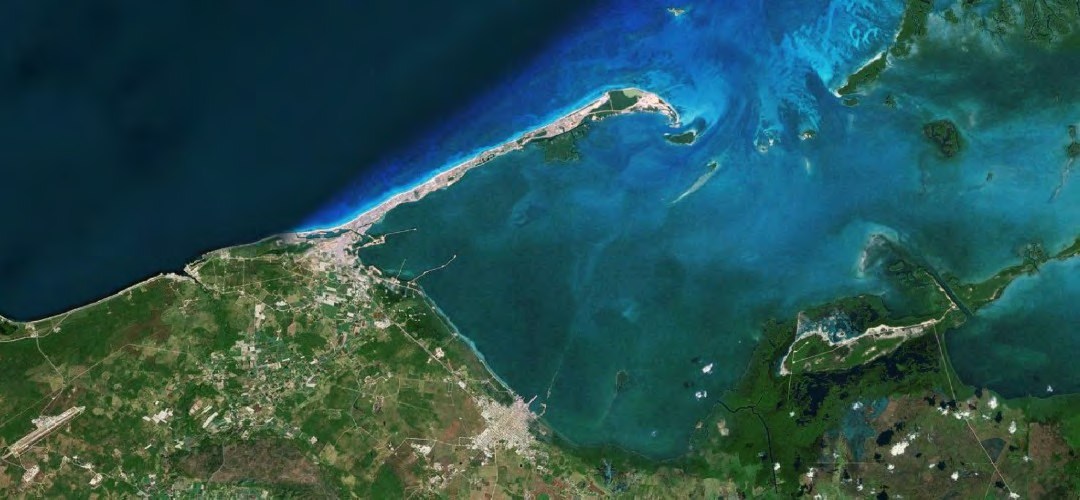
The relief is flat and not very dissected, its heights do not exceed 30 meters above sea level. The average height is 10 meters and the maximum is 27 meters (Chapelin and Frances). Curious rocks formed by sands with crossed stratification also rise. The peninsula, when beaten by the waves, has formed cliffs with caves of marine origin. The coastline has been, in part, modified by complex biological processes (corals and mangroves), erosive and depositional, and cumulative abrasive processes: the mangroves form a mesh with their roots that fixes the accumulations of mud and sand moved by the marine currents, giving rise to cays and mangroves. There is a tendency for the northern coast to rise and the southern coast to fall.
From the point of view of its geological structure, the peninsula is located in the region of development of tertiary rocks, mainly calcarenites. The Hicacos Peninsula has six beaches that stand out for their wide strip of fine white sand, the smooth profile of their bathing area and the extraordinary transparency and intense turquoise color of their waters, which have earned them the title of “Cuba’s blue beach”. Separated by low rocky cliffs, the widest beaches are Varadero (10.8 km), Rincon Frances (3.5
km) and La Alameda (4.5 km). Three other smaller beaches (together they total 1.6 km) are located between the San Bernardino Rock, on which the famous Xanadu Mansion is located, and the Pirate Caves, in the Chapelin Ecological Reserve. Playa Coral is another interesting beach for diving.
Aerial view of the Hicacos Peninsula. In the foreground, Varadero Beach, the longest of the six beaches located on its coastline and after which the resort is named. As a curiosity, this beach would be interrupted in its southern portion with the construction of the Paso Malo lagoon channel. Its vegetation is very similar to that existing in the Cuban keys, characterized by the presence of coastal mangrove, xeromorphic scrub and microphyllous and mangrove forests, with some species endemic to the western region of Cuba. Particularly relevant are the Hicacos (Chrysabalanus), which give the peninsula its name, and the cacti (Pilosocereus robinii and Dendrocereus nudiflorus) with specimens such as “The Patriarch”, a giant arboreal cactus that has become an attractive natural monument, estimated to be nearly half a millennium old.
Varadero has a territorial extension of 8 662.4 km², a population density of 96.2 inhabitants per km² and approximately 833 424 inhabitants.
Fish Collection
For the sampling and collection of fish in the different ecosystems, a jamb with a 1.5 mm diameter mesh size and the following dimensions (70x50x50 cm), with a 150 cm handle was used (Figure 2). Samplings was carried out on January 24 and 25, 2020.
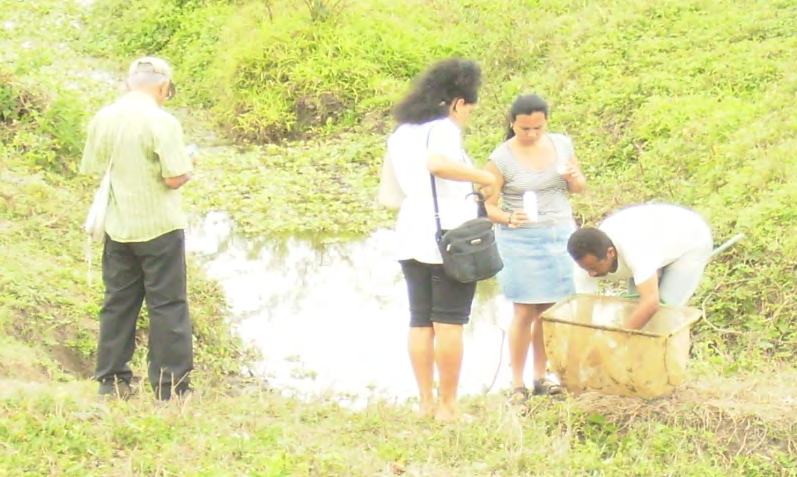
Three sets were made with the jamb at a distance of 2.5 m between sets (in the area with the greatest visible presence of fish). The samples obtained were deposited in 2% formalin, most of them in glass bottles, while the rest were transferred in nylon bags (5 and 10 L capacity), with water from the reservoirs themselves in 25 L plastic buckets to the laboratory of the Centro de Vigilancia, Monitoreo y Control de Culicidos de Varadero, where studies were carried out for the identification of each specimen collected, supported by different keys for such purposes [25, 26, 27].
Results
A total of six species were identified, distributed in an equal number of genera, and grouped into three families (Table 1).
| Species | Status | Family |
|---|---|---|
| Gambusia puncticulata Poey, 1854 | N | Poeciliidae |
| Limia vittata (Guichenot, 1853) | E | Poeciliidae |
| Cyprinodon variegatus Poey, 1860 | N | Cyprinodontidae |
| Cyprinus carpio (Linnaeus, 1758) | I | Cyprinodontidae |
| Tilapia rendalli (Boulenger,1897) | I | Cichlidae |
| Oreochromis mossambicus (Peters, 1852) | I | Cichlidae |
| Species | Total specimens | % |
| G. puncticulata | 385 | 66,3 |
| L. vittata | 92 | 15,8 |
| C. variegatus | 51 | 8,7 |
| C. carpio | 11 | 1,8 |
| T. rendalli | 32 | 5,5 |
| O. mossambicus | 9 | 1,5 |
| Total | 580 | 100 |
Table 1: Species distribution of collected specimens.
Legend: E: Endemic; I: Introduced; N: Naturalized. Table1: Fluvial Ichthyofauna identified by species, condition and family.
Regarding the distribution of specimens collected by species (Table 2), G. puncticulata (385) and L. vittata (92) were the best represented and distributed species.
Discussion
Of the three families identified, Poeciliidae was the best represented and distributed, being present in 100 % of the sampled reservoirs, while of the total number of fish species identified, those with the best bioregulatory potential on mosquito larvae were G. puncticulata and L. vittata, which is equivalent to 33.3 % of the total number of species identified [20, 28, 29]. In relation to the total number of species identified, the greatest number corresponded to endemic and naturalized species (528), which coincides with the ichthyofauna of South America and the Caribbean Islands, and corroborates the theory of Iturralde & MacPhee, et al. [30] in relation to the origin of the Cuban flora and fauna, and which has also been demonstrated by other authors for South America, especially in Venezuela and Peru [31, 32].
G. puncticulata was the best distributed and distributed species in the sampled reservoirs, followed by L. vittata, which agrees with the results obtained by Morejon, et al. [33], for Sancti Spiritus province, and Garcia, et al. [34] for Cuba, which may be due to various factors, such as the substantial increase in the levels of contamination of the river ecosystems of Varadero (domestic activity, tourism, agriculture and industries), as well as the intensification of interspecific competition, mainly with exotic species that have been introduced into these river ecosystems, mainly T. rendalli, C. carpio and Clarias gariepinus, which have greater ecological plasticity and adaptive capacity than endemic and naturalized species [35, 36, 37, 38].
Conclusion
The updating of the fluvial ichthyologic record of any locality is of vital importance in the surveillance, monitoring and control of culicidae larval populations.
Conflict of Interest Statement
The authors declare that they have no conflict of interest.
Contribution
All the authors contributed substantially to the concrescence of the manuscript
Financing
No funding was available.
References
-
Aguilera L, Gonzalez M, Marquetti MC, Capin JL, Fustes C (2000) Incidence of Aedes (S) aegypti and other Culicidae in the municipality of Playa, La Habana City. Rev Cubana Med Trop 52 (3): 174-189.
-
Fimia RD, Hernandez NC, Berovides VA, Gutierrez AA (2003) Effects on native larvivorous ichthyofauna caused by exotic fish introduced in mosquito breeding sites in the Yaguajay municipality, Sancti Spiritus, Cuba. Year 2000-2001. Revista infociencia 7 (3): 1-8.
-
Guzman MG, Kouri G (2002) Dengue: an update. Lancet Infection Diseases 2(1): 33-42.
-
Chandra G, Bhattacharjee I, Chatterjee SN, Ghosh A (2008) Mosquito control by larvivorous fish. Indian J Med Res 127(1): 13-27.
-
Dia I, Diop T, Rakotoarivony I, Kengne P, Fontenille D (2003) Bionomic of Anopheles gambiae Giles, An. arabiensis Patton, An. funestus Giles and An. nili (Theobald) (Diptera: Culicidae) and Transmission of Plasmodium falciparum in a Sudano-Guinean Zone (Ngari, Senegal). Journal of Medical Entomology 40(3): 279-283.
-
Gore A (2007) An Inconvenient truth [videocinta] EUA: Paramount Classics and Participant Productions. EUA 2(5).
-
Oses RR, Fimia DR, Iannacone OJ, Saura GG, Lomberto GC, et al. (2015) Modelacion de temperatura efectiva equivalente, impacto en la densidad larvaria total de mosquitos en Caibarien, Cuba. The Biologist (Lima) 13(S1).
-
Fimia DR, Alarcon EPM, Oses RR, Argota PG, Iannacone OJ, et al. (2017a) Modeling of Equivalent Effective Temperature and its possible incidence on larval density of Anopheles mosquitoes (Diptera: Culicidae) in Villa Clara province, Cuba. Revista de Biologia Tropical 65 (2): 565-573.
-
Fimia DR, Oses RR, Castillo CJC, Iannacone J, Alarcon EPM, et al. (2018) Influencia de algunas variables meteorologicas en la modelacion de la dinamica de mosquitos (Diptera: Culicidae) con importancia entomoepidemiologica en la provincia Villa Clara, Cuba. Neotropical Helminthology (aphia) 12 (1): 47-62.
-
Ramirez LM, Ramirez SM (2012) Biological Control of Mosquito Larvae by Bacillus thuringiensis subsp. israelensis, Insecticides-Pest Engineering. In: Perveen F, et al. (Eds.), pp: 1-28.
-
Soumare MKF, Cilek JE (2011) The effectiveness of Mesocyclops longisetus (Copepoda) for the control of container-inhabiting mosquitoes in residential environments. Journal of the American Mosquito Control Association 27(4): 376-383.
-
Walshe DP, Garner P, Abdel Hameed AA, Pyke GH, Burkot T (2013) Larvivorous fish for preventing malaria Transmission. The Cochrane Database of Systematic Review 10: 1-65.
-
Angulo E, Diagne C, Ballesteros ML, Adamjy T, Ahmed DA, et al. (2021) Non-English languages enrich Scientific knowledge: The example of economic costs of biological invasions. Science of the Total Environment 775(25): 144-441.
-
Epanchin NR, McAusland C, Liebhold A, Mwebaze P, Springborn MR (2021) Biological Invasions and International Trade: Managing a Moving Target. Review of Environmental Economics and Policy 15: 180-190.
-
Hulme PE (2021) Unwelcome Exchange: International trede as a direct and indirect driver of biological invasions worldwide. One Eart 4(5): 666-679.
-
Fimia DR, Esteban MR, Hernandez CN, Menendez DZ, Cruz CL, et al. (2015a) The copepods (Crustacean: Copepod) and fish (Osteichthyes) that inhabit in the fluvial ecosystems from Sancti Spiritus province, Cuba. International Journal of Current Research 7 (6): 17387- 17392.
-
Dieguez FL, Alarcon Elbal PM, Mantecon EM, Acao FL, Fimia DR, et al. (2012) Entomological remarks on Culex quinquefasciatus (Diptera: Culicidae) in Camaguey, Cuba. Journal of Mosquito Research 2 (3): 19-24.
-
Argota PG, Argota CH, Fimia DR (2013) Biomarcadores en la especie Gambusia punctata (Poeciliidae) dada las condiciones ambientales del ecosistema San Juan. REDVET 14(6).
-
Fimia DR, Oses RR, Argota PG, Iannacone OJ (2015b) Modeling of the wind chill and it is impact in the larval density of Anopheles mosquitoes (Diptera: Culicidae) in Villa Clara, Cuba. The Biologist (Lima) 13 (S1): 071806V.
-
Fimia DR, Alegret RM, Villavicencio CN, Cardoso LM, Hernandez CN, et al. (2012) Listado de mosquitos (Diptera: Culicidae) y peces (Octeichthyes: Actinopterigii) en ecosistemas fluviales de la provincia Sancti Spiritus, Cuba. BRENESIA/ Journal of Biodiversity and Conservation 78: 100-103.
-
Argota G, Iannacone J, Fimia R (2013) Characteristics of Gambusia Punctata (Poeciliidae) for Selection as A Biomonitor in Aquatic Ecotoxicology in Cuba. The Biologist (Lima) 11(2): 44-51.
-
Fimia DR, Aldaz CJW, Aldaz CNG, Segura OJJ, Cepero RO, et al. (2017b) Mosquitoes (Diptera: Culicidae) and their control by means of biological agents in Villa Clara, Cuba. International Journal of Current Research 08 (12): 43114-43120.
-
Fimia DR, Iannacone J, Alarcon EPM, Hernandez CN, Arminana GR, et al. (2016a) Potentialities of the Biological Control of Fish and Coepod on Mosquitoes (Diptera: Culicidae) of Hygienic-Sanitary Importance in the Province Villa Clara, Cuba. The Biologist (Lima) 14(2): 371-386.
-
Fimia DR, Alarcon EPM, Iannacone J, Gomez CL, Arminana GR, et al. (2016) Multimodal Relationship Between River Ictiofauna, Larval Mosquito Populations and Ecological Factors in Sancti Spiritus, Cuba. Neotropical Helminthology 10 (2): 233-247.
-
Alayo PD (1973) Lista de los peces fluviatiles de Cuba. Rev Torreia, pp: 24.
-
Koldenkova L, Garcia AI (1990) Clave pictorica para las principales especies de peces larvivoros de Cuba. La Habana: IPK/Poligrafico “Pablo de la Torriente Brau”, pp: 56.
-
Jannagblin J, Alvarino L (1997) Peces larvivoros con potencial para el control biologico de estadios inmaduros de zancudos del Peru. Rev Peruana Entomologia 40: 9-19.
-
Fimia DR, Quiros EA, Menendez DZ, Perdomo LME (2005) Depredacion experimental de larvas de mosquitos por el copépodo Mesocyclops aspericornis (Copepoda: Cyclopoida). Poeyana 492: 39-42.
-
Fimia DR, Castillo CJC, Cepero RO, Corona SE (2009) Eficacia del control de larvas de mosquitos (Diptera: Culicidae) con peces larvivoros. Rev Cubana Med Trop 61(2).
-
Iturralde VM, MacPhee RDE (1999) Paleogeography of the Caribbean Region: Implication for Cenozoic Biogeography. Bulletin of the American Museum of Natural History 238: 95.
-
Rodriguez JM, Cepero O, Rodriguez A (2006) Vigilance and control in temporary and permanent breeding ground of mosquitoes in Villa Clara. REDVET 7(7): 12- 16.
-
Rojas EP, Gamboa MB, Villalobos S, Cruzado FV (2004) Eficacia del control de larvas de vectores de la malaria con peces larvivoros nativos en San Martin, Peru. Rev Peru Med Exp Salud Publica 21(1): 44-50.
-
Morejon MP (1992) Eficacia del Bacillus sphaericus Neide, 1904 Cepa 2362 y peces larvivoros para el control de larvas de mosquitos (Diptera: Culicidae) [tesis de maestria]. La Habana: Instituto de Medicina Tropical “Pedro Kouri” (IPK), pp: 57.
-
Garcia AI, Gonzalez BR (1986) Main species of larvivorous fishes in the Poecilidae family and their effectiveness in natural conditions of Cuba. Rev Cubana Med Trop 38 (2): 197-202.
-
Imbahale SS, Mweresa CK, Takken W, Mukabana WR (2011) Development of environmental tools for anopheline larval control. Parasites and Vectors 4: 130.
-
Aditya G, Santanu P, Nabaneeta S, Goutam KS (2012) Efficacy of indigenous larvivorous fishes against Culex quinquefasciatus in the presence of alternative prey: Implication for biological control. J Vector Borne Dis 49(4): 217-225.
-
Iannacone J, Alvarino L, Valle RV, Ymana B, Argota G, Fimia R, Carhuapoma M (2015) Toxicidad de agentes antiparasitarios, antimicrobianos e insecticidas sobre larvas del camaron salino Artemia franciscana (Crustacea: Artemiidae). The Biologist (Lima) 13(S1).
-
Lockwood JL, Welbourne DJ, Romagosa CM, Cassey P, Mandrak NE, et al. (2019) When pets become pests: The role of the exotic pet trade in producing invasive vertebrate animals. Frontiers in Ecology and Environment 17(6): 323-330.
- California Red-Legged Frog and Non-Listed Amphibians Response to Non-Native Fish Removal
- Industrial Standardization of the Bio-OS: Algorithmic Codification of Resilience Engineering Guidelines and Version V8 Architecture
- Climate Variability and the Sustainability of Snail Farming in Nigeria: Past Trends, Present Challenges and Potential Outlook
- The Evaluation of the Surveillance System of Anthrax in Gilgit-Baltistan, Pakistan, 2018
- Natural Decline to Extinction of A New Zealand Rabbit Population
- Mitochondrial Bio-Logistics: Steering Co-Enzyme Q10 and Lycopene Synergies within the Science 4.0 Bio-OS Framework