
Conservation Recommendations and Identification of Nest Holes of Rose Ringed Parakeet (Psittacula Krameri) in the Botanical Garden of Pakitan Forest institute Peshawar, KPK, Pakistan
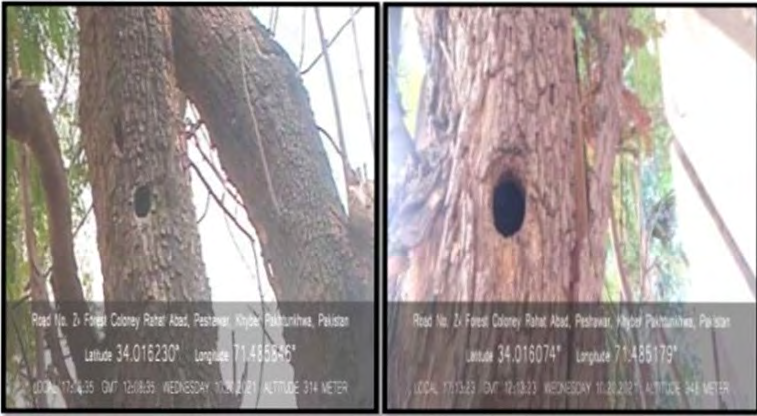
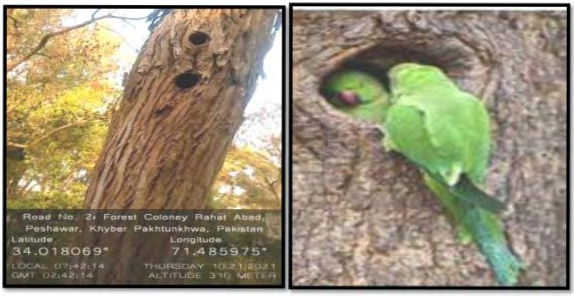
A study was conducted in the botanical garden of Pakistan forest institute Peshawar in the month of October, 2021. The purpose of paper was to sight and identify the parakeet nest cavities in old trees wherein 30 holes were seen mainly in the tree species as key stones sustaining the parrot population i.e. Acacia catechu, Albizzia lebbek, Eheratia serrate, Kydia calyeina, Millettia ovalifolia, Proosopia crneraria, Tamarix articulata, Leucaaena leucocephala, Platanus orientalis and Dalbergia sisso etc trees were with one or three nest cavities and the visual cues indicated that each cavity was occupied by parakeets, this paper also aimed to observe threats of parakeets nests including predation which has impact on rose ringed parakeet .The nesting key plants resources were identified in the study area and all trees hole size were measured which were ideal, parakeet likes 2.285 to 8.04 inches wide roost holes and preferred tree diameter 22 to 86 inches. Two species of parakeets were observed in study area i.e. Rose-ringed Parakeet (Psittacula krameri), Alexandrine or Large Indian Parakeet (Psittacula eupatria). The population of parrots increasing in the PFI Peshawar due to availability of roost cavities in old trees and less hunters competitors.
Introduction
Most commonly, rose-ringed parakeet prefers Morus alba, Albizia lebbeck, Acacia nilotica, Zizyphus spp, Melia azedarach, Salvadora oleoides, Tamarix aphylla, Phoenix dactylifera, Mangifera indica, Salmalia malabarica, Eucalyptus spp, Cedrella toona, Ficus bengalensis, Dalbergia sissoo, Terminalia arjuna, Erythrina suberosa, Jacaranda mimosifolia, Eugenia jambolana and Eugenia cumini, Rose ringed parakeet and Alexandrine parakeet (Psittacula Eupatria) is mostly distributed in Pakistan, it is most popular companion cage bird through the Pakistan. Khan, et al. [1] mentioned that rose ring parakeets primarily feed on citrus fruit, Guava, Mango, Almonds, Nuts, Buds and flowers are mostly general opportunistic feeders. The study was succeeded to see important habitat features of parakeets, wherein the biodiversity is viewed from the habitat perspective of parakeet the rose ringed parakeet is commonly known as parrot, male has black color and female lack black throat collar as well as rose colored ring on neck the bird prefer to live in large and old trees to acquire roosting and nesting opportunities with varieties in feed the government must change its status from unprotected to protected species and should ban its dealing for pet. The nests are important in the reproductive success of the avian species and nest selection is the main driving force behind the population, distribution and abundances. Cavity nesting is to assist in breeding [2, 3] the previous study also show that rose ringed parakeet prefers to breed near human settlements [4]. In Pakistan no documented study is available on status and distribution of the parakeets except Roberts, et al. [5]. Few studies including feeding behavior of parakeets in Guava, Sunflower and maize fields and roosting and feeding behavior of Rose-ringed Parakeet in Central Punjab have been carried out [6, 7, 8, 9, 10]. If we refer all the studies in Pakistan Rose-ringed Parakeet has been given the status of a common crop pest.
Materials and Methods
The study area is situated in the north western Pakistan, Peshawar, KPK. The data was collected weekly in the morning and evening time, using the transect survey. This survey was conducted at Pakistan Forest Institute Peshawar a urbanized area, block randomized, direct observation, transect walk, point transect were preferred to collect data. It has been taken care intentionally do not to damage or injured any species involved in this research paper without interpreting, co-ordinates were taken. The soft material likes cotton, stubbles; feathers were seen in their nests.
| S. No | Scientific Name | English Name | Location (Plot No) | Coordinates | |
|---|---|---|---|---|---|
| Latitude | Longitude | ||||
| 1 | Acacia Catechu | Balck Catechu | 11 | 34°1’0.25’’N | 71°29’8.08’’E |
| 2 | Alibizza Lebbok | Black Siris | 12 | 34°0’59.66’’N | 71°29’8.27’’E |
| 3 | Eheratia Serrata | Bedar | 16 | 34°0’58.25’’N | 71°29’8.20’’E |
| 4 | Kydia calyeina | Kubinde | 10 | 34°0’57.03’’N | 71°29’8.13’’E |
| 5 | Millettia Ovalifolia | Rose Wood | 9 | 34°0’55.81’’N | 71°29’8.18’’E |
| 6 | Prosopia crneraria | Mesqeut | 11 | 34°0’53.90’’N | 71°29’10.41’’E |
| 7 | Tamarix articylata | Tamzrix | 6 | 34°0’57.06’’N | 71°29’10.30’’E |
| 8 | Leucaaena leucocephala | IplePle | 12 | 34°0’54.36’’N | 71°29’8.35’’E |
| 9 | Platanus orientalis | Chinar | PFI Premises | 34°0’57.64’’N | 71°29’13.75’’E |
| 10 | Dalbergia sisso | shesham | 15 | 34°0’59.06’’N | 71°29’10.25’’E |
Table 1: Holes/cavity in tree Species in P.F.I botanical Garden Species Names.
Result, Discussion and Recommendation
Further it has been decided that its nesting and young parrots will again be revisited in the coming breeding season (February to may) the trees possess cavity played role in the terms of parakeet’s habitats and provide food for their population sustenance. Protection measures of these matures trees with indispensables cavity in the botanical garden of Pakistan Forest Institutes is appreciated these trees need more protection to enhance diversity of parakeets and other species .the owls and fruit bat were also observed in these developed cavities where they rear. The nests were observed on fork, trunk, and terminal. Further role may be studied in facilities occurrences of other species through the provision of nesting cavities co relations with excavators and other birds. The holes were seen 90 to 284 inches from ground levels, moreover, the future focus of this study should include whole of the KPK. Recommendations are as under:
• No census ever has been conducted on parakeet population in Pakistan. Country level census for Parakeets should be executed to determine population and status of all the species of parakeets including study of habitat.
• Export and other illegal smuggling of parakeets should be strictly monitored and ban on exports of parakeets may not be lifted till country level data is not obtained.
• Local level community organizations may be formed with alternate livelihood options to protect avifauna including parakeets.
• The provincial wildlife departments KPK may refrain from issuing license for all and sundry for catching common birds especially the Parakeets.
• Strict control and monitoring on bird trade within Pakistan and export to other countries may be strictly imposed.
• The raptors including kites, owls and the squirrels were main predator in the study area. A management plan is required to protect study area on avian perspectives.
Acknowledgements
The authors are thankful to senior officers of Pakistan Forest Institute Peshawar, Forest and Wildlife Department Balochistan and KPK for their invaluable inputs.
References
-
Ali S (2002) The Book of Indian Birds. Bombay: Bombay Natural History Society, Oxford University Press, Inc.
-
Thomas l, Conn PB (2009) A handbook of the birds of India and Pakistan. Bombay, India: Oxford University Nicholas. Inferences about land bird abundance from count data.
-
Fry CH, Keith S, Urban E (1998) The Birds of Africa. In: 3rd (Edn,). New Jersey: Princeton University Press.
-
Long JL (1981) Introduced Birds of the World: the Worldwide History, Distribution, and Influence of Birds Introduced into New Environments. London: Universe Books pp: 354 360.
-
Royle JA, Dorazio RM, Link WA (2007) Analysis Multinomilal Models with unknown index using data augmentation Journal of Computational and graphical statistics 16: 67-85.
-
Gallagher M, Woodcock M (1980) The birds of Oma. London: Quartet Books pp: 310.
-
Sibley C, Monroe B (1990) Distribution and taxonomy of birds of the world New Haven: Yale University Press, pp: 1111.
-
Richardson C (1990) The birds of the United Arab Emirates. 1st (Edn.), Dubai: Hobby Publications, pp: 176- 180.
-
Shirihai H, Dovrat E, Christie DA, Harris A (1996) The birds of Israel 692: London: Academic Press.
-
Strubbe D, Matthysen E (2009) Predicting the potential distribution of invasive ring- necked parakeets Psittacula krameri in northern Belgium using an ecological niche modelling approach Biological Invasions. 11(3): 497- 513.
- California Red-Legged Frog and Non-Listed Amphibians Response to Non-Native Fish Removal
- Industrial Standardization of the Bio-OS: Algorithmic Codification of Resilience Engineering Guidelines and Version V8 Architecture
- Climate Variability and the Sustainability of Snail Farming in Nigeria: Past Trends, Present Challenges and Potential Outlook
- The Evaluation of the Surveillance System of Anthrax in Gilgit-Baltistan, Pakistan, 2018
- Natural Decline to Extinction of A New Zealand Rabbit Population
- Mitochondrial Bio-Logistics: Steering Co-Enzyme Q10 and Lycopene Synergies within the Science 4.0 Bio-OS Framework