
Anesthesia and Braquial Plexus Block in Nine-Banded Armadillo (Dasypus novemcinctus)-Case Report
The nine-banded armadillo (Dasypus novemcinctus) is the most common species of armadillos in North, Central and South Americas. This case report is about an anesthetic procedure of a male armadillo received for rehabilitation with a radioulnar fracture. For the anesthesia, we use methadone, midazolam, s-ketamine and isoflurane. We also use a human laryngeal mask for secure airway and brachial plexus block with a peripheral nerve stimulator. There is a little information about anesthesia of these species in the literature and the aim of this work is to contribute to this knowledge. Though it is unknown the minimum alveolar concentration of isoflurane in nine-banded armadillo, we concluded that, with the blockage of the brachial plexus, we saw cardiovascular stability and a decrease in isoflurane use. The reversal of midazolam added to a quick recovery. The human laryngeal mask is effective for inhalation anesthesia in nine-banded armadillo.
Introduction
The nine-banded armadillo (Dasypus novemcinctus) is currently classified as a ‘’least concern’’ species in the conservation status of biological species, it is a medium- sized animal with nocturnal and lonely habits and is found in North, Central and South America which makes it the one of the most common of the armadillos [1]. A few armadillo’s (Nine-Banded, Six-Banded (Euphractus sexcinctus), three-banded (Tolypeutes matacus), long-nose (Dasypus kappleri), Andean hairy armadillo (Chaetophractus nationi), southern naked-tailed (Cabassous unicinctus) and Giant (Priodontes maximus) anesthetic procedures are described in the literature, most of them using dissociative protocols, including quetamine or tiletamine + zolazepam associated with xylazine, detomidine, butorfanol or midazolam [2, 3, 4, 5, 6, 7]. One particular case of a P. maximus was using Isoflurane by mask for maintaining the anesthesia [8].
No reports were found about laryngeal mask use in these species and also we didn’t find any reports on using regional and local anesthesia, only one phrase emphasizing that anatomical features of these species can make it’s use difficult [8].
This work aims to describe the anesthetic protocol and blockage of the brachial plexus at a surgical procedure of osteosynthesis.
Body of Paper
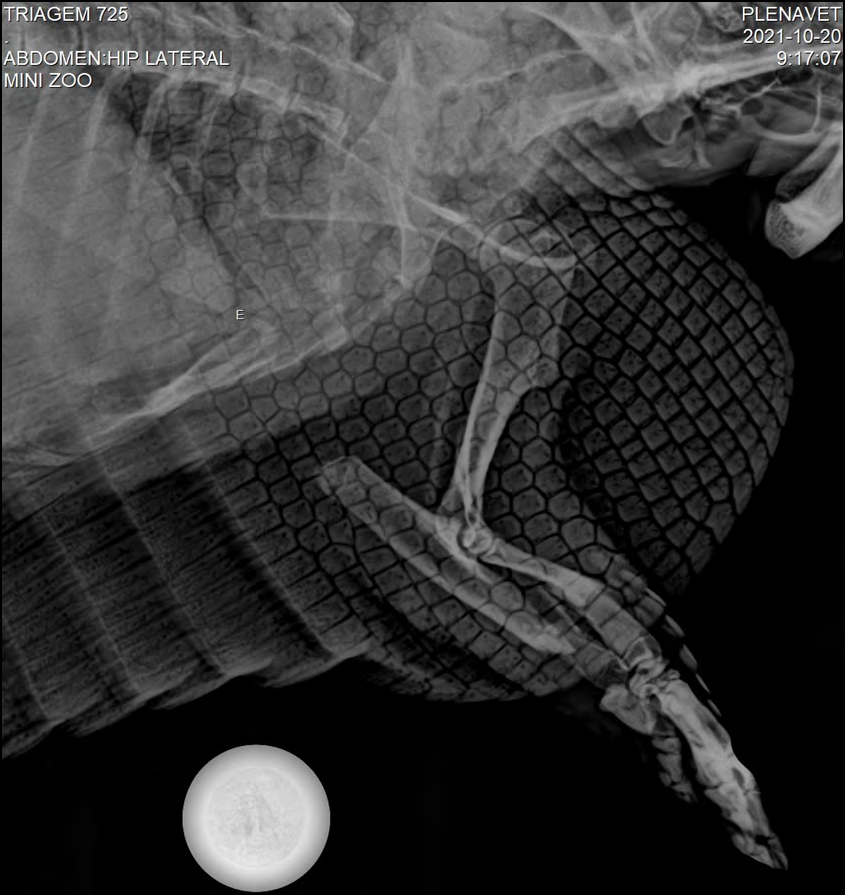
A male nine-banded armadillo, weighing 3.4kg was rescued and brought to the zoo after possibly being runned over by a vehicle. Radiographic exams were performed and revealed complete radioulnar fracture of the left thoracic limb (Figure 1). Until the surgery, the animal received meloxicam (0.1 mg/kg), tramadol (2mg/kg) and dipyrone (25 mg/kg).
.
For the preanesthetic medication, an association of methadone at 0,2 mg/kg, S-cetamine at 10 mg/kg and midazolam at 0.2 mg/kg by Intramuscular route. Venous access was made in the internal saphenous vein with a 24G catheter. The anesthetic induction was done with 1% isoflurane and the animal was kept with a laryngeal mask of 1.0 sterile silicon, with cuff, at spontaneous ventilation, non- rebreathing system (baraka) and 2 l/min O2, isoflurane and fluid therapy at a 1-2 ml/kg.h Table 1.
| Time of anesthesia (min) | 0 | 10 | 20 | 30 | 40 | 50 | 60 | 70 |
|---|---|---|---|---|---|---|---|---|
| Isoflurane (%) | 0.6 | 0.6 | 0.8 | 0.4 | 0.3 | 0.3 | 0.3 | 0.3 |
| Fluid (ml/Hr) | 3.4 | 3.4 | 3.4 | 3.4 | 3.4 | 6.8 | 10.2 | 10.2 |
Table 1: Isoflurane (%) and fluid therapy rates (ml/h) during the surgical procedure.
As an alternative to endotracheal tube, the laryngeal mask is an apparatus that allows easy access to the airway [9, 10, 11, 12]. The human laryngeal mask has varied sizes, and the size 1 was utilized in this case. The mask provides adequate maintenance of the airways under spontaneous or controlled respiration and reduces the possibility of trauma caused by the introduction of the endotracheal tube at the laryngeal region. In this case, the mask was efficient, properly occluding the glottis, as verified at the monitor through pulse oximetry, capnography and capnometry. The low value at pulse oximetry may be due to the laryngeal mask applying a little pressure at the sublingual artery, such as in rabbits [13].
Parameters such as echocardiogram, oxygen saturation, respiratory frequency, end-tidal carbon dioxide concentration, systolic and diastolic arterial pressure, temperature were checked through a multiparameter monitor (Table 2). Furthermore, eye lubrication was monitored during the entire surgical procedure and eye drops were used to lubricate within ten minutes intervals.
| 0 | 10 | 20 | 30 | 40 | 50 | 60 | 70 | |
|---|---|---|---|---|---|---|---|---|
| $SpO_{2 (%) | 94 | 92 | 93 | 93 | 93 | 97 | 86 | 86 |
| HR | 23 | 24 | 22 | 19 | 25 | 24 | 26 | 20 |
| RR | 90 | 90 | 80 | 85 | 70 | 65 | 80 | 80 |
| EtCO2 (mmHg) | 17 | 17 | 13 | 17 | 19 | 18 | 17 | 17 |
| Temp (°C) | 29.8 | 29.8 | 29.5 | 29.0 | 28.6 | 28.4 | 28.6 | 28.8 |
| SBP (mmHg) | 75 | 70 | 100 | 70 | - | - | 100 | 100 |
| MBP (mmHg) | 55 | 55 | 60 | 55 | - | - | 65 | 65 |
| DBP (mmHg) | 40 | 40 | 40 | 70 | - | - | 55 | 50 |
Table 2: SpO2-Pulse Oximetry; HR-Heart Rate; RR-Respiratory Rate; EtCO2-End tidal CO2; Temp-temperature; ia; SBP-Systolic Blood P
For the brachial plexus block, lidocaine was used to promote analgesia of the thoracic member distal to the spaculohumeral joint. The identification of the blockage was realized through palpation of the anatomical region associated with peripheral nerve stimulator (PNS). The anatomy of the nine-banded armadillo members (short, strong and hidden in carapace) makes the palpation and identification of the anatomics difficult, that is why PNS was helpful in this case. This equipment, with the aid of a specific needle for neurolocalization, emits electrical pulses to localize the desired nerve and muscular responses that occur when approached. The moment that the contraction involves the extension from the distal part of the member, stimulating the radial nerve, an aspersion is performed to check vascular puncture, and if it is not identified, the local anesthetic is injected [14].
Postoperative medication used were meloxicam at 0.2 mg/kg, dypirone at 25 mg/kg, enrofloxacin at 0.05 mg/kg and flumazenil at 0.05 mg/kg by subcutaneous route
Conclusion
Despite the unknown minimum alveolar concentration of isoflurane in nine-banded armadillo, we concluded that, the use of brachial plexus blockage and the cardiovascular stability suggest that this maneuver proved to be effective in the analgesia and decrease in isoflurane use. The reversal of midazolam with flumazenil added to a quick recovery. The human laryngeal mask also proved to be effective in the management of the airways in the armadillo.
Acknowledgement
The authors would like to thank Zoológico Municipal de Canoas for their support. We also thank Plenavet Radiologia Móvel for the radiographs.
References
-
IUCIN (2022) Red list of Threatened Species.
-
Fournier Chambrillon C, Vogel I, Fournier P, Thoisy B, Vié JC (2000) Immobilization of free-ranging nine-banded and great long-nosed armadillos with three anesthetic combinations. J Wildl Dis 36(1): 131-140.
-
Hernandez SM, Gammons DJ, Gottdenker N, Mengak MT, Conner M, et al. (2010) Technique, Safety, and Efficacy of Intra-Abdominal Transmitters in Nine-Banded Armadillos. Journal of Wildlife Management 74(1): 174- 180.
-
Orozco MM (2011) Chemical immobilization of three- banded armadillos (_Tolypeutes matacus_) using two anesthetic protocols in Northern Argentina. Edentata 12: 1-6.
-
Rojas G, Bermúdez L, Enciso MA (2013) Chemical Immobilization of Andean Hairy Armadillos Chaetophractus nationi (Thomas, 1894): Use of Ketamine, Xylazine and Midazolam with Yohimbine Reversal. Edentata 14: 51-57.
-
Sousa PC, Amorim GL, Lima ALC, Paiva VV, Paula, CIA, et al. (2016) Establishment of an anesthetic protocol for semen collection by electroejaculation in six-banded armadillos (Euphractus sexcinctus Linnaeus, 1758). Brazilian Archive of Veterinary Medicine and Animal Science 68(6).
-
Kluyber D, Lopez RPG, Massocato G, Attias N, Desbiez ALJ (2020) Anesthesia and Surgery Protocols for Intra- abdominal Transmitter Placement in Four Species of Wild Armadillo. Journal of Zoo and Wildlife Medicine 51(3).
-
Stocco MB, Gomes LG, Morgado TO, Corrêa SHR, Guimarães S, et al. (2017) Anesthesia in a giant armadillo (Priodontes maximus) for femoral fracture fixation. Acta Veterinaria Brasilica 11(4).
-
Pennant JH, White PF (1993) The laryngeal mask airway. Its use in anesthesiology. Anesthesiology 79(1): 144- 163.
-
Malbty JR (1994) The laryngeal mask airway in anaesthesia. Canadian Journal of Anesthesia 41: 888- 893.
-
Ivens D, Verborgh C, Phan Ti HP, Camu F (1995) The quality of breathing and capnography during laryngeal mask and facemask ventilation. Anaesthesia 50(10): 858-862.
-
Voyagis GS, Pappakalou EP (1996) A comparison of the laryngeal mask and tracheal tube for controlled ventilation. Acta Anaesthesiologica Belgica 47: 81-84.
-
Bateman L, Ludders JW, Gleed RD, Erb HN (2005) Comparison between facemask and laryngeal mask airway in rabbits during isoflurane anesthesia. Vet Anaesth Analg 32(5): 280-288.
-
Ibañez JF (2021) Veterinary Anesthesia: For Academics and Beginners. In: 1st (Edn.), Sao Paulo, MedVet Publishers.
- Mitochondrial Bio-Logistics: Steering Co-Enzyme Q10 and Lycopene Synergies within the Science 4.0 Bio-OS Framework
- Hymenoptera Specimens from the Caño Negro Wetland, of the National Museum Collection, Costa Rica
- Science 4.0: Comprehensive Architecture of the Biological Operating System (Bio-OS) A Framework for Systemic Resilience and Industrialized Bio-Governance
- Rabbit on, or Hare Back? Understanding Climate Change
- Clinical Validation of Science 4.0: Flow Steering and Epigenetic Drift Inversion on a 76-Year-Old Hybrid System
- Seeds Planted by another Mind