
Acipensor Stellatus, Rutilus (Rutilus) Caspicus, Leuciscus Cephalus Orientalis of the Fauna of the Nakhchivan Autonomous Republic Faunistic Analysis of Fishes
Summarizing the obtained literature materials and the results of our research, it was determined that 33 fish species or subspecies consisting of 6 groups, 9 chapters and 28 genera are distributed in the waters of Nakhchivan AR. Acipenser stellatus - A fairly large fish, its adult individuals in the ichthyofauna of Azerbaijan vary in body length from 105 to 225 cm and weight from 9 to 73 kg. The body stretches. Rutilus rutilus caspicus - A number of esophageal teeth, gingival teeth are sparse and rough. It is the only widespread species in Azerbaijan. The body, slightly flattened on the sides, is covered with fairly large scales. The eyes are large, the iris is red. Leuciscus cephalus orientalis - Fish is distinguished by broad and rigid forehead, cylindrical and large scales. The eyes are big and bright.
Mini Review
The Kura long nose was first encountered in the Nakhchivan reservoir in 1985. In the following years (1985- 2007) their number reached 9. The body length of the fish was 55-60 cm, weight was 4.2-5.3 kg. It was determined that the juveniles of this fish were released into the reservoir by fishermen of the Islamic Republic of Iran for experimental purposes. In the future, it will be useful for Azerbaijani fishermen to conduct experiments in this area (Figure 1) [1].
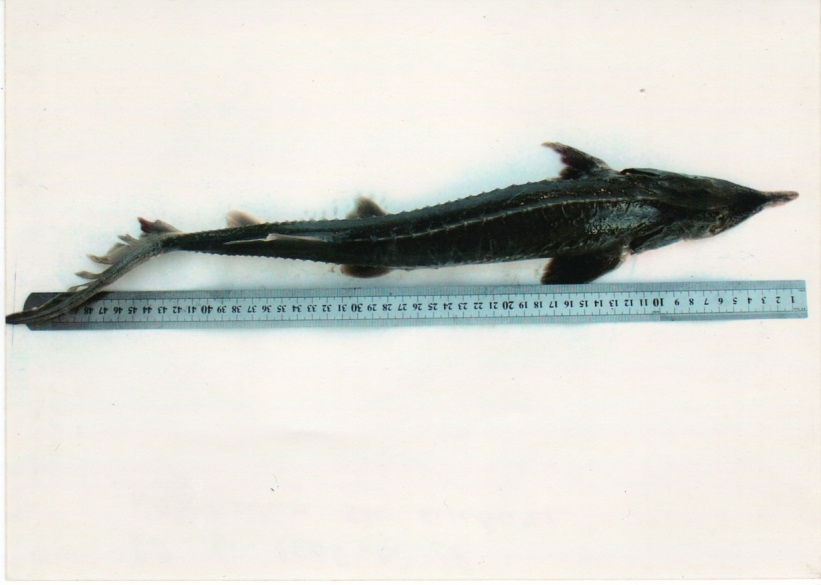
The long-nosed sturgeon feeds on small fish, various mollusks, arthropods, crustaceans (Malacostraca) and other aquatic organisms that live near the bottom in brackish and freshwater.
Cypriniformes
Scorpions are bony transient and semi-transient freshwater fish that are widespread throughout the world. It is estimated that there are 3,200 types of weights in the world, combined in 25-30 chapters. The freshwaters of Africa and South Asia differ in the richness of their species. More than 30 species and about 40 subspecies are widespread in Azerbaijani waters. The weights of the fauna of the Nakhchivan Autonomous Republic differ sharply in size, weight, feeding nature and behavior. Representatives of the family are known from sediments of Cretaceous and Pliocene (110-70 million years ago) [2].
The body length of weightlifters varies from 6 cm to 1.7 m. Transient and semi-transient sediments of freshwater origin are also widespread in the Caspian Sea, occupying the first place in the number of species in the ichthyofauna. Starting from the seventies of the last century, in the reservoirs of the Caspian Basin, the season of hamsters has been enriched with individuals of freshwater fish that feed
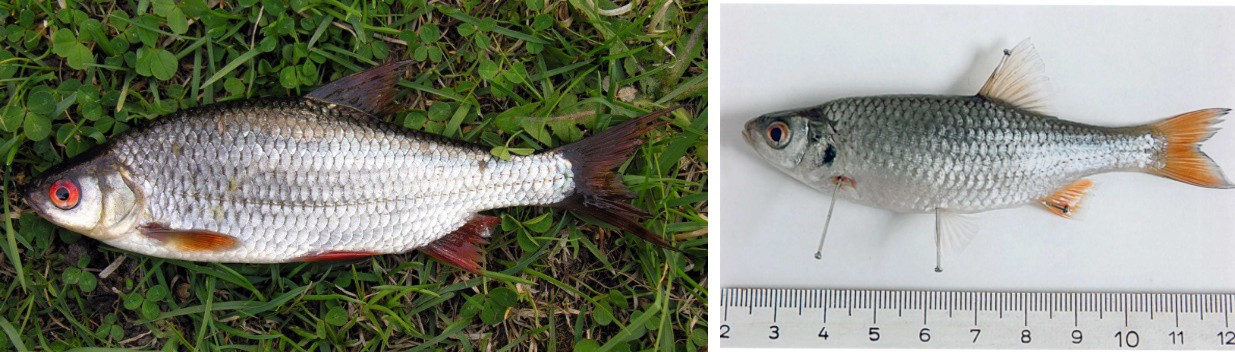
The ash obtained from the Araz reservoir was 15-30 cm long and weighed 80-500 g. In some cases, fish individuals with a body length of 35 cm and a weight of 700 g were also found.
In the conditions of the Araz reservoir, the ashes are 2-3 years old, and some females reach sexual maturity even at the end of the first year. Sexual productivity varies widely (7.0-70 thousand caviar), on average 29.0 thousand spawn. At full maturity, the diameter of the eggs varies between 1.12-1.40 mm. The period of intensive reproduction of ash begins in early April and lasts until the end of May. At the end on 3 types of plants. Weights in the Caspian Sea differ from the same species in freshwater in size, weight, nutrition and behavior. Avoid domesticated breeds (mirror, bare and other carp), grass carp and thick carp are currently producing high yields in fishing ponds. Since the individuals of these fish are mainly plant-fed, they are also used to prevent the development of vegetation in the irrigation canals of the southern geographical zones. At present, silver trout, one of the most important fish species in the Araz Reservoir, has been domesticated and artificially selected for about a thousand years. Rutilus (rutilus) caspicus Jakovlev [3].
The ash is distributed in the Caspian Sea along the coast from the Samur River to the Gulf of Anzali. It is distributed in the Kura River up to the Varvara reservoir dam, in Mingachevir, Varvara and Shamkir reservoirs, in the Kura surrounding water basins, in the Devechi port, in the Oxlov lake, in the Vilash river.
Laughter is a semi-transient fish. The subspecies has created a local population in the Araz Reservoir. It is found everywhere in Sututar. Bottom silt is more common in benthos-rich areas. Rare individuals of fish rising from Araz during spring floods were also found in Nakhchivanchay, et al. [4] (Figure 2).
of July, the length of infants reaches an average of 62 mm (52- 72 mm) and weight 5.8 g (4.1-7.7 g). It has been established that ash forms a hybrid under natural conditions with bream, algae and kutum [5, 6]. In general, this species is abundant in muddy, slow-flowing or stagnant warm waters in rivers, lakes, canals and dams. Spends the winter in herds. The species, which is usually 25 cm long, can live up to 14 years. Species found in fresh and salt water can live in the pH 7.0-7.5 and 10-20ºC. They can also grow in poor quality and polluted water. Their diet consists of insects, crustaceans, mollusks and plants. Adults prefer plants for nutrition. It attaches its eggs to the roots and vegetative parts of plants [7].
It is an important fish. As can be seen, the ash, which is not very large in size and weight, is highly valued by the population, both fresh and smoked. Currently, the species’s natural reserves have significantly decreased and its annual catch is about 0.1%. Therefore, we consider it important to take measures to increase ash reserves.
Cyprinidae
• Leuciscus cephalus orientalis It is a freshwater fish. It lives mainly in small, sparsely flowing, plant-rich stagnant waters of spring origin, as well as in canals. It is mostly distributed in the Kura River basin in Ganikhchay, Turyanchay, Agstafachay, Tartarchay, Gargarchay and Mingachevir, Varvara, Jeyranbatan reservoirs. The subspecies is also known as Squalius cephalus orientalis. One subspecies of the genus is widespread in the inland waters of Azerbaijan. In the territories of the Caucasus Nakhchivan Autonomous Republic, it is widespread in the Nakhchivanchay, Gilanchay, Alinjachay and Arpachay, Arpachay, Heydar Aliyev and Bilav reservoirs. It is rare to find in the areas where most of the collector-drainage waters and rivers in the Araz reservoir enter the reservoir. Prefers slow- flowing parts (Figure 3).
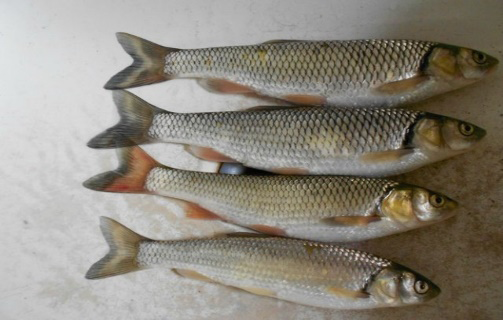
The body length of the obtained broad-headed individuals varied between 10-28 cm and weight between 14-426 g. In the waters of Azerbaijan, mainly individuals with a length of 41 cm and a weight of more than 900 g are widespread.
During this season, reproductive tubercles, or pearl organs, are observed in various parts of the male body (especially the head and fins). These tubercles, formed by epidermal cells, are formed under the influence of hormones shortly before the reproductive period and disappear shortly after this period. Sexual maturity occurs at the age of 3-4 years. Each tooth lays approximately 50,000–200,000 eggs spaced 0.7 mm in size. Spawning occurs in 18ºC-20ºC water. They lay their sticky eggs on underwater plants, sometimes on rocks, pebbles or underwater tree branches.
The Caucasian enlibashi feeds mainly on plants, insect larvae, and partly on mollusks. It also harms fish stocks by eating the eggs, larvae and babies of other fish species. Due to the small number of species, it is not important for waterfowl, and is caught by amateur fishermen in very small quantities [8].
• Ecological features : From November to winter they lie in the pits and stay until spring. Although they prefer clean, relatively fast-flowing rivers, they can sometimes enter lakes and even saltwater (Geldiay and Balık, 1988 Small flocks of Leuciscus cephalus living in lakes have been observed near shore. Large fish are caught from deep places. Large groups of this species. pelagic river fish, usually moving close to the surface of the water.
• Economic significance : The maximum length so far caught in natural waters is 60 cm and weighs 3 kg. The ability to grow is quite good, but the quality of the meat is low. Although the meat is delicious when fresh, it is not used much because it is very bony. However, the locals hunt and use it as food, especially in the spring and summer. It is easily hunted by the locals because it is easy to catch with a hook. They are especially 5-10 cm in size. They are caught in shallow streams with small nets with small eyes and are used as bait for fishing by predatory fish living in large freshwater sources where rivers join lakes [9, 10].
References
-
Bagirova M, Mustafayeva GY (2000) Comparative study of morphological features of fish in Shamkir reservoir, Aggol and Nahaligchala lakes. News of ANAS. Biological Sciences Series pp: 49-55
-
Bagirova M, Askerova XM, Agayarova AE, Agayeva SA (2003) Biological features of the main trout of Devechi port. News of ANAS. Biological Sciences Series pp: 39-44.
-
Bagirova M, Askerova XM, Agayarova AE (2004) Morphological features of internal organs of herring in Yenikend reservoir and histological structure of sexual organs. News of ANAS. Biological Sciences Series pp: 72- 79.
-
Bagirova M, Askerova XM, Agayarova AE (2006) On ichthyofauna of Yenikend reservoir. Works of the Institute of Zoology of ANAS 28: 131-137.
-
Bayramov AB (1993) Distribution of zoobenthos in Nakhchivan reservoir by fields. Materials of scientific- practical conference. Nakhchivan pp: 36- 40.
-
Bayramov AB, Mammadov TM (2001) On the development of fisheries in the Nakhchivan Autonomous Republic. Natural resources of Nakhchivan AR and ways of their more efficient use. Materials of the international symposium. Nakhchivan pp: 123-126.
-
Bayramov AB, Pashayev TY, Azizova CF (2001) Distribution of zoobenthos on biotopes in Nakhchivan reservoir. Works of Nakhchivan Regional Science Center. Nakhchivan pp : 123-126
-
Bayramov AB (2004) The role of zoobenthos in the feeding of fish in Nakhchivan reservoir. News of ANAS. Biological Sciences Series pp : 153-158.
-
Bayramov AB, Mammadov TM, Farajov HR (2003) Hydrobiological features of the main rivers of the Nakhchivan Autonomous Republic. Works of the Nakhchivan Regional Science Center, In : 7 (Edn.), Baku: Elm, pp : 244-254.
-
Bayramov AB (2005) Dynamics of perennial development of higher cancer species in Nakhchivan reservoir/Development of Azerbaijani science and regional problems. Materials of the scientific conference. Baku: Nurlan pp: 446-450.
- California Red-Legged Frog and Non-Listed Amphibians Response to Non-Native Fish Removal
- Industrial Standardization of the Bio-OS: Algorithmic Codification of Resilience Engineering Guidelines and Version V8 Architecture
- Climate Variability and the Sustainability of Snail Farming in Nigeria: Past Trends, Present Challenges and Potential Outlook
- The Evaluation of the Surveillance System of Anthrax in Gilgit-Baltistan, Pakistan, 2018
- Natural Decline to Extinction of A New Zealand Rabbit Population
- Mitochondrial Bio-Logistics: Steering Co-Enzyme Q10 and Lycopene Synergies within the Science 4.0 Bio-OS Framework