
Effectiveness of Cimetrol SE 11.16 (Alfacypermethrin 4.65% + Pyriproxyfen 1.86% + Tetramethrin 4.65%) in Aedes aegypti and Blatella germanica control in Cuba
In Cuba, insecticides to control Aedes aegypti mosquito and Blatella germanica cockroach has been frequently used with different formulations, such as emulsifiable concentrates, wettable powders, gels, microencapsulates and suspo-emulsions (SE): the latter is a type of formulation that combines the residuality of a suspension concentrate with the speed of effect of "oil in water" (EW) emulsions. The Cimetrol SE 11.16 formulation is composed of a mixture of two pyrethroid molecules with an insect growth regulator, providing the formulation with great residual power combined with eviction power, due to the mode of action of each one of them. In the following study, we evaluated the effectiveness of Cimetrol SE 11.16 in the control of Ae. aegypti through surface bioassays, and of B. germanica through residual treatment. The residual effect on tile, concrete and wood surfaces was evaluated for 10 weeks and fluctuated from the first weeks (but remained high > 80%). However, mortality on all surfaces remained above 80% until week 6. The highest mortalities occurred in plastic and metal during the 10 weeks (100%). To monitor the cockroach infestation rate, sticky traps (ERADIROACH) were used, which resulted in 95% reduction by the eighth week.
Introduction
Aedes (S) aegypti (Linnaeus, 1762) is an effective vector of various arboviral diseases. Its greatest epidemiological importance is linked to its role as a transmitter of Yellow Fever, Dengue, Chikungunya and Zika [1, 2]. The incidence of dengue has increased dramatically in the world. The majorities of cases are asymptomatic or mild and self-managed, so the actual number of dengue cases is not reported. Many cases are also misdiagnosed as other febrile illnesses [3].
The control of arboviral diseases depends exclusively on effective measures to combat the transmitting vector [4]. As a result of 1981epidemic in Cuba, the Program for Aedes aegypti Eradication and later the Program for Ae. aegypti and Ae. albopictus control were implemented which developed a whole series of measures focused on vector surveillance and control [5].
The application of insecticides with the aim of reducing mosquito populations always brings with it the generation of resistant individuals. In Cuba this is not an isolated phenomenon [6, 7, 8]. That is why other alternatives for vector control are investigated, in the short and medium term, such as obtaining new isolates of Bacillus thuringensis [9, 10], the study of essential oils with insecticidal activity [11, 12], the introduction of the sterile insect technique [13] in addition to interventions with other synthetic products such as growth inhibitors [14], However, chemical formulations continue being the most used and extended measure par excellence for this vector population control.
Of the known species of cockroaches, B. germanica is the species with the highest population development, the most distributed in the world and the one with the greatest contact with humans. This species proliferates rapidly because it has a short life cycle, in which the adult female is capable of producing between 4 and 8 oothecae with an average of 30 to 48 nymphs each. It is suggested that it is a cosmopolitan species, native to Asia and introduced to America from Europe [15].
Cockroaches are persistent household pests in urban areas worldwide of approximately 4 000 existing cockroaches’ species. B. germanica (Linnaeus, 1767) “German cockroach” is the most abundant synanthropic species with a cosmopolitan distribution [15, 16]. In addition to the inconvenience it causes, it affects the economy and is considered of great medical importance as it transmits innumerable pathogenic organisms such as viruses, fungi, helminths and bacteria; this species is also responsible for serious allergic diseases such as bronchial asthma and allergic rhinitis [17]. The presence of cockroaches in urban environments, such as day care centers, can cause serious problems in infants [17]. German cockroaches are heterogeneously distributed in the different environments they infect, and it is noted that chemical control has been used mainly for the control of this species [17].
The formulation of Cimetrol SE 11.16 is composed of (Alphacypermethrin 4.65% + pyriproxyfen 1.86% + tetramethrin 4.65%), this mixture of two pyrethroid molecules with an insect growth regulator, provides a great residual power combined with eviction power, due to the mode of action of each one of them. Alphacypermethrin and tetramethrin, like any pyrethroid, generate an alteration in the flow of sodium-potassium ions at the level of the neurons of the central nervous system of insects, initially producing nerve excitability, affecting both the peripheral and central nervous systems of insects, and later paralysis and death [16, 17].
Pyriproxyfen is a growth regulator, belonging to the Pyridine chemical group, analogous to the action of the juvenile hormone that acts by competing and displacing it. In this way, a “false signal” is produced that determines the secretion of ecdysone, a molting-promoting hormone, accelerating the molting process thus generating an immature or juvenile stage that is not viable (cannot continue to develop). At the same time, the contact of pyriproxyfen with the females alters their reproductive capacity effecting their reproductive system, and together with this, their embryogenesis, that is, the eggs laid don not have the ability to develop an embryo inside, being non-viable eggs.
The objective of this study was to evaluate the efficacy of Cimetrol SE 11.16 formulated for Ae. aegypti and B. germanica control.
Materials and Methods
For the application of Cimetrol SE 11.16 formulation, a mixture was prepared at a rate of 5 ml/L of water, for a dose of 20-25 mg a.i./m2 to be distributed at a rate of 30-50 ml/ m2. The application was made with the 1-gallon Guarany pre- compression sprayer. The equipment had 80-02 flat nozzles, which allows a mixing rate within the range recommended by the WHO of 760 ml/min ±15 ml. The spraying was carried out in vertical strips 75 cm wide, with an overlap of 5 cm, from top to bottom, keeping the tip of the sprinkler 45 cm from the surfaces to be treated to ensure the correct width of the strip following the WHO methodology [18].
After the treatment, two dwellings from the blocks treated intra- and extra-domiciliary and two control dwellings were used. Various surfaces were selected, such as, tile, wood, plastic, metal, etc. where the cones were placed.
The first bioassay was performed 24 hours after the surfaces were impregnated and weekly after the treatment. Batches of 20 females from 3 to 6 days after emergence were used from the population of Ae. aegypti Cárdenas, established in the insectarium of Varadero-based Mosquito Control Center as an exception, during the evaluation stage, for which all biological safety measures were adopted. Four replicates were evaluated for each type of surface. The exposed females remained in contact with the treated surfaces for one hour. After this time, they were extracted using a captor (glass exhauster) beginning with the controls and later the cones of the treated surfaces to avoid contaminating them. The mosquitoes were transferred to clean cups, which were covered with double mesh cloth placed on top and tied with an elastic band. The corresponding knockdown (KN =Knock Down) was recorded for each of the treated surfaces, including those used as control that were not exposed to the insecticide. A previously moistened piece of cotton was placed on the upper external part of each glass. Mortality was read 24 hours later. The test was repeated every 7 days for 10weeks, and it was discontinued when the mortality was less than 80%, according to the WHO criteria [19].
For each weekly bioassay, the change of place on each type of surface where the cones would be fixed was taken into account. It was not necessary to apply the Abbott, et al. [20] formula to correct the mortality of the bioassays, since it was less than 5% [19]. The temperature did not exceed 25ºC, and the relative humidity was > 50%.
To determine the cockroach infestation rates of the selected location before the application of the insecticide, sticky traps (ERADIROACH), carefully supplied by the manufacturer, of the formulated were used. Small ones were placed according to the infestation detected by visual inspection in the preferred sites of the species at a rate of 4 per 16 m2. Traps were checked 48 hours after they were placed, and the number of specimens captured per unit and place of placement were counted. For the post-treatment surveys, the aforementioned methodology was followed. To carry out the treatment, 50 ml/5 liters of water, dose recommended by the manufacturer for high infestation in crawling insects (cockroaches, fleas, ants) were applied with the 1-gallon Guarany pre-compression sprayer.
The treatment was carried out in the dining room kitchen of a hotel, under the countertops, the shelves to store kitchen utensils, as well as the shelves where the different edible products are placed, and behind the refrigerator. After the treatment, weekly sampling was carried out using sticky traps during 8 weeks.
Results
After the intervention with Cimetrol SE 11.16, the residual effect on different surfaces treated post-treatment with Ae. aegypti was evaluated for 10 weeks. Figure 1A shows the high percentage of mortality obtained after that time. The residuality of tile followed by concrete and wood fluctuated from the first weeks (Figure 1A), but remained high (>80%) until week 6 for tile, concrete and wood until week 8. Mortality, on all surfaces remained above 80% until week 10. The highest mortality occurred on plastic and metal during the 10 weeks of the evaluation (Figure 1B). It is important to note that most of the water storage containers for human consumption are made of these materials.
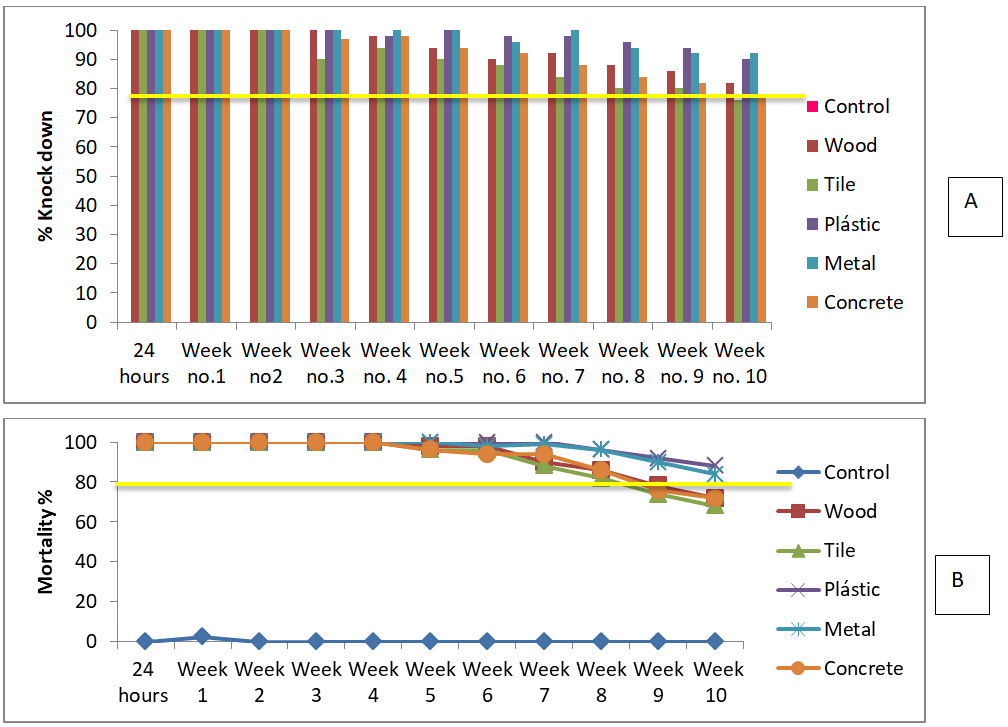
Table 1 shows the means of infestation and the percentages of reduction of B. germanica in the post- treatment surveys in the house where the treatment with Cimetrol SE 11.16 was carried out. In the data from the pre- treatment surveys, it is observed that the infestation rates were very high, so that with the first treatment carried out there was not a good reduction of these therefore, a second treatment had to be carried out, with which there was a reduction of infestation means and an increase in percent reduction compared to pretreatment.
| Infestation Mean | ||||
|---|---|---|---|---|
| Weeks | Adults | Nymphs | Total ( average) | % of reduction |
| pre-treatment | 65 | 79 | 72 | |
| Post- treatment | ||||
| 1er treatment | 34 | 40 | 37 | 48,6 |
| 2do treatment | ||||
| 2 | 17 | 23 | 20 | 72,2 |
| 3 | 12 | 15 | 13,5 | 81,3 |
| 4 | 9 | 11 | 10 | 86 |
| 5 | 7 | 9 | 8 | 88,8 |
| 6 | 7 | 7 | 7 | 90 |
| 7 | 5 | 7 | 6 | 92 |
| 8 | 4 | 4 | 5 | 95 |
Table 1: Means of infestation and percentage of reduction of the population of B. germanica pre and post-treatment in the house t
Discussion
The applications of residual treatments have been generalized in America for the control of triatomines [21, 22]. They are also used for the control of malaria and filaria worldwide [23, 24], highlighting a growing interest in the implementation and generalization of this methodology for arbovirosis control [25].
Ae. aegypti adults normally rest indoors (endophilia), where they frequently and almost exclusively feed on human blood (anthropophilia) [26, 27]. This explains why space fumigation outside the dwellings have little efficacy against this vector [28, 29]. Indoor insecticide applications may have a more direct impact on resting adult mosquitoes [30]. This is particularly used during epidemics because it quickly kills adults that are presumably flying. It often happens that up to three applications are required to achieve maximum efficacy even if the durability is short [31].
Indoor application of residual insecticides can provide longer-term protection after a single application; however, the time spent can increase, since it is necessary to remove all the furniture and belongings of the dwellers from the house [31]. This reason makes the work more intense and less accepted by the community [32], which hinders its generalization for vector control specifically on Ae. aegypti. The effectiveness of a residual action intervention depends on several factors: a) the susceptibility of the vector mosquitoes to the sprayed insecticides, b) the type of formulation, the quality of the spray, the spray coverage, c) the nature of the surface and d) the cooperation of the inhabitants in not removing the spray from the surfaces through washing or painting [23, 32, 33, 34] Regarding the formulation; Cimetrol SE 11.16, with few practical results published in the literature, is a potentiated suspension. Usually, this type of intervention is evaluated through cone tests [19] to determine the residuality in the different types of surface and thus the efficacy [34], although other methodologies could be followed [31].
According to some authors, these bioassays should ideally be carried out on impregnated surfaces in real human rooms, since bioassays under controlled conditions can show a longer residual effect [35]. In our study, using the cone methodology on treated surfaces in a house, a high percentage of mortality was obtained in mosquitoes exposed to metal and plastic surfaces for 10 weeks, followed by concrete, where mortality was above 90% from week 4 to 10. Dzib Florez, et al. [34] in tests carried out with Ae. aegypti, under controlled conditions with domestic sprays containing pyrethroids, durability lasted between 2 and 3 weeks. The wood and concrete surfaces evaluated with these sprays provided the longest residual time, results that partially coincide with ours.
In most studies, the mortality rates in the exposed groups are established as satisfactory when this indicator are greater than or equal to 80%, according to the criteria of Rodríguez, et al. [8]. In the case of the study carried out by Ibrahim, et al. [24], the knockdown and mortality rates at 24 hours were similar in the time intervals evaluated. In bioassays carried out by Corrêa, et al. [36], using deltamethrin on two types of surfaces, the mortality rates of Anopheles (Nyssorhynchus) marajoara remained above 80% for the 8 months of the experiment on painted wood and cement surfaces, mortality was higher for wood than for cement. In our study, the knockdown and mortality values at 24 hours remained similar until week 4. From week 6, mortality continued to be higher than 80% on most surfaces, except for metal and plastic, which remained on this indicator until the trial was discontinued at week 10. These results differ from studies by Ab Hamid, et al. [25] in the cement walls those that showed high mortality up to week 16.
The factors that may have influenced in our study, the low durability on some surfaces, may be from the smooth and poorly adherent texture of the tile to the porosity of the concrete. Some authors suggest that the rough and porous surface of the concrete walls are highly alkaline, tend to absorb the insecticide, degrade the active principle more quickly and reduce the residual effect [38, 39, 40], to which is incorporated the effect of temperatures and rainfall on the exterior walls of the houses. According to our previously exposed results, it is demonstrated that the Cimetrol SE 11.16 formulation is effective in controlling the Ae. aegypti mosquito.
Despite the fact that various intensive control activities against the German cockroach, both by government entities and by the affected population are being implemented, B. germanica is an important pest in public and medical health, and continues to infest buildings such as houses and restaurants at high and low population densities [41].
Many conventional insecticides are not effective in controlling massive infestations of B. germanica, due to its short life cycle of three to six months depending on the temperature. Therefore, it is very difficult to control this species in comparison with other species of cockroaches [17]. On the other hand, according to literature B. germanica shows resistance to insecticides such as Malathion and Propoxur [17]. In addition, this species shows a slight tolerance to Sumition and Tetramethorin [41]. Has found that field varieties of B. germanica show high to moderate resistance to cypermethrin. Our results show greater efficacy after 8 days of treatment. Previous studies have revealed that B. germanica massively infests kitchens in hospitals, apartments, hotels, private homes, and restaurants for breeding and feeding purposes, being able to visit other places to find its food [17, 42]. These results were similar to ours, since higher densities of B. germanica were found in the kitchen.
Different methods have been used for the census of cockroaches such as visual counting and sticky traps. The visual count is carried out after 22:30, so the lights go out at 21:30 pm for one hour. Then the light is turned on and the cockroaches that are moving on the tables and feeding areas are observed and counted for 5 min. This method allows dividing cockroaches into three categories of infestation: high (>75), medium (25-75) and low (<25) density of cockroaches [41]. On the other hand, we propose to census cockroaches, by placing sticky traps in sufficient quantities close to their shelters to estimate the density and type of cockroach present.
Finally, our results indicate that the use of Cimetrol SE 11.16 formulation (Alfacypermethrin 4.65% + pyriproxyfen 1.86% + tetramethrin 4.65%) is recommended for the suppression of B. germanica population.
- Acknowledgements To Pelgar International for its Technical assistance and its logistical support.
- Conflict of Interest Statement The authors declare that they have no conflict of interest.
- Contribution All the authors contributed substantially to the concrescence of the manuscript.
- Financing No funding was available.
References
-
Pérez-Vigueras I (1956) Los ixódidos y culícidos de Cuba. Su historia natural y médica. Universidad de la Habana pp: 579.
-
PAHO (2016) Zika-Epidemiological Report Cuba. Pan American Health Organization / World Health Organization. Washington DC, USA.
-
WHO (2020) Dengue and severe dengue.
-
Bisset JA, Rodríguez MM, Moya M, Ricardo Y, Montada D, et al. (2011) Efectividad de formulaciones de insecticidas para el control de adultos de Aedes aegypti en La Habana, Cuba. Revista Cubana Medicina Tropical pp: 63.
-
DNVLA (2012) Manual de Normas y Procedimientos Técnicos para la Vigilancia y Lucha Antivectorial. Editorial Ciencias Médicas. La Habana, Cuba.
-
Rodríguez MM, Bisset JA, Hernández H, Ricardo Y, French L, et al. (2012) Caracterización parcial de la actividad de esterasas en una cepa de Aedes aegypti resistente a temefos. Revista Cubana Medicina Tropical 64: 175-181.
-
Rodríguez MM, Bisset JA, Hurtado D, Montada D, Leyva M, et al. (2016) Estudio sobre la susceptibilidad a insecticidas en Aedes aegypti del Área de Salud Raúl Sánchez, Pinar del Río. Revista Cubana Medicina Tropical pp: 68.
-
Rodríguez MM, Crespo A, Bisset JA, Hurtado D, Fuentes I (2017) Diagnostic doses of insecticides for adult Aedes aegypti to assess insecticide resistance in Cuba. Journal American Mosquito Control Association 33(2): 142-144.
-
González A, Rodríguez G, Bruzón RY, Díaz M, Companioni A, et al. (2013) Isolation and characterization of entomopathogenic bacteria from soil samples from the western region of Cuba. Journal Vector Ecology 38(1): 46-52.
-
González A, Castañet CE, Companioni A, Menéndez Z (2019a) Effect of chlorine and temperature on larvicidal activity of Cuban Bacillus thuringiensis isolates. Journal Arthropod-Borne Disease 13(1): 39-49.
-
Leyva M, Pino O, Marquetti MC, Payroll JA, Scull R, et al. (2019) Ovicidal activity and repellent of essential oils on the oviposition of Aedes aegypti and Aedes albopictus (Diptera: Culicidae). Integrate Journal Veterinary Bioscience 3: 1-6.
-
Leyva M, Marquetti MC, Montada D, Payroll JA, Scull R, et al. (2020) Actividad insecticida de los aceites esenciales de Piper aduncum Subsp. Ossanum y Ocimun basilicum sobre Aedes aegypti y Aedes albopictus NOVITATES CARIBAEA 16: 122-132.
-
Gato R, Menéndez Z, Prieto E, Argiles R, Rodríguez M, et al. (2021) Sterile insect technique: successful suppression of Aedes aegypti field population in Cuba. Insect 12: 460-469.
-
Montada D, Castex M, Leyva M, Fuster CA (2019) Persistence and efficacy of Sumilarv 0.5 G (Pyriproxifen) an insect growth regulator in laboratory and field conditions for Aedes aegypti and Culex quinquefasciatus control in Cuba. J Pesticides and Biofertilizers.
-
Cochran DG (2019) Cockroaches, biology and control. Documento de la Organización Mundial. WHO/UBC/ 82.856. Ginebra.
-
Bret BL, Ross MH (1986) Behavioral responses of the German cockroach, Blatella germanica (L.) (Orthoptera: Blatellidae), to a propoxur formulation. J Econ Entomol 79(2) 426-30.
-
Díaz C, Pérez M, Magdalena RM (2000) Resistencia a insecticidas en cepas de terreno de la especie Blattella germánica procedentes de Santiago de Cuba Rev Cubana Med Trop 52: 24-30.
-
WHO (2007) Manual for indoor residual spraying: application of residual sprays for vector control. . Geneva: World Health Organization Licence: CC BY-NC- SA 3.0 IGO.
-
WHO (2006b) Evaluación de los depósitos de insecticidas en las paredes OMS / CDS / NTD / WHOPES / GCDPP / 2006.3.
-
Abbott WS (1925) A method for computing the effectiveness of an insecticide. Journal Economic Entomology 18(2): 265-267.
-
Palomino M, León W, Valencia P, Cárdenas F, Ancca J (2007) Evaluación de campo del efecto residual de la deltametrina sobre la mortalidad y knockdown en Triatoma infestans, según tipo de supeficie en Arequipa, Perú. Rev Peru Med Exp Salud Publica 24(2): 136-143.
-
Mougaboure-Cueto G, Picollo MI (2015) Insecticide resistance in vector Chagas disease: evolution, mechanisms and management. Acta Tropica 149: 70-85.
-
Dengela D, Seyoum A, Lucas B, Johns B, George K, et al. (2018) Multi-country assessment of residual bio- efficacy of insecticides used for indoor residual spraying in malaria control on different surface types: results from program monitoring in 17 PMI/USAID supported IRS countries. Parasites Vectors 11.
-
Ibrahim KT, Popoola KO, Akure KO (2017) Laboratory evaluation of residual efficacy of Actellic 300 CS (Pirimiphos-Methyl) and K-Othrine WG 250 (Deltamethrin) on different indoor surfaces. International Journal of Insect Science 9: 1-7.
-
Ab Hamid N, Mohd Noor SN, Susubi J, Isa NR, Md Rodzay R, et al. (2020) Semi-field evaluation of the bio- efficacy of two different deltamethrin formulations against Aedes species in an outdoor residual spraying study. Heliyon 6(1): e03230.
-
Stoddard ST, Forshey BM, Morrison AC, Paz-Soldan VA, Vazquez-Prokopec GM, (2013) House-to-house human movement drives dengue virus transmission. Proc Natl Acad Sci USA 110(3): 994-999.
-
Dzul-Manzanilla F, Ibarra-López J, Marín WB, Martini- Jaimes A, Leyva JT, et al. (2017) Indoor resting behavior of Aedes aegypti (Diptera: Culicidae) in Acapulco, Mexico. Journal Medical Entomol 54(2): 501-504.
-
Esu E, Lenhart A, Smith L, Horstick O (2010) Effectiveness of peridomestic space spraying with insecticide on dengue transmission; systematic review. Tropical Medical Int Health 15(5): 619-631.
-
Vythilingam I, Wan-Yusoff WS (2017) Dengue vector control in Malaysia: are we moving in the right direction?. Tropical Biomedicine 34(4): 746-758.
-
Samuel M, Maoz D, Manrique P, Ward T, Runge-Ranzinger S, Toledo J (2017) Community effectiveness of indoor spraying as a dengue vector control method: A systematic review. PLoS Neglected Tropical Disease 11: e0005837.
-
Dunbar MW, Correa-Morales F, Dzul-Manzanilla F, Median-Barreiro A, Bibiano-Marín W, et al. (2019) Efficacy of novel indoor residual spraying methods targeting pyrethroid-resistant Aedes aegypti within experimental houses. PLoS Neglected Tropical Disease 13(2): e0007203.
-
Bowman LR, Donegan S, McCall PJ (2016) Is dengue vector control efficient in effectiveness or evidence?: Systematic review and meta-analysis. PLoS Neglected Tropical Diseases 10(3): e0004551.
-
Sreehari UK, Raghavendra SN, Tiwari S, Sreedharan SK, Valecha N (2018) Small-scale (Phase II) evaluation of the efficacy and residual activity of SumiShield® 50 WG (clothianidin 50%, w/w) for indoor residual spraying in comparison to deltamethrin, bendiocarb and pirimiphos- methyl for malaria vector control in Karnataka state, India. Journal Vector Borne Disease 55(2): 122-129.
-
Dzib Florez SA (2019) Evaluación de la aplicación de insecticidas comerciales residuales, para el control de Aedes aegypti en Yucatán. Facultad de Ciencias Biológicas [Doctorado thesis], Universidad Autónoma de Nuevo León.
-
Galardo AKR, Galardo CD (2009) Relatório técnico sobre o Estudo da Eficácia de Redes Impregnadas com Inseticidas e do uso de Fendona ® em borrifações domiciliares para o controle de Anopheles sp. em bioensaios de campo e laboratório no estado do Amapá- Brasil. Macapá. Instituto de Pesquisas Científicas e Tecnológicas do Estado do Amapá.
-
Corrêa APSA, Galardo AKR, Lima LA (2019) Efficacy of insecticides used in indoor residual spraying for malaria control: an experimental trial on various surfaces in a “test house”. Malaria Journal 18: 340-345.
-
Ab Hamid N, Mohd Noor N, Saadatian-Elahi S, Isa M, Rodzay N, et al. (2019) Residual spray for the control of Aedes vectors in dengue outbreak residential areas. Advances in Entomology 7(4): 105-123.
-
Camilleri P (1984) Alkaline hydrolysis of some pyrethroid insecticides. Journal of Agricultural and Food Chemistry 32(5): 1122-1124.
-
Santos RLC, Fayal ADS, Aguiar AEF, Vieira DBR, Povoa MM (2007) Evaluation of the residual effect of pyrethroids on Anopheles in the Brazilian Amazon. Revista Saude Publica 41(2): 276-283.
-
Rohani A, Zamree I, Wan Najdah WMA, Azahari AH, Matusop A, et al. (2017) Impact of indoor residual- sprayed deltamethrin on different surfaces in a malaria endemic area in Balai Ringin, Sarawak. Advances in Entomology 2(3): 151-160.
-
Gliniewicz A, Krzeminska A, Sawicka B (1996) Susceptibility of cockroaches Blatella germanica L., collected from hospitals to selected pyrethroid and carbamate insecticides. Rocz Panstw Zakl Hig 47(3): 333-341.
-
Zayas F (1974) Entomofauna Cubana. T3. La Habana: Editorial Científico Técnica, pp: 128.
- California Red-Legged Frog and Non-Listed Amphibians Response to Non-Native Fish Removal
- Industrial Standardization of the Bio-OS: Algorithmic Codification of Resilience Engineering Guidelines and Version V8 Architecture
- Climate Variability and the Sustainability of Snail Farming in Nigeria: Past Trends, Present Challenges and Potential Outlook
- The Evaluation of the Surveillance System of Anthrax in Gilgit-Baltistan, Pakistan, 2018
- Natural Decline to Extinction of A New Zealand Rabbit Population
- Mitochondrial Bio-Logistics: Steering Co-Enzyme Q10 and Lycopene Synergies within the Science 4.0 Bio-OS Framework