
Additional Data on Arctozenus australis Ho et Duhamel, 2019 (Pisces: Aulopiformes, Paralepididae) off Kerguelen Islands
This work clarifies the morphological data for the recently described species Arctozenus australis Ho et Duhamel, 2019. Specimens caught in the northwest of the known range of the species confirm the validity of diagnostic characters and expand the known range of the following parameters: predorsal length, prepelvic length, preanal length, distance between origins of dorsal and anal fins, head depth, distance between origins of dorsal and pelvic fins, interorbital width, caudal-peduncle depth, snout length, upper-jaw length, lower jaw, number of caudal vertebrae, preanal vertebrae, and anal fin rays.
Introduction
When checking the ZIN collection, the author found several specimens of Arctozenus caught on the shelf of the Kerguelen Archipelago in the Southern Ocean, identified as Arctozenus risso confer (Bonaparte, 1840). Upon closer examination, the fish were identified as the recently described species Arctozenus australis Ho, et al. [1]. This article is intended to slightly alleviate the lack of published data on this species, known so far only from the Kerguelen shelf.
Now, only the above two species are known to belong to the genus Arctozenus Gill, 1864, although there is information that Arctozenus risso may consist of two cryptic species from different oceans, the Pacific and Atlantic [2].
Materials and Methods
Examined material: ZIN 56771, 6 specimens SL 258–278 mm, NW off Kerguelen 46°52’S-67°53’E, RV Skif, cruise 3, trawl No. 110, station 1069/158, depth 340–354 m, 02 Jan. 1971 3:00 – 5:30 AM, collector A.F. Pushkin.
Measurements follow Ho et Duhamel [1].
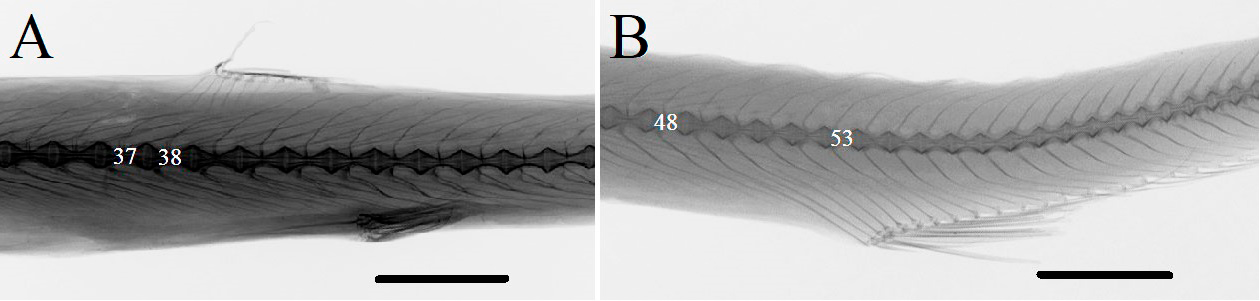
The counting of the predorsal and preanal vertebrae was carried out to the first rays of the fin, and not to the corresponding pterygiophores, which are located 1–3 and 4–6 vertebrae rostrally, respectively (Figure 1). The caudal fin formula is written as upper procurrent rays + principal rays + lower procurrent rays. Isobaths are drawn Figure 2 according to the General Bathymetric Chart of the Oceans (GEBCO), Mercator projection [3].
Results and Discussion
Fish have been identified as Arctozenus australis according to the description in Ho and Duhamel [1]. Anterior lateral-line scales long; origin of pelvic fin slightly behind dorsal-fin base (Figure 1A); body depth 5.7–6.3 %SL (Table 1); a slender head, its depth at middle of eye 4.1‒4.5 in HL; the ratio of snout length/eye diameter 3.3–3.6. Some questions remain about the presence of teeth in adult Alepisauroids [1, 4, 5] so it is important to mention that all examined specimens have well-developed teeth on the jaws.
Ho, et al. [1] examined a similar size group when describing A. australis, so the data presented here should not be considered a manifestation of allometry. Limit values for predorsal length, prepelvic length, preanal length, D–A, head depth have shifted upwards compared to the original description; D–V values have expanded in both directions; interorbital width, caudal-peduncle depth, snout length, upper-jaw length, and lower jaw (in % HL) expanded downwards. Of the counting parameters, in two cases a smaller number of caudal vertebrae and in one case a greater number of preanal vertebrae were noted, the same fish had a reduced number of anal fin rays (Table 2).
| 56771-1 | 56771-2 | 56771-3 | 56771-4 | 56771-5 | 56771-6 | N=13* | |||||||||||||||||
|---|---|---|---|---|---|---|---|---|---|---|---|---|---|---|---|---|---|---|---|---|---|---|---|
| TL (mm) | 295,0 | 285,0 | 276,0 | - | 276,0 | 276,0 | - | ||||||||||||||||
| SL (mm) | 278,0 | 268,0 | 262,0 | 274,0 | 258,0 | 259,0 | 257–291 | ||||||||||||||||
| % SL | |||||||||||||||||||||||
| Head length | 23,3 | 22,6 | 22,9 | 22,4 | 22,8 | 22,2 | 22.6 (21.6–23.8) | ||||||||||||||||
| Body depth | 5,7 | 6,3 | 6,3 | 6,3 | 6,2 | 6.2 (5.2–7.3) | |||||||||||||||||
| Predorsal length | 67,3 | 66,8 | 67,2 | 66,4 | 66,7 | 66,8 | 66.5 (65.5–67.0) | ||||||||||||||||
| Prepelvic length | 70,9 | 70,9 | 71,4 | 71,5 | 72,5 | 70,7 | 70.7 (69.8–72.2) | ||||||||||||||||
| Preanal length | 82,7 | 83,2 | 83,6 | 82,8 | 84,1 | 83,0 | 82.0 (81.1–82.8) | ||||||||||||||||
| D–V | 3,9 | 3,7 | 4,3 | - | 5,3 | 3,5 | 4.2 (3.7–5.2) | ||||||||||||||||
| D–A | 15,2 | 16,3 | 16,9 | 16,1 | 16,6 | 15,4 | 15.6 (14.5–16.5) | ||||||||||||||||
| Head depth | 5,4 | 5,2 | 5,3 | 5,2 | 5,1 | 5,4 | 4.9 (4.4–5.2) | ||||||||||||||||
| Snout length | 11,6 | 11,6 | 11,9 | 11,3 | 11,6 | 11,0 | 11.8 (11.3–12.3) | ||||||||||||||||
| Eye diameter | 3,3 | 3,4 | 3,4 | 3,1 | 3,5 | 3,3 | 3.3 (3.1–3.8) | ||||||||||||||||
| Interorbital width | 1,8 | 1,8 | 2,0 | 1,9 | 1,9 | 2,0 | 2.0 (1.9–2.1) | ||||||||||||||||
| Upper-jaw length | 9,6 | 9,3 | 9,4 | 9,0 | 9,0 | 8,8 | 9.4 (8.9–9.7) | ||||||||||||||||
| Lower-jaw length | 12,8 | 12,7 | 13,1 | 13,0 | 13,1 | 12,8 | 13.1 (12.7–13.7) | ||||||||||||||||
| Pectoral-fin length | 7,2 | 7,6 | 7,7 | 6,9 | 7,3 | 5,9 | 7.2 (5.3–7.9) | ||||||||||||||||
| Caudal-peduncle depth | 1,7 | 1,8 | 1,8 | 1,6 | 1,9 | 1,8 | 1.8 (1.7–1.9) | ||||||||||||||||
| Caudal-peduncle length | 2,8 | 2,9 | 3,0 | 2,8 | 2,8 | 2,8 | 3.2 (2.9–3.5) | ||||||||||||||||
| Anal-fin-base length | 15,7 | 14,0 | 13,9 | 14,4 | - | 15,0 | 15.0 (13.1–15.8) | ||||||||||||||||
| % HL | |||||||||||||||||||||||
| Head depth | 23,0 | 23,0 | 23,0 | 23,3 | 22,4 | 24,4 | 21.7 (19.6–23.4) | ||||||||||||||||
| Snout | 49,6 | 51,4 | 52,0 | 50,5 | 51,0 | 49,5 | 52.3 (50.7–55.2) | ||||||||||||||||
| Eye | 14,2 | 15,2 | 14,7 | 14,0 | 15,5 | 15,0 | 14.6 (13.7–15.5) | ||||||||||||||||
| Interorbital | 7,9 | 7,9 | 8,8 | 8,3 | 8,3 | 8,9 | 8.9 (8.4–9.4) | ||||||||||||||||
| Upper jaw | 41,3 | 41,2 | 41,2 | 40,2 | 39,5 | 39,5 | 41.3 (39.9–43.5) | ||||||||||||||||
| Lower jaw | 54,7 | 56,2 | 57,3 | 57,8 | 57,7 | 57,7 | 58.1 (56.3–61.6) | ||||||||||||||||
| Pectoral fin | 31,0 | 33,7 | 33,5 | 30,8 | 32,0 | 26,8 | 32.1 (23.2–36.6) |
Table 1: Morphometric data of examined Arctozenus australis specimens and of *Ho and Duhamel [1] material. Data in bold is slight
Table 1 (Continuation): Morphometric data of examined Arctozenus australis specimens and of *Ho and Duhamel [1] material. Data in bold is slightly outside the original description.
| 56771-1 | 56771-2 | 56771-3 | 56771-4 | 56771-5 | 56771-6 | |||
|---|---|---|---|---|---|---|---|---|
| Vertebrae | ||||||||
| Prehaemal | 39 | 40 | 40 | 40 | 40 | 40 | ||
| Caudal | 44 | 41 | 40 | 41 | 40 | 41 | ||
| Predorsal | 38 | 37 | 37 | 37 | 36 | 38 | ||
| Prepelvic | 40 | 40 | 40 | 42 | 40 | 41 | ||
| Preanal | 53 | 55 | 51 | 52 | 52 | 53 | ||
| Total | 83 | 81 | 80 | 81 | 80 | 81 | ||
| Fin rays | ||||||||
| Dorsal | 9 | 9 | 9 | 9 | 9 | 9 | ||
| Anal | 31 | 29 | 30 | 30 | 30 | 31 | ||
| Caudal | 13+19+12=44 | 13+19+12=44 | 14+19+12=45 | 12+19+11=42 | 14+19+12=45 | 12+19+11=42 |
Table 2: Meristic data of examined Arctozenus australis specimens. Data in bold is slightly outside the original description.
The presented data do not contradict the data of Ho and Duhamel but expand the known parameter values of the species. Despite the shifted limit of the head height values towards A. risso, the head height in A. australis is still notably slender (19.6–24.4 vs 24.5–28.9 of A. risso [1]). Location and conditions of capture correspond well to previously published data (Figure 2). There is no doubt that A. australis can be caught all around the Kerguelen Archipelago on the continental slope.
![Figure 2: Kerguelen Archipelago. Distribution map of Arctozenus australis, ∎ - ZIN 56771, ▲ – data from Ho and Duhamel [1].](/fulltextimages/10866/fig_2.png)
Funding
The study was supported by the State Research Program number 122031100285-3.
Acknowledgments
This research was performed using the equipment of the Core Facilities Centre “Taxon” at the Zoological Institute Russian Academy of Sciences (St Petersburg, Russia).
References
-
Ho H-C, Duhamel G (2019) A new species of the fish genus Arctozenus from the Kerguelen Islands, with comments on the lost teeth in adults (Aulopiformes: Paralepididae). Zootaxa 4651(3): 497-512.
-
Kenchington EL, Baille SM, Kenchington TJ, Bentzen P (2017) Barcoding Atlantic Canada’s mesopelagic and upper bathypelagic marine fishes. PLoS ONE 12(9): e0185173.
-
GEBCO World Map (2014) Global ocean & land terrain models. Gridded Bathymetry Data.
-
Franz GP, Warth P, Grunow B, Konstantinidis P (2022) Osteology of the White Barracudina, Arctozenus risso (Bonaparte) (Aulopiformes: Paralepididae). Ichthyology & Herpetology 110(1): 115-130.
-
Post A (1987) Results of the research cruises of FRV “Walther Herwig” to South America. LXVII. Revision of the subfamily Paralepidinae (Pisces, Aulopiformes, Alepisauroidei, Paralepididae). I Taxonomy, morphology and geographical distribution. Fischereiwissenschaft 38: 75-131.
- Mitochondrial Bio-Logistics: Steering Co-Enzyme Q10 and Lycopene Synergies within the Science 4.0 Bio-OS Framework
- Hymenoptera Specimens from the Caño Negro Wetland, of the National Museum Collection, Costa Rica
- Science 4.0: Comprehensive Architecture of the Biological Operating System (Bio-OS) A Framework for Systemic Resilience and Industrialized Bio-Governance
- Rabbit on, or Hare Back? Understanding Climate Change
- Clinical Validation of Science 4.0: Flow Steering and Epigenetic Drift Inversion on a 76-Year-Old Hybrid System
- Seeds Planted by another Mind