
The genus Merodon (Diptera, Syrphidae) of the Landscape of Outstanding Features “The Valley of Pčinja”
With about 250 species the genus Merodon Meigen, 1803 (Diptera, Syrphidae, Merodontini) is the largest within the family in Europe. A total of 32 Merodon species have been recorded in Serbia, of which almost half (13 species) occurs in the Landscape of Outstanding Features “the valley of Pčinja”. Among the identified taxa there are one endangered species: M. testaceus Sack, 1913, and one vulnerable species: M. euri Vujić & Radenković, 2018, base of the criteria of the IUCN Red List of European Hoverflies. The data of distribution of above mentioned 13 Merodon species both in Europe and in Serbia is given and discussed.
Introduction
The phytophagous hoverfly genus Merodon Meigen, 1803 (Diptera, Syrphidae, Merodontini) is the most numerous within the family in Europe with more than 200 described and about 30 still undescribed species [1, 2]. It is distributed across the Palaearctic and Afrotropical regions [1], with the exception of M. equestris (Fabricius, 1794) introduced in the Nearctic Region and New Zealand [3]. The highest species diversity has been recorded in the northern and eastern parts of the Mediterranean Basin, probably thanks to the high diversity of geophytes hosting their larvae in these areas [4, 5, 6, 7].
The Landscape of Outstanding Features “the valley of Pčinja” is located in southeastern Serbia. It comprises the foothills of the Kozjak Mountain and Starac Mountain, which are separated by the river Pčinja. The specificity of the biotope of the valley of Pčinja River lies in the fact that this area is located at the border of the continental and Mediterranean climate, and with the combination of the characteristics of two climate types results in high diversity of flora and fauna [8].
Despite its relatively small area (2606 ha), the valley of Pčinja River has a specific flora and fauna structure. The ornithofauna and the herpetofauna Puzović et al. [9, 10, 11, 12, 13, 14, 15, 16, 17] are relatively well studied in this area, while many of insect groups are as well researched in detail, such as: diurnal and nocturnal butterflies [18, 19, 20, 21, 22], true bugs [23], orders Raphidioptera and Neuroptera [24], as well as grasshoppers, bush crickets and crickets [25]. The complete checklist of hoverflies for this area is not yet given.
The collecting of hoverflies in Serbia started in the mid- 20th century, which is still going on today. Based on Vujić A. et al. [26] the fauna of hoverflies in Serbia consists of 412 species and subspecies from 83 genera, while more recently Vujić M. et al. [27] registered six additional species, which raised the final number to 418 species. Among them there are 32 species of the genus Merodon, from which 13 are present also in the LOF “the valley of Pčinja”. Within this paper, an analysis of their European and local distribution is given.
Material and Methods
Species of the genus Merodon in the LOF “the valley of Pčinja” were registered on the following localities (Figure 1).
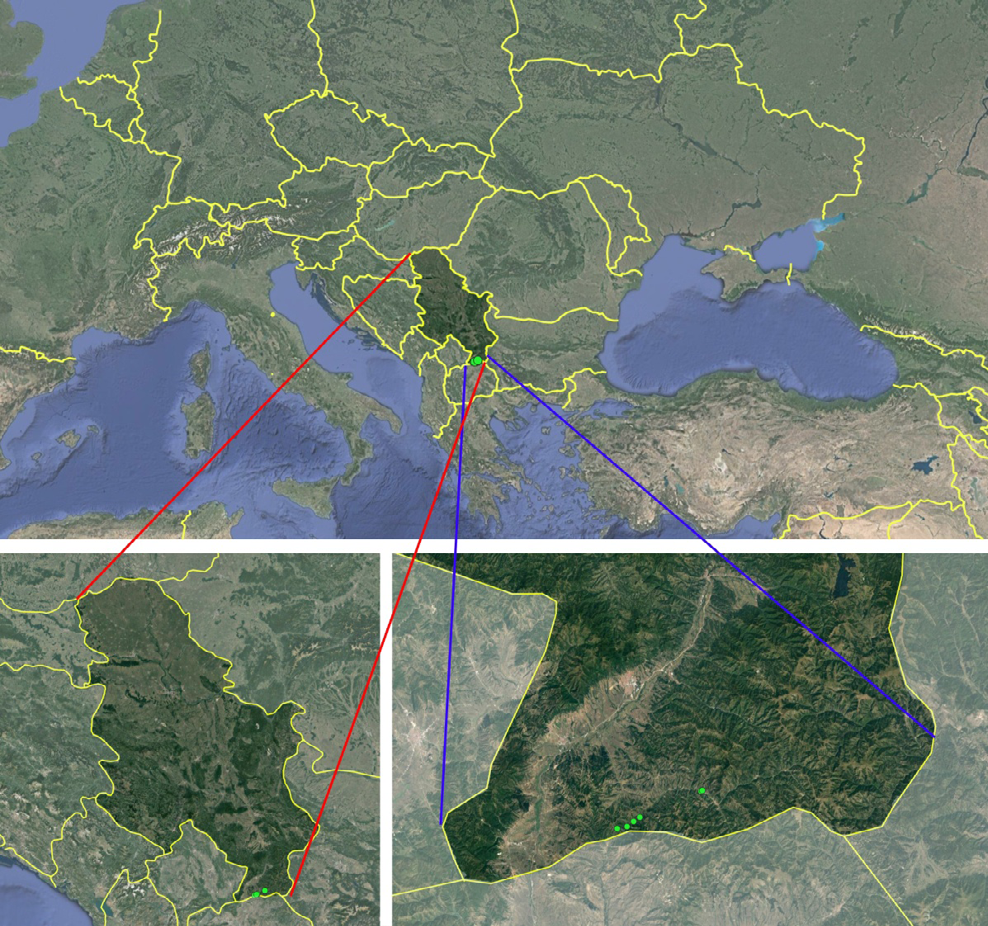
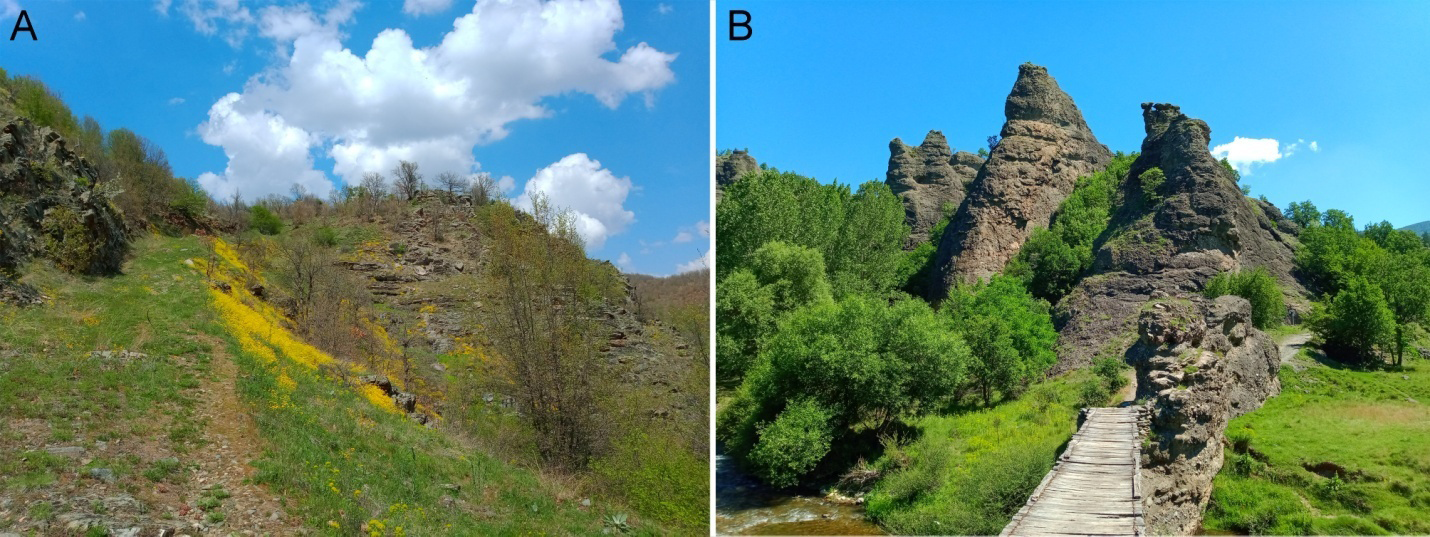
(1) Donja Trnica (42.38396N 22.05246E, 622 m a.s.l.); (2) Monastery (42.328785N 21.898E, 486 m a.s.l.); (3) Pčinja valley (42.325833N 21.87777E, 730 m a.s.l.); (4) Trgovište (42.38264N 22.0501E, 586 m a.s.l.); (5) Vogance (42.3429519N 21.9244209E, 475 m a.s.l.) (Figure 2A); (6) Vogance, near the river (42.336545N 21.911565E, 464 m a.s.l.); (7) Vražji kamen (42.383772N 22.052763E, 613 m a.s.l.) (Figure 2B).
Results
Merodon aberrans Egger, 1860
Occurrence: locality (5). Distribution: in Europe this species is widely distributed in the mountains of Central and southern Europe; in Serbia is widespread.
Merodon analis Meigen, 1822
Occurrence: locality (2). Distribution: in Europe occurs from western to central Europe, until the Balkan Peninsula; it is present on most of the mountains throughout Serbia.
Merodon avidus (Rossi, 1790)
Occurrence: localities (4), (5), (6), (7). Distribution: this species is distributed in the Mediterranean zone of Europe; in Serbia is widespread.
Merodon aureus Fabricius, 1805
Occurrence: localities (5), (7). Distribution: it is known from the high European mountains; as well as of Serbia.
Merodon bessarabicus Paramonov, 1924
Occurrence: locality (5). Distribution: this species is distributed on the Balkan Peninsula; it is recorded only on few mountains in southern Serbia.
Merodon clavipes (Fabricius, 1781)
Occurrence: locality (4). Distribution: this species is distributed in central and southern Europe; it is present on few mountains of Serbia, mostly in eastern and southern parts.
Merodon constans (Rossi, 1794)
Occurrence: locality (2). Distribution: in Europe is distributed on Apennine and Balkan Peninsulas; in Serbia it is registered only on three mountains in central and southern parts.
Merodon erivanicus Paramonov, 1925
Occurrence: locality (5). Distribution: this species is distributed only on Balkan Peninsula; in Serbia it is collected only on few mountains in eastern and southern parts.
Merodon euri Vujić & Radenković, 2018
Occurrence: locality (5). Distribution: it is known from the eastern to the southern parts of the Balkan Peninsula; in Serbia the only locality where is registered is the valley of the Pčinja river.
Merodon moenium Wiedemann in Meigen, 1822
Occurrence: localities (4), (5), (7). Distribution: this species is widespread in Europe; as well as in Serbia.
Merodon natans (Fabricius, 1794)
Occurrence: localities (1), (5), (7). Distribution: this species is mainly distributed in southern Europe; in Serbia the only locality where is registered is the valley of the Pčinja river.
Merodon obscuritarsis Strobl, 1909
Occurrence: localities (4), (5), (7). Distribution: it is distributed mainly in the Mediterranean region in Europe; it is present on few mountains across Serbia.
Merodon testaceus Sack, 1913
Occurrence: locality (3). Distribution: this species occurs in the southeastern Mediterranean; in Serbia the only locality where is registered is the valley of the Pčinja river.
Discussion
The regions with the highest diversity of Merodon taxa, such as the Mediterranean Basin, are rich in species of geophytes, as the bulbs and other underground storage organs of these plants, which represent a food sources for Merodon larvae [4, 5].
Species of genus Merodon in Europe are mainly distributed on the Greek islands and on high mountains of the three Mediterranean peninsulas (Iberian, Apennine and Balkan), which represents the main refugial centres of Mediterranean species [28]. Based on that this area is considered the richest in the number of Merodon species in Europe [29, 30, 31]. Among them, the Balkan Peninsula stands out as an important part of the areal for several species groups within the mentioned genus, such as: constans [32], aberrans [33], tarsatus [34], natans [35], aureus [36, 37] and avidus [38]. For example, the Merodon constans species group is most diverse on the Balkan Peninsula. One member, M. analis, is a continental species, while the other, M. constans, is a sub-Mediterranean species, distributed closer to the Mediterranean coast. Regardless of such a clearly defined different types of distribution of this two species, they detected in sympatry only in South Serbia, exactly in the valley of Pčinja river [32]. Additionally, in Serbia, the distribution of 3 Merodon species is related only to Pčinja valley.
The LOF “the valley of Pčinja” is positioned in the heart of the Balkan Peninsula, which region has long ago been recognized as a species, and specifically, hoverfly hotspot, owing to its geographical position, climatic conditions and rich and complex geological history [39]. Because of all the above, this area represents a very important cube in the distribution of a large number of organisms as well as for some rare and endangered/vulnerable species at the level of Europe [32].
Acknowledgements
The data for this study was obtained as part of the realization of the projects SPAS – Serbian Pollinator Advice Strategy – for the next normal (Science Fund of the Republic of Serbia, Program IDEAS, GA ID: 7737504). The authors acknowledge financial support of the Ministry of Science, Technological Development and Innovation of the Republic of Serbia (Grant No. 451-03-47/2023-01/200125). The authors declare that no competing interests exist.
References
-
Vujić A, Radenković S, Likov L, Veselić S (2021a) Taxonomic complexity in the genus Merodon Meigen, 1803 (Diptera, Syrphidae). ZooKeys 1031: 85-124.
-
Vujić A, Radenković S, Kočiš Tubić N, Likov L, Popov G, et al. (2022b) Integrative taxonomy of the Merodon aberrans (Diptera, Syrphidae) species group: distribution patterns and description of three new species. Contributions to Zoology pp: 1-46.
-
Speight MCD (2020) Species accounts of European Syrphidae, 2020. Syrph the Net, the database of European Syrphidae (Diptera), vol. 104. Syrph the Net Publications, Dublin, pp: 314.
-
Ricarte A, Marcos-García MÁ, Rotheray GE (2008) The early stages and life histories of three Eumerus and two Merodon species (Diptera: Syrphidae) from the Mediterranean region. Entomologica Fennica 19(3): 129-141.
-
Ricarte A, Souba-Dols GJ, Hauser M, Marcos García MÁ (2017) A review of the early stages and host plants of the genera Eumerus and Merodon (Diptera: Syrphidae), with new data on four species. PLoS One 12(12): e0189852.
-
Andrić A, Šikoparija B, Obreht D, Ðan M, Preradović J, et al. (2014) DNA barcoding applied: identification of the larva of Merodon avidus (Diptera: Syrphidae). Acta Entomologica Musei Nationalis Pragae 54: 741-757.
-
Preradović J, Andrić A, Radenković S, Šašić Zorić L, Pérez- Bañón C, et al. (2018) Pupal stages of three species of the phytophagous genus Merodon Meigen (Diptera: Syrphidae). Zootaxa 4420(2): 229-242.
-
Amidžić L, Krasulja S, Đorđević Z, Brusin A (2017) Protected natural resources in Serbia. Institute for Nature Conservation of Serbia, Belgrade pp: 280.
-
Puzović S, Sekulić S, Stojnić N, Grubač B, Tucakov M (2009) Important bird areas in Serbia - IBA. Ministarstvo životne sredine i prostornog planiranja - Zavod za zaštitu prirode Srbije.
-
Radišić D, Spremo N, Šćiban M, Ristić N, Grbić Z (2009) Summer aspect of ornithofauna of Pčinja river valley. In: Anonymous (Ed.), Zbornik radova naučnog skupa„ EkoBioMorfa“, Naučno-istraživačko društvo studenata biologije, Josif Pančić“, Novi Sad, pp: 26–39.
-
Ružić M, Shurulinkov P, Daskalova G, Ralev A, Spasov L, et al. (2011) Semi-collared Flycatcher Ficedula semitorquata – a new breeding species in Serbia. Ciconia 20: 72-76.
-
Ružić M, Radišić D, Popović M, Ralev A (2012) Breeding of Blue Rock Thrush Monticola solitarius in Pčinja River Valley. Ciconia 21: 50-53.
-
Crnobrnja-Isailović J, Aleksić I (1999) First record of Coluber najadum Eichwald (1831) in Serbia. Archives of Biological Sciences, Belgrade 51: 47-48.
-
Crnobrnja-Isailović J, Ajtić R, Tomović LJ (2004) Contribution to Batrachofauna and Herpetofauna of Pčinja River in the Southern Serbia. First Symposium of Ecologists of the Republic of Montenegro. Book of Abstracts pp: 72.
-
Tomović LJ, Ajtić R, Đoković Đ, Antić S (2004) Records of Testudo graeca ibera Pallas, 1814 in Serbia and Montenegro. Herpetozoa 17: 189-191.
-
Ristić N, Tomović LJ, Ajtić R, Crnobrnja-Isailović J (2006) First record of the four-lined snake Elaphe quatuorlineata (Lacépède, 1789) in Serbia. Acta Herpetologica 1(2): 135-139.
-
Ralev A, Popović M, Ružić M, Shurulinkov P, Daskalova G, et al. (2013) A new record of Testudo graeca ibera Pallas, 1814, in southern Serbia. Herpetozoa 25: 151-153.
-
Đurđević A, Đurić M (2011) Blepisanis vittipennis (Reiche 1877) (Coleoptera: Cerambycidae), a new longhorn beetle for Serbia. Biologica Nyssana 2(2): 49–50.
-
Popović M, Milenković M (2012) First record of Anthocharis gruneri for Serbia (Lepidoptera: Pieridae). Phegea 40(1b): 37-38.
-
Popović M, Radevski Đ, Miljević M, Đurić M (2014) First record of Pyrgus cinarae (Lepidoptera: Hesperiidae) in Serbia. Acta entomologica serbica 19(1/2): 45-51.
-
Beshkov S, Nahirnić A (2016) New and rare nocturnal Lepidoptera species for Serbia from Preševo District and Pčinja River Valley - hot spots for biodiversity (Insecta: Lepidoptera). Atalanta 47 (1/2): 139-149.
-
Tot I, Djurić M, Vukajlović F, Vujić M (2021) Little Tiger Blue, Tarucus balkanicus (Freyer, 1845) – a new butterfly species in the fauna of Serbia (Lepidoptera: Lycaenidae). Acta Entomologica Serbica 26(2): 85-88.
-
Šeat J (2011) True Bugs (Heteroptera) of Pčinja valley (Serbia). Acta entomologica serbica 16 (1/2): 9-24.
-
Devetak D, Jakšić P, Nahirnić-Beshkova A, Janžekovič F, Klenovšek T, et al. (2023) Contribution to the knowledge of Neuropterida (Raphidioptera, Neuroptera) of Serbia collected in the period 2015-2016. Acta Entomologica Slovenica Ljubljana 31 (1): 77-100.
-
Ivković S, Horvat L (2016) Contribution to the knowledge of the grasshoppers, bush crickets and crickets of southern Serbia. Articulata 31: 69-76.
-
Vujić A, Radenković S, Nedeljković Z, Šimić S (2018) A new check list of hoverflies (Diptera: Syrphidae) of the Republic of Serbia. Zbornik Matice srpske za prirodne nauke/Matica srpska. J Nat Sci Novi Sad 135: 7-51.
-
Vujić M, Đurić M, Tot I (2021) Six new hoverfly species (Diptera: Syrphidae) in the fauna of Serbia. Kragujevac J Sci 43: 149-155.
-
Schmitt T (2007) Molecular biogeography of Europe: Pleistocene cycles and postglacial trends. Frontiers in Zoology 4: 11.
-
Marcos-Garcia MA, Vujić A, Mengual X (2007) Revision of Iberian species of the genus Merodon (Diptera: Syrphidae). European Journal of Entomology 104: 531- 572.
-
Kaloveloni A, Tscheulin T, Vujić A, Radenković S, Petanidou T (2015) Winners and losers of climate change for the genus Merodon (Diptera: Syrphidae) across the Balkan Peninsula. Ecological Modelling 313: 201-211.
-
Vujić A, Pérez-Bañón C, Radenković S, Ståhls G, Rojo S, Petanidou T, et al. (2007) Two new species of genus Merodon Meigen, 1803 (Syrphidae, Diptera) from the island of Lesvos (Greece), in the eastern Mediterranean. Annales de la Société Entomologique de France 43(3): 319-326.
-
Vujić A, Radenković S, Likov L, Andrić A, Janković M, et al. (2020a) Conflict and congruence between morphological and molecular data: revision of the Merodon constans group (Diptera : Syrphidae). Invertebrate Systematics 34: 406-448.
-
Vujić A, Šašić Zorić LJ, Ačanski J, Likov L, Radenković S, et al. (2020b) Hide-and-seek with hoverflies: Merodon aureus – a species, a complex or a subgroup?. Zoological Journal of the Linnean Society 190(3): 974-1001.
-
Vujić A, Radenković S, Barkalov A, Kočiš Tubić N, Likov L, et al. (2023) Taxonomic revision of the Merodon tarsatus species group (Diptera, Syrphidae). Arthropod Systematics & Phylogeny 81: 201-256.
-
Vujić A, Tot T, Andrić A, Ačanski J, Šašić Zorić L, et al. (2021b) Review of the Merodon natans group with description of a new species, a key to the adults of known species of the natans lineage and first descriptions of some preimaginal stages. Arthropod Systematics & Phylogeny 79: 343-378.
-
Radenković S, Šašić Zorić L, Djan M, Obreht Vidaković D, Ačanski J, et al. (2018) Cryptic speciation in the Merodon luteomaculatus complex (Diptera: Syrphidae) from the eastern Mediterranean. Journal of Zoological Systematics and Evolutionary Research 56(2): 170-191.
-
Vujić A, Gilbert F, Flinn G, Veličković N (2022a) Pollinators on the edge: our European hoverflies. The European Red List of Hoverflies. European Commission, Brussels.
-
Ačanski J, Vujić A, Djan M, Obreht-Vidaković D, Ståhls G, et al. (2016) Defining species boundaries in the Merodon avidus complex (Diptera, Syrphidae) using integrative taxonomy, with the description of a new species. European Journal of Taxonomy 237: 1-25.
-
Ačanski J, Miličić M, Likov L, Milić D, Radenković S, et al. (2017) Environmental niche divergence of species from Merodon ruficornis group (Diptera: Syrphidae). Archives of Biological Sciences 69: 247-259.
- California Red-Legged Frog and Non-Listed Amphibians Response to Non-Native Fish Removal
- Industrial Standardization of the Bio-OS: Algorithmic Codification of Resilience Engineering Guidelines and Version V8 Architecture
- Climate Variability and the Sustainability of Snail Farming in Nigeria: Past Trends, Present Challenges and Potential Outlook
- The Evaluation of the Surveillance System of Anthrax in Gilgit-Baltistan, Pakistan, 2018
- Natural Decline to Extinction of A New Zealand Rabbit Population
- Mitochondrial Bio-Logistics: Steering Co-Enzyme Q10 and Lycopene Synergies within the Science 4.0 Bio-OS Framework