
Consumption of fruits of Dimorphandra jorgei M.F.Silva by Tapirus terrestris (Linnaeus, 1758) in a Remnant of Atlantic Forest in Southeast Brazil
The Fabaceae family holds great ecological and economic importance. Some species contribute to increased nitrogen levels in the soil (association with mycorrhizae), benefiting the natural regeneration process. Other species have high therapeutic value, while another can be used for ornamentation and urbanization. This study reports the presence of seeds from a tree species in the Fabaceae family, Dimorphandra jorgei M.F.Silva, in the fecal sample of South American tapir, Tapirus terrestris (Linnaeus, 1758), in a remnant of the Atlantic Forest in Southeastern Brazil. The fecal sample was found on an unpaved road, between the forest edge and an area undergoing reforestation with native species. Our record corroborates that D. jorgei can be an important supplementary food item in the tapir’s diet in the region, with its consumption linked to dry periods. The fruits of D. jorgei are not morphologically attractive to vertebrate fauna in general, highlighting the importance of tapirs in the dispersal of this and other species with similar fruits. It is also emphasized that seed dispersal contributes to the maintenance and regeneration of vegetation, serving as an Ecosystem Service of Support.
Ana Carolina Srbek-Araujo1,2*, Cristina Jaques da Cunha1,3 and Geovane Souza Siqueira4
Keywords: Ecosystem Service; Fabaceae; Fabales; Perissodactyla; Seed dispersal; Tapiridae
Introduction
The Fabaceae family (Leguminosae) is widely distributed in Brazilian biomes, and its representatives are characterized by having fruits like legumes, samaras, or drupes, which can be dry or fleshy. In Brazil, there are records of more than 2,800 species of Fabaceae, distributed across 222 genera, encompassing various life forms, including shrubs, trees, herbs, and lianas [1]. This family holds great ecological and economic importance. Due to its symbiotic association with nitrogen-fixing fungi (mycorrhizae), some species in this family contribute to increased nitrogen levels in the soil, benefiting the natural regeneration process [2, 3]. Examples include Acacia mangium Willd., Leucaena leucocephala (Lam.) de Wit. [2], and Dimorphandra jorgei M.F.Silva [4]. Additionally, some species have high therapeutic value for medicinal use, such as Dimorphandra mollis Benth., Dimorphandra gardneriana Tul [5], and Melilotus officinalis (L.) Lam. [6]. Other species are used for ornamentation and urbanization purposes, such as Senna siamea (Lam.) H.S. Irwin & Barneby and Adenanthera pavonina L. [7].
The present study reports the presence of seeds from a tree species in the Fabaceae family, Dimorphandra jorgei (commonly known as “pau-para-tudo”), in the fecal sample of South American tapir, Tapirus terrestris (Linnaeus, 1758), in a remnant of Atlantic Forest in Southeastern Brazil. The tapir is a large species that acts as a seed disperser [8, 9, 10, 11], standing out for dispersing larger-sized structures and covering great distances in its movements [12].
Material and Methods
The record was obtained in the Vale Natural Reserve (Reserva Natural Vale - RNV), located in the municipality of Linhares, in the northern part of the state of Espírito Santo. The RNV, along with the Sooretama Biological Reserve and other adjacent protected areas, constitutes the largest forest remnant in the state: the Linhares-Sooretama Forest Block (Bloco Florestal Linhares-Sooretama - BLS; ~53 thousand hectares).
The fecal sample of T. terrestris was detected on August 22, 2016, during a walk on an unpaved road located in the western portion of the RNV (19°08’17”S, 40°03’38”W). The sample was fresh (recently deposited), and there were small seeds both on the external surface and inside the feces. The fecal sample was photographed, and a sample of the seeds was collected for subsequent identification in the laboratory. The species identification was confirmed by comparing the seeds with materials available in the RNV Seed Collection.
Results and Discussion
The seeds were identified as belonging to the species Dimorphandra jorgei (Figure 1). It is an endemic species of the Atlantic Forest, occurring from southern Bahia to northern Espírito Santo [13]. It is often found in forest areas near the coast and in restinga areas [4]. Considered a secondary species in the early stages of regeneration, it is recommended for use in environmental reforestation projects [4]. Its fruit is a dry, dehiscent legume with a hard covering (non-zoochoric fruit), exhibiting morphological dormancy [14] (Figure 1).
The tapir inhabits various environments, primarily occurring in forests associated with water bodies [15]. It has herbivorous diet and covers great distances in search of food [16], dispersing the seeds it consumes in different environments [8, 9, 11, 17]. As a result, the tapir contributes to the processes of germination, survival, and plant recruitment [9, 11, 12], influencing species distribution patterns and the structure of plant communities [18, 19].
The seed dispersal potential of tapirs has been demonstrated in various studies, with a wide range of species having their seeds dispersed by this large mammal [8, 9, 10, 11]. However, the consumption of D. jorgei by tapirs had only been recorded in two other areas: the Biological Reserve of Córrego do Veado (municipality of Pinheiros) and the Private Natural Heritage Reserve Recanto das Antas (municipality of Linhares), both located in the northern part of Espírito Santo [17]. It is worth noting that the second reserve is adjacent to the RNV, representing one of the areas that make up the BLS. The data obtained in the present study, combined with Seibert’s records [17], highlight that the tapir is a potential disperser of D. jorgei in the Atlantic Forest, possibly being one of the main dispersers of this species in the sampled region. In the Cerrado biome, tapirs are the main dispersers of D. mollis [20], suggesting that the interaction between tapirs and the genus Dimorphandra may be even broader than reported in the scientific literature.
The record of D. jorgei seeds in tapir feces in the RNV was obtained during the dry season, similar to Seibert’s findings [17]. This author suggests that tapirs may need to supplement their diet during periods of low availability of fruits with succulent pericarp (zoochoric fruits) [17], which could explain the consumption of fruits considered unattractive to mammals based on their morphological characteristics during the dry season. In the RNV, there are records of D. jorgei fruiting from May to August, October to November, and January (CVRD Herbarium, unpublished data), indicating that the fruits of this species are not produced exclusively during the dry season (= April to September in the region). It is worth noting that the year in which our record was obtained (2016) was one of the driest years (accumulated annual precipitation = 728 mm) in the entire historical precipitation series recorded in RNV (1975- 2022: average annual precipitation = 1,194 mm; range = 585 to 1,940 mm) (RNV Weather Station, unpublished data).
The fecal sample containing D. jorgei seeds was deposited on an unpaved road located between the forest edge and an area undergoing reforestation with native species. This reinforces that tapirs can also contribute to the forest regeneration process by depositing feces containing seeds in altered and regenerating areas [21]. The process can be optimized by the dispersal of species that form associations with mycorrhizas, as is the case with D. jorgei.
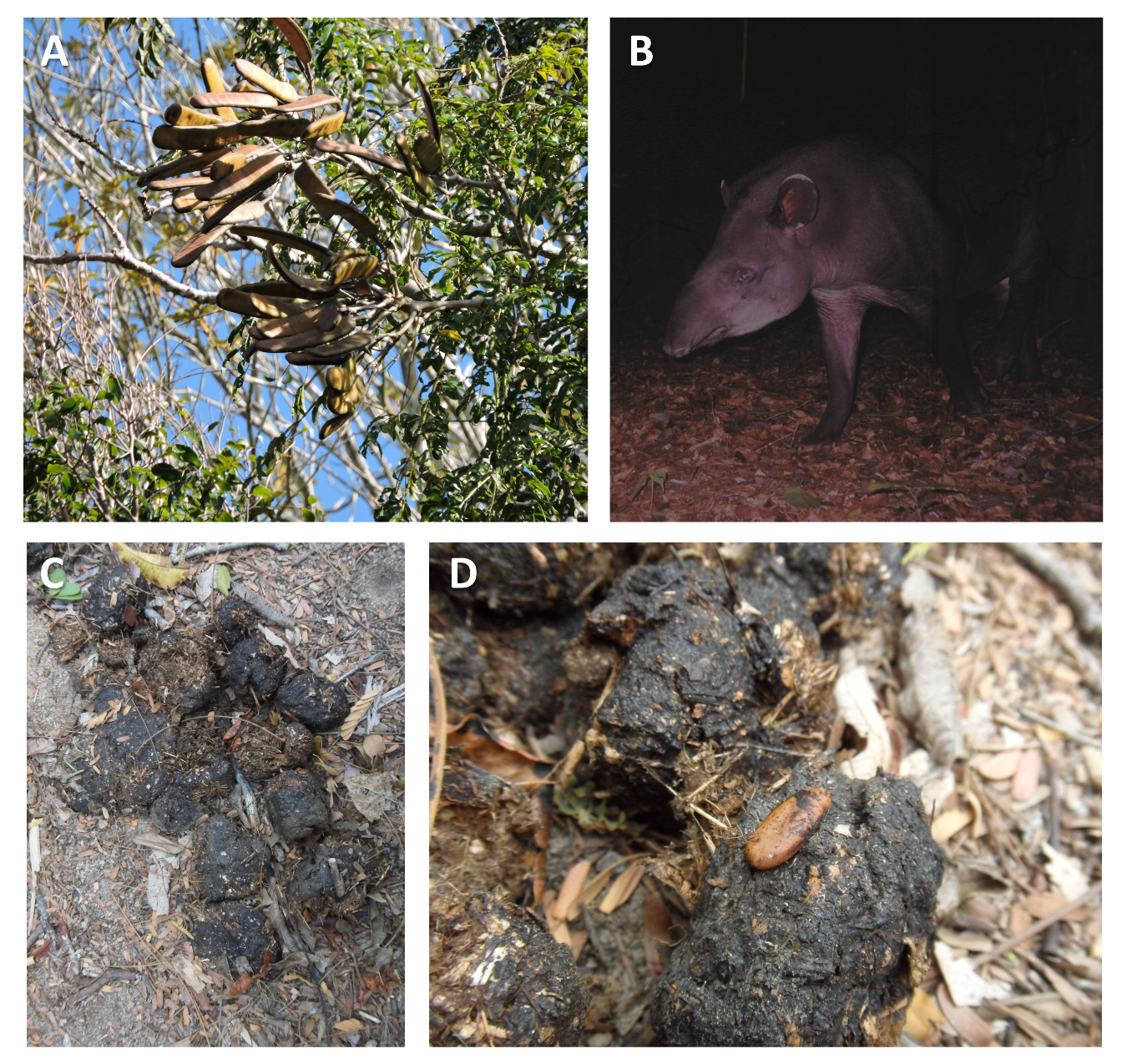
The tapir is classified as Endangered in the Atlantic Forest [22] and is considered extinct in almost all of Espírito Santo [23, 24]. Currently, the species occurs in a few protected areas in the northern region of the state, with only one viable population in the entire Espírito Santo, corresponding to that present in the BLS [23]. Since the fruits of D. jorgei are not morphologically attractive to vertebrate fauna in general but can be dispersed by tapirs, the loss of tapir populations may compromise its long-distance seed dispersal. It is emphasized that seed mortality near the parent plant tends to be higher, as it has a density-dependent response, and seed dispersal by fauna is one of the elements contributing to seed survival and seedling establishment [19, 25]. Thus, the seed dispersal of D. jorgei, as well as other species whose dispersal is dependent or primarily carried out by tapirs, may be compromised in areas where this large mammal is currently absent, affecting the seed dispersal process. It is worth noting that seed dispersal is an Ecosystem Service of Support, and is directly related to the production of food, wood and/or plant fibers, as well as medicinal products, among other benefits [26]. However, by contributing to the maintenance and regeneration of vegetation, seed dispersers indirectly participate in other Ecosystem Services such as habitat maintenance, production of plant biomass, carbon sequestration and storage, and may also be associated with soil improvement and nutrient cycling (especially when the dispersed species form associations with mycorrhizas), among others.
Our record confirms the consumption of D. jorgei by tapirs in the RNV, corroborating that this species can be an important supplementary food item in the diet of these large mammals during dry periods. Additionally, we suggest that the tapir may be one of the main dispersers of D. jorgei, a pattern that may also apply to other species whose fruits are morphologically considered unattractive to vertebrates in general. The discovery of the fecal sample with D. jorgei seeds in an altered area reinforces the ecological role of tapirs in the natural regeneration of environments, highlighting their contribution to promoting multiple Ecosystem Services.
Authors Contributions
Ana Carolina Srbek-Araujo [Conceptualization, data analysis, interpretation and writing] Cristina Jaques da Cunha [Data analysis, interpretation and writing] Geovane Souza Siqueira [Data analysis, interpretation and writing]
Conflicts of Interest
The authors declare that there are no conflicts of interest associated with this publication.
Acknowledgements
Cristina Jaques da Cunha thanks the Coordenação de Aperfeiçoamento de Pessoal de Nível Superior (CAPES) for the postgraduate scholarship. Ana Carolina Srbek-Araujo thanks the Fundação de Amparo à Pesquisa e Inovação do Espírito Santo (FAPES) for a productivity fellowship (Bolsa Pesquisador Capixaba - FAPES 404/2022).
References
-
Lima HC, Queiroz LP, Morim MP, Souza VC, Dutra VF, et al. (2015) Fabaceae. In: Lista de Espécies da Flora do Brasil. Jardim Botânico do Rio de Janeiro.
-
Franco AA, Dias LE, Faria SD, Campello EFC, Silva ER (1995) Use of nodulated and mycorrhizal forest legumes as agents for recovering and maintaining soil life: a technological model. Australis Oecology 1(1): 459-467.
-
Franco AA, Faria SM (1997) The contribution of N2-fixing tree legumes to land reclamation and sustainability in the tropics. Soil Biology Biochemistry 29(5/6): 897-903.
-
Lorenzi H (2009) Brazilian trees: manual for identification and cultivation of tree plants native to Brazil. New Odessa: Instituto Plantarum pp: 155.
-
Landim LP, Costa JGM (2012) Dimorphandra gardneriana Tulasne (Fava d’anta) - An ethnobotanical approach and risks of extinction. Biology Magazine 9(1): 6-11.
-
Pleşca‐Manea L, Pârvu AE, Pârvu M, Taamaş M, Buia R, et al. (2002) Effects of Melilotus officinalis on acute inflammation. Phytotherapy Research 16(4): 316-319.
-
Dantas IC, Souza CD (2004) Arborização urbana na cidade de Campina Grande-PB: Inventário e suas espécies. Revista de Biologia e Ciências da Terra 4(2): 1-18.
-
Fragoso JMV, Huffman JM (2000) Seed-dispersal and seedling recruitment patterns by the last Neotropical megafaunal element in Amazonia, the tapir. Journal of Tropical Ecology 16(3): 369-385.
-
Galetti M, Keuroghlian A, Hanada L, Morato MI (2001) Frugivory and Seed Dispersal by the Lowland Tapir (Tapirus terrestris) in Southeast Brazil 1. Biotropica 33(4): 723-726.
-
Tófoli CF (2006) Frugivory and seed dispersal by Tapirus terrestris (Linnaeus, 1758) in the fragmented landscape of Pontal do Paranapanema, São Paulo. Master Thesis. São Paulo University, Brazil, pp: 89.
-
Tobler MW, Janovec JP, Cornejo F (2010) Frugivory and Seed dispersal by the Lowland Tapir Tapirus terrestris in the Peruvian Amazon. Biotropica 42(2): 215-222.
-
O’Farrill G, Galetti M, Campos‐Arceiz A (2013) Frugivory and seed dispersal by tapirs: an insight on their ecological role. Integrative Zoology 8(1): 4-17.
-
Thomas WW, Jardim JG, Fiaschi P, Amorim AMA (2003) Preliminary list of Angiosperms locally endemic to southern Bahia and northern Espírito Santo, Brazil. In: Biodiversity Corridor of the Atlantic Forest of Southern Bahia. 1 CD-ROM. IESB-Conservation International. Ilheus.
-
Clifton-Cardoso BC, Mielke MS, De Melo JR, Querino RN (2008) Germination and seedling growth of Dimorphandra jorgei MF Silva and Swartzia macrostachya Benth. var. riedelii Cowan. New Forests 35(1): 15-31.
-
Medici EP (2010) Assessing the viability of lowland tapir populations in a fragmented landscape. Doctoral Thesis. Kent Canterbury University, United Kingdom, pp: 292.
-
Fragoso JMV, Silvius KM, Correa JA (2003) Long-distance seed dispersal by tapirs increases seed survival and aggregates tropical trees. Ecology 84(8): 1998-2006.
-
Seibert JB (2015) Pattern of frugivory by Tapirus terrestris in the Atlantic Forest of northern Espírito Santo. Master Thesis. Espírito Santo Federal University, Brazil, pp: 43.
-
Willson MF, Traveset A (2000) The ecology of seed dispersal. In: Fenner M (Ed.). Seeds: The ecology of regeneration in plant communities. 2ed. Wallingford: Cabi Publishing, pp: 85-110.
-
Howe HF, Miriti MN (2004) When seed dispersal matters. BioScience 54(7): 651-660.
-
Bizerril MXA, Rodrigues FHG, Hass A (2005) Fruit Consumption and Seed Dispersal of Dimorphandra mollis Benth. (Leguminosae) by the Lowland Tapir in the Cerrado of Central Brazil. Brazilian Journal of Biology 65(3): 407-413.
-
Paolucci LN, Pereira RL, Rattis L, Silvério DV, Marques NCS, (2019) Lowland tapirs facilitate seed dispersal in degraded Amazonian forests. Biotropica 51(2): 245-252.
-
Medici EP, Flesher K, Beisiegel BM, Keuroghlian A, Desbiez ALJ, et al. (2012) Avaliação do Risco de Extinção da Anta brasileira Tapirus terrestris Linnaeus, 1758, no Brasil. Biodiversidade Brasileira Ano II 3: 103-116.
-
Flesher KM, Gatti A (2010) Tapirus terrestris in Espírito Santo, Brazil. Tapir Conservation 19(1): 26.
-
Costa LP, Bergallo HG, Caldara Junior V, Evaldt BHC, Fagundes V, et al. (2019) Mamíferos ameaçados de extinção no estado do Espírito Santo. In: Fraga CN, Formigoni MH, Chaves FG (Org.). Fauna e flora ameaçadas de extinção no estado do Espírito Santo. 1ed. Santa Teres: Instituto Nacional da Mata Atlântica, p. 314-341.
-
Janzen DH (1970) Herbivores and the number of tree species in tropical forest. American Naturalist 104: 501- 528.
-
Wenny DG, Devault TL, Johnson MD, Kelly D, Sekercioglu CH, et al. (2011) The need to quantify ecosystem services provided by birds. Auk 128: 1-14.
- California Red-Legged Frog and Non-Listed Amphibians Response to Non-Native Fish Removal
- Industrial Standardization of the Bio-OS: Algorithmic Codification of Resilience Engineering Guidelines and Version V8 Architecture
- Climate Variability and the Sustainability of Snail Farming in Nigeria: Past Trends, Present Challenges and Potential Outlook
- The Evaluation of the Surveillance System of Anthrax in Gilgit-Baltistan, Pakistan, 2018
- Natural Decline to Extinction of A New Zealand Rabbit Population
- Mitochondrial Bio-Logistics: Steering Co-Enzyme Q10 and Lycopene Synergies within the Science 4.0 Bio-OS Framework