
Aspects of the Biology of (Pseudotolithus elongatus) Bobo Croaker Fish From Jaja Creek, Ikot Abasi Local Government Area, Akwa Ibom State, South Eastern Nigeria
Aspect of the biology of Pseudotolithus elongatus was carried out in Jaja creek in Ikot Abasi Local Government Area, between December to May, 2022. A total of hundred and eighty (180) fish specimens were analyzed for sexual dimorphism, sex ratio, size distribution, gonad morphology, reproductive investment using gonadosomatic index, hepatosomatic index and condition factor and determination of Length-weight relationship. Male and female were identified, results showed that the males were significantly more than the females with the ratio of 1.0: 0.7 and was significant difference from the expected 1:1 ratio. The smallest fish examined was male with the total length of 13.9cm while the largest fish was male with the total length of 26.0cm the male possess a pair of testes while the females possess a pair of ovaries. The GSI ranged from 0.08 to 8.13 and the HSI ranged from 0.08 to 4.66, K ranges from 0.63 to 1.08 respectively. The regression exponent showed that males were isometric; females negative allometric and combined sexes negative allometric. The r value obtained showed a strong linear relationship between the length and weight of the species. The Length-weight relationship showed allometric growth for the species. Jaja Creek seems to be polluted as the growth exponent and condition factor showed negative allometric growth pattern and less than one respectively. Hence proper monitoring of the ecosystem is recommended.
Introduction
Fish can be defined as an aquatic animal that has a backbone, gills, and fins [1]. However in fisheries, the term fish is used to classify any aquatic animal that is harvested, this includes invertebrates like crustaceans and mollusks, which are collectively identified as shellfish [2]. Fish that conform to the biological definition are often referred to as true fish or finfish [1]. Pseudotolithus elongatus is the most economically important species in the Cross River estuary, where it constitutes 43.4% of the total catch by artisanal fishermen [3, 4]. The estuarine croaker (P. elongatus, Sciaenidae) has long term socio-economic and ecological significance in tropical and sub-tropical regions of the world, but little has been reported on the population demographics of this species [5]. The genus Pseudotolithus (Family Sciaenidae) commonly known as Croakers constitute an abundant and commercially important fish in Nigerian inshore waters [6]. They occur throughout the Atlantic coast of West Africa [7] and account for about 7.15% of the total marine fish landings of Akwa Ibom State, Nigerian [8]; 42.90% by weight of the total average landings in the Nigerian coast and 40% of the value of landings made by trawlers operating along the West coast of Africa [3].
The most economically important and dominant species in the Nigerian coastal waters are Pseudotolithus elongatus, P. senegalensis and P. typus, while the less prominent ones include P. brachygnatus, P. epiperchus and P. moori [6]. The Croakers are commonly found on muddy deposits [6] and are exploited by both industrial and artisanal fisheries. Spawning fish occur very close to inshore water, generally in untrawlable shallow waters. P. senegalensis and P. typus are mostly marine, forming an estimated 30% of the catch of the trawl fishery on the continental shelf, while P. elongatus occurs in the estuaries and saline creek systems. Out of the two open sea species, P. elongatus is widely distributed along the coast of tropical West Africa from Senegal to Angola and enters the estuary. Prior to the pioneering report of Akpan, et al. [9], information on the trophic ecology of Pseudotolithus species in Southeastern Nigeria was generally lacking. The report which examined three species of the Sciaenidae depicted them as specialized feeders subsisting on similar food sources which were dominated by crustaceans (shrimps) and juvenile fish. The present report focuses specifically on the trophic ecology of P. elongatus of the Cross River estuary. Aspects of the biology of fish encompasses the sexual dimorphism, sex ratio, size composition, reproductive biology which encompasses gonadosomatic index, hepatosomatic index and condition index, diet and growth. Sexual dimorphism is the condition where the sexes of the same species exhibit different characteristics, particularly characteristics not directly involved in reproduction [10].
The Jaja creek extends to the western bank of Eniong creek about 12 km from Imo River where the water breaks the coastal area into an irregular shaped tidal mud flat. The area is typical of an estuarine tidal water zone with fresh water input from the Imo River extensive mangrove swamps and inter-tidal mud flats it is bounded by thick mangrove mostly rhizophora species and interspaced by Nypa plam. The main occupation of the people are fishing, farming, firewood cutting and water transportation [11] sea foods such as croaker fish from Jaja creek of Imo River in Ikot Abasi Local Government Area, Akwa Ibom State, Nigeria are important aquatic food with nutritional and commercial value and are greatly affected by effluent discharge into the creek by Aluminum Smelter Company (ALSCON). The Anthropologic activities going on around the Jaja creek in particular and Niger delta in general such as oil exploration and exploitation, agricultural activities and the deposition of domestic and urban waste into the aquatic ecosystem has the potential of altering the physical, biological and chemical characteristics of the water which might have adverse effects on the biology of the flora and fauna that inhabit the water body including P. elongatus. There is inadequate information on the aspects of the biology of Pseudotolithus elongatus from Jaja creek hence the reason of this research with the following specific objectives: to determine the sexual dimorphism, sex ratio and size composition, reproductive indices of the species using GSI and HIS, condition factor and the growth pattern of the species using length- weight relationship. Findings from this research would add to the information on the biology of P. elongatus and boost the scientific knowledge of this species in the Niger Delta in particular, Nigeria generally and the world at large.
Materials And Method
Description of the Study Area
This study was carried out in Jaja creek in Ikot Abasi Local Government Area, Akwa Ibom State Nigeria, the Jaja creek is located at latitude 400 32 to 400 52 N and longitude 70° 25 to 70° 45 E with elevation generally less than 30 m above sea level the Jaja creek extends to the western bank of Eniong creek about 12km from Imo River where the water breaks the coasted Area into an irregular shaped tidal mud flat. The area is typical of an estuarine tidal water zone with fresh water input from the Imo River extensive mangrove mostly by Rhizophora species and interspaced by Nypa plam. It has a climate that can be differentiated into two seasons the wet seasons begins in march and ends November, having annual rainfall varying between 2000mm to 3500mm and dry season begin November to February. Jaja creek receives effluent discharge from Aluminum Smelter Company (ALSCON) located a distance of about 4miles from the creek. The main occupation of the people are fishing farming, firewood cutting and water transportation [11] and the area is semi-rural community in which the inhabitants depend on rain and surface water as the only source of drinking and for domestic purposes. The major protein in the area is seafood (crayfish, fish, crabs, periwinkle, clams) the effluent from Aluminum Smelter Plant and Domestic waste water from Housing Estates (Ferrostial Camp, Suleato Camp, worker’s camp bergers camp, and Alscon camp) in Ikot Abasi are discharged into the creek (Figure 1 & Plate 1).
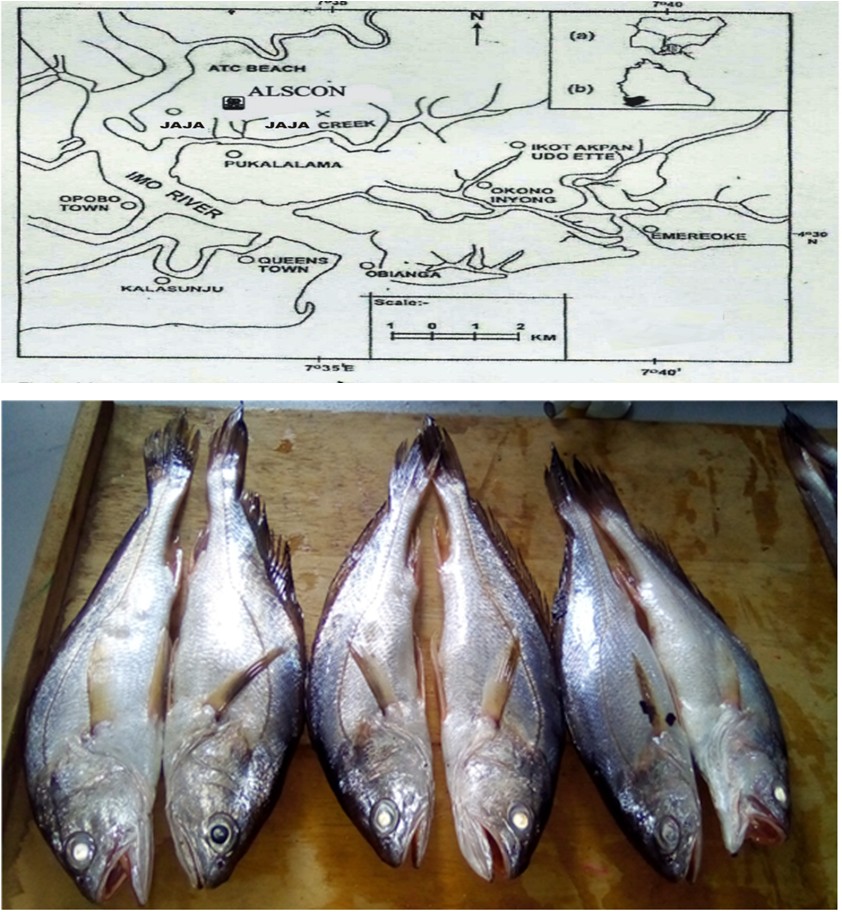
Plate 1: Pseudotolithus elongatus samples.
Sample Collection
Samples of Pseudotolithus elongatus were collected monthly for six months from December 2021 to May 2022 from mudflats of the mangrove swamps of Jaja creek. Services of local fishers were employed in setting out the trap and diurnal collection of the fish. A total of 30 fish samples were collected monthly, the samples were washed with water, placed in a bucket and preserved in Ice chest the sample were later transported to zoology departmental laboratory, Akwa Ibom State University and stored in the freezer prior to laboratory analysis.
Sample Preparation
The samples were preserved with ice chest immediately after being caught and was transported to the Akwa Ibom State University Zoology laboratory, Ikot Akpaden Akwa Ibom state, for analysis. The total length, standard length, gut length, liver length, gonad length were carefully measured using measuring board. Fish weight, gonad weight, liver weight and the gut weight was measured using electronic weighing balance. All length measured was done to the nearest 0.1 centimeter and all weight measured was done to the nearest 0.1 grams.
Sexual Dimorphism
The sexes of Pseudotolithus elongatus were differentiated by the observation of the genital papillae on the ventral surface of the abdominal region and confirmed by the type of gonad possessed by the specimen after dissection.
Sex Ratio
Each specimen was dissected and the gonads were removed. The sex of each specimen was identified by the examination of the gonad. Number of males and females specimen was counted and was recorded appropriately. The proportion of the two sexes was used to calculate the sex ratio, and it was calculated monthly there after the results was tested by chi square ascertain deviation from the hypothetical 1:1 ratio (Fisher’s principle).
Size Composition
Each specimen was measured to the nearest 0.1 centimeter using fish measuring board and the weight was taken by using electronic weighing balance to the nearest 0.1 grams and was recorded.
Gonad Morphology
Each specimen was dissected and the gonad was removed and observed, the ovaries were present in female while testes were seen in males.
Gonadosomatic Index (GSI) The weight of the fish and that of the gonad was used to determine the (GSI) following [12].
100 weight of gonad Weight of fish weight of gon G I ad S − = ×
That is . 100 wg GSI Sw = ×
Hepatosomatic Index (HSI) The weight of each fish and that of the liver were used to determine the hepatosomatic index. Thus:
0 10 Weight of liver Weight of fish weight of liver HSI − = ×
1 100 W HSI Sw = ×
Condition factor (K) Length in exponent 3 expressed as a percentage was used to calculate the condition factor estimated from the relation man below;
3 100_W_ K L = Determination of length- weight relationship Data Analysis The relationship between the length (L) and weight (W) of fish was expressed by the equation given by Gayanilo, et al. [13]. W = aLb ln W = lna + bln L Where W = Weight of fish in (g) TL = Total length (TL) of fish in (cm) a = Constant (intercept) b = slope (change in weight per unit change in length) The “a” and “b” values were obtained from a linear regression of the length and weight of the fish measured. The exponent `b` provides information on fish growth. When b = 3, increase in weight is isometric and when the value of b is other than 3, weight increase is allometric, (positive allometric if b>3, negative allometric if b<3). The null hypothesis of the isometric growth (H0: b = 3) was tested by t - test, using the statistic: ts = (b-3)/Sb, Where Sb is the standard error of the slope, for α=0.05 for testing significant differences among slopes (b) between two regressions for the same species [14].
Results and Discussion
Sexual Dimorphism
The genital papillae on the postero-ventral surface of the abdomen were more rounded in female than those of the male counterpart, also the physical examination of the gonad, showed testes for males and ovaries for females (Plate 2).
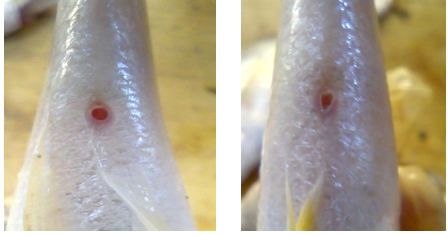
Female Male Plate 2: Sex differences between male and female P. elongates.
Sex Ratio
The monthly variation in sex ratio is presented in Table 1. A total of 180 specimens were collected, 108 (60%) males and 72 (40%) females giving a male: female of 1.0: 0.7 which was different from unity in favour of the males.
| Sex | Ratio | Calculated x² test | Sign | |||
|---|---|---|---|---|---|---|
| Month | Male | Female | Male | Female | ||
| December | 15 | 15 | 1 | 1 | 0 | 0 |
| January | 18 | 12 | 1 | 0.66 | 3.600a | < |
| February | 17 | 13 | 1 | 0.76 | 5.378a | < |
| March | 19 | 11 | 1 | 0.57 | 4.178a | < |
| April | 20 | 10 | 1 | 0.5 | 11.11a | < |
| May | 19 | 11 | 1 | 0.57 | 4.178a | < |
Table 1: Monthly sex ratio of _P. elongatus_ from Jaja Creek River.
*= Significant at p<0.05. Table 1: Monthly sex ratio of P. elongatus from Jaja Creek River.
Size Distribution
The total length of male P. elongatus ranged from 13.90 to 26.00 cm (mean = 20.09 ± 2.142) while that of female ranged from 15. 80 to 25.50 cm with the (mean of 21.02 ± 1.958 cm) while the total weight of the male ranged from 22.0 to 146.80 g with a mean of 70. 06 to 23.573 g and that of the females ranged between 34.10 and 130.90 g (mean = 78.37±2.61 g). The smallest fish by length male and female were caught march and February respectively, while the largest fish male and female were caught in April and February respectively. By weight the smallest male and female were caught in March and February respectively while the heaviest male and female were caught in April and February respectively.
Gonad Morphology
The examination of the gonad morphology showed that the ovaries were a pair of pale whitish to yellowish in color, blubber and oval structure lying on the dorsal wall of the visceral cavity. The lobes were generally equal in size, the right and the left lobes joined posteriorly and open to the outside through the vent. The testes were a pair of small, pale white, thin and elongated structure, resting on the dorsal surface of the abdominal cavity. The lobes join together and open to the exterior through the vent.
Gonadosomatic Index (GSI)
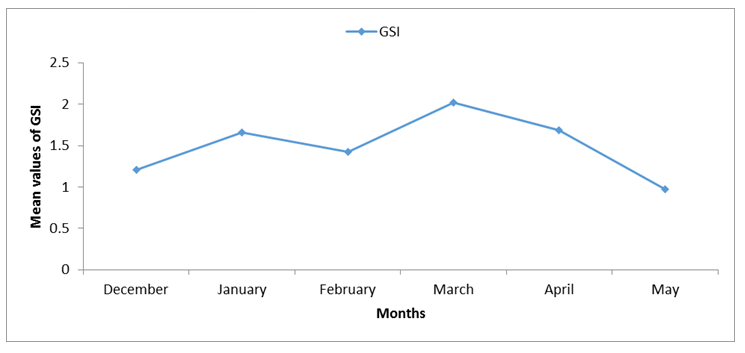
The gonadosomatic index ranged between 0.08 and 8.13 in April and in December with the mean value of 0.843 ± 1.086 in males and ranged between 0.10 in May and 5.22 in March (mean = 1.474 ± 1.03) in females. Major peak was recorded in March and minor peak was observed in January as depicted in Figure 2.
Hepatosomatic Index (HSI)
The hepatosomatic index varied between 0.08 in December and 4.66 in January with a mean value of 0.858 ± 0.696 in males while it ranged from 0.10 in May to 4.33 (mean = 0.843 ± 0.609) in females. Major peak was recorded in January while minor peak was recorded in February and April.
Condition Factor (K)
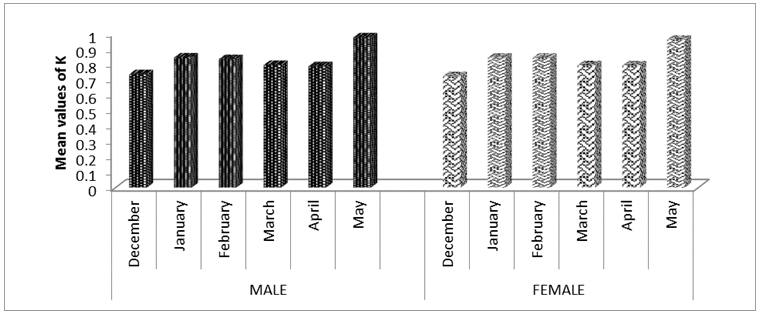
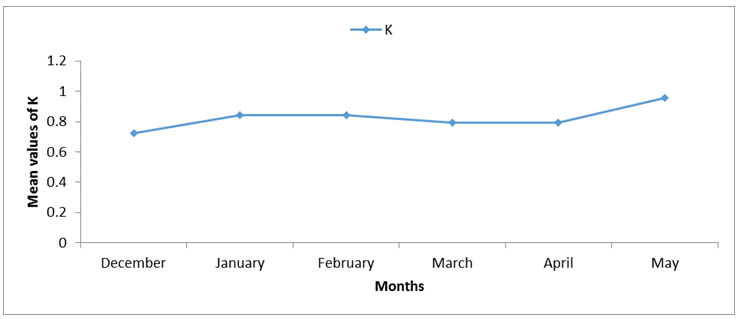
The monthly condition factor (K) recorded for male P. elongatus ranged from 0.63 to 1.08 with mean of 0.831 ± 0.930, for the females K ranged between 0.70 and 1.06 (Mean = 0.826 ± 0.932) and for combined sexes K varied between 0.63 and 1.08 with a mean of 0.8263 ± 0.093. The combined sexes of K increased progressively and peaked at a mean value of 0.9683 in May as shown in Figure 3. Both sexes showed similar K trend and peak in May as presented in (Figure 4).
Length-Weight Relationship
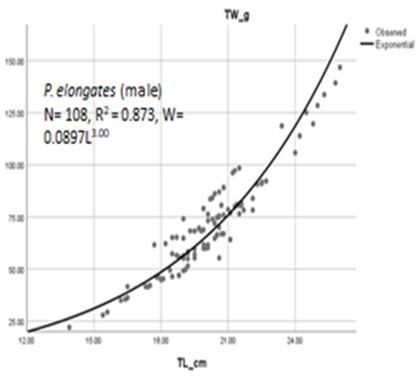
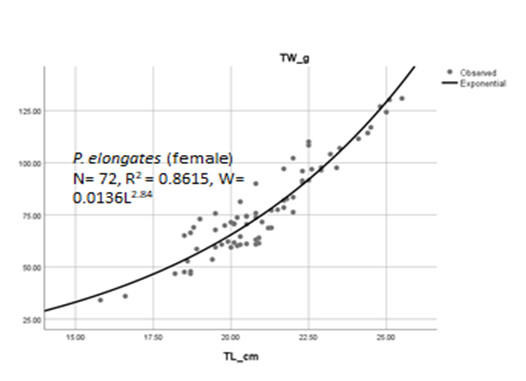
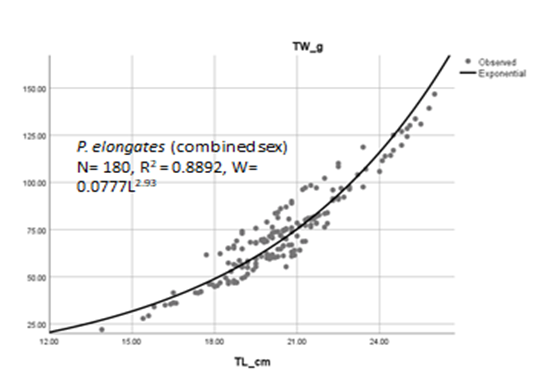
The results for the regression of length and weight parameters of male, female and combine sexes of P. elongatus is presented in Table 2.The regression exponent values obtained for males, females and combined sexes were 3.00, 2.84 and 2.93 respectively. The results for the regression of length and weight are depicted in Figures 5-7 for males, females and combined sexes respectively. The strong linear relationship between the length and weight of the male, female and combined sexes are indicated by the high coefficient of determination (Table 2).
| LW Parameters | Male | Female | Overall |
|---|---|---|---|
| N | 108 | 72 | 180 |
| b | 3 | 2.84 | 2.93 |
| a | 0.09 | 0.0136 | 0.0777 |
| r2 | 0.897 | 0.8615 | 0.8892 |
Table 2: Length-weight Parameters of _Pseudotolithus_ _elongatus_ in Jaja creek.
Discussion
In the present study on the fish P. elongatus, sexual dimorphism, sex ratio, size composition, Gonadosomatic index, Hepatosomatic index, condition index and length- weight relationship were discussed in order to clarify some characteristics of its reproductive biology and growth pattern. In the study, the sexes of P. elongatus were differentiated on the basis of genital papillae on the postero-ventral surface of the abdomen. A similar sex differentiation was reported by Ekanem, et al. [15] for P. elongatus in cross river estuary, Nigeria. The overall sex ratio was significantly male biased. Given that 1:1 sex ratio indicates the absence of a sex biased dichotomy in longevity [16, 17]. The sex ratio (1: 0. 7, males: females) observed in the present study pointed to the fact that there were more males than females. This results was similar to what was observed for P. senegalensis and P. typus in coastal water of Liberia, [18] and P. typus in near shore water of Benin [19] where the number of male exceeded that of the females. However the results obtained by Olapade and Tarawallie for P. senegalensis in Tombo Western Rural District, Sierra Leone which recorded female dominance (1: 1. 5, male: female) contradicts the results of the present study. Pena-Mendozo, et al. reported that variation in sex ratio can occur in favour of males because once the fertilization of egg has concluded the males possibly emigrate from spawning areas towards feeding grounds located in the shallow part of the water where they are captured. The females possibly go towards submerged vegetation and rocky area to avoid predators including fishermen and to carry out incubation and protection of the offspring.
P. elongatus showed size variation across the sexes, viz: Male, 13.90 to 26.00 cm; female, 15.80 to 25.50 cm. The present study contradicts the finding of Isangedighi on the same species from Cross River who recorded the largest fish to be female. It also contradicts the findings of Olapade, et al. [20], Austin, et al. [18] and Awotunde [21] who recorded larger size for P. typus from Tombo Western Rural District water, coastal water of Liberia and Lagos lagoon, Nigeria. However, the present results agreed with the maximum size obtained for the same species by Ajah and Udoh from cross River water, it also agreed with Waly, et al. who recorded the largest fish to be 26.8 cm for P. typus from Bandiala River, Saloum Delta, Senegalensis. The variation in fish size indicates that the fish population ranged from immature specimen to fully mature one. In fish, size is generally more biologically relavant than age, mainly because several ecological and physical factors are more size dependent than age dependent. Consequently, variability in size has important implication for diverse aspect of fisheries science and population dynamics [22].
Gonadosomatic index (GSI) showed major peak in March and minor peak in January. These could suggest that the spawning period of P. elongatus is March which is the onset of the wet season which is obviously the best period for most fishes to spawn because of the high abundance of food materials for the fry and fingerlings [20]. The present of major and minor peaks depict that the fish can spawn more than once in a year and can be described as a multiple spawner. This results agreed with that reported by Olapade, et al. [20] on P. senegalensis from Tombo Western Rural District of Sierra Leone. It also agreed with the results obtained by Austin, et al. [18] on P. senegalensis from the coastal water of Liberia and that of Ekanem, et al. [15] on P. elongatus from cross River. The GSI is the ratio of fish gonad weight to body weight, the variation in GSI throughout an annual cycle usually indicates the beginning and end of the fish reproductive period, an important component of fish life history. The GSI is particularly helpful in identifying days and seasons of spawning, as the Ovaries of the gravid females swiftly increase in size just prior to spawning. Spawning time are shown when GSI values increase and peak [12].
The hepatosomatic index recorded in the present study ranges from 0.08 to 4.66 and the mean value of HSI is 1.095 ± 1.108 the highest peak was in January which contradicts the results recorded by Olapade, et al. [20] in Tombo Western Rural District. The mean condition factor for the male, female and combined sexes was less than one (1) which proved that the fish did not feed well and live in a good environmental conditions, this may be owing to the low availability of food resources in the water body hence the fish had limited access and did not consume them according to their need and food requirements. Condition factor or ponderal index is another important parameter that is obtained from the length-weight (L-W) data. It is a measure of how well the fish is doing in the environment, it also allows for the conversion of fish length to weight and vice versa [23]. As a measure of condition of fish, K values below one (1) for the fish indicates a poor condition, which implies a thin and long fish probably poorly fed. The study of condition factor is important to understand the life cycle of fish species and contributes to the adequate management of the species and to the maintenance of the ecosystem equilibrium [24].
The intersexual pattern in the length-weight relationship (LWR) of P. elongatus revealed that the length-weight exponent similarly approximate the cube of the length. In Jaja creek, the b values were 3.00, 2.84 and 2.93 for the male, female and combined sexes respectively. The exponent ‘b’ provide information on fish growth. When b = 3, increase in weight is isometric and when the values of b is other than 3, weight increase is allometric , if b < 3 , growth is negative allometric and when b >3 growth is positive allometric. Hile [25] and Martin [26] observed that the values of the regression coefficient ‘b’ usually lies between 2.5 and 4.0 and for an ideal fish to maintain its shape, b = 3 is required. Isometric b value was recorded for male specimen in the present research and near isometric but toward negative allometric for female and combined specimens respectively. Ogunola, et al. reported that the growth pattern of S. melanotheron (b = 2.50). The negative allometric growth indicates that as the length of the fish increased, it became lighter, thinner or less plumpy or simply put, it shows poor growth of length and weight. The fish did not grow symmetrically as they become thinner with increase in length, this confirms that the fish were in a poor environment as the condition factor was below 1. However, the growth was within the limit or range of 2 and 4 reported for most fish.
The b values gotten here were higher than that gotten for P. typus from Lagos lagoon which recorded a clear negative allometric growth [21]. The results were however different from that recorded by Olapade, et al. [20] on P. senegalensis from Tombo Western Rural District of Sierra Leone which was positive allometric growth pattern. Length-weight relationship give information on the condition and growth pattern of fish. The change in b values depends primarily on the shape and fatness of the species although other factors may be responsible for the difference in the parameters of the length weight relationship among season and years such as temperature, salinity, food, sex, time of the year and stages of maturity [27, 28]. A positive correlation values obtained in this research showed there were correlation between the total length and body weight measurements of the fish, meaning the fish increase in the body weight as it grows in total length. Similar trend were observed in P. typus by Ajah, et al. [29]; Austin, et al. [18] and Awotunde [21] in cross River Estuary; coastal water of Liberia and Lagos lagoon Nigeria respectively. A high correlation coefficient value was also recorded by Olapade, et al. [20] in P. senegalensis from Tombo Western Rural District of Sierra Leone [30, 31, 32, 33, 34, 35, 36, 37, 38, 39, 40, 41, 42, 43, 44, 45, 46, 47, 48, 49, 50, 51]. Isometric relationship obtained here for male samples implies that as the species grows the body shape or specific gravity did not alter appreciably in length [52, 53, 54, 55, 56, 57, 58, 59].
References
-
Allen L, Pondella D, Horn M (2006) Ecology of marine fishes: California and adjacent waters. Berkeley (CA): University of California.
-
Castro P, Huber M (2000) Marine biology. In: 3rd (Edn.), Boston (MA): McGraw-Hill; MarineBio.org. Marine vertebrates Encinitas (CA).
-
Etim L, Uwe-Bassey BU, Brey T (1994) Population dynamics of the West African Croaker _Pseudotolitus_ _elongatus_ in the Cross River Estuary, Nigeria Sc Mar 58(4): 315-321.
-
Miller SA, Harley JP (1996) Zoology. In: 3rd (Edn.), WCBI McGraw Hill New York, USA, pp: 752.
-
Philomena E Asuquo, Honor T Ifon (2022) Morphological discreteness of the estuarine croaker _Pseudotolithus_ _elongatus_ (Teleostei: Sciaenidae), J Fish Biol 100(3): 619-624.
-
Isangedighi IA (2001) Studies on the Biology of Pseudotolithus species. (Sciaenidae) in the Inshore waters of Southern Nigeria. M.Sc. Thesis, University of Uyo, pp: 79.
-
Edwards AJ, Gill AC, Aboyweyere PO (2001) A revision of Irvines marine fishes of tropical West Africa. Darwin Initiative Report pp: 157.
-
Petters SW, Iwok ER, Uya OE (1994) Akwa Ibom: The Land of Promise. Gabuno, Publishing Co. Ltd, Lagos, Nigeria, pp: 77.
-
Akpan AW, Isangedighi IA (2004) Aspects of the feeding Ecology of three Species of _Pseudotolithus (Sciaenidae)_ in the Inshore waters of Southeastern Nigeria, East of the Niger Delta, Nigeria Journal of Aquatic Sciences 19(2): 51-58.
-
Encyclopedia of Animal Behaviour (2019) 2: 7.
-
Esenowo IK, Akpan AU, Egwali EC, Akpabio EE (2016) The abundance and composition of crabs (Decapoda) in Uta Ewa brackish water, Akwa Ibom State, South-South, Nigeria. Journal of Applied Sciences and Environmental Management 20(4): 919-924.
-
Abiaobo NO, Asuquo IE, Ejiogu IN, Etimfon JJ (2021) Aspect of the biology of _Periophthalmus barbarous_ (mudskipper) from Jaja creek, Niger Delta, Nigeria, Ecology and Evolutionary Biology 6(1): 15-22.
-
Gayanilo FC, Pauly D (1997) FAO ICLARM stock assessment tools (FISAT): Reference Manual, FAO, Computerized Information Series (Fisheries) (8): 262.
-
Morey G, Moranta J, Massuti E, Grau A, Linde M, Riera F, et al. (2003) Weight-length relationships of littoral to lower slope fishes from the Western Mediterranean. Fisheries Res 62(1): 89-96.
-
Ekanem SB, Marilyn-Joan A, Ekere MM (2004) Studies on some reproductive aspects of _Pseudotolithus elongatus_ in the Cross River estuary, Nigeria Sci Mar 68(2): 265-271.
-
Udo MT, Abiaobo NO, Asuquo IE (2016) Aspects of the reproductive biology in mudskippers _Periophthalmus_ _barbarus_ (Gobiidae) (Linneaus 1766) in mangrove swamps of Iko Estuary, Southeast, Nigeria. International Journal of Fisheries and Aquatic Studies 4(3): 27-32.
-
Abiaobo NO, Asuquo IE, Akpabio EP (2020) Heavy Metal Bioaccumulation in Periwinkle (_Tympanotonus fuscatus_) and Tilapia Fish (_Oreochromis niloticus_) Samples Harvested from a Perturbed Tropical Creek in the Niger Delta, Nigeria. Asian Journal of Environment & Ecology 12(1): 18-27.
-
Wehye AS, Ofori-Danson OK, Manekuor Lamptey A (2017) Population structure and some aspects of biology of _Pseudotolithus senegalensis_ and _Pseudotolithus typus_ within the coastal waters of Liberia. International Journal of Fisheries and Aquatic Research 2(2): 08-16.
-
Edmond S, Francis K, Ewusie N, Hederick RD (2013) Population structure and reproductive parameters of the _Pseudotolithus typus_ in near shore water of Benin and their implications for management. Scientific research open access 4(6): 10.
-
Olapade, Tarawallie (2014) The Length-Weight Relationship, Condition Factor And Reproductive Biology of _Pseudotolithus (P) Senegalensis_ in Tombo Western Rural District of Sierra Leone, African Journal On Food, agriculture nutrite and development 14: 6.
-
Awotunde MO (2021) Length-weight relationship and condition factor of long neck croaker _Pseudotolithus_ _typus_ from Lagos Lagoon, Nigeria. International Journal of Fisheries and Aquatic Studies 9(2): 09-13.
-
Erzini (1994) An Empirical Study of variability in length at age in marine fishes. J Apple Ichthyol 10(1): 12-41.
-
Udo MT (2002) Intersexual plasticity in Aspect of the biology of the Mudskipper swamp of Imo estuary, Nigeria) Environmental science (China) 14(1): 85-101.
-
Haruna MA (2006) Length weight relationship of four fish species chichlidar from magaga lake Kano, Nigeria REST Journal 3(3): 109-111.
-
Hile R (1936) Age and growth of Cisco leucicthye and K. Suercur in the lake pf North Eastern Hig and S. Bull. United States Bureau of fishery 48: 211-314.
-
Martin WR (1949) The mechanic of environmental control of body form in Fishes University of Toronto. Study of biology 58: 1-9.
-
Pauly D (1983) Some simple method of the assessment of tropical fish stock. FAO fisheries technical paper, FAO Rome Italy, pp: 234.
-
Abiaobo NO, Udo MT (2017) Population dynamics of mudskipper, periophthalmus barbarous (LINNEADS 1766) (TELEOSTEI, GOBIIDEA) and the implications for conservation and management in the mangrove swamp of Iko estuary, southern Nigeria. Journal of Applied Life Sciences International 14(4): 1-19.
-
Ajah PO, Udoh SA (2012) Food and feeding habit, condition factor and length weight relationship _Mugil_ _cephalus_ and _Pseudotolithus elongatus_ in cross river estuary, cross river state, Nigeria. Tropical fresh water biology 21(2): 59-70.
-
Anene A (2005) Condition Factors of Cichlid Species of Man-made Lake in Imo State, Southeast, Nigeria. Journal of Fish and Aquatic Science 5: 43-47.
-
De Guevara GCL, Bojórquez EM, Sánchez RR (2011) Age and growth of the sailfish Istiophorus platypterus (Istiophoridae) in the Gulf of Tehuantepec, Mexico. Mar Biol Res 7(5): 488-499.
-
Chen Y, Paloheimo JE (1994) Estimating fish length and age at 50% maturity using a logistic type model. Aquat Sci 56: 206-219.
-
Chukwu KO, Deekae NS, Gabriel UU (2010) Reproductive biology of mudskipper, _Periophthalmus_ _barbarus_ (Linneaus 1766) in new Calabar River, Nigeria. Agriculture and Biology Journal of North America 1(6): 1158-1161.
-
Delahunty G, De Vlaming VL (1980) Seasonal relationships of ovary weight, liver weight and fat stores with body weight in the gold fish, _Carassius auratus_ (L.). J Fish Biol 16(1): 5-13.
-
Diouf PS (1996) Les peuplements de poissons des milieux estuariens de l’Afrique de l’Ouest: L’exemple de l’estuaire hyperhalin du Sine-Saloum. Université de Montpellier II. Thèses et Documents Microfiches 156: 267.
-
Eschmeyer W, Fricke R, Fong JD (2019) Species by Family/Subfamily In. Catalog of Fishes. California Academy of Sciences.
-
FAO (2011) Yearbook of fishery and aquaculture statistics 2009 Capture production.
-
FAO (2020) Fishery and aquaculture statistics. Global production by production source 1950-2018 (Fishstat J) Retrieved from FAO Fisheries and Aquaculture Department.
-
Froese, Rainer, Pauly D (2019) Sciaenidae in Fish Base.
-
Frota LO, Costa PAS, Braga AC (2004) Length-Weight Relationships of Marine Fishes from the Central Brazilian Coast. Naga, World Fish Center Quarterly 27(1&2): 20-
-
Gaffer JA (1994) Fish production and the Nigerian environment, status, opportunities, threats. A keynote address presented at the11th Annual Conference of Fisheries Society of Nigeria pp: 22-25.
-
Hasan T, Hossain MD, Mamun M, Alam J, Salam MA, et al. (2018) Reproductive Biology of _Puntius sophore_ in Bangladesh. Fishes 3(2): 22.
-
Jega IS, Miah I Md, Haque MM, Shahjahan Md, Ahmed JF, et al. (2017) Sex ratio, length-weight relationships and seasonal variations in condition factor of menoda catfish _Hemibagrus menoda_. Hamilton, 1822) of the Kangsha River in Bangladesh. International Journal of fisheries and aquaculture studies 5(5): 49-54.
-
Isangedighi IA, Ambrose EE (2015) Aspects of the Reproductive Strategy of _Pseudotolithus elongatus_ (Teleostei: Sciaenidae) in the Cross River Estuary, Nigeria. International Journal of Multidisciplinary Research and Development 2(8): 593-595.
-
Isangedighi IA, Ambrose EE (2016) Trophic spectrum of _Pseudotolithus elongatus_ (Sciaenidae: Teleostei) in Imo River estuary, Nigeria. Int J Fish Aquat Stud 4(6): 108- 111.
-
Jacob Cervantes ML, Aguirre Villaseñor H (2014) Inferencia multimodelo y selección de modelos aplicados a la determinación de L50 para la sardina crinuda Opisthonema libertate del sur del golfo de California. Cienc Pesq 22(1): 61-68.
-
Johnson GD, Gill AC, Paxton JR, Eschmeyer WN (1998) Encyclopedia of Fishes. San Diego: Academic Press pp: 182.
-
Kharat SS, Khillare YK, Dahanukar N (2008) Allometric Scaling in Growth and Reproduction of a Freshwater Loach Nemacheilus mooreh (SYKES, 1839). Electronic Journal of Ichthyology 1: 8-17.
-
King M (1995) Fisheries biology, assessment and management. In: 1st (Edn.), Fishing News Books, pp: 338.
-
Mbu oben P (1995) Age, growth and reproductive biology of some Mormyrid species in Lekki lagoon, Nigeria. Ph.D. Thesis. University of Ibadan.
-
Nelson JS (2006) Fishes of the World. In: 4th (Edn.), Hoboken, NJ: John Wiley & Sons, pp: 372.
-
Oransaye CG Nakpodia FA (2005) A comparative study of the food and feeding habits of _Chrysicthys nigrodigitatus_ and Brycinus nurse in a tropical river. Pakistan Journal of Science Industry and Research 48(2): 118-121.
-
Osho FE, Usman AR (2019) Length-Weight Relationship, Condition Factor and Fecundity of African Snakehead _Parachanna obscura_ from the Anambra River, South East Nigeria. Croatian Journal of Fisheries 77(2): 99-105.
-
Peña Mendoza B, Gómez Márquez JL, Salgado Ugarte IH, Ramírez Noguera D (2015) Reproductive biology of _Oreochromis niloticus_ (Perciformes: Cichlidae) at Emiliano Zapata dam, Morelos, Mexico. Rev Biol Trop 53(3-4): 515-552.
-
Ramcharitar J, Gannon DP, Popper AN (2006) Bioacoustics of fishes of the family Sciaenidae (Croakers and Drums). Transactions of the American Fisheries Society 135(5): 1409-1431.
-
Roach J (2005) Fish Croaks like a Frog, But Why.
-
Stiassny MLJ, Teugels GG, Hopkins CD (2018) Institut de Recherche pour le Dévelopement, Paris, France, Muséum National d-Histoire Naturelle, Paris, France, and Musée Royal de l-Afrique Centrale, Tervuren, Belgium, pp: 603.
-
Vazzoler AEAM (1996) Reproduction biology of teleotean fishes: theory and practice. Moringa, EDUEM Brazilian Society of Ichthyology pp: 161.
-
Vicentini RN, Araújo FG (2003) Sex ratio and size structure of _Micropogoni asfurnieri_ (Desmarest, 1823) (_Perciformes, Sciaenidae_) in Sepetiba Bay, Rio de Janeiro. Brazillian Journal of Biology 63(4): 13.
- California Red-Legged Frog and Non-Listed Amphibians Response to Non-Native Fish Removal
- Industrial Standardization of the Bio-OS: Algorithmic Codification of Resilience Engineering Guidelines and Version V8 Architecture
- Climate Variability and the Sustainability of Snail Farming in Nigeria: Past Trends, Present Challenges and Potential Outlook
- The Evaluation of the Surveillance System of Anthrax in Gilgit-Baltistan, Pakistan, 2018
- Natural Decline to Extinction of A New Zealand Rabbit Population
- Mitochondrial Bio-Logistics: Steering Co-Enzyme Q10 and Lycopene Synergies within the Science 4.0 Bio-OS Framework