
Diversity of Ant Species (Hymenoptera: Formicidae) along Cauvery River Basin, Tamil Nadu, India
Ants are the social insects under the order Hymenoptera are playing an important role in the ecosystem. They help human beings as seed dispersal agent, pollinators and controlling harmful insect pest. They are the most divergent group of insect distributed universally and constitute greater part of biomass. They play very important role in the ecosystem by enriching soil fertility, decomposing process, etc. Congregation of ants indicates the environmental disturbance in an ecosystem. Among the insect communities ants communicate each other through pheromones secretion and obedient characters follow each other for searching food, collection and storing their food in safer place of their tunnel. They depend both plant and animal matters as food item for them. Ants are the species which is an architect to build the burrow is an evident of engineering system in the ecosystem. The present study investigate the diversity of ant species in and around the Kumbakonam area of Cauvery delta region and recorded 21 species of ants under 14 genera and four subfamilies. The recorded four subfamilies of ants, Formicinae was the dominant subfamily in terms of species richness followed by Dolichoderinae, Myrmicinae and Ponerinae. This study may bring out the availability of ant species in the region and make as a preliminary research on ants in the future researchers.
Introduction
Ants are the tiny social insect are abundant everywhere in the terrestrial ecosystem, but only occasionally noticed for their importance. They are the pioneer of creating burrows, making channels among the insect fauna need to be get attention which is being mentioned only in the text books of ecology. They release a combination of various chemicals for their communication. The researchers neglect of ants to study it’s science and natural history [1]. Ants are belongs to a single large family Formicidae and dominant species of order Hymenoptera. It is represented by 26 subfamilies with 14,711 species and 428 genera reported by Bolton [2]. In Indian sub-continent, Himalayas and the Western Ghats have highest number of ant species, of which 656 species under 88 genera in Himalayas and 455 species of 75 genera from the Western Ghats of Tamil Nadu [3, 4]. The subfamilies of Aenictinae, Amblyoponinae, Cerapachyinae, Dolichoderinae, Dorylinae, Ectatomminae, Formicinae, Leptanillinae, Myrmicinae, Ponerinae, Proceratiinae , Pseudomyrmecinae are the most dominant group in India [5]. Ants are found in all types of terrestrial habitats especially subarctic tundra and equatorial rain forests [6], and they also seen in marshes to deserts, from sea coastline to great elevations and deep underground to the apex of the tallest trees [7]. They are totally absent in Iceland, Greenland and Antarctica [1] and also absent in few island [8].
Ants are one of the important components in ecosystems because they establish a greater part of the animal biomass [9]. Most of the species of ants are eusocial reported by Gadagkar, et al. [10]. Studying ant species would help to monitor impacts created in the environment and act as a tool in ecological studies [11, 12, 13]. They are used as an indicator of management practices of land and taken as an efforts for restoration [13, 14, 15]. Sabu, et al. [15] recorded different species of ants from forest litter in the Wayanad region of the Western Ghats. Bharti and Sharma [13] made a preliminary investigation on diversity and abundance of ants along an elevational gradient in Jammu-Kashmir, Himalaya. Gadagkar, et al. [10] recorded the evidences of food of ants consists of insects, terrestrial arthropods, excretion from plants, honey dew excreted by aphids and mealy bugs, secretion of the caterpillars of the family Lycaenidae, seeds of plants etc. There are studies of diversity and abundance of ants from Thiruthangal of Tamil Nadu was carried out by Manikandan, et al. [16]. Ants are ubiquitous in distribution and occupy almost all terrestrial ecosystems. Very limited studies have been carried out on diversity of ants in Cauvery delta region. Hence this study was conducted [17] with the objectives of to conduct survey, to document the ant species diversity and to prepare a checklist of ants in the study area.
Material and Methods
The present investigation was carried out in Kumbakonam region of Tamil Nadu, mainly in the campus of Government Arts College, along the bank of Cauvery river, cultivated lands, wooded lands, etc. The area is rich in cultivation of different kind of crops, flowering plants and vegetable. Hence the area is suitable for ants and other invertebrates. Collection of ants were carried out using pitfall traps and hand collection methods which was described by Gadagkar, et al. [10]. Following the study of Gadagkar, et al. [10] all the two methods suggested by them were employed for collection of ant samples in the college campus during the study period are, a) Bait Trap (BT); The baits were kept for four hours without any disturbances and later ant species were collected and photographed from all the baited places. b) All-Out Search Method (AOSM): This method was carried out to collect ant species during the post monsoon seasons [10, 18]. Ant specimens were identified up to the genus level based on taxonomic keys prepared by Balton in 1994 also keys given by Ali [19] Bingham [20] Bolton[21, 22] Rastogi, et al. [23] Tiwari [24] Varghese [25, 26] and Mahalakshmi, et al. [27].
Results
The results of the present study shows that the diversity of Ants in the study site are mostly under the family Formicidae. The ant species identified are given in the (Table 1).
| Family | Sub Family | Common Name | Scientific Name | |
|---|---|---|---|---|
| 1 | Formicidae | Formicinae | Weaver ant | Oecophylla longinoda |
| 2 | Green tree ant | Oecophylla smaragdina | ||
| 3 | Red wood ant | Formica rufa | ||
| 4 | Yellow crazy ant | Anoplolepis gracillipes | ||
| 5 | Great carpenter ant | Camponotus herculeanus | ||
| 6 | Japanese carpenter ant | Camponotus japonicus | ||
| 7 | Black carpenter ant | Camponotus pennsylvanicus | ||
| 8 | Indian black ant | Camponotus compressus | ||
| 9 | Carpenter ant | Camponotus atriceps | ||
| 10 | Western carpenter ant | Camponotus modoc | ||
| 11 | Black garden ant | Lasius niger | ||
| 12 | Longhorn crazy ant | Paratrechina longicornis | ||
| 13 | Dolichoderinae | Argentine ant | Linepithema humile | |
| 14 | Sugar ant | Tapinoma sessile | ||
| 15 | Ghost ant | Tapinoma melanocephalum | ||
| 16 | Velvety tree ant | Liometopum occidentale | ||
| 17 | Myrmicinae | Big headed ant | Pheidole pallidula | |
| 18 | Desert harvester ant | Novomessor cockerelli | ||
| 19 | Jack jumper ant | Myrmecia pilosula | ||
| 20 | Red imported fire ant | Solenopsis invicta | ||
| 21 | Ponerinae | Giant Amazonian ant | Dinoponera gigantean |
Table 1: Ant species recorded during the in the Study period.
Oecophylla longinoda Oecophylla smaragdina Formica rufa
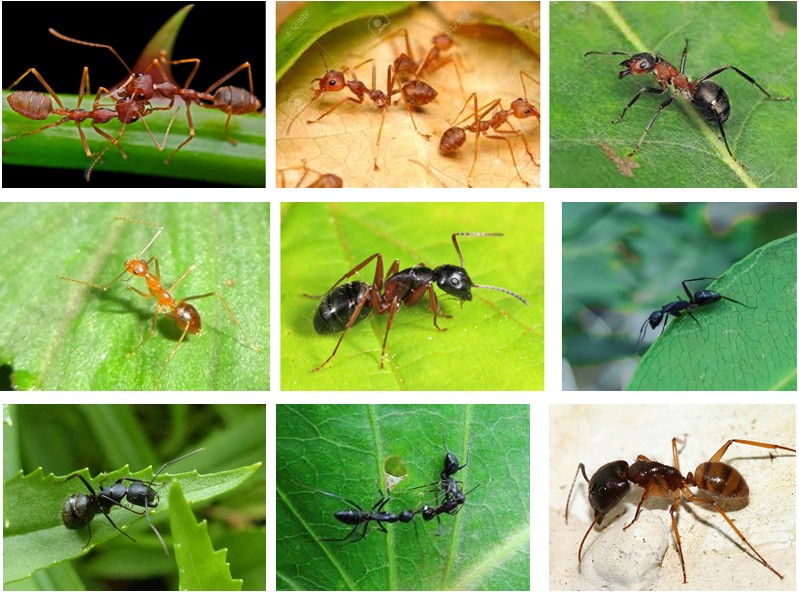
Anoplolepis gracillipes Camponotus herculeanus Camponotus japonicas
Camponotus pennsylvanicus Camponotus compressus Camponotus atriceps
Camponotus modoc Lasius niger Paratrechina longicornis
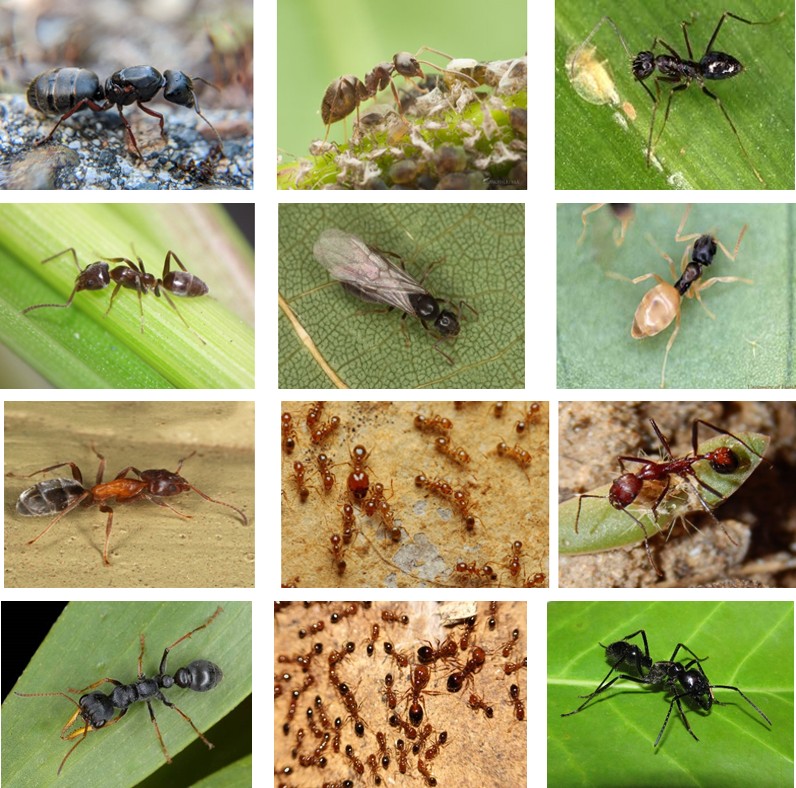
Linepithema humile Tapinoma sessile Tapinoma melanocephalum
Liometopum occidentale Pheidole pallidula Novomessor cockerelli
Myrmecia pilosula Solenopsis invicta Dinoponera gigantean
The results shows that out of 21 species of ants recorded, the sub family Formicinae has 12 species followed by Dolichoderinae and Myrmicinae has 4 species each and sub family Ponerinae has only one species. The composition of different ant species recorded is depicted in Figure1.
Discussion
According to the results obtained from the present study the sub family Formicinae consists of 12 species of ants. Similar observations were made by Azhagu Raj, et al. [9] in the campus of Pachiyappas College for Men, Kanchipuram. Similar studies on diversity and abundance of ants were recorded by Manikandan, et al. [16] from Thiruthangal of Tamil Nadu. According to their study, a total of 10 species of ants belonging to 9 genera, 4 subfamilies were observed. Anu, et al. [28] reported 22 species of ants from 16 genera at Wayanad region of Western Ghats and mentioned subfamily Formicinae was the highly dominant group in evergreen forests. Similar study was also carried out by Kashmira, et al. [29] in Mumbai, Maharashtra.
On contrary the report of Bharti, et al. [13] at Jammu- Kashmir, Himalaya reveals that the subfamily Myrmicinae was the most abundant subfamily, followed by Formicinae, Ponerinae, and Dolichoderinae. Savitha, et al. [30] reported the richness of ant species in the disturbance gradients in and around Bengaluru, India. The report of Odum and Rajagopal, et al. [31, 32] shows that the relative abundance of predatory ant of subfamilies including Formicinae, Dolichoderinae and Myrmicinae which are reflected in the present study too. Similar ant diversity studies were also reported from different regions of Bangalore [10, 33, 34]. The reports of Baldi [35] reveals that small and more homogeneous areas often harbor a lower number of species than large and heterogeneous areas. According to Wilson [8] big trunks or stems of trees and shrubs belonging to the dicotyledon families were used the ants for nesting [36].
Conclusion
The present investigation reveals that availability of favorable humidity and presence of diverse habitat and food resources reflects the richness of ant species. The dispersal of ant species occurs possibly through transport of construction materials (wooden trunks, bamboo, brick, pebbles), green vegetables and other raw food materials, etc. They can easily adapt to any changes in the environment and very fast they can survive to the new habitats. Similarly in any biotic and abiotic factors including plant community, edaphic factors, human disturbance and pollution can influence the assemblage pattern of ants. Detailed studies on diversity and assemblages of ants is needed to establish the importance of ants in the ecosystem. More areas covering more geographical locations and frequent sampling for a longer period will definitely bring out more information on the ants of Cauvery delta region.
References
-
Holldobler B, Wilson EO (1990) The Ants. Cambridge, Belknap of Harvard University Press, pp: 732.
-
Bolton B (2011) Bolton’s Catalogue and Synopsis.
-
Bharti H (2011) List of Indian Ants (Hymenoptera: Formicidae). Halteres 3: 79-87.
-
Bharti H, Guénard B, Bharti M, Economo EP (2016) An updated checklist of the ants of India with their specific distributions in Indian states (Hymenoptera, Formicidae). ZooKeys 551: 1-83.
-
Bharti H (2012) Indian ants.
-
Brian MV (1978) Production ecology of ants and termites.Cambridge University Press 201(4353): 337.
-
Bolton B (1994) Identification Guide to the Ant Genera of the World. Cambridge, Massachusetts: Harvard University Press, pp: 232.
-
Wilson EO, Tayler RW (1967) The ants of Polynesia (Hymenoptera: Formicidae). Pacif. Insects Monogr pp: 14.
-
Azhagu Raj R, Sathish R, Prakasam A, Krishnamoorthy D, Balachandar M (2017) Diversity and distribution of Ant species (Hymenoptera: Formicidae), in Pachaiyappa’s College, Kanchipuram, Tamil Nadu, India. Journal of Entomology and Zoology Studies 5(1): 459-464.
-
Gadagkar R, Padmini Nair, Chandrasekhara K, Bhat DM (1993) Ant species richness and diversity in some selected localities in Western Ghats 5: 79-94.
-
Andersen AN (1988) Immediate and longer-term effects of fire on seed predation by ants in sclerophyllous vegetation in Southeastern Australia. Australian Journal of Ecology 13(3): 285-293.
-
Andrade T, Marques GV, Del‐Claro K (2007) Diversity of ground dwelling ants in Cerrado: An Analysis of temporal variations and distinctive Physiognomies of vegetation(Hymenoptera: Formicidae) 50.
-
Bharti H Sharma YP (2009) Diversity and abundance of ants (Hymenoptera: Formicidae) along an elevational gradient in Jammu-Kashmir Himalaya-1. Halteres 1: 10- 19.
-
Agosti D, Majer JD, Alonso LE, Schultz TR (2000) Ants: standard methods for measuring and monitoring biodiversity. The Quarterly Review of Biology 77(2): 280.
-
Sabu TK, Vinesh PJ, Vinod KV (2008) Diversity of forest litter-inhabiting ants along elevation in the Wayanad region of the Western Ghats. Journal of Insect Science 8: 69.
-
Manikandan B, Anusuyadevi P, Sevarkodiyone SP (2018) Diversity and Abundance of Ants (Hymenoptera: Formicidae) from Thiruthangal, Sivakasi (Taluk), Tamil Nad. Int J Agric Sc Food Technol 4(1): 001-002.
-
Hariprasanth K (2023) Study on Diversity of Ant Species (Hymenoptera: Formicidae) along Cauvery River Basin, Tamil Nadu. M.Sc. Dissertation, Department of Zoology, Government Arts College, Kumbakonam.
-
Alonso EL (2000) In Ants: Standard Methods for Measuring and Monitoring Biodiversity. In: Agosti D, et al. (Eds.), Smithsonian Institute Press, US, PP: 280.
-
Ali TM (1992) Ant fauna of Karnataka. IUSSI Newsletter. 6:1-7.
-
Bingham CT (1903) The fauna of British India, including Ceylon and Burma. Hymenoptera 2. Ants and cuckoo- wasps. London: Taylor & Francis.
-
Bingham CT (1903) The Fauna of British India, Hymenoptera, London: Taylor and Francis pp: 2.
-
Bolton B (1995)A New General Catalogue of the Ants of the World. Harvard University Press.
-
Rastogi N, Nair P, Kolatkar M, William H, Gadagkar R (1997) Ant fauna of The Indian Institute of Science CampusSurvey and some preliminary observations. J Indian Inst Sci 77(2): 133-140.
-
Tiwari RN (1999) Taxonomic studies on Ants of a Southern India (Insecta: Hymenoptera: Formicidae). Memories 18: 1-96.
-
Varghese T (2002) Record of Strumigenys emmae (Emery) (Formicidae: Myrmicinae) from Bangalore, Karnataka and a key to Indian species of Agriculture, Mysore state, India.
-
Varghese T (2003) Ants of the Indian Institute of science campus. Technical report no 93, Centre for Ecological Sciences, India.
-
Mahalakshmi BR, Channaveerappa H (2016) Diversity of ant species (Hymenoptera : Formicidae) in the campus of Mharani’s Science College for Women: A mini model of habitat persistence. Int J Pure and Appl Zool 4(3): 277- 281.
-
Anu A , Sabu TK (2006) Biodiversity analysis of forest litter ant assemblages in the Wayanad region of Western Ghats using taxonomic and conventional diversity measures. Journal of Insect Science 7(1): 1-13.
-
Goldin Q Vaishali S (2013) Ant Diversity in an urban garden at Mumbai, Maharashtra. National Conference on Biodiversity: Status and Challenges in Conservation - ‘FAVEO’, pp: 121-125.
-
Savitha S, Barve N, Davindar P (2008) Response of ants to disturbance gradients in and around Bangalore, India. Tropical Ecology 49(2): 235-243.
-
Odum ER (1997) Fundamentals of Ecology, WB Saunders Limited. pp: 384.
-
Rajagopal T, Severkodione SP, Manimozhi A (2005) Ant diversity in some selected localities of Sattur Taluk, Virudhunagar district of Tamil Nadu. Zoos Print Journal 20(6): 1887-1888.
-
Varghese T (2009) A Review of Extant Subfamilies, Tribes and Ant Genera in India. pp: 81-89.
-
Aswathi G, Dhivya R (2021) Assessment of the Ant Diversity in Chethallur Village In Palakkad District, Kerala, India. Int J Recent Sci Res 12(05): 41680-41684.
-
Baldi A (2008) Habitat heterogeneity overrides the species– area relationship. J Biogeogr 35: 675-681.
-
Oliver I, Beattie AJ (19960) Designing a cost effective invertebrate survey: a test of methods for rapid assessment of biodiversity. Ecological Applications 6(2): 594-607.
- California Red-Legged Frog and Non-Listed Amphibians Response to Non-Native Fish Removal
- Industrial Standardization of the Bio-OS: Algorithmic Codification of Resilience Engineering Guidelines and Version V8 Architecture
- Climate Variability and the Sustainability of Snail Farming in Nigeria: Past Trends, Present Challenges and Potential Outlook
- The Evaluation of the Surveillance System of Anthrax in Gilgit-Baltistan, Pakistan, 2018
- Natural Decline to Extinction of A New Zealand Rabbit Population
- Mitochondrial Bio-Logistics: Steering Co-Enzyme Q10 and Lycopene Synergies within the Science 4.0 Bio-OS Framework