
Lyme Disease: A Zoonosis Tick-Borne Borrelia Bacterium [4/4]
Diagnosing Lyme disease involves assessment of the patient’s symptoms and EM rash. When EM rash and recent tick exposure are evident, additional laboratory tests may not be required. However, in cases where there is no EM rash or a clear history of tick exposure, a Lyme disease diagnosis may involve blood antibody tests. Serological testing, such as ELISA and immunoblots, is a common approach, and ELISA is reliable when IgG levels are at or above 200 IU/ml.
Editorial
Diagnosing Lyme disease involves assessment of the patient’s symptoms and EM rash. When EM rash and recent tick exposure are evident, additional laboratory tests may not be required. However, in cases where there is no EM rash or a clear history of tick exposure, a Lyme disease diagnosis may involve blood antibody tests. Serological testing, such as ELISA and immunoblots, is a common approach, and ELISA is reliable when IgG levels are at or above 200 IU/ml. It’s important to note that a positive test result in such cases does not definitively confirm an active infection, and caution to prevent false positives. Early diagnosis ensures effective antibiotic treatment. Lyme disease diagnosis entails a two- stage blood test employing ELISA and Western blot methods, utilizing IgM and IgG antibodies at different infection stages and the potential reliance on the EM rash for early detection [1, 2, 3].
In adults with Lyme neuroborreliosis, it is concerning that fewer than half of early cases receive a definitive diagnosis. Common symptoms in these cases include cranial neuropathy and meningitis [4]. The diagnostic of neuroborreliosis outlines the presence of lymphocytic pleocytosis, elevated immune cell levels, and increased CSF protein in cerebrospinal fluid analysis [5, 6]. CSF analysis patients exhibit symptoms limited to the peripheral nervous system, such as facial palsy. Neurological complications include cranial neuritis, meningitis, and radiculoneuritis/ mononeuropathy multiplex. The CSF pleocytosis or specific intrathecal antibodies identify central nervous system infections [7].
Diagnostic of Lyme carditis uses electrocardiograms and echocardiography to identify cardiac issues and myocardial dysfunction [8, 9, 10]. Neuroimaging is instrumental in diagnosing neuroborreliosis caused by Borrelia infection. The effectiveness of MRI in detecting brain abnormalities in these cases is notable, as is the observation of positive responses to antibiotic treatment. PTLD is characterized by persistent symptoms, particularly cognitive issues, underscoring its impact on the brain. Utilizing neuroimaging provides valuable insights into the aspects of the recovery process in PTLD cases [11].
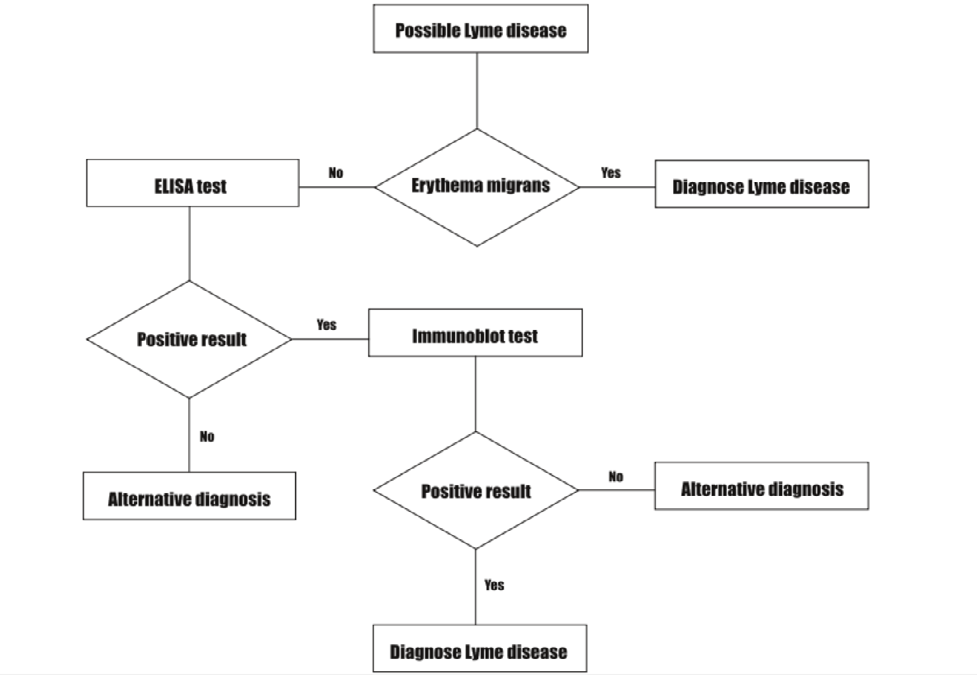
These editorials focus on the clinical, epidemiological, and diagnostic aspects of Borrelia, a pathogen transmitted by ticks. Achieving precise and swift diagnoses with heightened sensitivities remains a formidable challenge in infectious diseases, essential for promptly treating afflicted individuals [12, 13, 14]. In response to Borrelia burgdorferi infection, the immune system generates antibodies, triggering both humoral and cell-mediated immune reactions. The identification of the humoral immune response relies on detecting specific antibody reactions. Lyme disease diagnosis is still a substantial concern [15, 16, 17, 18, 19, 20, 21, 22, 23, 24, 25].
Acknowledgments
The author acknowledges Mrs. Norri Zahra and Mr. Regragui Moumaris.
References
-
Zwerink M, Zomer TP, Van Kooten B, Blaauw G, Van Bemmel T, et al. (2018) Predictive value of Borrelia burgdorferi IgG antibody levels in patients referred to a tertiary Lyme centre. Ticks Tick Borne Dis 9(3): 594- 597.
-
Shea J (2021) Physical Therapist Recognition and Referral of Individuals With Suspected Lyme Disease. Phys Ther 101(8): 128.
-
Wilske B, Fingerle V, Schulte-Spechtel U (2007) Microbiological and serological diagnosis of Lyme borreliosis. FEMS Immunol Med Microbiol 49(1): 13-21.
-
Stupica D, Bajrović FF, Blagus R, Cerar Kišek T, Collinet- Adler S (2021) Clinical manifestations and long-term outcome of early Lyme neuroborreliosis according to the European Federation of Neurological Societies diagnostic criteria (definite versus possible) in central Europe. A retrospective cohort study. Eur J Neurol 28(9): 3155-3166.
-
Rojko T, Bogovič P, Lotrič-Furlan S, Ogrinc K, Cerar-Kišek T (2019) Borrelia burgdorferi sensu lato infection in patients with peripheral facial palsy. Ticks Tick Borne Dis 10(2): 398-406.
-
Theel ES, Aguero-Rosenfeld ME, Pritt B, Adem PV, Wormser GP (2019) Limitations and Confusing Aspects of Diagnostic Testing for Neurologic Lyme Disease in the United States. J Clin Microbiol 57(1): e01406-418.
-
Roos KL (2021) Neurologic Complications of Lyme Disease. Continuum (Minneap Minn) 27(4): 1040-1050.
-
Lohr B, Fingerle V, Norris DE, Hunfeld KP (2018) Laboratory diagnosis of Lyme borreliosis: Current state of the art and future perspectives. Crit Rev Clin Lab Sci 55(4): 219-245.
-
Lee SH, Healy JE, Lambert JS (2019) Single Core Genome Sequencing for Detection of both Borrelia burgdorferi Sensu Lato and Relapsing Fever Borrelia Species. Int J Environ Res Public Health 16(10): 1779.
-
Prochnau D, Kühnemund J, Heyne JP (2022) Reversible high-grade atrioventricular block with septal myocardial edema in Lyme carditis. Herzschrittmacherther Elektrophysiol 33(3): 327-329.
-
Marvel CL, Alm KH, Bhattacharya D, Rebman AW, Bakker A, et al. (2022) A multimodal neuroimaging study of brain abnormalities and clinical correlates in post treatment Lyme disease. PLoS One 17(10): e0271425.
-
Halperin JJ (2018) Diagnosis and management of Lyme neuroborreliosis. Expert Rev Anti Infect Ther 16(1): 5-11.
-
Sriram A, Lessen S, Hsu K, Zhang C (2021) Lyme Neuroborreliosis Presenting as Multiple Cranial Neuropathies. Neuroophthalmology 46(2): 131-135.
-
Pegalajar-Jurado A, Schriefer ME, Welch RJ, Couturier MR, MacKenzie T, et al. (2018) Evaluation of Modified Two-Tiered Testing Algorithms for Lyme Disease Laboratory Diagnosis Using Well-Characterized Serum Samples. J Clin Microbiol 56(8): e01943-19417.
-
Moumaris M( 2023) Lyme Disease: A Zoonosis Tick- Borne Borrelia Bacterium [3/4]. Int J Zoo Animal Biol 6(4): 000500.
-
Moumaris M (2023) Lyme Disease: A Zoonosis Tick- Borne Borrelia Bacterium [2/4]. Int J Zoo Animal Biol 6(2): 000465.
-
Moumaris M (2022) Lyme Disease: A Zoonosis Tick- Borne Borrelia Bacterium [1/4]. Int J Zoo Animal Biol 5(6): 000425.
-
Moumaris M, Bretagne JM, Abuaf N (2020) Nanomedical Devices and Cancer Theranostics. The Open Nanomedicine and Nanotechnology Journal 6: 1-11.
-
Moumaris M, Bretagne JM, Abuaf N (2019) Biological Membranes and Malaria-Parasites. The Open Parasitology Journal 7: 1-18.
-
Moumaris M, Bretagne JM, Abuaf N (2018) Hospital Engineering of Medical Devices in France.The Open Medical Devices Journal 6: 10-20.
-
Moumaris M, Rajoely B, Abuaf N (2015) Fluorescein Isothiocyanate-Dextran can track Apoptosis and Necrosis induced by heat shock of Peripheral Blood Mononuclear Cells and HeLa Cells. Open Biological Sciences Journal 1: 7-15.
-
Moumaris M, Rajoely B, Abuaf N (2012) The Naïve B Cells are the Lymphocytes with the Highest Anionic Phospholipid Binding Ratios. The Open Immunology Journal 5: 27-35.
-
Moumaris M, Abuaf N (2002) Use of labeled dextran for in-vitro assessment of increased cell permeability, cell death and apoptosis. Bulletin officiel de la propriété industrielle (Brevet n°00/09235) 2811682: A3.
-
Moumaris M, Benoliel S, Rouquette AM, Rajoely B, Abuaf N (2000) Phospholipid binding proteins on the plasma membrane of lymphocytes. J Autoimmun 15: A33.
-
Moumaris M, Sestier C, Miltgen F, Halbreitch A, Gentilini M, et al. (1995) Effect of Fatty Acid Treatment in Cerebral Malaria-Susceptible and Nonsusceptible Strains of Mice. The Journal of Parasitology 81 (6): 997-999.
- California Red-Legged Frog and Non-Listed Amphibians Response to Non-Native Fish Removal
- Industrial Standardization of the Bio-OS: Algorithmic Codification of Resilience Engineering Guidelines and Version V8 Architecture
- Climate Variability and the Sustainability of Snail Farming in Nigeria: Past Trends, Present Challenges and Potential Outlook
- The Evaluation of the Surveillance System of Anthrax in Gilgit-Baltistan, Pakistan, 2018
- Natural Decline to Extinction of A New Zealand Rabbit Population
- Mitochondrial Bio-Logistics: Steering Co-Enzyme Q10 and Lycopene Synergies within the Science 4.0 Bio-OS Framework