
Global Checklist of Sparganophilus Species (Annelida: Clitellata: Oligochaeta: Sparganophilidae) by County Equivalents
This paper presents the known global distribution of all species in the genus Sparganophilus which includes 11 species and two subspecies, in order of description: Sparganophilus tamesis Benham, 1892, S. smithi Eisen, 1896, S. sonomae Eisen, 1896, S. pearsei Reynolds, 1975, S. tennesseensis Reynolds, 1977, and in Reynolds, 1980 – S. gatesi, S. helenae, S. komareki, S. kristinae, S. meansi, S. wilmae and subspecies S. pearsei libertiensis, S. pearsei sarasotae.
Introduction
One of my early mentors described a checklist as “A checklist is literally a list of names prepared for the purpose of checking off certain ones. Through extension of meaning, the word checklist has come to refer to any tabulation of species, even if it includes most of the features usually found in catalogues” [1]. This checklist presents the known global distributions of the species in the genus Sparganophilus without any features usually found in catalogues. Recently, along with two long-time colleagues, Will Reeves and Mark Wetzel, we presented new data on Sparganophilus in North America. With their permission, I believe the following repeated introduction is the best one for this checklist [2].
Oligochaetes in the family Sparganophilidae are primarily limicolous, or mud-dwelling species – living in very wet habitats that include the saturated soils along the banks and in submerged sediments of streams, ponds, lakes, springs, spring-runs, wetlands, caves, floodplains, as well as in moist litter covering the soil / muddy surfaces, and occasionally in saturated tree-wood in these areas [3, 4, 5, 6, 7, 8, 9, 10, 11, 12, 13, 14, 15, 16, 17, 18].
Sparganophilus appear to thrive in relatively oxygen-poor, waterlogged soils of permanent streams and lakes and have been collected from aquatic habitats several metres in depth with the aid of Ekman dredges and other substrate sampling devices [6, 19, 20]. Sparganophilus pearsei (first described from North Carolina by Reynolds [21] in 1975) was recently reported from several sandy riverside habitats across several western U.S. states (California, Colorado, New Mexico), indicating it is established in riparian habitats and might be a previously overlooked native to the western USA [2, 22].
The Family Sparganophilidae, most likely originating in the Nearctic Region, consists of one genus, Sparganophilus (typ: Sparganophilus tamesis Benham, 1892), found in North America and Europe [6, 9].
When Benham originally described S. tamesis he had placed it in the Family Rhinodrilidae. Michaelsen [23] then placed Sparganophilus in the Subfamily Criodrilinae in the Family Glossoscolecidae. Michaelsen [24] placed Sparganophilus in a newly created Subfamily Sparganophilinae within the Family Lumbricidae. Soon after, Michaelsen [25] elevated the Subfamily to full Family status – even though Stephenson [26], in his book The Oligochaeta, had positioned Sparganophilinae as a Subfamily
in Glossoscolecidae. Less than three decades later, Gates [27] re-elevated Sparganophinae to Family status, where it remains today [2, 28].
The monotypic South American genus Areco [29] included originally in the family Sparganophilidae – was recently placed in the newly described family Arecoidae erected by James, Csuzdi and Brown, in Misırlioglu et al. [30].
Currently, we recognize 11 species and two subspecies of Sparganophilus: S. tamesis Benham, 1892 [31], S. smithi Eisen, 1896 [32], S. sonomae Eisen, 1896 [33], S. pearsei Reynolds, 1975 [21], S. tennesseensis Reynolds, 1977a [20], S. gatesi Reynolds, 1980 [6], S. helenae Reynolds, 1980, S. komareki Reynolds, 1980, S. kristinae Reynolds, 1980, S. meansi Reynolds, 1980 [6], S. wilmae Reynolds, 1980 [6], S. pearsei libertiensis Reynolds, 1980 [6], and S. pearsei sarasotae Reynolds, 1980 [6]. With the exception of S. tamesis – all other Sparganophilus taxa occur exclusively in the continental United States [2, 6, 7, 9, 20, 28, 33, 34, 35, 36].
Two other enigmatic taxa, Helodrilus elongatus, then later Sparganophilus elongatus and Sparganophilus langi, are considered synonyms of S. tamesis [2, 37, 38, 39, 40].
Sparganophilus species are semiaquatic, meaning they inhabit the interface between aquatic and terrestrial environments. They are typically found in damp soils, leaf litter, and near streams, ponds, or wetlands. Their preference for moist habitats allows them to thrive in areas with high humidity.
Sparganophilus earthworms are detritivores, feeding on decaying organic matter. They play a crucial role in nutrient cycling by breaking down dead plant material and contributing to soil fertility. These earthworms create burrows in the soil, which enhances soil aeration and water infiltration. Their burrowing activities facilitate the movement of water and nutrients through the soil profile.
Sparganophilus species are adapted for both aquatic and terrestrial locomotion. Due to their habitat in mud next to rivers and streams, Sparganophilus species may encounter various aquatic and semi-aquatic predators. These could include aquatic insects, amphibians, and fish that inhabit similar environments.
Unfortunately, specific research on Sparganophilus predation is scarce. Most studies focus on their ecology, distribution, and taxonomy rather than interactions with predators [20, 28].
Methods
The distributional information for Sparganophilus records presented in this paper are based on specimens in my personal collection (Oligochaetology Laboratory), specimens sent to me by colleagues and the general public for identification, and data presented in the literature cited and references included herein, most recently in Reeves, et al. [2].
Checklist
Phylum – Annelida Lamarck [40] Class – Clitellata Michaelsen [41] Subclass – Oligochaeta Grube [42] Order – Crassiclitellata Jamieson, [43] Suborder – Lumbricina Bouché [44, 45, 46, 47, 48, 49] Family – Sparganophilidae Michaelsen [41] Genus – Sparganophilus Benham [31]
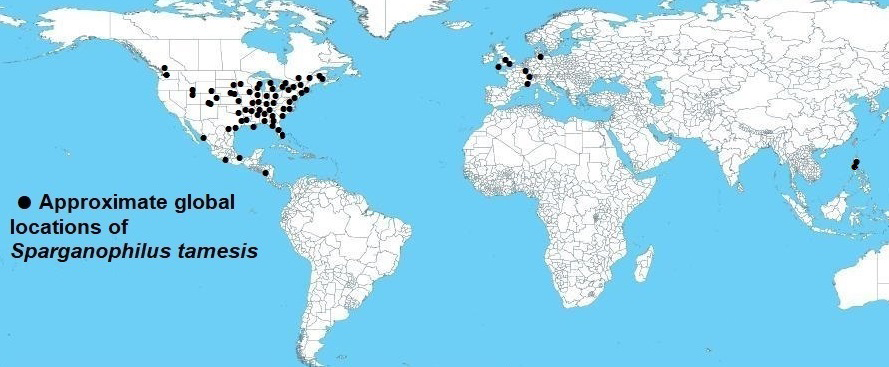
The known global distributions of Sparganophilus tamesis – based on published records, those in my own collection, and those specimens sent to me for study – are shown in Figure 1. The known distributions of the other species in the genus Sparganophilus, thus far known to occur only in the USA, are shown in Figure 2.
Sparganophilus tamesis Benham, 1892
- 1892 Sparganophilus tamesis Benham, Quart. J. Microsc. Soc. (n.s.), 34: 156. Types in British Museum Natural History, cat. no. 1892:12:16:1–2 [46].
- 1895 Sparganophilus eiseni Smith. Illinois St. Lab. Nat. Hist. 4(5): 142. Types are missing [46].
- 1911 Helodrilus elongatus Friend, Zoologist (4), 15: 192. Types in British Museum Natural History, cat. no. 1923:12:31:267-7 [46].
- 1921 Sparganophilus elongatus-Friend, Ann. Mag. Nat. Hist. (9), 7: 137.
- 1934 Pelodrilus cuenoti Tétry, C.R. Acad. Sci. Paris 199: 322. Types in British Museum Natural History, cat. no. BMNH 1949:3:1:190 [46].
- 1934 Eiseniella tetrahedra (laps.)-Moon, J. Anim. Ecol. 3: 17.
- 1998 Sparganophilus langi Qui and Bouché, Doc. Pédozool. Integral. 4: 179. Types in La Collection Ouest-Européenne Centrale dꞌOligochètes, c/o Station de Recherche sur la Faune du Sol 7 rue Sully, F-21 034 Dijon-Cedex, France, cat. no. 2/2/1988/7712 [46].
Canada
British Columbia (Vancouver Co.) [2] New Brunswick (Carleton, Kings, Madawaska, Queens, York, Cos.) [28, 50] Ontario (Bruce, Haldimand, Halton, Kent, Manitoulin, Norfolk, Parry Sound Cos.) [20] Quebec (Gatineau, Nicolet Cos.) [15]
United States
Alabama (Calhoun, Clay, Coosa, Crenshaw, Dallas, Lee, Limestone, Perry, Pike Cos.) [51] Arkansas (Cross, Lincoln, Madison Cos.) [52] Colorado (Huerfano, Yuma Cos.) [53] Connecticut (New Haven Co.) [54] Florida (Alachua, Dade, Franklin, Gadsden, Hillsborough, Leon, Okeechobee, Orange, Santa Rosa, Sarasota, Taylor, Wakulla, Walton, Washington Cos.) [2, 55, 56, 57] Georgia (Clarke, Cobb, Grady, Harris, Jasper, Morgan, Rabun, Thomas Cos.) [58] Idaho (Bonneville, Franklin Cos.) [2] Illinois (Adams, Bureau, Carroll, Champaign, Christian, DeWitt, Edgar, DuPage, Fayette, Franklin, Gallatin, Grundy, Hardin, Henderson, Iroquois, Jefferson, Jo Daviess, Kane, Kankakee, Kendall, Lake, LaSalle, Lee, Livingston, Marshall, Mason, McHenry, McLean, Monroe, Montgomery, Ogle, Pope, Putnam, Rock Island, Saline, Sangamon, Tazewell, Union, Vermilion, Warren, Washington, Whiteside, Will, Williamson Cos.) [2, 16, 18, 55]
Indiana (Boone, Brown, Cass, Fulton, Gibson, Henry, Howard, Huntington, Knox, Kosciusko, LaPorte, Lawrence, Madison, Marshall, Martin, Porter, Pulaski, Tippecanoe, Tipton, Vanderburgh, Wayne, White, Whitley Cos.) [2, 59, 60] Iowa (Clayton, Jefferson Cos.) [31, 61] Kansas (Wabaunsee Co.) [2] Kentucky (Garrard, Knott, McCreary Cos.) [62] Louisiana (East Baton Rouge, Lincoln, Orleans Parishes) [55] Maryland (Baltimore, Montgomery Cos.) [63, 64] Massachusetts (Suffolk Co.) [54] Michigan (Cheboygan, Emmet, Kent, Macomb, St. Joseph Cos.) [2, 55, 56] Minnesota (Lincoln Co.) [2] Mississippi (Attala, Choctaw, Marshall, Perry, Union, Walthall, Washington Cos.) [6, 65] Missouri (Crawford, Holt Cos.) [66] Nebraska (Buffalo, Cuming (new record), Dixon (new record), Hamilton, Madison (new record), Merrick, Pierce (new record), Polk Cos.) [12] New Jersey (Morris Co.) [8, 67] New York (Chautauqua, Clinton, Erie, Niagara, Onondaga, Ontario, Oswego, Otsego, Tioga, Tompkins, Ulster Cos.) [2, 68] North Carolina (Brunswick, Cherokee, Duplin, Johnson, Macon, Mecklenburg, Moore, Onslow, Pitt, Richmond Cos.) [69] Ohio (Butler, Fairfield, Hamilton, Lake, Licking, Logan, Lucas, Mahoning, Mercer, Ottawa, Summit, Washington Cos.) [70, 71] Oklahoma (Creek, Marshall, Murray Cos.) [13] Oregon (Columbia (new record), Yamhill Cos.) [72] Pennsylvania (Dauphin, Montgomery, Philadelphia Cos.) [73] South Carolina (Anderson, Barnwell, Berkeley, Dorchester, Greenville, Greenwood, Marion, McCormick, Oconee, Pickens, Saluda, Spartanburg, Union, York Cos.) [74] South Dakota (Minnehaha Co.) [2] Tennessee (Blount, Campbell, Chester, Dickson, Franklin, Hardeman, Johnson, Knox, Macon, Obion, Scott, Sevier, Sullivan Cos.) [5, 75] Texas (Goliad, Uvalde Cos.) [2] Utah (Cache Co.) [2] Virginia (City of Virginia Beach, Page Cos.) [76, 77] Washington (Columbia (new record), Island, Jefferson, Pacific, Whatcom Cos.) [2] Wisconsin (Green Lake Co.) [55] Wyoming (Laramie Co.) [2] Guatemala [31, 78, 79, 80, 81, 82] Alta Verapaz Dept. (Santo Domingo de Corbán, as S. benhami guatemalensis) Guatamala Dept. (Guatamala City, as S. benhami guatemalensis) Mexico [31, 51, 78] Nayarit State (Tepic, as S. benhami) Tamaulipas State Veracruz de Ignacio de la Liave State
Europe
France [3, 80] Lorraine Dept. (Moselle, as Pelodrilus cuenoti Tétry [3]) Germany [81] Schleswig-Holstein State (Alster, Hamburg) Italy [6] Lombardy Region (Mincio) Switzerland [39, 83] Geneva Canton [39]
United Kingdom
Cornwall Co. (Pencarrow) [84] Cheshire Co. (Cheshire Meres) [84] Greater London Co. (Greenford, Kew) [31] Oxfordshire Co. (Goring-Thames) [84] Westmoreland Co. (Windermere) [85]
Asia
Philippines Cordillera (Provinces: Nueva Ecija, Mountain, Kalinga, Ifugao) [86, 87].
![Figure 2: New [★] and previously [■] published known records of Sparganophilus species other than S. tamesis. Legend: S. gatesi [■], S. helenae [■], S. komareki [■], S. kristinae [■], S. meansi [■], S. pearsei [■], S. p. libertiensis [■], S. p. sarasotae [■], S. smithi [■] S. sonomae [■], S. tennesseensis [■], S. wilmae [■], [?] Unconfirmed S. tennesseensis in Florida (modified from Reeves, Reynolds and Wetzel, 2024; Reeves et al., 2018) and in Connecticut and Massachusetts (Khalil et al., 2023).](/fulltextimages/12830/fig_2.png)
Figure 2. New [★] and previously [■] published known records of Sparganophilus species other than S. tamesis. Legend: S. gatesi [■], S. helenae [■], S. komareki [■], S. kristinae [■], S. meansi [■], S. pearsei [■], S. p. libertiensis [■], S. p. sarasotae [■], S. smithi [■] S. sonomae [■], S. tennesseensis [■], S. wilmae [■], [?] Unconfirmed S. tennesseensis in Florida (modified from Reeves, Reynolds and Wetzel, 2024; Reeves et al., 2018) and in Connecticut and Massachusetts (Khalil et al., 2023).
Sparganophilus gatesi Reynolds, 1980 [46]
1980 Sparganophilus gatesi Reynolds, Mega- drilogica 3(12): 194. Types destroyed [46]. Florida (Okaloosa Co.) [6] Michigan (Benzie, Leelanau Cos.) [90] North Carolina (Avery Co.) [69]
Sparganophilus helenae Reynolds, 1980
1980 Sparganophilus helenae Reynolds, Megadrilogica 3(12): 195. Types destroyed [46]. North Carolina (Brunswick Co.) [6] South Carolina (Oconee Co.) [74]
Sparganophilus komareki Reynolds, 1980
1980 Sparganophilus komareki Reynolds, Megadrilogica 3(12): 195. Types in New Brunswick Museum, Saint John, cat. no. 980.79.6. [46]. Georgia (Toombs Co.) [6] Michigan (Leelanau Co.) [90] North Carolina (Cherokee, Hayward Cos.) [69] South Carolina (Greenville Co.) [74]
Sparganophilus kristinae Reynolds, 1980
1980 Sparganophilus kristinae Reynolds, Megadrilogica 3(12): 195. Types in New Brunswick Museum, Saint John, cat. no. 980.79.3 [52]. North Carolina (Chatham Co.) [6] Virginia (Virginia Beach Co.) [76]
Sparganophilus meansi Reynolds, 1980
1980 Sparganophilus meansi Reynolds, Megadrilogica 3(12): 195. Types in New Brunswick Museum, Saint John, cat. no. 980.79.5. [46]. Florida (Sarasota Co.) [63] Illinois (Peoria Co.) [2] Michigan (Marquette Co.) [2, 17] Mississippi (Benton Co.) [6, 65]
Sparganophilus pearsei Reynolds, 1975
1975 Sparganophilus pearsei Reynolds, Megadrilogica 2(2): 10; Types in British Museum Natural History, cat. no. 1935:2:28:50-1 [46]. California (Contra Costa, Kern, San Luis Obispo, Santa Clara, Solano Cos.) [2, 33] Colorado (Freemont, Weld, Yuma Cos.) [91] Florida (Bay, Marion, Orange Cos.) [56] Georgia (Grady, Harris, Lumpkin Cos.) [58] New Mexico (Catron, Grant, Hidalgo Cos.) [22] North Carolina (Buncombe, Swain Cos.) [63] Virginia (Westmoreland Co.) [6]
Sparganophilus pearsei libertiensis Reynolds, 1980
1980 Sparganophilus pearsei libertiensis Reynolds, Megadrilogica 3(12): 195. Types in New Brunswick Museum, Saint John, cat. no. 980.79.5. [46]. Florida (Liberty Co.) [6]
Sparganophilus pearsei sarasotae Reynolds, 1980
1980 Sparganophilus pearsei sarasotae Reynolds, Megadrilogica 3(12): 196. Types in New Brunswick Museum, Saint John, cat. no. 980.79.11. [46]. Arizona (Coconino Co.) [2] Florida (Sarasota Co.) [6] Tennessee (Maury Co.) [75]
Sparganophilus smithi Eisen, 1896 1896 Sparganophilus smithi Eisen, Mem. Calif. Acad. Sci. 2(5): 154. Types unknown. [46]. California (San Francisco Co.) [32]
Sparganophilus sonomae Eisen, 1896
1896 Sparganophilus sonomae Eisen, Mem. Calif. Acad.
Sci. 2(5): 154. Types unknown [46]. California (Sonoma Co.) [32] Oregon (Curry Co.) [72]
Sparganophilus tennesseensis Reynolds, 1977a
1977 Sparganophilus tennesseensis Reynolds, Mega- drilogica 3(3): 63; Types in National Museum of Natural Sciences, National Museums of Canada, cat. no. 1978-375 [46]. Connecticut (New Haven?, New London? Cos.) [89] Florida (Wakulla Co.) [56] Massachusetts (Essex Co.?) [89] Michigan (Leelanau Co.) [12] North Carolina (Haywood, Pitt Cos.) [92] Tennessee (Hamilton, Polk Cos.) [5, 75] Florida (Alachua?, Columbia?, Indian River Cos.) [88] ? Based on blood meal from the fly (Diptera: Uranotaenia sapphirina), the identification of the oligochaetes can’t be verified. Outreach to the senior author for varification has been unsuccessful.
Sparganophilus wilmae Reynolds, 1980
1980 Sparganophilus wilmae Reynolds, Megadrilogica 3(12): 198. Types in New Brunswick Museum, Saint John, cat. no. 980.79.2. [46]. Florida (Leon Co.) [6]
Discussion
Many synonyms have occurred over the years since Benham first described Sparganophilus tamesis in 1892 from Kew Gardens in the United Kingdom (England). The first synonym, S. eiseni, was described by Frank Smith in 1895 from Havana in Mason County, Illinois. This name persisted in the literature in North America until recently [2, 19, 28].
Eisen [32] described a new species with two subspecies/ varieties from Guatemala, S. benhami and two subspecies, S. benhami var. guatemalensis and S. benhami var. carnea. Fifteen years later, Friend [37] introduced the name Helodrilus elongatus Friend [37] into the literature, but with little other descriptive information. Sparganophilus elongatus [37, 38, 93, 94, 95] is unaccepted, considered a synonym of S. tamesis.
Throughout the historical and more recent literature, Friend [37] has been referenced as having described Helodrilus elongatus (Sparganophilus tamesis). Subsequent authors have attributed, or misattributed, Friend’s original description to his very brief 1911a paper. In that paper, he stated “31. H. elongatus Friend. Found in Cornwall in April 1910, by Mr. Bartlett of Pencarrow. Girdle [clitellum] from 15th to 24th segment. Related to Criodrilus and Pontodrilus.”
In my opinion, this cannot be considered the description of a new species based on insufficient information. Additional papers of Friend’s at that time (e.g., 1911b, 1911c, 1911d, 1911e, 1912a, 1912b) made no mention of H. elongates [93, 96, 97, 98, 99]. In the following year, Friend [94] he stated, “Helodrilus elongatus Friend (a species which has not yet been described) in a garden in Cornwall, to say nothing of certain more or less well-known species which occur in Kew Gardens.” This indicates to me that, in 1913, Friend did not consider H. elongatus as a described species and added no additional information on the species. Friend [95] repeated the information first included in his paper, as well as provided some characteristics differentiating S. elongatus from S. benhami [37]. In 1921, Friend [38] provided significant characterization of S. elongatus, in my opinion suggesting that S. elongatus should be the year and designated publication in which the description should be attributed [38].
However, after consultation, I have reluctantly changed my opinion. “Friend [37] did present a brief description, although not by the standards of current taxonomy, it should be considered valid. If we only regard species names valid if there is a more detailed description according to current standards, then we must exclude many species described in the 18th and 19th centuries, including those by Linnaeus.” (Ton van Haaren, pers. com., 18 May 2024). In chapter 4 of the International Code of Zoological Nomenclature (International Commission on Zoological Nomenclature [ICZN] [100]), Section 12.1, Requirements, of Article 12, Names published before 1931, states ‘To be available, every new name published before 1931 must satisfy the provisions of Article 11 and must be accompanied by a description or a definition of the taxon that it denotes, or by an indication.’ “It doesn’t say anything about how extensive it should be.” (Ton van Haaren, pers. com., 18 May 2024).
Jamieson, in Brinkhurst and Jamieson [101], Zicsi and Vaucher [83] and Reynolds [28] considered S. elongatus a synonym of S. tamesis.
Tétry [49] described another synonym, Pelodrilus cuenoti and then Qiu and Bouché [39] described yet another synonym, S. langi. Gates [78] made Eisen’s [32] species and subspecies synonyms of S. eiseni, now S. tamesis.
Sherlock and Carpenter [102] stated that Friend [103] considered Sparganophilus elongatus and Sparganophilus tamesis to be two species, also referencing Jamieson (p. 812, in Brinkhurst and Jamieson [97] who listed S. elongatus as a junior synonym of S. tamesis.
The research of Anderson, et al. [104] clarified “earthworm phylogeny and evolution, by supporting several recently proposed revisions to our understanding of earthworm relationships and resolving others, most notably including 1) placement of Kynotidae (Madagascar) with a group containing the North American taxa Komarekionidae and Sparganophilidae, 2) a clade comprising Lutodrilidae, Criodrilidae, Hormogastridae and Lumbricidae, 3) Dichogaster paraphyly, 4) affirmation of a restricted Glossoscolecidae and 5) Hormgastridae monophyly. Recovery of two major clades, each consisting of a Northern Hemisphere subclade and a Southern Hemisphere subclade, suggested a major role for vicariance (specifically, the breakup of Pangaea during the Mesozoic) in earthworm phylogeny and biogeography. Divergence time estimation provided additional support for this hypothesis, dating the north-south splits within each major clade to approximately 161–185 Million years ago.” Rota, et al. [82] provided mitochondrial evidence that all European populations of Sparganophilus: 1) belong to the same species, 2) derive from a recent introduction, 3) are conspecific with the most widespread species of Sparganophilus in North America (specimens from Ontario, Illinois, Tennessee, and Washington state), and 4) that S. tamesis Benham [31] is a senior synonym of S. eiseni Smith [47].
Although S. tamesis was described from specimens collected in the United Kingdom, it is believed that these specimens were transported from North America on plant material sent to Kew Gardens. The wide distribution in North America is seen in Figure 1. Aside from Tetry’s 1934 record, it is only in the past 26 years that this species has been recorded from other countries in Europe: Switzerland, United Kingdom, Germany, and Italy [39, 81, 82, 84]. In a recent study, Mathieu et al. [105] presented multiple invasion routes that have led to the pervasive introduction of earthworms in North America, but none of the suggested routes specifically suggested a route for North America [106].
Conclusion
This paper represents the most recent overview of the known global distribution of species in the genus Sparganophilus (Spaaganophilidae).
Acknowledgements
I am grateful to Wilma M. Reynolds (Oligochaetology Laboratory, Kitchener, Ontario), Mark J. Wetzel (Illinois Natural History Survey, Prairie Research Institute at the University of Illinois Urbana-Champaign, Champaign, Illinois, USA) and Will K. Reeves (Colorado State University, C.P. Gillette Museum of Arthropod Diversity, Fort Collins, Colorado, USA), for reviewing the manuscript, and for their comments and suggestions which have improved the draft. I
also thank, Ton van Haaren (Eurofins Omegam, Amsterdam- Duivendrecht, The Netherlands) for assistance with specific aspects of the manuscript. I wish to thank the editorial board of the International Journal of Zoology and Animal Behaviour for waiving the publication fees for this manuscript. I am always indebted to Bruce Miller (Elmira, Ontario) for cartographical assistance.
Disclosure
Funding: The study has been funded by Oligochaetology Laboratory, Kitchener, Ontario, Canada. Conflict of Interest: The author has no conflict of interest. Data available within the article or its supplementary materials: The author confirms that the data supporting the findings of this study are available within the article [and/or] its supplementary materials. Code availability (software application or custom code): The author confirms that the software applications used in the present study are freely available in the public domain and no copyright was breached. Statement Ethical approval: This article does not contain any studies with human participants performed by any of the authors. Ethical approval: This article does not contain any studies with animals performed by the authors. Ethical approval: This article does not contain any studies with human participants or animals performed by the author and no AI was used in the preparation of this article.
References
-
Blackwelder RE (1967) Taxonomy: a text and reference book. New York: John Wiley and Sons, USA, pp: 698.
-
Reeves WK, Reynolds JW, Wetzel MJ (2024) Sparganophilus (Annelida, Oligochaeta, Sparganophilidae) in North America. Megadrilogica 28(5): 53-80.
-
Damoff, GA, Reynolds JW (2009) The earthworms (Oligochaeta: Acanthodrilidae, Eudrilidae, Lumbricidae, Megascolecidae, Ocnerodrilidae, and Sparganophilidae) of east Texas, USA. Megadrilogica 13(8): 113-140.
-
Holler C, Mays JD, Niemiller ML (2020) The fauna of caves and other subterranean habitats of North Carolina, USA. Journal of Cave and Karst Studies 82(4): 221-260.
-
Reynolds JW (1977a) The earthworms of Tennessee (Oligochaeta). II. Sparganophilidae, with the description of a new species. Megadrilogica 3(3): 61-64.
-
Reynolds JW (1980) The earthworm family Sparganophilidae (Annelida, Oligochaeta) in North America. Megadrilogica 3(12): 189-204.
-
Reynolds JW (2001) Sparganophilidae — are terrestrial oligochaetologists missing the habitat in North America? Megadrilogica 8(11): 82-84.
-
Reynolds JW (2007a) The earthworms (Oligochaeta: Lumbricidae, Megascolecidae and Sparganophilidae) of New Jersey, USA. Megadrilogica 11(6): 63-72.
-
Reynolds JW (2008b) Sparganophilidae (Annelida, Oligochaeta) distribution in North America and elsewhere, revisited. Megadrilogica 12(9): 125-143.
-
Reynolds JW (2010) The earthworms (Oligochaeta: Acanthodrilidae, Lumbricidae, Megascolecidae and Sparganophilidae) of northeastern United States, revisited. Megadrilogica 14(7): 101-157.
-
Reynolds JW (2012) The earthworms (Oligochaeta: Lumbricidae, Megascolecidae and Sparganophilidae) of the North-Central United States. Megadrilogical 15(7): 151-187.
-
Reynolds JW, Reeves WK (2022) New earthworm (Oligochaeta: Acanthodrilidae, Lumbricidae, Mega- scolecidae and Sparganophilidae) records from southern Nebraska. Megadrilogica 27(11): 135-146.
-
Reynolds JW, Damoff GA (2010) The earthworms (Oligochaeta: Acanthodrilidae, Lumbricidae, Mega- scolecidae and Sparganophilidae) of Oklahoma, USA. Megadrilogica 13(12): 173-193.
-
Reynolds JW, Damoff GA (2011) More earthworms (Oligochaeta: Lumbricidae and Sparganophilidae) from Colorado, USA. Megadrilogica 14(8): 159-172.
-
Reynolds JW, Reynolds KW (1992) Earthworms on the north shore of the St. Lawrence (Quebec). Megadrilogica 4(9): 145-161.
-
Reynolds JW, Wetzel MJ (2011) The earthworms (Oligochaeta: Acanthodrilidae, Glossoscolecidae, Komarekionidae, Lumbridicae, Megascolecidae, and Sparganophilidae) of Illinois. Megadrilogica 15(4): 35- 67.
-
Reynolds JW, Wetzel MJ (2014) A checklist by counties of earthworms (Oligochaeta: Acanthodrilidae, Lumbricidae, Megascolecidae and Sparganophilidae) in Michigan, USA. Megadrilogica 17(5): 51-72.
-
Wetzel MJ, Reynolds JW (2024) The earthworms (Annelida, Clitellata, Crassiclitellata) of Illinois: Introduction and annotated checklist of species. Earthworms of Illinois.
-
Rota E, Martinsson S, Bartoli M, Beylich A, Graefe U, Laini A, Wetzel MJ, Erséus C (2016) Mitochondrial evidence supports a Nearctic origin for the spreading limicolous earthworm Sparganophilus tamesis Benham, 1892 (Clitellata, Sparganophilidae). Contributions to Zoology 85(1): 113-119.
-
Reynolds JW (1977b) The earthworms (Lumbricidae and Sparganophilidae) of Ontario. Royal Ontario Museum, Life Sciences Miscellaneous Publications, pp: 141.
-
Reynolds JW (1975) Sparganophilus pearsei n. sp. (Oligochaeta: Sparganophilidae) a Nearctic earthworm from western North Carolina. Megadrilogica 2(2): 9-11.
-
Reynolds JW, Reeves WK (2019) New earthworm (Oligochaeta: Acanthodrilidae, Lumbricidae and Sparganophilidae) records for California and New Mexico, USA. Megadrilogica 25(3): 39-45.
-
Michaelsen W (1900) Oligochaeta. Berlin Friedländer xxix. pp: 575.
-
Michaelsen W (1918) Die Lumbriciden, mit besonderer Berücksichtigung der bisher als Familie Glossoscolecidae zusammengefaßten Unterfamilien. Zoologische Jahrbücher Abteilung für Systematik Jena 41: 1-398.
-
Michaelsen W (1921) Zur Stammesgeschichte und Systematik der Oligochäten, insbedsondere der Lumbriculiden. Archiv für Naturgeschichte 86(A-8): 130-141.
-
Stephenson J (1930) The Oligochaeta. Clarendon Press pp: 978.
-
Gates GE (1959) on a taxonomic puzzle and the classification of the earthworms. Bulletin of the Museum of Comparative Zoology, Harvard College 121: 229-261.
-
Reynolds JW (2022) The Earthworms (Lumbricidae, Megascolecidae and Sparganophilidae) in Canada. Canada Food Inspection Agency pp: 180.
-
Righi G, Ayers I, Bittencourt ERC (1978) Oligochaeta (Annelida) from the National Amazon Research Institute. Acta Amazonica 8(3): 1-49.
-
Mısırlıoǧlu M, Reynolds JW, Stojanović M, Trakić T, Sekulić J, et al. (2023) Earthworms (Clitellata, Megadrili) of the world: an updated checklist of valid species and families, with notes on their distribution. Zootaxa 5255(1): 417- 438.
-
Benham WB (1892) A new English genus of aquatic Oligochaeta (Sparganophilus) belonging to the family Rhinodrilidae. Quarterly Journal of Microscopical Science 34: 155-179.
-
Eisen G (1896) Pacific Coast Oligochaeta. Memoirs of the California Academy of Science 2(5): 123-199.
-
Reynolds JW (1999) New earthworm records for the state of California, USA. Megadrilogica 7(8): 54.
-
Reynolds JW, Wetzel MJ (2004) Terrestrial Oligochaeta (Annelida: Clitellata) in North America north of Mexico. Megadrilogica 9(11): 71-98.
-
Reynolds JW, Wetzel MJ (2008) Terrestrial Oligochaeta (Annelida: Clitellata) in North America, including Mexico, Puerto Rico, Hawaii, and Bermuda. Megadrilogica 12(12): 157-208.
-
Reynolds JW, Wetzel MJ (2012) Terrestrial Oligochaeta (Annelida: Clitellata) in North America, including Mexico, Puerto Rico, Hawaii, and Bermuda. III Megadrilogica 15(8): 191-209.
-
Friend H (1911) A revised check list of British earthworms. The Naturalist A Monthly Illustrated Journal of Natural History for the North of England 36(42): 123-129.
-
Friend H (1921) XI – Two new aquatic Annelids. The Annals and Magazine of Natural History including Zoology Botany and Geology 7(9): 137-141.
-
Qiu JP, Bouché MB (1998) A new Sparganophilus, (Annelida: Oligochaeta) from Europe, with paleogeographic considerations on the Lumbricina. In: National Institute of Agronomic Research (Ed.), Soil zoological and integrological documents 4: 178-180.
-
Lamarck JB (1802) Opening Speech, Delivered on Floreal 27 Year 10, at the Natural History Museum. Research on the organization of living bodies. Scientific Bulletin of France and Belgium (5e series) 40: 483-517.
-
Michaelsen W (1919) On the relationships of the Hirudinea to the Oligochaetes. Messages from the Natural History Museum in Hamburg, 36: 131-153.
-
Grube AE (1850) The families of the annelids. Natural History Archives 16: 249-361.
-
Jamieson BGM (1988) On the Phylogeny and Higher Classification of the Oligochaeta. Cladistics 4(4): 367- 401.
-
Bouché MB (1970) Remarks on some Lumbricina from France and consequences of the discovery of the new taxa Vignysinae (Subfam. nov.) and Diporodrilidae (Fam. nov.). Pedobiologia-Journal of Soil Ecology 10(1): 246- 256.
-
WoRMS Editorial Board (2024) World Register of Marine Species.
-
Reynolds JW, Wetzel MJ (2024) Nomenclatura Oligochaetologica – A catalogue of names, descriptions and type specimens of the Oligochaeta. Editio Secunda.
-
Smith F (1895) A preliminary account of two new Oligochaeta from Illinois. Bulletin of the Illinois State Laboratory of Natural History 4(5): 138-148.
-
Friend H (1911) A new earthworm. The Zoologist: A Monthly Journal of Natural History 15(4): 192-193.
-
Tétry A (1934) Description of a French species of the genus Pelodrilus. Report of the Academy of Sciences, France, 199: 322.
-
McAlpine DF, Reynolds JW, Fletcher TJ, Trecartin JL, Sabine DL (2001) Sparganophilus eiseni (Oligochaeta, Sparganophilidae) in New Brunswick, an addition to the earthworm fauna of Maritime Canada. Megadrilogica 8(10): 53-56.
-
Reynolds JW (1994) Earthworms of Alabama (Oligochaeta: Acanthodrilidae, Eudrilidae, Lumbricidae, Megascolecidae, and Sparganophilidae). Megadrilogica 6(4): 35-46.
-
Reynolds JW (2008) The earthworms (Oligochaeta: Acanthodrilidae, Lumbricidae, Megascolecidae and Sparganophilidae) of Arkansas, USA revisited. Megadrilogica 11(11): 115-130.
-
Reynolds JW (2014) A checklist by counties of earthworms (Oligochaeta: Lumbricidae and Sparganophilidae) in Colorado, USA. Megadrilogica 16(5): 37-48.
-
Reynolds JW (2015) A checklist by counties of earthworms (Oligochaeta: Lumbricidae, Megascolecidae and Sparganophilidae) in the states of Connecticut, Massachusetts and Rhode Island, USA. Megadrilogica 17(8): 113-123.
-
Hague FS (1923) Studies on Sparganophilus eiseni Smith. Transactions of the American Microscopical Society 42(1): 1-42.
-
Reynolds JW, Wetzel MJ (2014) A checklist by Counties of Earthworms (Oligochaeta: Acanthodrilidae, Lumbricidae, Megascolecidae and Sparganophilidae) in Michigan, USA. Megadrilogica 17(5): 51-72.
-
Zigler KS, Niemiller ML, Niemiller CDR, Stephen CDR, Ayala BN, et al. (2020) Biodiversity from caves and other subterranean habitats of Georgia, USA. Journal of Cave and Karst Studies 82(2): 125-167.
-
Reynolds JW (2009) The earthworms (Oligochaeta: Acanthodrilidae, Eudrilidae, Lumbricidae, Mega- scoecidae, Ocnerodrilidae, and Sparganophilidae) of Georgia, USA. Megadrilogica 13(7): 85-111.
-
Reynolds JW (1994) The distribution of the earthworms (Oligochaeta) of Indiana: a case for the Post Quaternary Introduction Theory of megadrile migration in North America. Megadrilogica 5(3): 13-32.
-
Reynolds JW (2015) A checklist by counties of earthworms (Oligochaeta: Acanthodrilidae, Komarekionidae, Lumbricidae, Megascolecidae, and Sparganophilidae) in Indiana, USA. Megadrilogica 19(8): 123-145.
-
Reynolds JW (2011) The earthworms (Oligochaeta: Acanthodrilidae, Glossoscolecidae, Komarekionidae, Lumbricidae, Megascolecidae and Sparganophilidae) of the midwestern United States. Megadrilogica 15(5): 69- 139.
-
Reynolds JW (2016) A checklist by counties of earthworms (Oligochaeta: Acanthodrilidae, Komarekionidae, Lumbricidae, Megascolecidae, and Sparganophilidae) in Kentucky, USA. Megadrilogica 19(9): 147-166.
-
Reyolds JW (1974) The earthworms of Maryland (Oligochaeta: Acanthodrilidae, Lumbricidae, Megascolecidae and Sparganophilidae. Megadrilogica 1(11): 1-12.
-
Reynolds JW (2015) A checklist by counties of earthworms (Oligochaeta: Acanthodrilidae, Lumbricidae, Megascolecidae and Sparganophilidae) in Delaware, District of Columbia and Maryland, USA. Megadrilogica 18(4): 57-71.
-
Reynolds JW (2015) A checklist by counties of earthworms (Oligochaeta: Acanthodrilidae, Lumbricidae, Megascolecidae, Ocnerodrilidae and Sparganophilidae) in Mississippi, USA. Megadrilogica 19(4): 41-60.
-
Reynolds JW (2015) A checklist by counties of earthworms (Oligochaeta: Acanthodrilidae, Lumbricidae, and Sparganophilidae) in Missouri, USA. Megadrilogica 18(3): 37-55.
-
Reynolds JW (2015) A checklist by counties of earthworms (Oligochaeta: Acanthodrilidae, Lumbric- idae, and Sparganophilidae) in New Jersey, USA. Megadrilogica 17(12): 179-188.
-
Reynolds JW (2014) A checklist by counties of earthworms (Oligochaeta: Lumbricidae, Megascolecidae and Sparganophilidae) in New York, USA. Megadrilogica 17(3): 15-30.
-
Reynolds JW (2015) A checklist by counties of earthworms (Oligochaeta: Acanthodrilidae, Komarekionidae, Lumbricidae, Megascolecidae, Ocnerodrilidae and Sparganophilidae) in North Carolina, USA. Megadrilogica 19(5): 61-84.
-
Reynolds JW (2007) The earthworms (Oligochaeta: Acanthodrilidae, Lumbricidae and Sparganophilidae) of Ohio, USA revisited. Megadrilogica 11(9): 91-105.
-
Reynolds JW (2015) A checklist by counties of earthworms (Oligochaeta: Acanthodrilidae, Lumbricidae, Megascolecidae, and Sparganophilidae) in Ohio, USA. Megadrilogica 18(1): 1-20.
-
Reynolds JW (2015) A checklist by counties of earthworms (Oligochaeta: Lumbricidae, Megascolecidae, Ocnerodrilidae, and Sparganophilidae) in Oregon, USA. Megadrilogica 18(10): 141-156.
-
Reynolds JW (2014) A checklist by counties of earthworms (Oligochaeta: Acanthodrilidae, Lumbricidae, Megascolecidae and Sparganophilidae) in Pennsylvania, USA. Megadrilogica 16(6): 49-67.
-
Reynolds JW (2014) A checklist by counties of earthworms (Oligochaeta: Acanthodrilidae, Glossoscolecidae, Lumbricidae, Megascolecidae, Ocnerodrilidae and Sparganophilidae) in South Carolina, USA. Megadrilogica 16(3): 15-28.
-
Reynolds JW (2016) A checklist by counties of earthworms (Oligochaeta: Acanthodrilidae, Komarekionidae, Lumbricidae, Megascolecidae and Sparganophilidae) in Tennessee, USA. Megadrilogica 19(11): 185-215.
-
Reynolds JW (2015) A checklist by counties of earthworms (Oligochaeta: Acanthodrilidae, Komarekionidae, Lumbricidae, Megascolecidae and Sparganophilidae) in Virginia, USA. Megadrilogica 18(5): 73-97.
-
Reynolds JW (2015) Earthworms of the Families Lumbricidae, Megascolecidae and Sparganophilidae in the collections of the Virginia Museum of Natural History. Megadrilogica 19(2): 11-22.
-
Gates GE (1942) Check list and bibliography of North American earthworms. American Midland Naturalist 27(1): 86-108.
-
Fragoso C (2001) Earthworms of Mexico (Annelida, Oligochaeta): Diversity, ecology and management. Acta Zoologica Mexicana 1(S1): 131-171.
-
Bouché MB (1972) Earthworms of France: ecology and systematics. National Institute of Agricultural Research, Paris Publ, pp: 671.
-
Graefe U, Beylich A (2011) First record of the aquatic earthworm Sparganophilus tamesis Benham, 1892 (Clitellata, Sparganophilidae) in Germany. 5th International Oligochaete Taxonomy Meeting, Beatenberg, Switzerland.
-
Rota E, Bartoli M, Laini A (2014) First time in Italy. Is the elusive aquatic megadrile Sparganophilus Benham, 1892 (Annelida, Clitellata) accelerating its dispersal in Europe. Journal of Limnology 73(3): 482-489.
-
Zicsi A, Vaucher C (1987) About the presence of Sparganophilus tamesis Benham in Lake Geneva in Geneva (Oligochaeta: Sparganophilidae). Revue Suisse Zoologie 94(4): 861-864.
-
Sims RW, Gerard BM (1999) Earthworms: keys and notes for the identification and study of the species, revised edition. Synopses of the British fauna (new series). Shrewsbury: Field Studies Council, pp: 171.
-
Cernosvitov L (1945) Oligochaeta from Windermere and the Lake District. Proceedings of the Zoological Society London 114(4): 523-548.
-
Magahud J, Dalumpines SLP, Aspe N, Cabusora C (2017) Responses of Paddy Earthworm, Sparganophilus sp., to Butachlor Herbicide. IAMURE International Journal of Ecology and Conservation 21(1): 50-87.
-
Joshi RC, Aspe NM, Cope AE (2020) Field Guide: Earthworms in Heirloom Rice Fields of the Philippine Cordillera and Their Integrated Management. Los Baños, (Philippines): International Rice Research Institute, pp: 26.
-
Reeves LE, Holderman CJ, Blosser EM, Gillett KJL, Kawahara AY, et al. (2018) Identification of Uranotaenia sapphirina as a specialist of annelids broadens known mosquito host use patterns. Communications Biology 1: 92.
-
Khalil N, Shepard JJ, Foss K, Molaei G (2023) Evidence of Uranotaenia sapphirina (Diptera: Culicidae) feeding on annelid worms in the Northeastern United States. Journal of Medical Entomology 60(3): 425-431.
-
Reynolds JW, Reeves WK (2018) Earthworms (Oligochaeta: Lumbricidae and Sparganophilidae) of the Sleeping Bear Dunes National Lakeshore, Benzie and Leelanau Counties, Michigan, USA. Megadrilogica 23(6): 93-101.
-
Reynolds JW, Reeves WK (2020) New earthworm (Annelida: Oligochaeta) records in Colorado and California, USA. Megadrilogica 26(2): 37-41.
-
Reynolds JW (2011) The earthworms (Oligochaeta: Acanthodrilidae, Eudrilidae, Glossoscolecidae, Komareki onidae, Lumbricidae, Lutodrilidae, Ocnerodrilidae, Octochaetidae, Megascolecidae and Sparganophilidae) of southeastern United States. Megadrilogica 14(9-12): 175-318.
-
Friend H (1912) New British oligochaets. The Zoologist A Monthly Journal of Natural History Fourth series 16(186): 220-226.
-
Friend H (1913) A contribution to the bionomics of English Oligochaeta. Part I. British earthworms. Science Progress in the Twentieth Century – A Quarterly Journal of Scientific Work & Thought VIII pp: 99-112.
-
Friend H (1919) Sparganophilus: A British oligochaet. Nature 31(2596): 426.
-
Friend H (1911) The distribution of British annelids. The Zoologist: A Monthly Journal of Natural History. Fourth series 15(172): 142-146.
-
Friend H (1911) The distribution of British annelids. The Zoologist A Monthly Journal of Natural History 15(173): 184-191.
-
Friend H (1911) New records for British Annelids. The Naturalist A Monthly Illustrated Journal of Natural History for the North of England 36(42): 411-417.
-
Friend H (1912) Annelid bionomics. The Zoologist A Monthly Journal of Natural History Fourth series, 16(187): 246-249.
-
International Commission on Zoological Nomenclature (1999) International Code of Zoological Nomenclature. In: 4th (Edn.), Published by the International Trust for Zoological Nomenclature, c/o The Natural History Museum, Cromwell Road, London SW7 5BD, United Kingdom.
-
Brinkhurst RO, Jamieson BGM (1971) Aquatic oligochaeta of the world. In: Cook DG (Ed.), Edinburgh: Oliver & Boyd, pp: 860.
-
Sherlock E, Carpenter D (2009) An updated earthworm list for the British Isles and two new ‘exotic’ species to Britain from Kew Gardens. European Journal of Soil Biology 45(5-6): 431-435.
-
Friend H (1923) British Earthworms and How to Identify Them. Nature 113: 64.
-
Anderson FE, Williams BW, Horn KM, Erseus C, Halanych KM, Santos SR, James SW (2017) Phylogenomic analyses of Crassiclitellata support major Northern and Southern Hemisphere clades and a Pangaean origin for earthworms. BMC Evolutionary Biology 17: 123.
-
Mathieu J, Reynolds JW, Fragoso C, Hadly E (2023) Multiple invasion routes have led to the pervasive introduction of earthworms in North America. Nature Ecology and Evolution 8: 489-499.
-
Wetzel MJ, Reynolds JW (2011) The earthworms (Annelida, Clitellata, Oligochaeta) of Illinois – Introduction and annotated checklist of species.
- California Red-Legged Frog and Non-Listed Amphibians Response to Non-Native Fish Removal
- Industrial Standardization of the Bio-OS: Algorithmic Codification of Resilience Engineering Guidelines and Version V8 Architecture
- Climate Variability and the Sustainability of Snail Farming in Nigeria: Past Trends, Present Challenges and Potential Outlook
- The Evaluation of the Surveillance System of Anthrax in Gilgit-Baltistan, Pakistan, 2018
- Natural Decline to Extinction of A New Zealand Rabbit Population
- Mitochondrial Bio-Logistics: Steering Co-Enzyme Q10 and Lycopene Synergies within the Science 4.0 Bio-OS Framework