
The Bees of Costa Rica and its Representation in two National Collections
For decades, scientific studies related to wildlife have been little reviewed for national inventories, with birds and mammals being the only faunal groups that have official lists and specific numbers. Although it is true that species of insects and other invertebrates appear constantly, this is not an excuse for not having official lists of species reported for science. In this review, a total of 507 were found for Costa Rica, 7 of Andrenidae, 299 of Apidae, 30 of Colletidae, 106 of Halictidae and 65 of Megachilidae. Any other species outside of this list that has been found, collected in Costa Rican territory and is not on this list is a new report.
Sánchez-Ocampo M* and Gomez-Moreno R
Abbreviations
MNCR: National Museum of Costa Rica; MIUCR: Insect Museum of the Faculty of Agronomy of the University of Costa Rica.
Introduction
The question that the public always asks us biologists is about the number of species, whether from a particular place or in general for science; however, this question always takes us off base because we only have inaccurate estimates that leave the public with doubts. At the National Museum of Costa Rica (MNCR) there is a consultation portal to which the public has access, in order to establish an interaction between society and science, but these questions about exact numbers are often not correctly addressed, and the reason is very simple: unlike other groups, such as ornithologists, who keep exact lists that they update and review annually, in Costa Rica there is no society, institution or group that keeps these numbers for the bee group.
This work responds to the need expressed by many bee lovers in Costa Rica, who although they are not scientists, seek a checklist and an updated count. Likewise, for the research group, this represents an exact and quantitative check list with which to refer.
Methodology
To generate the official list, it was necessary to review the scientific literature that mentioned data on location and distribution, namely the following texts were considered: Timberlake PH [1], Friese H [2], Moure [3], Friese [4], Sánchez-Ocampo [5], Snelling [6], Crawford [7], Snelling, et al. [8], Thiele [9], Ayala, et al. [10], Cockerell [11], LaBerge [12], Urban [13], Lutz, et al. [14], Rebêlo, et al. [15], Moure, et al. [16], Cresson [17], Tiberlake [18], Sánchez-Ocampo
[19], Sánchez-Ocampo [20], Camargo, et al. [21], Wille, et al. [22], Wille, et al. [23], Roubik, et al. [24], Wille [25], Onuferko [26], Rightmyer [27], Schrottky [28], Shanks [29], Smith [30], Friese [31], Dusmet, et al. [32], Friese [33], Michener, et al. [34], Engel, et al. [35], Engel [36], Engel [37], Engel, et al. [38], Engel [39], Engel [40], Engel [41], Hanson, et al. [42], Smith-Pardo [43], Brosi, et al. [44], Moure [45], Vachal [46], Roberts [47], Roberts RB, et al. [48], Crawford [49], Strand [50], McGinley RJ [51], McGinley RJ [52], Dumesh [53], Eickwort, et al. [54], Schwarz HF [55], Urban D [56], Urban D [57], Cockerell [58], Mitchell TB [59], Rocha-Filho, et al. [60], Rocha-Filho, et al. [61], Snelling [62], Mitchell TB [63] and Titus [64], Hinojosa-Días, et al. [65], Eltz, et al. [66].
After generating the list of species, the collections of the National Museum of Costa Rica (MNCR) and the Insect Museum of the Faculty of Agronomy of the University of Costa Rica (MIUCR) were reviewed in order to verify whether there were any species that had not been previously reported for the country. The review of the specimens from both museums was done manually, corroborating drawer by drawer the identification of the specimens present in both collections identified at the species level.
The following numerical indicators are used in the list to identify the species that meet these conditions:
- 1 (1) is given to the new reports for Costa Rica, made between 2023 and 2024 including this article.
- 2 (2) to the species whose distribution range includes Costa Rica, but the collection of a specimen of that species in national territory has not been officially reported (through a scientific publication), but it is not ruled out that there are specimens in other collections.
- 3 (3) is given to the species that up to the date of this publication are considered endemic to Costa Rica, because they have not yet been officially reported in another country, but again, this may be due to the fact that they have not yet been published.
- Species represented in the MNCR collection are marked with a 4 (4) and those represented in MIUCR with a 5 (5).
Results
A total of 507 species reported in the scientific literature were found, to which at least four new species of the genus Euglossa will be added in the near future, which are currently being described, and are not incorporated into the final list because they are not published.
Due to the existence of many taxonomic nomenclatures and divisions in use, especially for Apidae, the nomenclature of Michener CD [67] is used below, with the exception of the species of the tribe Meliponini, for which the nomenclature of Engel MS, et al. [68] is used:
National Bee Inventory
A. Andrenidae
- Andrena (Callandrena) discreta Smith, 1879
- Calliopsis (Calliopsis) hondurasica Cockerell, 1949
- Heterosarus parvulus (Friese,
3. Bombus (Fervidobombus) digressus Milliron, 1962 4. Bombus (Fervidobombus) mexicanus Cresson, 1878 5. Bombus (Fervidobombus) pullatus Franklin, 1913 6. Bombus (Fervidobombus) weisi Friese, 1903 7. Bombus (Pyrobombus) ephippiatus Say, 1837 8. Bombus (Robustobombus) volucelloides Gribodo, 1892 9. Centris (Acritocentris) agilis Smith, 1874 10. Centris (Aphemisia) agiloides Snelling, 1984 11. Centris (Aphemisia) plumipes Smith, 18541,4
12. Centris (Aphemisia) scutellata Friese, 1900 13. Centris (Centris) adani Cockerell, 19494
14. Centris (Centris) aethiocesta Snelling, 19844
15. Centris (Centris) aethyctera Snelling, 19744,5
16. Centris (Centris) flavifrons (Fabricius, 1775)1,5
17. Centris (Centris) flavofasciata Friese, 18991,5
18. Centris (Centris) obscurior Michener, 19544
19. Centris (Centris) varia (Erichson, 1849)4,5
20. Centris (Hemisiella) facialis Mocsáry, 18994
21. Centris (Hemisiella) nitida Smith, 18744
22. Centris (Hemisiella) trigonoides Lepeletier, 18414
23. Centris (Hemisiella) vittata Lepeletier, 18414
24. Centris (Heterocentris) analis (Fabricius, 1804)4
25. Centris (Heterocentris) bicornuta Mocsáry, 18991,4
26. Centris (Heterocentris) difformis Smith, 1854 27. Centris (Heterocentris) labrosa Friese, 18994
28. Centris (Heterocentris) terminata Smith, 18741
29. Centris (Melanocentris) erubescens Friese, 1925 30. Centris (Melanocentris) melanochlaena Smith, 18744
31. Centris (Ptilocentris) festiva Smith, 18544
32. Centris (Trachina) fuscata Lepeletier, 1841 33. Centris (Trachina) heithausi Snelling, 1974 34. Centris (Trachina) labiata Friese, 1904 35. Centris (Trachina) longimana Fabricius, 18044
36. Centris (Trachina) proxima Friese, 1899 37. Centris (Trachina) similis (Fabricius, 1804)4
38. Centris (Trachina) vidua Mocsáry, 1899 39. Centris (Trichocentris) atripes Mocsáry, 1899 40. Centris (Xanthemisia) bicolor Lepeletier, 1841 41. Centris (Xanthemisia) carolae Snelling, 1966 42. Centris (Xanthemisia) lutea Friese, 18994
43. Cephalotrigona zexmeniae (Cockerell, 1912)4,5
44. Ceratina alpestre Friese, 1910 45. Ceratina (Calloceratina) chloris (Fabricius, 1804) 46. Ceratina (Calloceratina) currani Schwarz, 1934 47. Ceratina (Calloceratina) dimidiata Friese, 1910 48. Ceratina (Calloceratina) eximia Smith, 1862 49. Ceratina (Ceratinula) aenescens Friese, 1916 50. Ceratina (Ceratinula) auriviridis Smith, 1907 51. Ceratina (Ceratinula) buscki Cockerell, 19191
52. Ceratina (Ceratinula) fumipennis Friese, 19163
53. Ceratina (Ceratinula) rectangulifera Schwarz & Mi- chener, 1954 54. Ceratina (Ceratinula) singularis Friese, 19163
55. Ceratina (Ceratinula) trimaculata Friese, 1916 56. Ceratina (Crewella) aeneiceps Friese, 19163
57. Ceratina (Crewella) claripennis Friese, 19163
58. Ceratina virescens Friese, 1910 59. Ceratina (Zadontomerus) abdominalis Smith, 19073
60. Ceratina (Zadontomerus) ignara Cresson, 1878 61. Ceratina (Zadontomerus) nigriventris Friese, 1916 62. Coelioxoides punctipennis Cresson, 1878 63. Ctenioschelus chalcodes Thiele, 2005 64. Ctenioschelus goryi (Romand, 1840) 65. Deltoptila costaricensis (Friese, 1916) 66. Dolichotrigona schulthessi (Friese, 1900)4
67. Epeolus luteipennis Friese, 1916 68. Epicharis (Epicharis) angulosa Snelling, 19844
69. Epicharis (Epicharis) bova Snelling, 1984 70. Epicharis (Epicharis) elegans Smith, 1861 71. Epicharis (Epicharis) rustica (Olivier, 1789) 72. Epicharis (Epicharoides) albofasciata Smith, 1874 73. Epicharis (Epicharoides) maculata Smith, 18744
74. Epicharis (Hoplepicharis) fasciata Lepeletier & Serville, 1828 75. Epicharis (Hoplepicharis) lunulata Mocsáry, 18984
76. Epicharis (Parepicharis) metatarsalis Friese, 1899 77. Eufriesea anisochlora (Kimsey, 1977)1,4
78. Eufriesea chrysopyga (Mocsáry, 1898) 79. Eufriesea coerulescens (Lepeletier, 1841) 80. Eufriesea concava (Friese, 1899)4,5
81. Eufriesea corusca (Kimsey, 1977)1,4
82. Eufriesea lucifera Kimsey, 1977 83. Eufriesea mexicana (Mocsáry, 1897)4
84. Eufriesea macroglossa (Moure, 1965)4
85. Eufriesea mussitans (Fabricius, 1787)2,4
86. Eufriesea nigrescens (Friese, 1923) 87. Eufriesea ornata (Mocsáry, 1896) 88. Eufriesea pallida (Kimsey, 1977)1,4
89. Eufriesea pulchra (Smith, 1854) 90. Eufriesea purpurata (Mocsáry, 1896) 91. Eufriesea rufocauda (Kimsey, 1977)1,4
92. Eufriesea rugosa (Friese, 1899) 93. Eufriesea schmidtiana (Friese, 1925)4,5
94. Eufriesea surinamensis (Linnaeus, 1758)4
95. Euglossa (Dasystilbe) obrima (Hinojosa-Díaz, Melo and Engel, 2011) 96. Euglossa (Euglossa) alleni Moure, 1968 97. Euglossa (Euglossa) azureoviridis Friese, 19304
98. Euglossa (Euglossa) championi Cheesman, 19294,5
99. Euglossa (Euglossa) cognata Moure, 19702,4
100. Euglossa (Euglossa) cordata (Linnaeus, 1758) 101. Euglossa (Euglossa) cybelia Moure, 19684,5
102. Euglossa (Euglossa) deceptrix Moure, 19681,2,4,5
103. Euglossa (Euglossa) despecta Moure, 19681,4
104. Euglossa (Euglossa) dilemma Bembé & Eltz, 2011 105. Euglossa (Euglossa) dissimula Dressler, 19781,4
106. Euglossa (Euglossa) erythrochlora Moure, 19682,4,5
107. Euglossa (Euglossa) hansoni Moure, 19651,4,5
108. Euglossa (Euglossa) hemichlora Cockerell, 1917 109. Euglossa (Euglossa) heterosticta Moure, 19684
110. Euglossa (Euglossa) igniventris Friese, 19254,5
111. Euglossa (Euglossa) maculilabris Moure, 19684,5
112. Euglossa (Euglossa) micans Dressler, 1978 113. Euglossa (Euglossa) milenae Bembé, 2007 114. Euglossa (Euglossa) mixta Friese, 1899 4,5
115. Euglossa (Euglossa) purpurea Friese, 18994,5
116. Euglossa (Euglossa) townsendi Cockerell, 19041,4
117. Euglossa (Euglossa) tridentata Moure, 19704,5
118. Euglossa (Euglossa) variabilis Friese, 18994,5
119. Euglossa (Euglossa) viridissima Friese, 18994,5
120. Euglossa (Euglossella) cyanura Cockerell, 19174
121. Euglossa (Glossura) allosticta Moure, 19691,2,4,5
122. Euglossa (Glossura) asarophora Moure & Sakagami, 19691,4,5
123. Euglossa (Glossura) flammea Moure, 19694,5
124. Euglossa (Glossura) ignita Smith, 18745
125. Euglossa (Glossura) imperialis Cockerell, 19224,5
126. Euglossa (Glossurella) bursigera Moure, 19701,4,5
127. Euglossa (Glossurella) crassipunctata Moure, 19681,4
128. Euglossa (Glossurella) dodsoni Moure, 19654,5
129. Euglossa (Glossurella) gorgonensis Cheesman, 19294,5
130. Euglossa (Glossurella) oleolucens Dressler, 19784
131. Euglossa (Glossurella) sapphirina Moure, 19684,5
132. Euglossa (Glossurella) turbinifex Dressler, 19781,4
133. Eulaema (Apeulaema) cingulata (Fabricius, 1804)4,5
134. Eulaema (Apeulaema) nigrita Lepeletier, 18414,5
135. Eulaema (Apeulaema) polychroma (Mocsáry, 1899)4,5
136. Eulaema (Apeulaema) speciosa (Mocsáry, 1897)4,5
137. Eulaema (Eulaema) bombiformis (Packard, 1869)4,5
138. Eulaema (Eulaema) leucopyga Friese, 18984
139. Eulaema (Eulaema) luteola Moure, 19674
140. Eulaema (Eulaema) meriana (Olivier, 1789)4,5
141. Eulaema (Eulaema) quadrifasciata (Friese, 1903) 142. Eulaema (Eulaema) seabrai Moure, 19604,5
143. Eulaema (Eulaema) terminata Smith, 1874 144. Exaerete dentata (Linnaeus, 1758)4
145. Exaerete frontalis (Guérin, 1844)1,4
146. Exaerete smaragdina (Guérin, 1844)4,5
147. Exomalopsis (Exomalopsis) aequalis Timberlake, 1980 148. Exomalopsis (Exomalopsis) analis Spinola, 1853 149. Exomalopsis (Exomalopsis) badioventris Timberlake, 1980 150. Exomalopsis (Exomalopsis) compta Timberlake, 19802
151. Exomalopsis (Exomalopsis) digressa Timberlake, 1980 152. Exomalopsis (Exomalopsis) fumipennis Timberlake, 1980 153. Exomalopsis (Exomalopsis) mellipes Cresson, 1878 154. Exomalopsis (Exomalopsis) otomita Cresson, 1878 155. Exomalopsis (Exomalopsis) planiceps Smith, 1879 156. Exomalopsis (Exomalopsis) pulchella Cresson, 1865 157. Exomalopsis (Exomalopsis) robertsi Timberlake, 1980 158. Exomalopsis (Exomalopsis) similis Cresson, 1865 159. Exomalopsis (Exomalopsis) subtilis Timberlake, 1980 160. Exomalopsis (Exomalopsis) tepaneca Cresson, 1878 161. Frieseomelitta nigra (Cresson, 1878) 162. Frieseomelitta paupera (Provancher, 1888)4
163. Gaesischia (Gaesischiana) exul Michener, LaBerge & Moure, 1951
164. Geotrigona chiriquiensis (Schwarz, 1951) 165. Geotrigona lutzi Camargo & Moure, 19964
166. Leiopodus lacertinus Smith, 1854 167. Lestrimelitta danuncia Oliveira & Marchi, 20054
168. Lestrimelitta mourei Oliveira & Marchi, 2005 169. Lophopedia apicalis (Cresson, 1878) 170. Lophopedia klugi (Friese, 1899) 171. Lophopedia pygmaea (Schrottky, 1902) 172. Melipona (Melikerria) beecheii Bennett, 18314,5
173. Melipona (Melipona) yucatanica Camargo, Moure & Roubik, 19885
174. Melissodes (Ecplectica) nigroaenea (Smith, 1854) 175. Melissodes (Eumelissodes) persimilis Cockerell, 19491
176. Melissodes (Melissodes) tepaneca Cresson, 1878 177. Melipona (Meliponiella) carrikeri Cockerell, 19194
178. Melipona (Michmelia) costaricensis Cockerell, 19194
179. Melipona (Michmelia) panamica Cockerell, 1912 180. Melipona (Michmelia) fallax Camargo & Pedro, 20084
181. Melitoma marginella (Cresson, 1872)1
182. Melitoma nudicauda Cockerell, 1949 183. Melitoma segmentaria (Fabricius, 1804) 184. Meliwillea bivea Roubik, Lobo & Camargo, 19973,4
185. Mesoplia decorata (Smith, 1854)2
186. Mesoplia rufipes (Perty, 1833)1
187. Mesocheira bicolor (Fabricius, 1804) 188. Mesoplia rufipes (Perty, 1833)1.5
189. Mesoplia sapphirina Melo & Rocha-Filho, 2011 190. Monoeca mexicana (Radoszkowski, 1884) 191. Monoeca pyropyga (Friese, 1925) 192. Nannotrigona mellaria (Smith, 1862)4,5
193. Nannotrigona perilampoides (Cresson, 1878)4,5
194. Nasutopedia morena Aguiar, 2018 195. Nogueirapis costaricana Ayala & Engel, 20143
196. Nogueirapis mirandula (Cockerell, 1917)4,5
197. Nomada confusa Schwarz & Gusenleitner, 2004 198. Nomada costaricensis Schrottky, 19203,5
199. Nomada flavescens Friese, 19163
200. Nomada nigrescens Friese, 1921 201. Nomada rugicollis Friese, 1916 202. Nomada xanthopus Friese, 19213
203. Osiris atriventris Friese, 19301
204. Osiris barrocoloradensis Schwarz, 1934 205. Osiris boliviensis Friese, 1930 206. Osiris fasciatus (Radoszkowski, 1884)1
207. Osiris marginatus Cresson, 1878 208. Osiris mourei Michener, 1954 209. Osiris panamensis Cockerell, 1919 210. Osiris stenolobus Shanks, 1986 211. Osiris tarsatus Smith, 1879 212. Oxytrigona daemoniaca Camargo, 19844
213. Oxytrigona mellicolor (Packard, 1869)4,5
214. Paratetrapedia albilabris (Friese, 1916)3
215. Paratetrapedia bifrons Aguiar & Melo, 2011 216. Paratetrapedia calcarata (Cresson, 1878) 217. Paratetrapedia chocoensis Aguiar & Melo, 2011 218. Paratetrapedia connexa (Vachal, 1909) 219. Paratetrapedia flavescens Aguiar & Melo, 2011 220. Paratetrapedia moesta (Cresson, 1878) 221. Paratrigona guatemalensis (Schwarz, 1938)5
222. Paratrigona lophocoryphe Moure, 19634,5
223. Paratrigona opaca (Cockerell, 1917)4,5
224. Paratrigona ornaticeps (Schwarz, 1938)4,5
225. Partamona grandipennis (Schwarz, 1951)4,5
226. Partamona musarum (Cockerell, 1917)4,5
227. Partamona orizabaensis (Strand, 1919)4
228. Peponapis apiculata (Cresson, 1878) 229. Peponapis crassidentata (Cockerell, 1949)5
230. Peponapis fervens (Smith, 1879) 231. Peponapis limitaris (Cockerell, 1906)5
232. Peponapis parkeri Ayala & Griswold, 2012 233. Peponapis utahensis (Cockerell, 1905)5
234. Plebeia franki (Friese, 1900) 235. Plebeia frontalis (Friese, 1911)4
236. Plebeia jatiformis (Cockerell, 1912)4,5
237. Plebeia mínima Gribodo, 18934
238. Plebeia pulchra Ayala, 19994
239. Plebeia tica (Wille, 1969)5
240. Ptilotrigona occidentalis (Schulz, 1904)4
241. Rhathymus acutiventris Friese, 1906 242. Scaptotrigona luteipennis (Friese, 1902)4,5
243. Scaptotrigona mexicana (Guérin, 1844)5
244. Scaptotrigona panamensis (Cockerell, 1913) 245. Scaptotrigona pectoralis (Dalla Torre, 1896)5
246. Scaptotrigona subobscuripennis (Schwarz, 1951)4,5
247. Scaptotrigona wheeleri (Cockerell, 1913) 248. Scaura argyrea (Cockerell, 1912)4
249. Tetragona perangulata (Cockerell, 1917)4
250. Tetragona ziegleri (Friese, 1900)4
251. Tetragonisca angustula (Latreille, 1811)4,5
252. Tetragonisca buchwaldi (Friese, 1925)4
253. Tetraloniella cacuminis LaBerge, 2001 254. Tetraloniella donata (Cresson, 1878) 255. Tetraloniella flavifasciata (Cockerell, 1949) 256. Tetraloniella fulvotecta (Cockerell, 1949)* 257. Tetraloniella perconcinna (Cockerell, 1949) 258. Tetrapedia diversipes Klug, 1810 259. Thalestria spinosa (Fabricius, 1804) 260. Thygater (Thygater) aethiops (Smith, 1854) 261. Thygater (Thygater) analis (Lepeletier, 1841) 262. Thygater (Thygater) cockerelli (Crawford, 1906) 263. Thygater (Thygater) crawfordi Urban, 1967 264. Thygater (Thygater) rubricata (Smith, 1879) 265. Trigona cilipes (Fabricius, 1804)4,5
266. Trigona corvina Cockerell, 1913 4,5
267. Trigona ferricauda Cockerell, 19174,5
268. Trigona fulviventris Guérin, 18444,5
269. Trigona fuscipennis Friese, 19005
270. Trigona muzoensis Schwarz, 19484
271. Trigona necrophaga Camargo & Roubik, 19914
272. Trigona nigerrima Cresson, 18784,5
273. Trigona silvestriana (Vachal, 1908)4
274. Trigonisca atomaria (Cockerell, 1917)5
275. Trigonisca discolor (Wille, 1965)4,5
276. Triepeolus antiguensis Cockerell, 1949 277. Triepeolus aztecus (Cresson, 1878) 278. Triepeolus cameroni (Meade-Waldo, 1913) 279. Triepeolus epeolurus Rightmyer, 2004 280. Triepeolus flavigradus Rightmyer, 2008 281. Triepeolus metatarsalis (Friese, 1921)3
282. Triepeolus osiriformis (Schrottky, 1910) 283. Triepeolus parkeri Rightmyer, 20083
284. Triepeolus zacatecus (Cresson, 1878) 285. Trophocleptria fumipennis (Say, 1837) 286. Trophocleptria schraderi Michener, 19543
287. Xenoglossa gabbii (Cresson, 1878)5
288. Xylocopa (Calloxylocopa) tenuata Smith, 18745
289. Xylocopa (Megaxylocopa) fimbriata Fabricius, 18044
290. Xylocopa (Megaxylocopa) frontalis (Olivier, 1789)4
291. Xylocopa (Megaxylocopa) nautlana Cockerell, 19044
292. Xylocopa (Neoxylocopa) gualanensis Cockerell, 19124,5
293. Xylocopa (Notoxylocopa) tabaniformis Smith, 18544,5
294. Xylocopa (Schonnherria) barbatella Cockerell, 19314
295. Xylocopa (Schonnherria) lateralis Say, 18374
296. Xylocopa (Schonnherria) muscaria (Fabricius, 1775) 297. Xylocopa (Schonnherria) subvirescens Cresson, 18794,5
298. Xylocopa (Schonnherria) viridis Smith, 1854 299. Xylocopa (Stenoxylocopa) strandi Dusmet & Alonso, 19244 C. Colletidae 1. Chilicola (Anoediscelis) ashmeadi (Crawford, 1906)5
2. Colletes bruneri Swenk, 19043
3. Colletes costaricensis Friese, 1916 4. Colletes niger Swenk, 1904 5. Colletes nigrior Michener, 19542
6. Colletes spilopterus Cockerell, 1917 7. Crawfordapis crawfordi (Cockerell, 1919) 8. Crawfordapis luctuosa (Smith, 1861)1,4
9. Hylaeus (Hylaeana) costaricensis (Friese, 1916)3
10. Hylaeus (Hylaeana) panamensis Michener, 19542
11. Hylaeus (Hylaeana) rufoclypeatus (Friese, 1916) 12. Hylaeus (Hylaeana) trivittatus (Friese, 1916)3
13. Hylaeus (Hylaeopsis) callosulus Meade-Waldo, 19233
14. Hylaeus (Hylaeopsis) gualanicus (Cockerell, 1912) 15. Hylaeus (Hylaeopsis) maculosus (Friese, 1921)3
16. Hylaeus (Hylaeopsis) opaciventris (Friese, 1925)3
17. Hylaeus (Hylaeopsis) titanius (Friese, 1925)3
18. Ptiloglossa buchwaldi Friese, 1908 19. Ptiloglossa costaricana Moure, 19453,4,5
20. Ptiloglossa eximia (Smith, 1861)1,4
21. Ptiloglossa fulvopilosa (Cameron, 1903)2
22. Ptiloglossa guinnae Roberts, 19713
23. Ptiloglossa hoplopoda Moure, 19891,4
24. Ptiloglossa mayarum Cockerell, 19122,5
25. Ptiloglossa mexicana (Cresson, 1878)2,4
26. Ptiloglossa rugata Moure, 19451,4
27. Ptiloglossa thoracica (Fox, 1895)1,4
28. Rhynchocolletes brevipes (Friese, 1922)3
29. Zikanapis inbio (Michener, Engel & Ayala, 2003)3
30. Zikanapis rozenorum (Michener, Engel & Ayala, 2003)3,4
D. Halictidae 1. Agapostemon (Agapostemon) aenigma Roberts, 1972 2. Agapostemon (Agapostemon) cockerelli Crawford, 19015
3. Agapostemon (Agapostemon) texanus Cresson, 1872 4. Agapostemon (Notagapostemon) atrocaeruleus Friese, 19165
5. Agapostemon (Notagapostemon) intermedius Roberts, 1972 6. Agapostemon (Notagapostemon) leunculus (Vachal, 1903) 7. Agapostemon (Notagapostemon) nasutus Smith, 18535
8. Agapostemonoides hurdi Roberts & Brooks, 19874
9. Andinaugochlora centralpina Engel & Smith-Pardo, 20043
10. Augochlora (Augochlora) albiceps Friese, 1925 11. Augochlora (Augochlora) caerulescens Friese, 1921 12. Augochlora (Augochlora) esox (Vachal, 1911) 2
13. Augochlora (Augochlora) foxiana Cockerell, 19002
14. Augochlora (Augochlora) glabricollis Friese, 1916 15. Augochlora (Augochlora) hallinani Michener, 1954 16. Augochlora (Augochlora) nigrocyanea Cockerell, 18972
17. Augochlora (Augochlora) obscuriceps Friese, 19253
18. Augochlora (Augochlora) quiriguensis Cockerell, 19132
19. Augochlora (Augochlora) sidaefoliae Cockerell, 1913
20. Augochlora (Augochlora) smaragdina Friese, 1916 21. Augochlora (Oxystoglossella) antonita Michener, 1954 22. Augochlora (Oxystoglossella) aurifera Cockerell, 18972
23. Augochlora (Oxystoglossella) cordiaefloris Cockerell, 1907 24. Augochlora (Oxystoglossella) cymatoides (Vachal, 1911)2
25. Augochlora (Oxystoglossella) ectasis (Vachal, 1911) 26. Augochlora (Oxystoglossella) fulgidana Friese, 19253
27. Augochlora (Oxystoglossella) fulvilabris Friese, 19163
28. Augochlora (Oxystoglossella) morrae Strand, 1910 29. Augochlora (Oxystoglossella) nominata Michener, 1954 30. Augochlora (Oxystoglossella) thalia Smith, 1879 31. Augochlorella comis (Vachal, 1911) 32. Augochlorella neglectula (Cockerell, 1897)2
33. Augochlorella pomoniella (Cockerell, 1915) 34. Augochloropsis auriventris (Friese, 1921) 35. Augochloropsis cyanescens (Friese, 1916)3
36. Augochloropsis ignita (Smith, 1861)2,5
37. Augochloropsis johannae (Friese, 1916)3
38. Augochloropsis metallica (Fabricius, 1793)5
39. Augochloropsis pallitarsis (Friese, 1916)3
40. Austrosphecodes costaricensis (Friese, 1916) 41. Caenaugochlora (Caenaugochlora) costaricensis (Friese, 1916)3
42. Caenaugochlora (Caenaugochlora) elisabethae Engel, 19974
43. Caenaugochlora (Caenaugochlora) gemmella (Cocker- ell, 1912) 44. Caenaugochlora (Caenaugochlora) leoi Engel, 20143
45. Caenaugochlora (Ctenaugochlora) beethoveni Engel, 19963
46. Caenaugochlora (Ctenaugochlora) donnae Engel, 1996 47. Caenaugochlora (Ctenaugochlora) perviridis Engel & Gonçalves, 2010 48. Chlerogella anthonoma Engel, 20093
49. Chlerogella kellieae Engel, 20093
50. Chlerogella pinocchio Engel, 20093
51. Dialictus aeneiventris (Friese, 1916)3
52. Dialictus aeneus (Friese, 1916) 53. Dialictus atrazureus Moure and Hurd, 1987 54. Dialictus chalybaeus (Friese, 1916) 55. Dialictus chrysonotus (Ellis, 1914) 56. Dialictus cinereus (Friese, 1916)3
57. Dialictus costaricensis Crawford, 1906 58. Dialictus cupreicollis (Friese, 1916) 59. Dialictus figueresi (Wcislo, 1990)3,4
60. Dialictus indistinctus (Crawford, 1906)3
61. Dialictus lustricollis Moure and Hurd, 1987 62. Dialictus nigroaeneus (Friese, 1916)3
63. Dialictus obscurior (Friese, 1925)3
64. Dialictus obscuripes (Friese, 1916)3
65. Dialictus rufoaeneus (Friese, 1925)3
66. Dialictus sudus (Vachal, 1904)
67. Dialictus surrubresensis (Strand, 1921)3
68. Dialictus umbripennis (Ellis, 1913) 69. Dinagapostemon costaricensis Roberts & Brooks, 19873
70. Dinagapostemon orestes Roberts & Brooks, 1987 71. Eickwortia alexanderi McGinley, 19993
72. Eickwortia eickworti McGinley, 1986 73. Evylaeus biciliatum (Friese, 1916) 74. Evylaeus pseudopectoralis (Cockerell, 1896) 75. Habralictus metallicus (Friese, 1916)3
76. Halictus (Halictus) ligatus Say, 18374
77. Halictus (Pachyceble) hesperus Smith, 18625
78. Halictus (Pachyceble) lutescens Friese, 19214
79. Lasioglossum amnestum Moure and Hurd, 1987 80. Lasioglossum costale (Vachal, 1904) 81. Lasioglossum crocoturum (Vachal, 1904) 82. Lasioglossum katyae McGinley, 1986 83. Lasioglossum uyacicola (Cockerell, 1949) 84. Megalopta amoena (Spinola, 1853)1,4
85. Megalopta atra Engel, 20064
86. Megalopta byroni Engel, Brooks & Yanega, 19971,4
87. Megalopta genalis Meade-Waldo, 191621,4
88. Megaloptina chibchani (Engel, 2013) 89. Mexalictus (Mexalictus) hansoni Dumesh, 2013 90. Microsphecodes kathleenae (Eickwort, 1972) 91. Neocorynura centroamericana Smith-Pardo, 2005 92. Neocorynura cribrita Smith-Pardo, 2005 93. Neocorynura fumipennis (Friese, 1916) 94. Neocorynura monozona (Friese, 1916)3
95. Neocorynura pubescens (Friese, 1916)5
96. Neocorynura tica Smith-Pardo, 20063
97. Neocorynura unicincta (Friese, 1916) 98. Pereirapis semiaurata (Spinola, 1853)1,4
99. Pseudaugochlora graminea (Fabricius, 1804)5
100. Pseudaugochlora sordicutis (Vachal, 1904) 101. Ptilocleptis tomentosa Michener, 1978 102. Rhinetula denticrus Friese, 19224
103. Sphecodes aeneiceps Friese, 19163
104. Sphecodes clypeatus Friese, 19163
105. Temnosoma smaragdinum Smith, 1879 106. Xenochlora ianthina (Smith, 1861)1,4
E. Megachilidae
- Anthidium hallinani Schwarz, 1933
- Anthodioctes calcaratus (Friese,
4. Coelioxys (Acrocoelioxys) azteca Cresson, 18784
5. Coelioxys (Acrocoelioxys) laevigata Smith, 1854 6. Coelioxys (Acrocoelioxys) otomita Cresson, 1878 7. Coelioxys (Acrocoelioxys) tolteca Cresson, 18784
8. Coelioxys (Boreocoelioxys) pratti Crawford, 1914 9. Coelioxys (Boreocoelioxys) schmidti Friese, 1916 10. Coelioxys (Cyrtocoelioxys) burgdorfi Cockerell, 193133
11. Coelioxys (Cyrtocoelioxys) chichimeca Cresson, 18782 12. Coelioxys (Glyptocoelioxys) chacoensis Holmberg, 19032
13. Coelioxys (Cyrtocoelioxys) costaricensis Cockerell, 1914 14. Coelioxys (Cyrtocoelioxys) sanguinicollis Friese, 1921 15. Coelioxys (Cyrtocoelioxys) sanguinosa Cockerell, 1912 16. Coelioxys (Glyptocoelioxys) mexicana Cresson, 18784
17. Coelioxys (Neocoelioxys) albifrons Friese, 1916 18. Coelioxys (Neocoelioxys) praetextata Haliday, 1836 19. Coelioxys (Neocoelioxys) simillima Smith, 1854 20. Coelioxys (Platycoelioxys) alatiformis Friese, 1921 21. Coelioxys (Rhinocoelioxys) nasidens Friese, 1921 22. Coelioxys (Rhinocoelioxys) zapoteca Cresson, 18784
23. Dolichostelis costaricensis (Friese, 1921) 24. Duckeanthidium thielei Michener, 20023
25. Heriades (Neotrypetes) bruneri Titus, 1904 26. Hoplostelis bivittata (Cresson, 1878) 27. Hoplostelis gabrieli Urban, 2003 28. Hypanthidium costaricense (Friese, 1916) 29. Lithurgopsis planifrons (Friese, 1908) 30. Loyolanthidium apicale (Cresson, 1878) 31. Loyolanthidium bilobatum (Friese, 1916) 32. Megachile (Acentron) candida Smith, 18792
33. Megachile (Acentron) candidella Mitchell, 19302
34. Megachile (Acentron) costaricensis Friese, 19163
35. Megachile aurorea Friese, 1916 36. Megachile (Austromegachile) antiqua Mitchell, 19302
37. Megachile (Austromegachile) exaltata Smith, 18531,5
38. Megachile (Austromegachile) habilis Mitchell, 19302
39. Megachile brunneipennis Friese, 1916 40. Megachile (Chelostomoides) abacula Cresson, 1878 41. Megachile (Chelostomoides) axyx (Snelling, 1990)3
42. Megachile (Chelostomoides) otomita Cresson, 1878 43. Megachile (Chelostomoides) peruviana Smith, 18792
44. Megachile (Chelostomoides) texensis Mitchell, 1956 45. Megachile (Chrysosarus) vestis Mitchell, 1930 46. Megachile clariceps Friese, 1916 47. Megachile (Cressoniella) boliviensis Friese, 1916 48. Megachile (Cressoniella) redondensis Mitchell, 1930 49. Megachile (Cressoniella) zapoteca Cresson, 1878 50. Megachile croceipennis Friese, 1916 51. Megachile joseana Friese, 19163
52. Megachile (Leptorachis) friesei Schrottky, 1902 53. Megachile (Leptorachis) mexicana Cresson, 18782
54. Megachile (Leptorachis) paulistana Schrottky, 19022
55. Megachile (Leptorachis) schmidti Friese, 1916 56. Megachile (Moureapis) viator Mitchell, 19303
57. Megachile (Neochelynia) alta Mitchell, 19303
58. Megachile (Neochelynia) fumata Mitchell, 1930 59. Megachile (Sayapis) zaptlana Cresson, 18782
60. Megachile (Tylomegachile) toluca Cresson, 18781,5
61. Nananthidium gualanense (Cockerell, 1912) 62. Osmia (Diceratosmia) azteca Cresson, 1878 63. Osmia (Diceratosmia) costaricensis Friese, 19253
64. Paranthidium gabbii (Cresson, 1878) 65. Rapanthidium vespoides (Friese, 1925)
Discussion
Although this group of hymenoptera has very few national specialists, the total representation of species in official collections is quite low, so that the MNCR barely has a representation of 30% of the total species and the MIUCR with 13% (Figure 1).
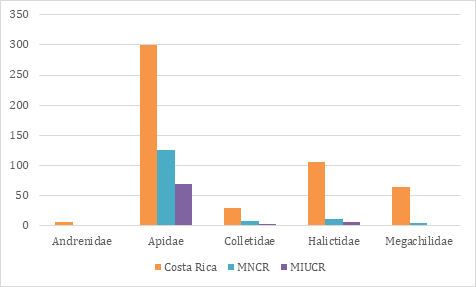
We could say that the MIUCR collection is actually quite complete considering that it is a collection with an agronomic focus, and the most important groups and species are well represented, some even with many specimens. The only thing needed is digitalization to allow better management of the specimens and their geographic data, since it was not possible to generate a collection map because it did not have coordinate data, which makes extra work necessary to search for the locations.
It is important to emphasize that at least in the MNCR collection, there are many genera that have not yet been worked on, so the percentage of representation will increase as well as the records for the country, since this is not only the largest collection, but, having been born under the objective of a national inventory of species, with the former National Institute of Biodiversity (INBio), it has an important representation of almost the entire territory of Costa Rica (Figure 2).
The 35 genera of the MNCR that have not yet been fully worked on are the following: Centris Fabricius, 1804, Epeolus Latreille, 1802, Epicharis Klug, 1807, Florilegus Robertson, 1900, Gaesischia Michener, LaBerge & Moure,
1955, Melissodes Latreille, 1829, Melissoptila Holmberg, 1884, Melitoma Lepeletier & Serville, 1828, Monoeca Lepeletier & Serville, 1828, Odyneropsis Schrottky, 1902, Svastra Holmberg, 1884 and Thygater Holmberg, 1884.
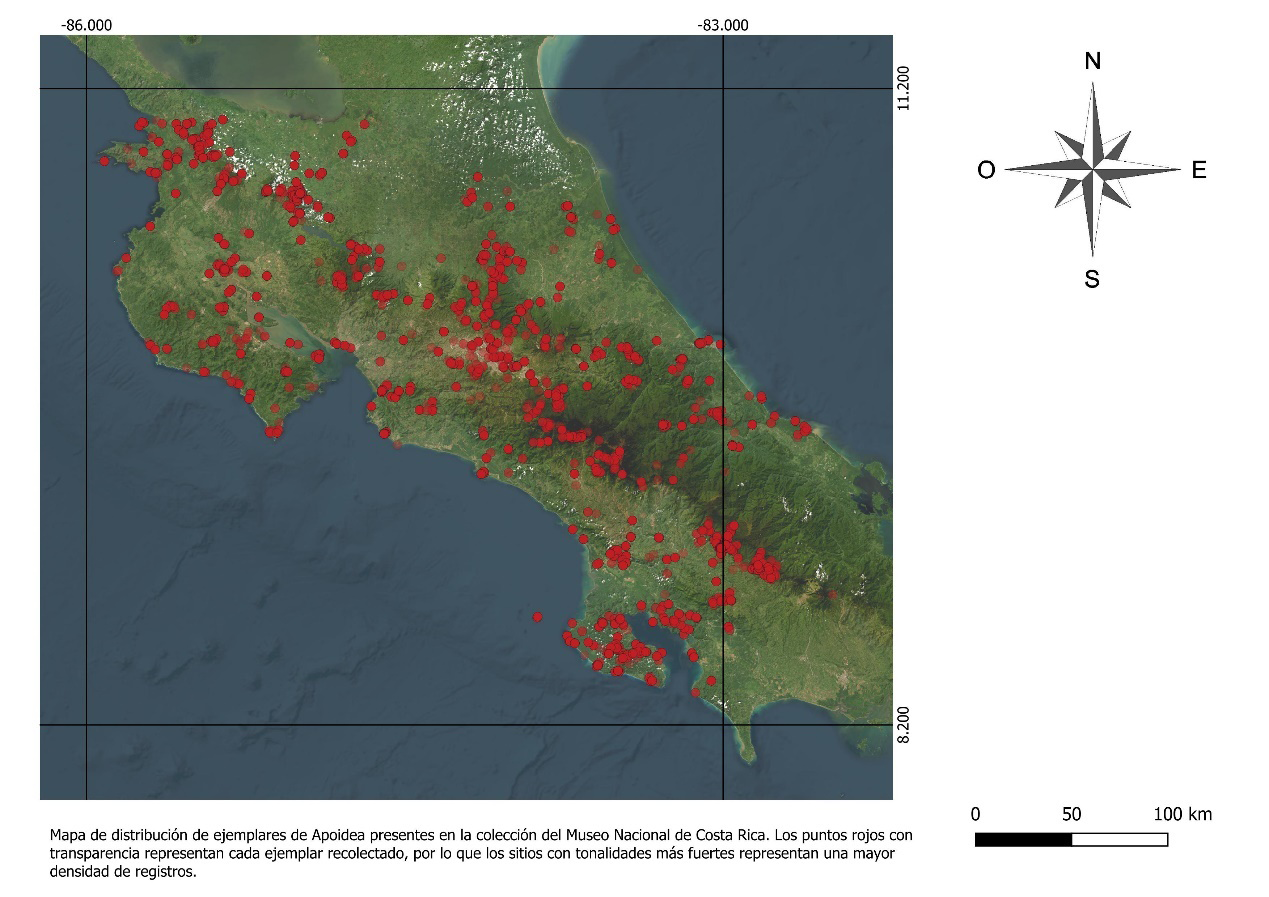
It is important to mention that the zoology collection of the School of Biology of the University of Costa Rica (ZBUCR) was not reviewed because it is in the digitalization phase, which will have public data until 2025, but it is a collection with very important data and specimens.
Conclusions
- Although a complete list of species was achieved, it is important to note that this is only a baseline reference, which includes exclusively the species officially reported in the literature, or those that have representatives in national collections.
- It is practically a given that there are many species that are not on this list, some of them are in the process of being described or may have been deposited and identified in foreign collections and not have been reported in scientific literature.
- There are many thesis projects, both national and international, in which it is possible that Costa Rican species have been described or identified and these results have not yet been published scientifically.
- The species represented in the MNCR and MIUCR collections will increase as work is done on the genera that are still uncurated due to a lack of specialists.
Acknowledgement
To the curator Andrés Arias for allowing the complete review of the MIUCR bee collection, and to Andrés Duarte for preparing and providing the collection map of the bee specimens in the MNCR collections.
References
-
Timberlake PH (1977) Description of two new species of Heterosarus Robertson. The Pan-Pacific Entomologist 53(1): 56-59.
-
Friese H (1916) On the bee fauna of Costa Rica. Stettiner Entomologische Zeitung 77: 287-350.
-
Moure JS (1999) Parapsaenythia species from Costa Rica described by Friese (Hymenoptera, Apoidea). Brazilian Journal of Zoology 16(1): 105-111.
-
Friese H (1921) Addendum to the bee fauna of Costa Rica 82: 73-98.
-
Sánchez-Ocampo M (2023) Key for Identification of Bumblebee Queens from Costa Rica (Apidae: Apinae: Bombini). International Journal of Zoology and Animal Biology 6(4): 000502.
-
Snelling RR (1984) Studies on the taxonomy and distribution of American Centridini bees (Hymenoptera: Anthophoridae). Contributions in science, Los Angeles County Museum of Natural History 347: 1-69.
-
Crawford JC (1906) Some Costa Rican bees. Transactions of the American Entomological Society 32: 157-163.
-
Snelling RR, Brooks RW (1985) A review of the genera of cleptoparasitic bees of the tribe Ericrocini (Hymenoptera: Anthophoridae). Contributions in science, Los Angeles County Museum of Natural History 369: 1-34.
-
Thiele R (2005) A new species of Ctenioschelus Romand from Costa Rican dry forest (Hymenoptera: Apidae: Ericrocidini). Journal of the Kansas Entomological Society 78(3): 272-276.
-
Ayala R, Griswold T (2012) Two new species of the bee genus Peponapis, with a key to the North and Central American species (Hymenoptera: Apidae: Eucerini). Revista Mexicana de Biodiversidad 83: 396-406.
-
Cockerell TDA (1949) Bees from Central America, principally Honduras. Proceedings of the United States National Museum 98: 429-490.
-
LaBerge WE (1956) A revision of the bees of the genus Melissodes in North and Central America. Part. I (Hymenoptera, Apidae). The University of Kansas science bulletin 37(18): 912-1194.
-
Urban D (1967) Species of the genus Thygater Holmberg, 1884 (Hymenoptera, Apoidea). Bol Univ Fed Parana Zool 2(12): 177-309.
-
Lutz FE, Cockerell TDA (1920) Notes on distribution and bibliography of North American bees of the families Apidae, Meliponidae, Bombidae, Euglossidae, and Anthophoridae. Bulletin of the American Museum of Natural History 42: 491-64.
-
Rebêlo JMM, Silva FS (1999) Distribution of Euglossini bees (Hymenoptera: Apidae) in Maranhão state, Brazil. Annals of the Entomological Society of Brazil 28(3): 389- 401.
-
Moure JS, Michener CD (1955) A contribution toward the classification of Neotropical Eucerini (Hymenoptera, Apoidea). Dusenia 6(6): 239-331.
-
Cresson ET (1878) Descriptions of new species of North American bees. Proceedings of the Academy of Natural Sciences of Philadelphia 30: 181-221.
-
Timberlake PH (1980) Review of North American Exomalopsis. University of California publications in entomology, 86: 1-158.
-
Sánchez-Ocampo M (2023) Notes on Euglossini (Hymenoptera: Apidae: Apinae) of Costa Rica: Identification key for genus Eulaema Lepeletier, 1841 and Exaerete hoffmannsegg, 1817. International Journal of Zoology and Animal Biology 6(5): 000516.
-
Sánchez-Ocampo M (2024) Identification Key for the Costa Rican Species of Euglossa Latreille, 1802 from the Costa Rican Sector of La Amistad International Park (Hymenoptera: Apidae: Apinae: Euglossini). International Journal of Research Studies in Zoology 8(1): 5-8.
-
Camargo JMF, Moure JS (1996) Neotropical Meliponini: the genus Geotrigona moure, 1943 (Apinae, Apidae, Hymenoptera), with special reference to phylogeny and biogeography. Arquivos de Zoologia, Brazil, 33(3): 95- 161.
-
Wille A, Orozco E, Raabe C (1983) Pollination of chayote Sechium edule (Jacq.) Swartz en Costa Rica. Revista de Biologia Tropical 31(1): 145-154.
-
Wille, A and Michener, CD (1973) The nest architecture of stingless bees with special reference to those of Costa Rica. Revista de Biologia Tropical 21(1): 1-278.
-
Roubik DW, Lobo JA, Camargo JMF (1997) New stingless bee genus endemic to Central American cloudforest: phylogenetic and biogeographic implications (Hymenoptera: Apidae: Meliponini). Systematic Entomology 22: 67-80.
-
Wille A (1969) A new species of stingless bee Trigona (Plebeia) from Costa Rica, with descriptions of its general behavior and cluster-type nest. Revista de Biologia Tropical 15(2): 299-313.
-
Onuferko, TM (2019) A review of the cleptoparasitic bee genus Epeolus Latreille, 1802 (Hymenoptera: Apidae) in the Caribbean, Central America and Mexico. European Journal of Taxonomy 563: 1-69.
-
Rightmyer, MG (2008) A review of the cleptoparasitic bee genus Triepeolus (Hymenoptera: Apidae).- Part I. Zootaxa 1710: 1-170.
-
Schrottky, C (1920) Himenopteros nuevos o poco conocidos sudamericanos. Revista do Museu Paulista 12(2): 179-227.
-
Shanks, SS (1986) A revision of the neotropical bee genus Osiris (Hymenoptera: Anthophoridae). The Wasmann Journal of Biology 44 (1-2): 1-56.
-
Smith, HS (1907) Contributions toward a monograph of the Ceratinidae of North and Middle America. Transactions of the American Entomological Society 33: 115-124.
-
Friese H (1925) Neue neotropische Bienenarten, zugleich II. Nachtrag zur Bienenfauna von Costa Rica. (Hym.). Stettin entomologische zeitung 86(2): 1-41.
-
Dusmet, Alonso (1924) Las “Xylocopa” (Hymen. Apidae) en las colecciones de Madrid. Trabajos del Museo Nacional de Ciencias Naturales de Madrid 49: 5-58.
-
Friese, H (1922) Eine neue Bienengattung aus Südamerika: Rhinetula (Apidae). Zoologische Jahrbücher. Abteilung für Systematik, Geographie und Biologie 45: 581-586.
-
Michener, C, Engel, M and Ayala, R (2003) The Bee Genus Caupolicana in Central America (Hymenoptera: Colletidae). Journal of the Kansas Entomological Society 76: 160-171.
-
Engel, MS, Smith-Pardo AH (2004) The bee genus Andinaugochlora in Central America (Hymenoptera: Halictidae). Journal of the Kansas Entomological Society 77(2): 116-120.
-
Engel MS (2014) Three new species of the genus Caenaugochlora from Central America and Colombia (Hymenoptera: Halictidae). Journal of Melittology 41: 1-15.
-
Engel, MS (1995) Three new species of Caenaugochlora (Ctenaugochlora) (Hymenoptera: Halictidae). Journal of the New York Entomological Society 103 (3): 281-286.
-
Engel MS, Gonçalves RB (2010) A revised key to the species of Caenaugochlora (Ctenaugochlora), with the description of a new species from Costa Rica (Hymenoptera: Apoidea: Augochlorini). Genus 21 (1): 101-110.
-
Engel MS (2006) A new nocturnal bee of the genus Megalopta, with notes on other Central American species (Hymenoptera: Halictidae). Mitteilungen des Internationalen Entomologischen Vereins 31 (1/2): 37- 49.
-
Engel MS (2009) Revision of the bee genus Chlerogella (Hymenoptera, Halictidae), Part I: Central American species. Zookeys 23: 47-75.
-
Engel MS (2013) Revision of the cleptoparasitic bee genus Cleptommation (Hymenoptera: Halictidae). J Melittology 22: 1-26.
-
Hanson, P, Fernández, M, Lobo, Frankie J, Coville G, et al. (2021) Abejas de Costa Rica. Editorial Universidad de Costa Rica, San Pedro, Costa Rica pp: 269.
-
Smith-Pardo, AH (2005) The bees of the genus Neocorynura of Mexico. Folia Entomológica Mexicana 44(2): 165-193.
-
Brosi, BJ, Smith-Pardo, A and Gonzalez, VH (2006) A new wood-nesting Neocorynura (Hymenoptera: Halictidae: Augochlorini) from Costa Rica, with notes on its biology. Zootaxa 1189: 55-68.
-
Moure JS (1960) Notes on the types of the Neotropical bees described by Fabricius (Hymenoptera: Apoidea). Stud Entomol (Rio J) 3(1-4): 97-160.
-
Vachal J (1904) Study on the Halictus of America (Hym.). Miscellaneous Entomology 12: 9-24.
-
Roberts RB (1972) Revision of the bee genus Agapostemon (Hymenoptera: Halictidae). The University of Kansas science bulletin 49(9): 439-590.
-
Roberts RB, Brooks RW (1987) Agapostemonine bees of Mesoamerica (Hymenoptera: Halictidae). The University of Kansas science bulletin 53(7): 357-392.
-
Crawford JC (1901) North American bees of the genus Agapostemon Guerin. Nebraska Academy of Sciences 7: 156-165.
-
Strand E (1921) Apidological information, especially about Palearctic Andrena species, based on material from the German Entomological Museum. Archiv für Naturgeschichte 87(3): 266-322.
-
McGinley RJ (1999) Eickwortia (Apoidea: Halictidae), a new genus of bees from Mesoamerica. In: Byers GW, Hagen, RH (Eds.), Entomological contributions in memory of Byron A. Alexander. University of Kansas. Museum of Natural History Special Publication, USA, 24(251): 111-120.
-
McGinley RJ (1986) Studies of Halictinae (Apoidea: Halictidae), I: Revision of New World Lasioglossum Curtis. Smithsonian Contributions to Zoology 429: 1-294.
-
Dumesh S (2013) Revision of the rare Mesoamerican bee genus Mexalictus (Hymenoptera: Halictidae), with the description of 21 new species. Zootaxa 3708: 1-81.
-
Eickwort GC, Stage GI (1972) A new Subgenus of Neotropical Sphecodes Cleptoparasitic upon Dialictus (Hymenoptera: Halictidae, Halictinae). Journal of the Kansas Entomological Society 45(4): 500–515.
-
Schwarz HF (1933) Some Neotropical Anthidiinae: Anthidium, Heteranthidium, and Dianthidium. American Museum Novitates 624: 1-27.
-
Urban D (1999) New species and notes on Anthodioctes Holmberg (Hymenoptera, Apoidea, Megachilidae). Revista Brasileira de Zoologia 16(1): 135-169.
-
Urban D (2003) A new species of parasitic Anthidiinae (Hymenoptera, Megachilidae) from Costa Rica. Acta Biológica Paranaense 30(1-4): 1-4.
-
Cockerell TDA (1914) New and little known bees. The Entomologist 45: 175-178.
-
Mitchell TB (1973) A subgeneric revision of the genus Coelioxys of the Western Hemisphere (Hymenoptera: Megachilidae). North Carolina State University, USA, pp: 1-129.
-
Rocha-Filho LC, Packer L (2015) Revision of the Neotropical subgenera Coelioxys (Platycoelioxys) Mitchell and C. (Rhinocoelioxys) Mitchell (Hymenoptera; Megachilidae) with the description of one new species. Zootaxa 3941(2): 151-203.
-
Rocha-Filho LC, Packer L (2017) Phylogeny of the cleptoparasitic Megachilini genera Coelioxys and Radoszkowskiana, with the description of six new subgenera in Coelioxys (Hymenoptera: Megachilidae). Zoological Journal of the Linnean Society 180(2): 354- 413.
-
Snelling RR (1990) A review of the native North American bees of the genus Chalicodoma (Hymenoptera: Megachilidae). Contributions in science, USA, 421: 1-39.
-
Mitchell TB (1930) A contribution to the knowledge of neotropical Megachile with descriptions of new species (Hymenoptera: Megachilidae). Transactions of the American Entomological Society 56(3): 155-305.
-
Titus ESG (1904) Notes on Osmiini with descriptions of new genera and species. Journal of the New York Entomological Society 12(1): 22-27.
-
Hinojosa-Días IA, Melo GAR, Engel MS (2011) Euglossa obrima, a new species of orchid bee from Mesoamerica, with notes on the subgenus Dasystilbe Dressler (Hymenoptera, Apidae). ZooKeys 97: 11-29.
-
Eltz T, Fritzsch F, Ramírez J, Quesada-Euan JJG, Bembé B (2011) Characterization of the orchid bee Euglossa viridissima (Apidae: Euglossini) and a novel cryptic sibling species, by morphological, chemical, and genetic characters. Zoological Journal of the Linnean Society 163(4): 1064-1076.
-
Michener CD (2000) The bees of the world. The John Hopkins University Press, USA.
-
Engel MS, Rasmussen C, Ayala R, de Oliveira FF (2023) Stingless bee classification and biology (Hymenoptera, Apidae): a review, with an updated key to genera and subgenera. Zookeys 1172: 239-312.
- California Red-Legged Frog and Non-Listed Amphibians Response to Non-Native Fish Removal
- Industrial Standardization of the Bio-OS: Algorithmic Codification of Resilience Engineering Guidelines and Version V8 Architecture
- Climate Variability and the Sustainability of Snail Farming in Nigeria: Past Trends, Present Challenges and Potential Outlook
- The Evaluation of the Surveillance System of Anthrax in Gilgit-Baltistan, Pakistan, 2018
- Natural Decline to Extinction of A New Zealand Rabbit Population
- Mitochondrial Bio-Logistics: Steering Co-Enzyme Q10 and Lycopene Synergies within the Science 4.0 Bio-OS Framework