
Adjustment of Amino Acids and Metabolizable Energy in Diets for High-Laying Brown Nick Hens under Heat Stress
Heat stress causes hens to reduce feed intake, so the nutrient intake of the diet must be adjusted to meet nutritional needs. The objective of this study was to evaluate the effect of adjustment of amino acids and metabolizable energy in the feed on the productivity of Brown Nick hens under heat stress. Sixty-three hens were used, of 22 weeks of age. Three diets were tested: commercial, processed1, and processed2. The productive characteristics of the hens and their eggs were evaluated. The experimental design used was a completely randomized block, with three treatments and seven replications. A stepwise variable selection test was also used. Feed intake and feed conversion were higher (p < 0.01) in the concentrated feed in relation to the processed feed. The laying percentage and total egg mass were similar (p > 0.05) in the concentrated and processed2 treatments. The weight of the egg (g) was greater (p < 0.05) in the processed2 food compared to the processed1. It is concluded that with respect to Brown Nick hens under heat stress conditions, the diet that showed the greatest improvement in productivity was the feed adjusted in both metabolizable energy and amino acids.
Introduction
Stress represents the reaction of the animal organism to stimuli that disturb the normal physiological balance, or homeostasis. It can be caused by a combination of environmental factors (sunlight, thermal irradiation, air temperature, and humidity) and the characteristics of the animal [1]. Thermal stress is a poor adaptation of the animal to environmental conditions of high temperature and relative humidity [2]. The optimal temperature for laying hens of the Brown Nick line is similar to other lines, ranging from 18 to 24 °C, with a critical limit of 28°C; they do not tolerate temperatures above 30°C for long periods of time, and the relative humidity must remain between 60 and 70% [3, 4]. Hens, in conditions of heat stress above the critical limit Investigation Paper (25°C), have been observed to reduce feed intake by 1.0 to 1.6% for every 1°C increase in temperature [5]. The decrease in feed intake suggests a reduction in the amount of nutrients and energy that the bird can obtain, thereby modifying productive efficiency [4, 5, 6, 7]. The energy density of the diet for laying hens in the thermoneutral zone is recommended between 2,684 and 2,992 kcal of ME/kg of food [8]. Brown Nick hens, subjected to heat stress conditions and fed with an ME content of 2,754 kcal/kg of feed, are found to consume less than 110 g of feed/d [9]. Hens adjust feed intake according to the energy density of the ration given. Hens subjected to different concentrations of dietary energy consume more or less feed, and consequently the productive performance and feed conversion rate are affected [8, 10]. Some studies indicate that increasing the ME content of the diet by increasing the supplemental fat content could improve the uptake of other components of the diet [11, 12].
In respect to laying hens fed mainly with diets based on corn and soy flour [13], complementing feed with amino acids such as methionine, lysine, and tryptophan has been proven beneficial in an effort to improve feed conversion [14] and obtain a diet with a higher productive level [13, 15, 16]. Another problem that can aggravate the situation in high- laying hens fed under heat stress is that industrial feed producers may formulate diets without taking environmental conditions of different regions into account. Nutritional information (in accordance with the manufacturer) is often provided for crude protein (CP), fiber, fat, moisture, nitrogen-free elements, ash, calcium, and phosphorus; but not for amino acids and metabolizable energy, which can alter nutritional content and lead to greater variation in feed intake in warm subhumid climates [17, 18]. Therefore, it is necessary to adjust the amount of metabolizable energy and essential amino acids according to feed intake in the subhumid tropics. That is, it is necessary to concentrate the nutrients in a smaller amount of feed for highly productive hens [7], which directly affects performance, egg size, and weight [19]. It is hypothesized that the adjustment of energy and essential amino acids, methionine, lysine, and tryptophan, in the diets for high-laying Brown Nick hens raised under heat stress conditions will improve productivity. The objective of the present study was to adjustment the amount of metabolizable energy and essential amino acids in the feed and evaluate the productivity and characteristics of the eggs in high-laying Brown Nick hens subjected to heat stress.
Materials and Methods
Location
The present study was carried out in the community of Bajos de Chila, Municipality of San Pedro Mixtepec- District 22, with geographical coordinates corresponding to 15°54’40.9” N 97°07’58.3” W, at an elevation of 13 m above sea level [20, 21]. The climate was categorized as warm, sub- humid, with less intense summer rains. The average annual temperature of the municipality has been recorded at 22°C, with a maximum of 28°C, with average annual precipitation of 1,300 mm [22]. However, in the study area the maximum and minimum temperatures previously recorded were 32.5 and 27.7°C respectively, with an average of 29.9°C (7). The comfort of the females was ensured so that they did not suffer from stress at any time. However, the only exception was the heat stress by the predominant climate of the study area. This study was conducted on a family farm in the community of Bajos de Chila. This study was endorsed by the University of the Sea, Puerto Escondido Campus in the official document: JCZPE/117/2021. The National Health Service, food safety, and quality was also taken into account.
Experimental Animals
63 adult hens from the Brown Nick high laying line were used in the study, at the age of 22 weeks, at the start of the first laying, with an average live weight of 1,715.4 ± 15.2 g. The hens were raised on the floor, in the same study area from the first day they were born until they began the laying period.
Facility and Equipment Characteristics
The warehouse that was used had a surface area of 31 m2, with a galvanized sheet roof at a height of 2.0 m; the area was closed on two sides with chicken wire and two brick walls: 1) one wall was completely closed, and 2) the other was built with lattice material that permitted natural ventilation. The ground had a cement floor and a 3% incline. The entry of rodents, birds, and mammals was prevented [23]. The area was cleaned, conditioned, and whitewashed on the floor and walls. A one m2 sanitary mat covered with lime was placed at the entrance.
Subsequently, cleaning and disinfection of the warehouse was carried out every eight days, with a surface sanitizer for walls and floors (20 ml/L water, Shine & Clean brand®). To reduce the temperature of the warehouse [7], ventilation was provided with a plastic fan (Man brand, high speed, air displacement of 105 m3/min and vertical rotation of 330°), which was kept on from 8:00 a.m. to 8:00 p.m. each day.
The hens’ housing was made of standard metal, measuring 1.50 m in length with 4 divisions of 37 x 45 x 45 cm in width, depth, and height, respectively. Each section was equipped with a semi-automatic plastic feeder (21 cm long, 15 cm wide and 9 cm high) and an automatic cup watered. Hens were raised in the areas without nests.
The total exposure to artificial light plus natural light for the hens was 16 h per day [24]. To turn on the artificial light, an analog timer (programmable Fulgore brand) was used, which provided artificial light at night (6:30 p.m. to 10:30 p.m.).
Food and Health Management
The hens were subjected to a period of adaptation to handling and feeding for 15 days, and the sampling period was three consecutive months. The areas, feeders and waterers were cleaned every day at 8:00 a.m., while feed was offered ad libitum, according to the assigned treatment. Vitamins® (1 g/L of water) were added to the drinking water. For sanitary management, all recommendations for Brown Nick hens were taken into account [24].
Treatments
Three diets were evaluated (Table 1): 1) commercial feed®, 2) processed1 feed (only metabolizable energy was concentrated), and 3) processed2 (metabolizable energy and amino acids were concentrated) according to a previous study [7].
| Components (%) | Diets | ||
|---|---|---|---|
| Commercial® | Elaborado Processed1 | Processed2 | |
| Whole soybeans | ---- | 21.65 | 35.34 |
| Corn | ---- | 60.56 | 45.24 |
| Sorghum | ---- | 2 | 3 |
| Methionine (synthetic) | ---- | 0.18 | 0.33 |
| Lysine (synthetic) | ---- | 0.17 | 0.1 |
| Valine (synthetic) | ---- | 0.03 | 0.17 |
| Tryptophan (synthetic) | ---- | 0.02 | 0.05 |
| Commercial vitamins | ---- | 0.1 | 0.1 |
| Oil | ---- | 5.51 | 5.94 |
| Rock phosphate | ---- | 0.92 | 0.8 |
| Calcium carbonate | ---- | 8.59 | 8.65 |
| Canthaxanthin | ---- | 0.006 | 0.006 |
| Salt | ---- | 0.25 | 0.27 |
| Nutrient Composition | |||
| Crude protein (%) | 15.47 | 13.2 | 17.09 |
| Metabolizable energy Kcal/kg | 2617 | 3300 | 3300 |
| Methionine (%) | 0.4 | 0.4 | 0.6 |
| Lysine (%) | 0.8 | 0.8 | 1.004 |
| Tryptophan (%) | 0.17 | 0.17 | 0.374 |
| Calcium (%) | 3.75 | 3.75 | 3.75 |
| Phosphorus (%) | 0.55 | 0.55 | 0.55 |
Table 1: Percentage of composition and nutrient contribution of processed feed for high laying Brown Nick hens in heat stress.
The commercial feed was standardized in size and prepared by grinding. The metabolizable energy was calculated with the support of proximal chemical analysis [25, 26]. To analyze the amino acid contribution of the feed, established values of methionine, lysine, tryptophan, calcium, and phosphorus were recorded [3, 24, 26, 27]. The processed feeds were formulated with the Microsoft Excel solver program, according to the nutritional needs for laying birds [3, 27].
Variables to Evaluate
The final weight (g) of the hens, the daily change in weight, daily feed intake (g), energy (kcal/kg), methionine, lysine, and tryptophan (g) were evaluated [28]. The feed conversion of the diets was also evaluated [29]. The monthly laying percentage, and the total egg mass per month were evaluated. The weight of the egg was measured with a digital scale (pocket scale brand model 10053, approximation 0.01 g), the length and width of the egg with a digital micrometer (Sure Bilt brand, Caliper Black model, scale 150 ± 0.2 mm). In addition, the morphological index of the egg was measured [30]. Halfway through the experiment, the temperature and relative humidity of the area that housed the hens were measured with a digital thermohygrometer (model HTC-1), for 24 consecutive hours for three days.
Statistical Analysis
The data were analyzed statistically using analysis of variance. A completely randomized block design was used, with three treatments and seven replicates. The weight of the breeding hens was considered as a block. Each experimental unit consisted of three females. When there were differences, a Tukey test comparison of means was applied. The Stepwise methodology was carried out for the variables final weight, daily weight change, total egg mass-produced per month and monthly laying percentage [31].
Results
The daily intake of metabolizable energy, crude protein, and lysine were higher (p < 0.01) in the treatments with commercial feed and processed2, with averages of 352.1 kcal, 19.5 g and 1.07 g, relative to the processed1 treatment with a value of 288.3 kcal, 11.53 g and 0.70 g, respectively. Feed intake was higher (p < 0.01) in the commercial treatment (131.8 g/day); The processed1 and processed2 treatments consumed 33 and 17% less food. Methionine, and tryptophan intake were different (p < 0.01) in the three food treatments; However, the treatment that had the greatest feed intake was that of processed2 (Table 2).
The variables final weight (g), daily weight change (g), monthly laying percentage, and total egg mass were higher (p < 0.01) in the commercial and processed2 treatments compared to the processed1. However, the feed conversion was lower (p < 0.01) by 18.4% for the processed2 compared to the commercial one (Table 3).
| Dietary Treatment | ME | Daily intake (g) | ||||
|---|---|---|---|---|---|---|
| CF | CP | Met | Lys | Trp | ||
| Commercial | 344.95a | 131.81a | 20.39a | 0.53b | 1.05a | 0.22b |
| Processed1 | 288.28b | 87.36c | 11.53b | 0.35c | 0.70b | 0.15c |
| Processed 2 | 359.25a | 108.86b | 18.61a | 0.65a | 1.09a | 0.40a |
| Average | 330.83 | 109.34 | 16.84 | 0.51 | 0.95 | 0.26 |
| F-value | 18.27 | 35.63 | 86.42 | 115.28 | 57.57 | 40.64 |
| Probability | 0.0025 | < 0.0001 | < 0.0001 | < 0.0001 | < 0.0001 | < 0.0001 |
| SEM | 10.69 | 4.83 | 0.93 | 0.03 | 0.04 | 0.02 |
Table 2: Feed intake in diets for high-laying hens in subhumid tropics.
ME= Metabolizable energy (kcal). PC= Crude protein (g). Met= Methionine (g). Lys= lysine (g). Trp= tryptophan (g). SEM= Standard error of the mean. a,b: Different superscripts in the same column indicate difference (p < 0.01).
| Treatment | Weight of hen (g) | Monthly laying percentage (%) | Total egg mass (g) | Feed conversion | |
|---|---|---|---|---|---|
| Final | Daily weight change | ||||
| Commercial | 1915.43a | 2.25a | 96.09a | 1853.5ª | 2.01c |
| Processed1 | 1375.30b | -3.94b | 74.49b | 1312.2b | 1.88cd |
| Processed2 | 1811.30a | 1.17a | 96.77a | 1889.2ª | 1.64d |
| Average | 1700.67 | -0.17 | 89.12 | 1685 | 1.84 |
| F-value | 33.71 | 28.28 | 22.48 | 30.54 | 4.49 |
| Probability | < 0.0001 | < 0.0001 | < 0.0001 | < 0.0001 | 0.0351 |
| SEM | 60.15 | 0.68 | 1.26 | 69.04 | 0.05 |
Table 3: ** Final weight response and weight gain or loss in Brown Nick hens fed with different levels of metabolizable energy an
EEM= Standard error of the means. a,b: Different superscripts in the same column indicate difference (p < 0.0001). c,d:Different superscripts in the same column indicate difference (p < 0.05). Table 3: Final weight response and weight gain or loss in Brown Nick hens fed with different levels of metabolizable energy and amino acids (methionine, lysine, and tryptophan) in the subhumid tropics.
The eggs laid by the hens which consumed the processed2 feed were 10.5% heavier (p < 0.01) than those of the hens given processed1 feed. Egg width was also 3.1% lower (p < 0.01) in the processed1 feed, compared to the other treatments. However, there were no differences (p > 0.05) in egg length and morphological index in the evaluated treatments (Table 4).
Table 5 shows the prediction equation for the final weight (EPF) of the hens: EPF=782.2 + 54.532(DCPI); where: DCPI = daily crude protein intake (r2=0.71). The daily weight change (DWC) of hens: DWC= -4.2283 + 0.9451(DCPI) - 0.0359(DMEI); where, DMEI = metabolizable energy intake/d (r2=0.77). The equation of the total egg mass: ETEM= 1375.4866 – 716.8422(PFC) + 3214.784(DLI)
– 2772.896(PDMI), (r2= 0.98); where: TFC = True Feed Conversion, DLI = Daily Lysine Intake and PDMI = Daily Methionine intake.
| Dietary treatment | Egg Variables | |||
|---|---|---|---|---|
| Weight (g) | Length (mm) | Width (mm) | Morphological Index | |
| Commercial | 68.88ab | 57.92 | 44.57a | 78.26 |
| Processed1 | 62.56b | 55.35 | 43.28b | 78.2 |
| Processed 2 | 69.91a | 57.55 | 44.65a | 78.6 |
| Average | 67.11 | 56.7 | 44.17 | 78.02 |
| F-value | 5.24 | 3 | 6.76 | 0.65 |
| Probability | 0.0231 | 0.0877 | 0.0108 | 0.537 |
| SEM | 1.25 | 0.48 | 0.23 | 0.43 |
Table 4: Egg characteristics of Brown Nick hens fed with different levels of metabolizable energy and amino acids (methionine, ly
SEM= Standard error of the means. a,b: Different superscripts in the same column indicate difference (p < 0.05). Table 4: Egg characteristics of Brown Nick hens fed with different levels of metabolizable energy and amino acids (methionine, lysine, and tryptophan) in the subhumid tropics.
| Parameter | Productive variables | ||
|---|---|---|---|
| Final weight | Daily weight change | Total egg mass | |
| Intercept | 782.2 | -4.2283 | 1375.4866 |
| Daily crude protein intake (DCPI) | 54.532 | 0.9451 | |
| Daily metabolizable energy intake (DMEI) | -0.0359 | ||
| True Feed conversión (TFC) | -716.8422 | ||
| Daily lysine intake (DLI) | 3214.784 | ||
| Daily methionine intake (PDMI) | -2772.896 | ||
| R2 | 0.71 | 0.77 | 0.97 |
| Probability | < 0.0001 | < 0.0001 | < 0.0001 |
Table 5: Parameters obtained in the selection of variables in Brown Nick hens fed with different levels of metabolizable energy a
Inside the warehouse, an average daily temperature of 27.4°C (minimum and maximum of 23.3 and 32.8°C respectively) was recorded, with average daily relative
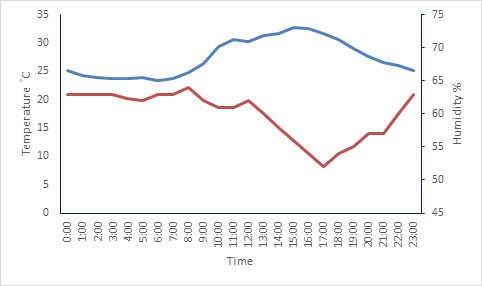
humidity of 59.9% (minimum 52% and maximum 64%), and temperatures above 28 °C for 9 h/d (Figure 1).
Discussion
The conditions in which the experiment was carried out in the subhumid tropics are characterized by an environmental temperature above 28°C for 9 hours a day, with high relative humidity of 60%, for 14 hours; Therefore, these conditions cause heat stress in laying birds [2, 7]. Despite the extreme environmental conditions, there was no death of hens, but immobility, opening of wings, panting and high water consumption were observed. Due to the use of the ventilation system, the laying birds were able to withstand the climate better and heat stress decreased in relation to other reports [3, 7, 27]. In high-laying Brown Nick hens, heat stress is a cause of decreased production, as it reduces feed consumption, body weight, egg production and egg weight;
It also affects the endocrine system, acid-base balance and organ functions [32].
It should be noted that the adjustment of the nutritional needs of the hens in this study was carried out with an expected consumption of 93.8g of feed per day, considering an increase in the physiological needs to maintain homeostasis, and heat stress above 28°C for roughly 19 hours a day. Feed consumption may have been improved by the use of the fan, leading to a slight reduction in heat stress.
The hens in the present study which came closest to the recommended feed consumption, in accordance with the recommendations suggested for the comfort zone [3], were those for whom the concentration of energy and amino acids of the feed were adjusted (processed2). However, the consumption of metabolizable energy in this diet was higher by 23.5 kcal of ME/kg of food. On the other hand, with the commercial feed, the hens exceeded recommended feed consumption, possibly because they did not meet their metabolizable energy needs. The indication of the average feed consumption of 115 g/d/bird includes a metabolizable energy content of 2,800 kcal/kg of feed, offered at a temperature within the comfort zone, therefore the laying hens consumed 336 kcal/d/bird [3, 24].
The amount of energy required by high-laying hens coincides with the knowledge that metabolizable energy needs increase by 5.8/kcal/bird/day for each degree of increase in environmental temperature [33].
The processed2 diet, with 17.1% CP showed excess consumption of amino acids: lysine, methionine and tryptophan. On the other hand, the hens that consumed the concentrated feed had adequate protein and amino acid consumption, at the expense of high feed consumption. Although CP consumption in birds is not essential [34, 35], it is important not to exceed the need, because when protein is provided in excess, the amino acids which are not absorbed are excreted as metabolic waste [36].
Within the components of protein, the essential amino acids play several important roles. Lysine serves an important function in muscle protein synthesis, maintenance and production in birds [37, 38]. Tryptophan reduces aggressive behavior in birds and also intervenes in circadian physiology, which in turn has an effect on feed consumption, sleep, and pain perception [39]. And finally, methionine is vital in protein synthesis, egg size, and weight [40, 41].
The high laying percentage of the hens, the decrease in feed conversion values, the increase in egg weight and egg width recorded in the processed2 diet are due to the greater concentration of metabolizable energy, lysine methionine, and tryptophan in the feed. The nutrient adjustment achieved more appropriate values for the species than in other studies [35, 42]. The optimal feed conversion for laying hens has been reported at 2.0 [29]. However, values lower than 1.9 have been recorded, as nutritional improvements are made to the diet of laying hens [35].
The high laying percentage of the hens reflects that, despite heat stress, nutrient consumption is adequate, and reproductive variables are possibly not affected. Under heat stress conditions there is no reduction in plasma LH, and FSH, which suggests a direct effect on ovarian function, as a result of reduced blood flow to the ovary [43]. The blood flow of the digestive system in the upper organs is 46% of normal, while in the uterus it decreases to 58% and 70-80% in the ovarian follicles [44].
The consumption of commercial and processed2 feeds induced the production of extra large eggs, while with processed1 feed the eggs were medium size [45]. The weight of the egg generally depends on the productive age of the hen [46]; Despite this, it is well established that methionine is the most important essential amino acid involved in egg weight [47]. However, in the present study lysine consumption was observed to have a greater effect on the total mass of eggs laid. The eggs obtained in the present study were classified as round since the morphological index of a normal egg is between 72 and 76, less than 72 are pointed, and greater than 76 are round [46, 47]. This may be a characteristic of Brown Nick chickens in warm subhumid climates.
Conclusions and Implications
Under the conditions in which this study was carried out, it is concluded that the adjustment of the amount of metabolizable energy, and amino acids, according to the feed consumption of the high-laying Brown Nick hens, causes the hens to consume less feed per day, improves feed conversion, produces extra-large eggs and generally surpasses the benefits of commercial feed. Therefore, the use of processed2 feed in the subhumid tropics is recommended, with a metabolizable energy contribution of 3080.0 kcal/kg for a feed consumption of 108.9 g/bird.
Conflict of Interest Statement
The authors declare that there are no conflicts of interest.
References
-
Lara LJ, Rostagno MH (2012) Impact of Heat Stress on Poultry Production. Animals 3(2): 356-369.
-
Farfán LCJ (2012) Uso de minerales para disminuir el estrés calórico en la producción de pollos de engorde en ambiente tropical de Venezuela. Alemania. Editorial académica española pp: 56.
-
H&N International (2020) Brown Nick ponedoras de huevo marrón, nueva guía de Manejo. H&N International GmbH.
-
Felver-Gant JN, Mack LA, Dennis RL, Eicher SD, Cheng HW (2012) Genetic variations alter physiological responses following heat stress in 2 strains of laying hens. Poult Sci 91(7): 1542-1551.
-
Cotrina TS del P (2016) Comportamiento productivo de la pollita HY Line Brown en la etapa de inicio, levante y pre postura en el C.I.P.P. San José de Chuco Distrito de Jesús Cajamarca. Cajamarca, Perú. Universidad Nacional de Cajamarca.
-
Star L, Kemp B, Van den Anker I, Parmentier HK (208) Effect of Single or Combined Climatic and Hygienic Stress in Four Layer Lines: 1. Performance. Poult Sci 87(6): 1022-1030.
-
Arcos GS (2023) Evaluación productiva de gallinas de la raza Brown Nick, alimentadas con diferente nivel de energía metabolizable en el trópico. Puerto Escondido, Oax; Universidad del Mar.
-
Barzegar S, Wu SB, Noblet J, Choct M, Swick RA (2019) Energy efficiency and net energy prediction of feed in laying hens. Poult Sci 98(11): 5746-5758.
-
Çabuk M, Bozkurt M, Kırkpınar F, Özkul H (2001) Effect of phytase supplementation of diets with different levels of phosphorus on performance and egg quality of laying hens in hot climatic conditions. S Afr J Anim Sci 34(1): 13-17.
-
Salvador TE, Bonifacio HSJ (2021) Gestión de la energía dietaría en la producción de costo de alimentación en la producción de huevo. Rev Inv Cs Agro y Vet 5(15): 509- 515.
-
Mateos GG, Sell JL (1980) Influence of carbohydrate and supplemental fat source on the metabolizable energy of the diet. Poult Sci 59(9): 2129-2135.
-
Mateos GG, Sell JL (1980) Influence of graded levels of fat on utilization of pure carbohydrate by the laying hen. J Nutr 110(9): 1894-1903.
-
Arquiñego AEG (2018) Efectos de diferentes niveles de proteína y aminoácidos azufrados en el rendimiento productivo de gallinas ponedoras. Tesis licenciatura. Lima, Perú; Universidad Nacional Agraria La Molina.
-
Macelline SP, Toghyani M, Chrystal PV, Selle PH, Liu SY (2021) Amino acid requirements for laying hens: a comprehensive review. Poult Sci 100(5): 101036.
-
Bonekamp RPT, Lemme A, Wijtten PJA, Sparla JKWM (2010) Effects of amino acids on egg number and egg mass of brown (heavy breed) and white (light breed) laying hens. Poult Sci 89(3): 522-529.
-
Novak C, Yakout HM, Scheideler SE (2006) The effect of dietary protein level and total sulfur amino acid: lysine ratio on egg production parameters and egg Yield in Hy- Line W-98 Hens. Poult Sci 85(12): 2195-2206.
-
Mendoza MGD, Hernández GPA, Plata PFX, Martínez GJA, Arcos GJL, et al. (2022) Nutrición animal cuantitativa. Ciudad de Mex, Universidad Autónoma Metropolitana: Guzon.
-
Cortes PDB (2023) Uso de harina de forraje verde hidropónico de maíz (Zea mays) y alimento concentrado para la engorda de pollos, su efecto en los parámetros productivos y calidad de la carne tesis licenciatura. Puerto Escondido, Oax: Universidad del Mar.
-
Gallardo C, Salvador TE (2016) Efecto de los niveles de aminoácidos azufrados sobre la calidad del huevo en gallinas de postura en el primer ciclo de producción. Rev Electrón Vet 17(9): 1-11.
-
Google Earth (2021) Localización del proyecto en la comunidad de Bajos de Chila, Oaxaca. México.
-
INEGI (2021) Instituto Nacional de Estadística y Geografía, Climatología de México.
-
SEDESOL (2012) Secretaría de Desarrollo Social. Atlas de Riesgos Naturales en el Municipio de San Pedro Mixtepec, Oaxaca. México.
-
Schopflocher R (1970) Avicultura lucrativa, cría de gallinas, patos, pavos gansos. Buenos Aires, Rgentina: Editorial Albatros.
-
Hy-line (2020) Hy-Line Internacional. Ponedoras comerciales Hy-line Brown, guía de manejo. Brn Alt Com Spn.
-
Santiago RH, Teixeira ALF, Hannas MI, Lopes DJ, Kazue SN, et al. (2017) Tablas Brasileñas para aves y cerdos, composición de alimentos y requerimientos nutricionales. Universidad Federal de Viçosa. Brazil.
-
AOAC (2000) Official methods of análisis. Association of Official Analytical Chemists. 17th ed. Washington, DC: Association of Official Analytical Chemists.
-
Lohmann (2017) Guía de Manejo sistemas de jaulas. Lohmann Brown-Clasic Ponedoras. Ed. Latinoamericana.
-
Velasteguí MJE (2016) Evaluación de los indicadores productivos en aves de postura Lohman Brown Classic mediante la utilización de silimarina (Silybum marianum) en la avícola sierra. Latacunga, Ecuador: Universidad Técnica de Cotopaxi.
-
Ferreira AJE (2021) Evaluación de los parámetros y sistemas de producción de gallinas ponedoras de huevo blanco (Lohmann LSL) y ponedoras de huevo rojo (Isa Brown, Hy Line Brown, Lohmann Brown) de las granjas avícolas San Pablo 1 y San Pablo 2. Colombia: Universidad Nacional de Colombia.
-
Ángel-Isaza J, Suarez-Orejarena C, Serrano-Galvis P, Parra-Mendez L, Campos-Paredes H, et al. (2021) Evaluación de escala visual como medida de calidad interna y frescura de huevo comercial. Rev MVZ Córdoba 26(2): 2-7.
-
SAS (2010) SAS Education Analytical Suite for Windows (Release 9.2). Cary NC, USA: SAS Inst. Inc. Order number 582235. Tech support site number 70088431.
-
Attia YA, ElHamid EAbd, Abedalla AA, Berika MA, AlHarthi Mohammed A, et al. (2016) Laying performance, digestibility and plasma hormones in laying hens exposed to chronic heat stress as affected by betaine, vitamin C, and/or vitamin E supplementation. SpringerPlus 5(1619): 1-12.
-
Harms RH, Russell GB, Sloan DR (2000) Performance of Four Strains of Commercial Layers With Major Changes in Dietary Energy. J Appl Poultry Res (9): 535-541.
-
Pavan AC, Móri C, García EA, Scherer MR, Pizzolante CC (2005) Níveis de proteína bruta e de aminoácidos sulfurados totais sobre o desempenho, a qualidade dos ovos e a excreção de nitrogênio de poedeiras de ovos marrons. R Bras Zootec 34(2): 568-574.
-
Fuente-Martínez B, Mendoza-Martínez GD, Arce-Menocal J, López-Coello C, Avila-González E (2012) Respuesta productiva de gallinas a dietas con diferentes niveles de proteína. Arch Med Vet 44(1):67-74.
-
Carvalho TSM, Sousa LS, Nogueira FA, Vaz DP, Saldanha MM, et al. (2018) Digestible methionine+cysteine in the diet of commercial layers and its influence on the performance, quality, and amino acid profile of eggs and economic evaluation. Poult Sci 97(6): 2044-2052.
-
Cevallos GAL, Fuente MB, Cortés CA, Ávila GE (2009) Nivel óptimo de lisina digestible en dietas para gallinas de postura de primer ciclo. Téc Pecu Méx 47(2): 215-222.
-
Caicedo ACA, VL Hurdado NVL, Torres NDM, Fuentes REE (2016) Hematología y química sanguínea de la codorniz japonesa (Coturnix coturnix japonica). Rev Sist Prod Agroecol 7(1): 22-43.
-
Lehninger AL (2006) Principios de Bioquímica. 4a ed. Barcelona. Omega**.**
-
Barbosa MJB, Cardozo RM, Souza VLF de, Rickli ME (2009) Níveis de metionina + cistina no desempenho de poedeiras comerciais leves com 45 semanas de idade. Rev Bras Saúde Prod An 10(4): 1032-1039.
-
Bunchasak C (2009) Role of dietary methionine in poultry production. J Poult Sci 46(3): 169-179.
-
Morales W, Rodriguez V, Verjan N (2018) Parámetros productivos y económicos de gallinas ponedoras ISA Brown en segundo ciclo de producción suplementadas con aminoácidos no esenciales. Rev Investig Vet Perú 29(2): 533-543.
-
Rozenboim I, Tako E, Gal-Garber O, ProudmanJA, Uni Z (2007) The effect of heat stress on ovarian function of laying hens. Poult Sci 86(8): 1760-1765.
-
Wolfenson D, Frei YF, Snapir N, Berman A (1981) Heat Stress Effects on Capillary Blood Flow and its Redistribution in the Laying Hen. Pflfigers Arch 390: 86- 93.
-
NOM (2021) Norma Mexicana. NMX-FF-127- SCFI-2016. Productos avícolas huevo fresco de gallina especificaciones y métodos de prueba México.
-
Rodríguez-Ortega LT, Segura-Soto CE, Pro-Martínez A, Sosa-Montes E, Alejos-de la Fuente JI, et al. (2021) Macroestructura del huevo de gallinas alimentadas con diferentes niveles de proteína cruda. Ecosist Recur Agropec 8(2): 1-7.
-
Rosabal NO, Martínez AY, Rodríguez BR, Pupo TG, Olmo GC, et al. (2017) Efecto de la suplementación dietética del polvo de hojas de Anacardium occidentale L. (marañón) en la producción y calidad del huevo de gallinas ponedoras. Rev Cubana Plant Med 22(1): 1-12.
- California Red-Legged Frog and Non-Listed Amphibians Response to Non-Native Fish Removal
- Industrial Standardization of the Bio-OS: Algorithmic Codification of Resilience Engineering Guidelines and Version V8 Architecture
- Climate Variability and the Sustainability of Snail Farming in Nigeria: Past Trends, Present Challenges and Potential Outlook
- The Evaluation of the Surveillance System of Anthrax in Gilgit-Baltistan, Pakistan, 2018
- Natural Decline to Extinction of A New Zealand Rabbit Population
- Mitochondrial Bio-Logistics: Steering Co-Enzyme Q10 and Lycopene Synergies within the Science 4.0 Bio-OS Framework