
Fascination on Animals of Kids and College Students in Bangladesh
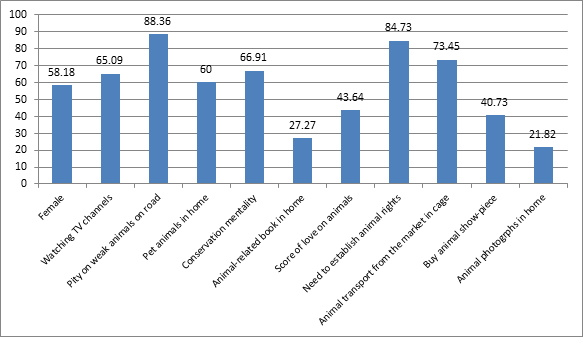
To conserve wildlife, this is very urgent to understand the mentality of people. This observation would show the exact scenario of the affection of animals. The questionnaire method suggested significant results for 275 students (58.18% female and 41.82% male) two 65.09% used to enjoy the animal-related channels. 88.36% of students showed sympathy for weak and stray animals, and their loving score on animals was 43.64%. In their house, they kept pet animals (60%). In addition, 66.91% showed a conservation attitude toward watching animal-related channels. Only 27.27% of students preserved some book on animals with their textbooks. Many students (84.73%) expressed a positive attitude toward establishing animal rights for their conservation. When students carried those live animals from the market, most used a cage (73.45%). 59.27% of students were not involved in buying animal models from the markets, and 78.18% had no animal photographs on the wall in their residences. From childhood, many students engaged in keeping some domestic or wild animals in their homes.
Introduction
The relationship between wildlife and humans and their conflicts are prehistoric [1]. Humans used to hunt wild animals from nature as their so-called aristocratic hobby [2]. Sometimes they captured live animals or their young and kept them home as a pet. Through this domestication, they pet many carnivore and herbivore animals as well. Many renowned documentary films prove the remarkable association between humans and animals in many geographical areas. Humans have instincts, so most of them like nature and natural resources. Animals are the source of infinite fascination- historical, scientific, and mythological [3]. Kellert, et al. [4] found that the most preferred animal groups were domesticated and game animals. Wildlife can experience interactions with both positive and negative people [5]. Human expectations of wildlife management shift with changing public perceptions of the values and threats associated with wildlife species themselves [6]. In this modern era, animal-related channels are a popular event for all ages together with the students. They could learn many things about the animals, especially their behavior and importance. The Dodo, Nat Geo Wild, BBC World, Brave Wilderness, Animal Aid Unlimited, Animal Planet, Real Wild, iPanda, Hope for Paws, and Kruger Sightings are popular animal-related channels in the world. Television is a primary source of scientific and technical information for Americans [7]. It has the potential effect on viewers’ thinking and feelings [8]. To protect biodiversity, watching animal-related channels could play a role in conservation. In many events in Bangladesh, people raise pigeons for any inauguration [9]. Famous people kept pigeons and other animals [10]. The objective of this study is to remark on the animal fascinations of intermediate college students of Bangladesh through some questions.
Materials and Methods
Cantonment Public School and College, Saidpur is one of the renowned educational institutes of Bangladesh. During classes, their part of the subject Zoology was possible to take some information on their fascination with animals. As a science teacher in four sections, 275 students (17-19 years) have participated in the following exam. Individuals were very cordial in those classes for answering the adherents’ questions.
| Answers | |
|---|---|
| Do you watch animal-related channel? | Yes |
| Do you watch animal-related channel? | No |
| What do you do when see ill animal on the street? | Inform vet |
| What do you do when see ill animal on the street? | Avoid |
| What do you do when see ill animal on the street? | Feel pity |
| Do you have pet? | Yes |
| Do you have pet? | No |
| During watching animal channel, how do you feel? | For their conservation |
| During watching animal channel, how do you feel? | Try for a job there |
| During watching animal channel, how do you feel? | Make a documentary film |
| Do you have books about animals? | Yes |
| Do you have books about animals? | No |
| Score your love on animals | 1 |
| Score your love on animals | 2 |
| Score your love on animals | 3 |
| Score your love on animals | 4 |
| Do you think that animals should be occupied with the same rights as humans? | Yes |
| Do you think that animals should be occupied with the same rights as humans? | No |
| How you carry live animal from the market? | In cage |
| How you carry live animal from the market? | By hanging |
| Do you buy show-piece of animal? | Yes |
| Do you buy show-piece of animal? | No |
| Do you have any animal portrait/animal photograph in your house? | Yes |
| Do you have any animal portrait/animal photograph in your house? | No |
Table 1: Questions for the survey.
Results and Discussion
A result showed that from ages 18 to 29 years, their participation was 31.09%, ages 30-49 were 32.17%, and 50- 64 years 27.65% [11], whereas this report completed only ages 17-19 with on average participation 65.09% differs significantly though here students were 275 where Dhingra, et al. [8] studied on 63 students with different parameters. The wildlife television documentary has a beneficial impact but problem genre between education and entertainment. The market context of television wildlife programming means that education and entertainment aims and claims are indeed in tension, but with a counter-intuitive outcome [12]. The experiences are comparable when a person is injured and then culled (Burns & Howard, 2003) or when interactions enhance wildlife conservation [13]. For humans’ bodily protein demand, they hunted those animals, and that activity led to some extinction of animals as well. While in front of the television, a child can have an extreme close-up view of a ferocious animal [14]. There are many therapeutic uses of animal meat, skin (hide), horn, feather, fur, wool, hoof, and teeth in Bangladesh [15].
Conclusion
Students are our future biodiversity conservationists. From this perspective, this type of motivational exam in their classes keeps an authentic record of domestic or wild animals. Television watching is our hobby to gather knowledge on various episodes on animals. Some people in the country are involved feed street animals cordially. Animal keeping is a common hobby in all aged people. Human-animal interaction influences our sympathy for them. Pet animals are common in most houses with proper care. In this way, students could attach to their conservation. Online supplements, books, and articles are the raw materials that promote knowledge about many animals. Animal transporting cages can use for any short or long distances. Animal fascinations have come in this way from their childhood. Their classes are an excellent place to deliver that information to their teachers. Our local markets import animal showpieces and portraits that carry a significant footstep to increase animal affection. Animal channels with many projects are upgrading day by day, and finally, within the motivation by the teachers, the conservational situation of animals could go up. Students’ perceptions and feelings were positive toward animals as a whole.
References
-
Kabir MA (2019a) Wildlife-human conflicts in some parts of Bangladesh. International J of Research Studies in Zoology 5(2): 8-14.
-
Kabir MA (2019b) Birds were hunted through making trap in the past in Bangladesh. EC Veterinary Science 4(8): 681-683.
-
Hooper R (2013) David Attenborough: animals are a source of infinite fascination. NewScientist.
-
Kellert S (1996) The Value of Life: Biological Diversity and Human Society. Island Press, Washington, D. C.
-
Herda Rapp A, Goedeke T (2005) Mad About Wildlife: Looking at Social Conflict over Wildlife. Boston, Brill.
-
Burns GL (2006) The fascination of fur and feathers: managing human-animal interactions in wildlife tourism settings. Australian Zoologist 33(4): 446-457.
-
National Science Board (1998) Science & engineering indicators—1998. Arlington, VA: National Science Foundation.
-
Dhingra K (2003) Thinking about television science: how students understand the nature of science from different program genres. Wiley Periodicals, Inc, J. Research Science Teach 40(2): 234-256.
-
Kabir A, Hawkeswood TJ (2022) Brief communication on the release of doves in some human events. Calodema 987: 1-3.
-
Kabir MA (2018) Famous people and their pet animals. J of Zoological Research 2(3): 9-10.
-
Kunst A (2020) Share of Americans who watched animal planet in the past month in 2018, by age.
-
Dingwall R, Aldridge M (2006) Television wildlife programming as a source of popular scientific information: a case study of evolution. SAGE Journals 15(2): 131-152.
-
Higginbottom K, Tribe A (2004) Contributions of wildlife tourism to conservation. In: Higginbottom, K (Ed.), Wildlife Tourism: Impacts, Management and Planning 1st (Edn,), Common Ground Publishing, Brisbane, Australia, pp: 99-124.
-
Sarkar S (2019) Of zoos and TV’s animal channels.
-
Kabir M A (2014) Superstitions and traditional uses of animal in Bangladesh. Standard Research Journals 1(1): 5-8.
-
Burns GL, Howard P (2003) When wildlife tourism goes wrong: A case study of stakeholder and management issues regarding dingoes on Fraser Island, Australia. Tourism Management 24(3): 699-712.
- In Situ Evaluation of the Anthelmintic Effect of the Aqueous Extract of Syzygium aromaticum (L) Merr and Perry on Bovine Strongyles
- Successful in Vitro Embryo Production with Oocytes Aspirated from Live White-Tailed Deer (Odocoileus Virginianus Texanus) Donors under Captivity in Northeast Mexico
- Bangladeshi Finches with their Evolutionary Thoughts (Aves: Passeriformes)
- Note on the Survival Status of Przewalski’s Horse, Equus ferus przewalskii (Perissodactyla: Equidae)
- In-Situ and Ex-Situ Protection of White-Breasted Waterhen (Amaurornis Phoenicurus) (Pennant, 1769) (Aves: Rallidae)
- Meat Examination in the Laboratory, the Acceptability and the Human Health