
Effects of Kinesiology Taping on Sleep Quality in Participants with Cronical Low Back Pain
Our main aim in this study is to compare the effectiveness of conventional physical therapy in the context of sleep quality of participants with chronic low back pain and the effectiveness of kinesiology taping applied to the waist area in a very short time. 40 participants (30 females, 10 males) whose age ranges ranged from 25 to 50 years were randomly divided into two groups (banding group and control group). In both groups, a home exercise program was given by applying therapeutic ultrasound for 5 minutes, TENS (Transcutaneous Electrical Nerve Stimulation) for 30 minutes and infrared for 30 minutes. In kinesiology taping groups, taping was applied to the waist region with the star technique, once for 48 hours. VAS (Visual Analog Scale) for pain, hip flexor flexibility test and hand-finger floor distance test for flexibility, Berg balance scale for balance, Beck anxiety scale for anxiety, Oswestry disability index for disability level, Tampa kinesiophobia scale for kinesiophobia, sleep quality Pittsburg sleep quality index and Nottingham life profiles were used for quality of life. Evaluations were made twice, before and after the treatment. The significance level was accepted as p <0.05.
Introduction
Depending on the duration of the symptoms, low back pain is called acute if it lasts less than 1 month, subacute if it lasts for 1-3 months, and chronic if it lasts more than 3 months [1]. With another definition, muscle tension in the region between the lower costal border and the upper inferior gluteal folds can be called. Although low back pain has become an important problem worldwide, 60-80% of the world’s population is faced with low back pain at some point in their lives. It has also been reported that approximately 23% of this low back pain is chronic low back pain [2, 3]. It is seen that 80% of patients with acute low back pain recover within 6 weeks, while 7-10% of them last longer than 3 months and become chronic, causing great labor and economic damage [4].
Chronic low back pain is a condition that limits the daily life activities and movements of the person, affects walking, dressing and social life, in short, reduces the quality of life. Anxiety has been reported to accompany chronic pain. Studies have also found a highly significant relationship between chronic pain and sleep quality [4].
There is no standardized treatment approach for the treatment of chronic low back pain [5]. There are many options ranging from conservative treatment to surgery. Physiotherapy agents, exercise programs, kinesiology taping, medical therapy, dry needle, yoga, pilates and surgical treatments are the most frequently used treatment methods [6].
Kinesiology taping technique was developed in 1973 by Dr. Developed by Kenzo Kase. The emergence philosophy of the method is that it is a taping method that does not prevent joint movements and resembles the structural features of human skin [7]. Kinesiology taping, which has not only a therapeutic role but also a preventive role in athletes, is supported by positive results in many studies that it increases functionality and helps reduce pain [8]. They mentioned some positive effects depending on the degree of tension applied to the band. These effects; To send signals to the central nervous system by stimulating mechanoreceptors through the skin, to create a positional warning by creating folds in the area where the tape is applied, to create more space by removing the fascia and skin and subcutaneous soft tissues on the painful or inflamed area with these folds, and by reducing the pressure in the area is to create a sensory stimulus to limit or increase movement. With the decreased pressure and increased blood circulation, the stimulation of pain receptors in the painful area is prevented. Thus, it is possible to move without pain [7].
Sleep is one of the basic physiological needs of humans, which ensures the continuity of human health [9, 10]. Sleep is also accepted as an important variable of health, affecting an individual’s quality of life and well-being [11, 12].
Sleep quality is also a concept that is emphasized in clinical research and applications today. The reason for this is that sleep-related complaints are increasing day by day and poor sleep quality may be a symptom of many medical diseases [13]. In addition to productivity and efficiency, functions such as memory and concentration are also positively affected by sleep quality [10, 14].
In the literature, the effect of kinesiology taping, which is used in the treatment of chronic or acute low back pain, on pain, physical competence and well-being has been questioned [15, 16]. Although it is known that sleep quality also affects chronic low back pain, there is no study in the literature investigating the effects of chronic low back pain and kinesiology taping on sleep quality parameters [4]. The aim of this study is to investigate the effectiveness of conventional physical therapy and kinesiology taping in addition to conventional treatment on pain, flexibility, balance, anxiety, disability, kinesiophobia, sleep quality and quality of life in patients with chronic low back pain.
Our hypotheses are as follows: Hypothesis 1: The sleep quality of the participants in the kinesiology taping group will differ according to the group that received only conventional physical therapy. Hypothesis 2: Pain, disability and quality of life will be different in the participants in the kinesiology taping group compared to the group that only received conventional physical therapy. Hypothesis 3: Anxiety and fear of movement will be different in the participants in the kinesiology taping group compared to the group that only received conventional physical therapy.
Case Report
Participants
A total of 40 patients with low back pain lasting longer than 3 months, who applied to the Medical Park Hospital Physical Therapy and Rehabilitation Department between 20 May and 20 December 2020, were included in the study. These 40 patients were randomly divided into banding group (n=20) and control group (n=20) by computer program.
All participants were treated with conventional chronic low back pain treatments such as US (4 min), TENS (30 min), infrared (30 min) and home exercise program treatment, and in addition to the taping group, kinesiology taping treatment with area correction technique was applied [17]. Evaluations were applied twice, before and after the treatment.
Admission criteria for research:
- Those over the age of 18 who agrees to participate in the research
- Those with low back pain for at least 3 months
- Those that have not had spine or lower extremity surgery
- Those that do not have any other musculoskeletal disorder affecting the lower extremity
- Individuals who regularly come to check and evaluate the physical therapy program The criteria for not being accepted into the study
- Those who have undergone spinal surgery
- Those who complain of low back pain due to inflammatory, tumoral, metabolic causes
- Those with orthopedic or neurological problems that prevent treatment
- Pregnant women
Research Materials and Methods
Evaluatıon
All of the patients in both treatment groups were evaluated by the physiotherapist before and after the treatment. It was recorded in the clinical trial follow-up form.
Pain in the lower back by Visual analog scale (VAS), flexibility; hip flexor flexibility test and hand-finger-to- floor distance tests (EPZM), balance by Berg balance scale (BDI), anxiety by Berg anxiety inventory (BAI), disability by Oswestry disability index (SAI), kinesiophobia by Tampa Chi- nesiophobia Scale (TKS), sleep quality was measured with the Pittsburg Sleep Quality Index (PUKI), and quality of life was measured with the Nottingham Health Profile (NSP).
Treatment
In addition to 15 sessions of US (4 min), TENS (30 min), infrared (30 min) and home exercise program to the patients in the taping group, four 5 cm wide 0.5 mm thick I tapes with 25% tension were applied to the point where the pain is felt most, with a star-shaped kinesiological examination. banding was applied. Taping (Figure 1) was applied once on the first day of the treatment, staying on the skin for 48 hours [18].
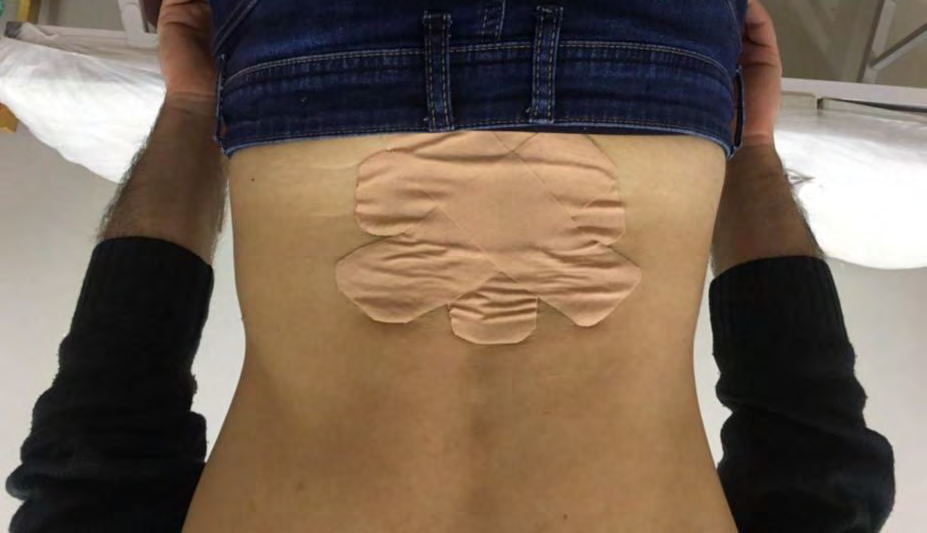
The patients in the control group received only 15 sessions of classical physical therapy modalities, including US (4 min), TENS (30 min), infrared (30 min) and home exercise program.
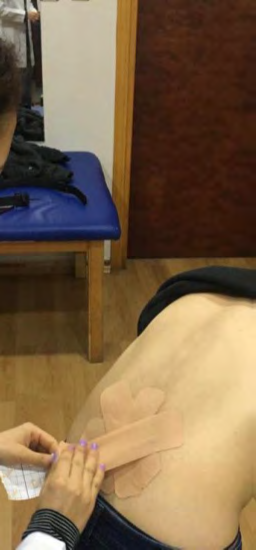
The application was made by the researcher with kinesiology taping (Figure 2) certificate.
Both groups were given a home program consisting of passive lumbar flexion (single and double leg stretching), hamstring stretching, pelvic tilt exercise, bridging, straight leg lifting, hip and back extensors strengthening exercises for 15 days. The patients were asked to perform the exercise program twice a day. The patients were informed to modify their daily living activities according to chronic low back pain. Evaluations were made before and 48 hours after treatment [19].
SPSS 21.0 for Macbook was used to evaluate the data. Mean, standard deviation and percentile distribution were given for the analysis of descriptive information. The shapiro- wilk test was used to determine whether the data showed normal distribution or not. Intra-group comparisons of normally distributed data were made with the paired sample t-test, and between-group comparisons were made with the independent sample t-test. Intra-group comparisons of data that did not show normal distribution were made using the wilcoxon, and between-group comparisons were made using the mann-whitney u test. Significance level was accepted as p<0.05.
Findings
When the demographic data of the participants were examined, a statistically significant difference was found between the mean ages (p <0.05).
When the distribution of the patients according to their education level is examined, there is no statistically significant difference. When the patients were examined according to their marital status, there was no statistically significant difference. There is no statistically significant difference when compared in terms of job status. Other demographic data are given in Table 1.
| BG N=20 | CG N=20 | P | |||
|---|---|---|---|---|---|
| Age | 42,1 ± 6,72 | 37,6 ± 9,42 | 0,037* | ||
| Sex | Female | 14 (%70) | 16 (%80) | 0,716 | |
| Sex | Male | 6 (%30) | 4 (%20) | ||
| Educational Status | Primary school | 5 (%25) | 4 (%20) | 0,756 | |
| Educational Status | Middle school | 7 (%35) | 5 (%25) | ||
| Educational Status | High school | 6 (%30) | 7 (%35) | ||
| Educational Status | University | 2 (%10) | 4 (%20) | ||
| Marital status | Married | 17 (%85) | 17 (%85) | 0,144 | |
| Marital status | Single | 3 (%15) | 3 (%15) | ||
| Working condition | Working | 8 (%40) | 8 (%40) | 0,744 | |
| Working condition | Not working | 12 (%60) | 12 (%60) |
Table 1: Demographic Data Table.
Paired Sample T Test *p< 0,05 Table 1: Demographic Data Table.
Comparisons of the participants’ activity, rest and night pain taping group are given in Table 2.
| BG N=20 | P | ||
|---|---|---|---|
| Rest Pain | Before Treatment | 6,8±2,26 | 0,055 |
| Rest Pain | After Treatment | 4,3±1,83 | |
| Activity Pain | Before Treatment | 5,6±2,49 | 0,000* |
| Activity Pain | After Treatment | 3,3±1,89 | |
| Night Pain | Before Treatment | 5,4±2,54 | 0,000* |
| Night Pain | After Treatment | 3,3±2,13 |
Table 2: Comparison of Banding Group Pain Findings.
Paired Sample T Test *p<0,05 BG: Banding group, KG: Control group Table 2: Comparison of Banding Group Pain Findings.
In the control group, there was a statistically significant difference in activity, rest, and night pain before and after treatment (p <0.05) (Table 3).
| CG N=20 | P | ||
|---|---|---|---|
| Rest Pain | Before Treatment | 5,4±1,93 | 0,001* |
| Rest Pain | After Treatment | 3,9±1,84 | |
| Activity Pain | Before Treatment | 5,2±1,71 | 0,000* |
| Activity Pain | After Treatment | 3,5±1,09 | |
| Night Pain | Before Treatment | 4,3±2,39 | 0,000* |
| Night Pain | After Treatment | 2,6±1,53 |
Table 3: Control Group Pain Data Table.
Paired Sample T Test *p<0,05 BG: Banding group, KG: Control group Table 3: Control Group Pain Data Table.
A statistically significant difference was found between the two groups in favor of the control group in terms of pain intensity in activity before treatment (p <0.05).
There was no statistically significant difference in activity pain intensity after treatment, rest pain intensity before and after treatment, and night pain severity before and after treatment (p>0.05) (Table 4).
Pain data between groups are given in Tables 4 and 5.
| BG N=20 | CG N=20 | |||
|---|---|---|---|---|
| Rest Pain | Before Treatment | 6,8±2,26 | 5,4±1,93 | 0,049* |
| Rest Pain | After Treatment | 4,3±1,83 | 3,9±1,84 | 0,552 |
| Activity Pain | Before Treatment | 5,6±2,49 | 5,2±1,71 | 0,559 |
| Activity Pain | After Treatment | 3,3±1,89 | 3,5±1,09 | 0,613 |
| Night Pain | Before Treatment | 5,4±2,54 | 4,3±2,39 | 0,167 |
| Night Pain | After Treatment | 3,3±2,13 | 2,6±1,53 | 0,241 |
Table 4: Comparison of Pain Findings between Groups.
Independent T-Test *p<0,05 Table 4: Comparison of Pain Findings between Groups.
When the banding group is examined; A significant difference was found in hip flexor flexibility before and after treatment (p <0.05). There was a significant difference in waist flexor flexibility before and after treatment (p <0.05).
When the control group is examined; There was no significant difference in hip flexor flexibility before and after treatment (p >0.05). There was a significant difference in waist flexor flexibility before and after treatment (p <0.05).
In comparisons between groups; the difference in flexibility parameter did not reach statistical significance (p>0.05).
BG N=20 CG N=20 p*
Hip flexor flexibility
Before Treatment 6,8±2,26 5,4±1,93 0,049*
$$ After Treatment 4, 3 \pm 1, 8 3 3, 9 \pm 1, 8 4 0, 5 5 2 $$
pw 0,020* 0,942 Waist flexor flexibility Before Treatment 5,6±2,49 5,2±1,71 0,559 $$ After Treatment 3, 3 \pm 1, 8 9 3, 5 \pm 1, 0 9 0, 6 1 3 $$ pw 0,023* 0,026*
- Wilcoxon and Paired Sample Test
- * Significance level between groups p<0.05 w Within-group significance level p<0.05
- BG: Banding group, KG: Control group
Table 5: Comparison between Hip flexor flexibility and Waist flexor flexibility.
In comparisons between groups; Although there was no significant difference before and after treatment in BDI, BAI, PAI, and PUKI, there was a significant difference before and after treatment in TKO and NSP, but not after treatment.
Although the findings of the Berg Balance Scale and Oswestry Disability Index were better in favor of the banding group, the difference obtained compared to the control group did not reach the statistical significance level (Table 6).
BG N=20 CG N=20 p*
Hip flexor flexibility
Before Treatment 49,9±3,56 49,0±5,16 0,525
$$ After Treatment 5 0, 7 \pm 3, 6 5 4 9, 8 \pm 4, 6 1 0, 4 9 8 $$
pw 0,009* 0,145 Waist flexor flexibility Before Treatment 24,9±6,32 22,8±6,58 0,310 $$ After Treatment 1 7, 6 \pm 6, 1 5 1 9, 6 \pm 5, 3 5 0, 2 6 8 $$ pw 0,000* 0,000*
- Wilcoxon and Paired Sample Test
- * Significance level between groups p<0.05 w Within-group significance level p<0.05
- BG: Banding group, KG: Control group
Table 6: Findings of the Berg Balance Scale and Oswestry Disability Index within and between groups
Low back pain is one of the most common cases in the society and causes many medical and non-medical problems. Chronic low back pain brings a burden to the individual and the country’s economy with its diagnosis and treatment [20].
In our study, the effects of kinesiology taping applied to patients with chronic low back pain on pain, flexibility, balance, anxiety, disability, kinesiophobia, sleep quality and quality of life were investigated; Kinesiology taping was found to be effective on quality of life and kinesiophobia.
In the comparison of the groups before and after the treatment, a positive relationship was found in the taping group on balance, anxiety, disability, kinesiophobia, sleep quality and quality of life. In the control group, there was a significant relationship between anxiety, disability, kinesiophobia, sleep quality and quality of life, except for the balance parameter.
In the evaluation between groups, a decrease in fear of movement (kinesiophobia) and an increase in quality of life and a decrease in pain findings were observed before treatment.
In our study, in the evaluation between groups, all values were found to be better in favor of the banding group, but it was seen that the difference obtained compared to the control group did not reach the level of statistical significance.
Instead of passive treatment methods in chronic low back pain, education programs in which the patient actively participates in the treatment, back mobility is provided and the patient is taught the methods of protecting the back are more preferred..
The prevalence of low back pain varies with age. In a cohort study, it was determined that the prevalence was highest between the ages of 40-60. Low back pain usually begins in the third decade of life, peaking at 55-60 years of age, and its prevalence begins to decline thereafter. In a study conducted by Karkucak et al. on patients with low back pain, the age distribution was determined as 45-54 years. In the study of Ketenci et al. with 1120 low back patients, the mean age was found to be 38.92 years. Most of the studies in the literature also support this situation.
In our study, the mean age of the banding group was significantly different, and parallel results were obtained with the literature.
Studies have found that low back pain is seen at the same rate in men and women. Heliovara et al. In their study, they found that the incidence of low back pain was equal between the groups, but when other factors were taken into account, it was more common in women. Ketenci et al. reported that more than half of the 218 patients with chronic low back pain enrolled in back school programs were women. Frymoyer et al. (1983) reported that the incidence of low back pain was higher in women, and they attributed this to the fact that women were more sensitive to body symptoms. In addition, factors such as women’s fertility characteristics, differences in biological factors, pain sensitivity and psychological factors are thought to be effective in the high rate of female participants.
In our study, the rate of women in the taping group and control group was more than half, and the results we found are in line with the literature.
Yang et al. (2012), 23 stroke patients participated in the study in which they investigated the effect of kinesiology taping on balance and walking in stroke patients. They divided the patients into two groups and applied a conventional physiotherapy program with taping to the patients in the first group, and applied only a conventional rehabilitation program to the patients in the second group. As a result of the study, it was seen that more effective results were obtained in the patients in the first group. In this context, it has been stated that kinesiology taping is an effective method in providing gait disorders and balance.
Kinesiology taping is also used in peripheral nerve diseases to increase functional functionality [18]. Cortesi et al. (2011) examined the effect of ankle kinesiology taping on balance parameters in patients with multiple sclerosis and showed that kinesiology taping had a significant effect on balance. This study is promising in terms of the use of taping in the treatment of balance disorder.
When we looked at the in-group values, we saw that there was a positive effect on the balance in the taping group before and after the treatment, but there was no positive effect on the balance score of the control group.
When we looked at the values between the groups, we saw that there was no effect in the banding and control groups before and after the treatment. So we can’t say that there is a relationship between balance and taping. As a reason for this, we can count the limitations of our study. The unsuitable environment in which we work and the fact that our measurements were not made with sensitive devices may have revealed this result.
In our study, there was a correlation between activity pain and balance score after treatment in the control group. As the level of pain increases, the balance score also increases, that is, the balance of the individual is impaired.
Depression often accompanies the symptoms in chronic low back pain diseases. Studies have reported that depression symptoms are more common in people with chronic pain compared to the healthy population, and that the functionality of patients with chronic low back pain is restricted due to pain, and the resulting disability triggers the depressive mood in patients, causing the feelings of sadness and pessimism to settle, and the motivation of the person to decrease.
The distress, anxiety and anxiety caused by the pain and limitation of movement experienced by patients with low back pain affect the quality of life negatively as they limit the daily life activities and social activities of the person. Studies show that both low back pain and anxiety-depression as a result of low back pain reduce the quality of life. In our study, however, no significant relationship was found between anxiety and quality of life.
Today, sleep quality is a concept that is emphasized in clinical practice and scientific research. As the reasons for this; The prevalence of sleep-related complaints can be shown as the possibility that poor sleep quality may be a symptom of many medical diseases, and the strong relationship between sleep health and physical and psychological well-being.
In a study conducted on 15 healthy and 15 low back pain patients to evaluate sleep quality in chronic low back pain, the findings were monitored for 3 nights and sleep patterns were recorded. According to the results of the study; It has been observed that sleep and sleep efficiency are poor in patients with chronic low back pain. While there was a strong relationship between pain and objective sleep measurement in the chronic low back pain group, it was reported that there was no relationship between sleep and quality of life.
In our study, no correlation was found between sleep and quality of life in the taping group. In the control group, a significant correlation was found before and after the treatment.
In a case-controlled study of sleep quality in patients with chronic low back pain, the Pittsburg sleep quality index value was found to be significantly higher in patients with chronic low back pain compared to the control group. It has been reported that there is a correlation between the Pittsburg sleep quality index and sleep disturbance.
Results
The results obtained from this study;
- Considering the occupational distribution of the groups, it was seen that there was a high rate of housewives.
- Considering the distribution of the groups in our study according to their diagnoses, it was observed that patients diagnosed with intervertebral disc displacement were included in our study at a higher rate.
- In our study, there was an increase in hip and waist flexibility in the taping group, and an increase in waist flexibility in the control group.
- Pre-treatment activity pain was better in the control group in patients with chronic low back pain.
- It was observed that kinesiology tape application applied in patients with chronic low back pain had positive effects on quality of life and kinesiophobia.
- Kinesiology tape application in patients with chronic low back pain was not found to have an effect on flexibility, balance, anxiety, and sleep quality.
Kinesiology taping applied in the waist area; We think that it can be used in patients with chronic low back pain due to its positive effects on pain, flexibility, balance, anxiety, sleep quality, and kinesiophobia and quality of life.
In future studies, we think that it may be beneficial to carry out kinesiology taping by evaluating different performance parameters in terms of gender reassignment.
References
-
Deyo RA, Rainville J, Kent DL (1992) What can the history and physical examination tell us about low back pain? JAMA 268(6): 760-765.
-
Borenstein DG (1994) Low-back pain. In: Klippel JH, Dieppe PA, (Eds). Rheumatology London: Mosby-Year Book Limited, Section 5:5. pp: 1-26.
-
Felson DT (1997) Epidemiology of the rheumatic diseases. In: Koopman WJ, MvVarty DJ, (Eds) Arthritis and Allied Conditions. Baltimore: Wlliams & Wilkins, 3-34.
-
Björnsdóttir SV, Jónsson SH, Valdimarsdóttir UA (2013) Functional limitations and physical symptoms of individuals with chronic pain. Scand J Rheumatol 42(1): 59-70.
-
Cox JM (1991) Loew back pain: Mechanism, diagnosis and treatment, Baltimore pp: 597-629.
-
İnanıcı F (2011) Bel Ağrısı Nedenleri ve Muayenesi. In: Beyazova M. Gökçe Kutsal Y, (Eds.) Fiziksel Tıp ve Rehabilitasyon; Güneş Tıp Kitapevleri 18(4): 2053-2066.
-
Kase K, Wallis J, Kase T (2003) Clinical therapeutic application of the kinesiotaping method. Tokyo, Japan: Ken Ikai Co Ltd.
-
Fraizer S, Whitman J, Smith M (2006) Utilization of kinesio tex tape in patients with shoulder pain or dysfunction: a case series. Advanced Healing; Summer: 18-20.
-
Uran G (2001) Kırsal kesimde evde ve huzurevlerinde kalan 60 yaş üzeri yaşlılarda pittsburg uyku kalitesi indeksi ile uyku kalitelerinin karşılaştırılması. Yüksek Lisans Tezi, Gazi Üniversitesi, Ankara.
-
Öztürk M (2003) Hastanede yatan yetişkin hastaların uygu gereksinimlerini etkileyen faktörlerin incelenmesi. Çukurova Üniversitesi Sağlık Bilimleri Enstitüsü, Yüksek Lisans Tezi, Adana.
-
Engin E, Özgür G (2004) Yoğun bakım hemşirelerinin uyku düzen özelliklerinin iş doyumu ile ilişkisi. Ege Üniversitesi Hemşirelik Yüksekokulu Dergisi 20(2): 45- 55.
-
Ertekin Ş, Doğan O (1999) Hastanede yatan hastalarda uyku kalitesinin değerlendirilmesi. VII. Ulusal Hemşirelik Kongresi Kitabı). Erzurum pp: 222-227.
-
Keshavarz Akhlaghi, AA, Ghalebandi MF (2009) Sleep Quality and Its Correlation with General Health in Pre- University Students of Karaj, Iran. Iranian Journal of Psychiatry and Behavioral Sciences 3(1): 44-49.
-
Potter PA, Perry AG (2005) Fundementals of Nursing, (6th Edn.), Elsevier mosby, St. Louis pp: 1198-1227.
-
Paoloni M, Bernetti A, Fratocchi G, Mangone M, Del Pilar Cooper M, et al. (2011) Kinesio Taping applied to lumbar muscles influences clinical and electromyographic characteristics in chronic low back pain patients. Eur J Phys Rehabil Med 47(2): 237-244.
-
Hwang-Bo G. ve Lee JH (2011) Effects of Kinesio Taping in a physical therapist with acute low back pain due to patient handling: A case report. Int J Occup Med Environ Health 24: 320-323.
-
Tantawy Sayed A, Kamel Dalia M (2016) The effect of kinesio taping with exercise compared with exercise alone on pain, range of motion, and disability of the shoulder in postmastectomy females: a randomized control trial. J Phys Ther Sci 28(12): 3300-3305.
-
Kalichman L, Vered E, Volchek L (2010) Relieving symptoms of meralgia paresthetica using kinesio taping: A pilot study. Arch Phys Med Rehab 91(7): 1137-1139.
-
Olga Velasco-Roldán, Inmaculada Riquelme, Alejandro Ferragut-Garcías, Alberto Marcos Heredia-Rizo, Cleofás Rodríguez-Blanco et al. (2018) Immediate and Short- Term Effects of Kinesio Taping Tightness in Mechanical Low Back Pain: A Randomized Controlled Trial. PMR Journal 10(1): 28-35.
-
Özdinçler AR, Kubat E (1998) The effectiveness of different exercise methods in mechanical low back pain without neurological deficit. Physiotherapy Rehabilitation 9(10): 22-32.
- Return to Work Among Manual Workers After the Latarjet Procedure: A Cohort Study of 43 Patients
- Refractory Pelvic Collection Following Modified Stoppa Approach for Both-Column Acetabular Fracture Fixation: A Case Report
- Comparative Study of Dynamic Knee Phenotypes Under Loaded and Unloaded Conditions: Clinical Impact
- Locked Intramedullary Nailing of the Tibia Using a Humeral Nail: A Care Case Report
- Subtalar Dislocation: About a Case Report
- Surgical Site Infection in Orthopedics in a Country with LimitedResources: Indications, Treatment and Results