
Effect of Selected Yogic Asanas on Lumbar Spondylosis: A Systematic Review
Introduction: Lumbar spondylosis most commonly occurs at the L4- L5 and L5-S1 vertebral level. It’s prevalence has increased in recent years across the middle age groups. Non pharmacological and non-invasive interventions like Yogic Asanas are economical and effective in Lumbar spondylosis. Almost 266 million (3.63%) cases are observed per year worldwide, which is a major cause of morbidity. Degenerative changes in the intervertebral joints can start after 40 years of age which become more common around 45 years of age. Approximately 10% of the adult population suffers from symptomatic lumbar spondylosis, with women and men affected equally. Aim & Objectives: To study and analyze the role of Yogic Asanas in the clinical management of lumbar spondylosis Materials and Methods: Screening of relevant material from the classical texts of Yoga. Systematic search of Pubmed, Google Scholar and other resources for published articles on Lumbar spondylosis and its management through Yoga and similar physical therapies. Discussion: A painful condition that puts stress on the muscles and bones of lumbar region is called lumbar spondylosis. In addition to limiting mobility, the medical condition additionally impacts quality of life. It may be caused by trauma, prolonged bike riding, poor sleeping habits, poor posture when sitting, and lack of physical activity. Numerous Yoga poses can help in lumbar spondylosis and offer particular therapeutic benefits for people with lumbar spondylosis. Conclusion: After a thorough review, reading and analyzing previous researches it can be concluded that physical, physiological, cognitive, and emotional levels are all affected by Yoga. Yogic Asanas are very much effective in improvement and strengthening the muscles of back, endurance and tone of whole back. Regular practice of Yoga poses stimulates many body parts, including the organs, muscles, joints, ligaments, vessels, and nerves. This is especially beneficial for treating lumbar spondylosis.
Introduction
Spondylosis, is a general term for age related wear and tear phenomenon of spinal discs. It is also known as spinal osteoarthritis, which affects lumbar region, since the lumbar spine carries most of the patient’s weight. Lumbar spondylosis most commonly occurs at the L4- L5 and L5- S1 vertebral level. Degenerative change in the spine is a universal phenomenon of aging. Lumbar spondylosis is caused by degeneration of lumbar disc vertebral bodies, the neural foramina and the facet joints. As the lumbar discs and associated ligaments undergo aging, the disc spaces frequently become narrow. Thickening of the ligaments that surround the disc and those that surround the facet joints develops with aging. This ligamentous thickening may eventually become calcified and this leads to narrowing of the spinal canal or of the openings through which the spinal nerves leave. Present article focuses on the systematic review of Lumbar Spondylosis and therapeutic application of Yogic Asanas in degenerative spinal disorders. Primarily the author made a review in therapeutic aspect of Yogic Asanas mentioned in Yogic literatures.
Aim
To study the role of Yogic Asanas in the management of lumbar spondylosis
Objectives
1) Systematic search of classical texts and research studies related to Yogic Asanas and lumbar spondylosis
2) To analyze the role of Yogic Asanas in the clinical management of lumbar spondylosis.
Materials and Methods
Screening of relevant material from the classical texts of Yoga. Systematic search of PubMed, Google Scholar and other resources for published articles on Lumbar spondylosis and its management through Yogic intervention and similar physical therapies. A thorough search of reference lists to identify relevant studies and their full paper analysis. The Manuscripts exploring the effect of Yogasanas on Lumbar Spondylosis were reviewed. Yoga postures supporting for rejuvenation and improving the Quality of life are also reviewed in this article.
Incidence
Almost 266 million (3.63%) cases are observed per year worldwide, which is a major cause of morbidity. In low to middle income countries like India, the incidence is up to four times higher than the high income countries/developed countries [1]. Although a very small percentage of these patients need surgical intervention, the overall number of such patients is soaring due to the enormous expanding Indian population.
Prevalence
According to a systematic review done by Jeffries LJ,et al.[2], idiopathic spinal pain was the most commonly reported with a lifetime prevalence ranging from 4.7-74.4% [3].
Epidemiology
O’Neill TW et al stated that in Spondylosis, degenerative changes in the intervertebral joints can start after 40 years of age which become more common around 45 years of age. Available data signifies age factor in Spondylosis [4]. In another study by Symmons,et al. It was found that 85.5% of participants of age group 45–64 years demonstrate osteophytes within the lumbar spine [5]. Approximately 10% of the adult population suffers from symptomatic lumbar spondylosis, in which women and men affected equally. Among asymptomatic individuals radiographical evidence of degenerative disease of the lumbar spine is quiet impressive. MRI imaging in asymptomatic patients above 60 years age reveals 80% disk protrusions [6] and degenerative spinal stenosis in 20% [7]. A study comparing radiographic evidence of spine degeneration among categories of men who were without pain, with moderate pain, or with severe lower back pain found similar frequency of disk space narrowing and bone spurs among all three groups [8].
Etiological factors [9-12].
| Ageing | Genetic factors | Metabolic disorders |
|---|---|---|
| Torsion | Nutrition | Low-grade infection |
| Compression | Toxic factors | Neurogenic inflammation |
| Degeneration | Autoimmune theory | Mechanical factors |
Table 1: Showing Various Etiological factors.
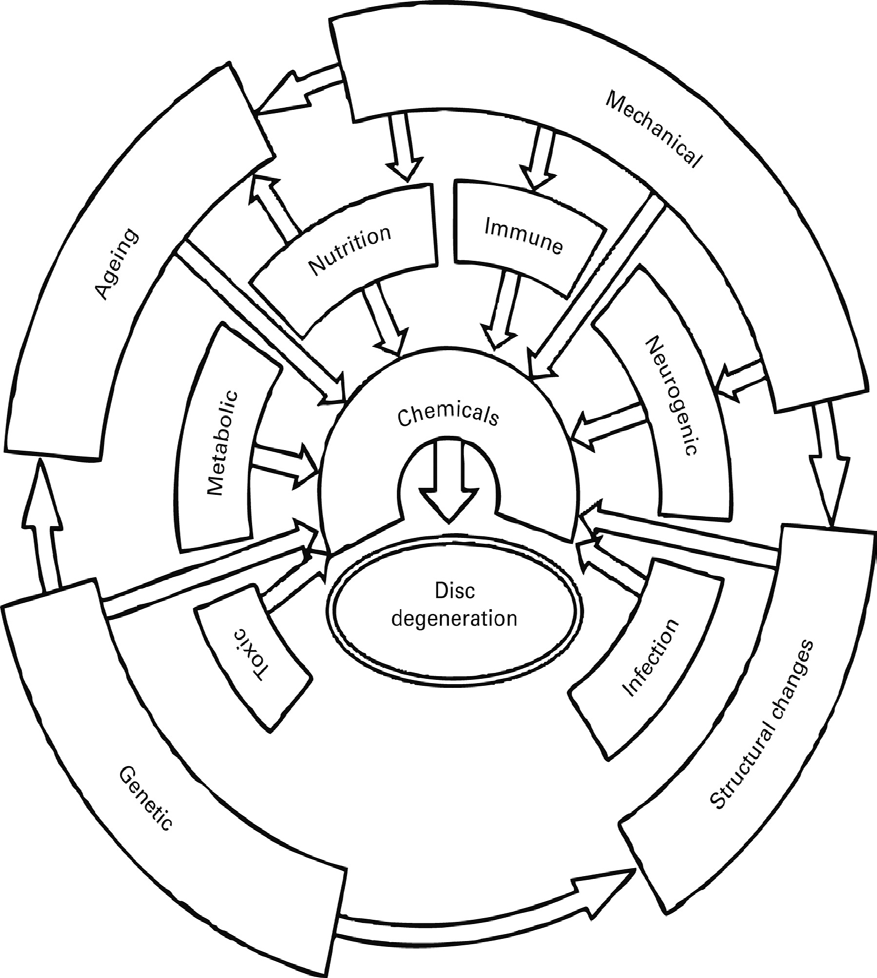
Pathophysiology [13]
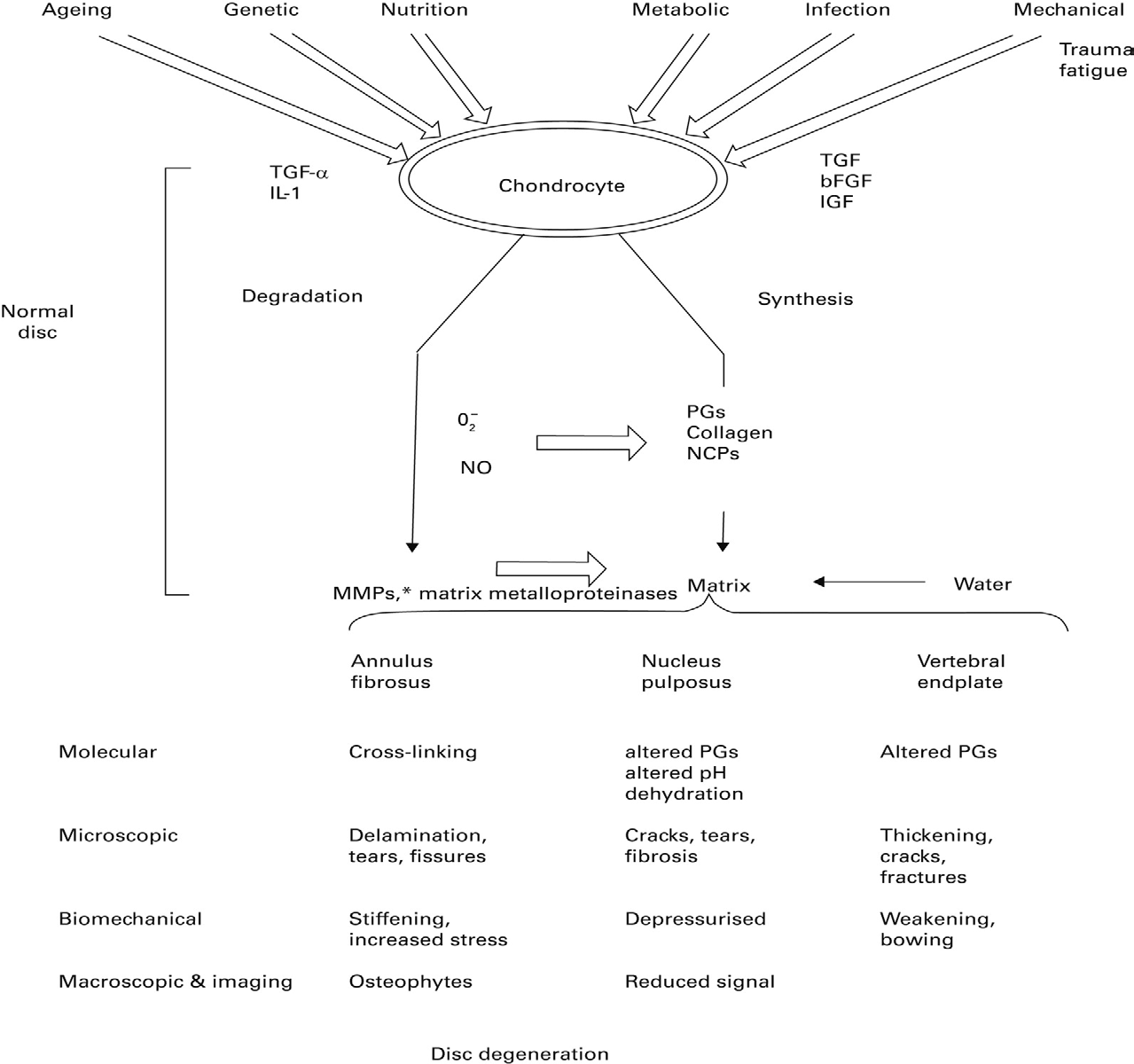
In a normal disc, the chondrocytes subserve a balance between the synthesis and degeneration of the matrix. synthesis is promoted by growth factors such a transforming growth factor (TGF), basic fibroblast growth factor (bFGF), and insulin-like growth factor(IGF). Degradation is activated by tumour necrosis factor-α (TNF-α) and interleukin-1 (IL-1), supplemented by superoxide (O2) and nitric oxide (NO). This balance can be disturbed in favour of degradation by a number of aetiological factors. That degradation can be expressed by various features at molecular, microscopic, biomechanical, and macroscopic levels, and some can be demonstrated by medical imaging” (*MMPs, matrix metalloproteinases)
Clinical Presentation [14-19]
- Idiopathic low back pain
- Spondylosis
- Osteoarthritis
- Progressive ingrowth of osteophytes
- Hypertrophy of the inferior articular process
- Disc herniation, bulging of the ligament flavum
- Lumbar stenosis
- Myelopathy
- Sitting for extended period of time
- Rotating, bending or lifting
- Neurogenic claudication
- Numbness or weakness in the lower back and feet
- Radiating pain in buttock region
Yogic Asanas
‘Yoga’ word literally means ‘Yoking’, or ‘Joining together’ for a congruous state among body, mind and soul to unite individual human spirit with divine spirit or the True Self [20, 21].
‘Asana’ is ‘Yoga Pose’ or ‘Position’ of the body. In Ashtanga Yoga Patanjali defines, Asana as steady and comfortable pose. In Asana, body is subjected to different stretches, bends, twists, inversions and strains to maintain the posture in a relaxed manner. Yogic Asanas are very impactful for Lumbar Spondylosis. With regular practicing Yogic Asanas various parts of the body such as organs, muscles, joints, ligaments, vessels and nerves are stimulated. Practicing Asanas invigorate muscle strength and stamina which buttress the vertebral column and relieve symptoms. The correction of the primary abnormality, i.e. instability of the spine improves or reverses the other changes and causes symptom relief. Various nonsurgical methods of traction presumably work by similar means, and have been used in the past [22].
Ekpada Shalabhasana: In this pose, body resembles like a locust. This Asana strengthens the core body and improves the muscles of lower back region, buttocks, thighs and legs.
Marjaryasana: It increases the lower back muscle strength, also helps in increasing the flexibility of intervertebral discs of lumbar vertebrae as a result proper blood circulation to the lower back region occurs. This enhances the flow of nutrients to the muscles. Marjaryasana may also stimulate the sensory and motor nerves arising from the spine [23].
Ekpada Pawanmuktasana: It develops awareness of the body’s movements and its subtle effects can be experienced after regular practice. This Asana helps to open up all the major joints of the body and induces relaxation to the muscles of the body Brown M,et al. [24].
Saral Bhujangasana: In this Asana, the body resembles with the shape of hooded snake. This posture gives rests to the body and the spine is completely extended which keeps spine stable and healthy. It also maintains flexibility of backbone and gives relaxation to nerves attached with the spine.
Makarasana: It relaxes body and mind both and reduces stress. It has been shown to improve blood circulation throughout the body, which is advantageous for prolonged sitting professionals.
Dhanurasan: In this Asana, the body resembles a bow with the string attached to it. Trunk and thigh represent the bow. Strengthens ankles, thighs, calves, back, neck and muscles of chest and arms. Helps to get rid of buttock fat. Dhanurasan helps in spine stretching. Regular practice of this Asana may help to extend the spine properly, including the cervical, thoracic and lumbar spine. Dhanurasan also exerts great pressure on the spine resulting in an adjustment of vertebral bones. It gives flexibility and elasticity to spine and tones up the abdominal muscles. Patients suffering from lumbar spondylosis should regularly practice Dhanurasan, which helps to get relief from symptoms. Similar to Saral Bhujangasana in Dhanurasan, also the spine is completely extended. All extensors of the back along with external oblique and transverse abdominus are contracted in Dhanurasan. These include the erector spinae muscles, transverse spinalis muscles, quadrates lumborum and Levator costum [25].
Matsyasan: In this Asana, body resembles like shape of a fish. It stretches the Trapezius, Latissimus dorsi muscle which covers the lower back, and is overlapped by Trapezius. Levtaor scapulae, Rhomboidus major and Rhomboidus minor are also stimulated by doing Matsyasana. Matsyasana helps to relax the upper back muscles, thus making the spine strong. It may be beneficial for back pain and knee pain as it helps stretch the back and knee.
Ushtrasana: This posture, body resembles a camel. Backward bending pose reduce back pain by stretching and strengthening the muscles. Ushtrasana is one of the important Asana as described in ancient texts; it is also known as camel posture. It creates maximum compression of spines which stimulates the nervous system and also improves flexibility of cervical and spinal region. Brian,et al. [26].
By holding the position and progressively relax, superficial muscles relax, nervous system start relaxing the final position is maintained more than 20 seconds, which stimulate clasp-knife reflex and golgi tendon reflex- responsible for relaxing muscles. This relaxation allows flexing of muscles and one can stretch muscles without much effort. The gentle stretching of muscles and joints, releases muscle tension, increases flexibility and thus helps in removal of stiffness. Botte,et al.[27]. The stretching of the joints in Ushtrasana causes the secretion of the lubricant called the synovial fluid and keeps them supple. This improves the range of S.L.R. test. Radin EL [28] Ushtrasana releases stress and anxiety. It helps to heal many different spinal ailments.
Discussion
A painful condition that puts stress on the muscles and bones of lumbar region is called lumbar spondylosis. In addition to limiting mobility, the medical condition additionally impacts quality of life. Spondylosis may be caused by trauma, prolonged bike riding, poor sleeping habits, poor posture when sitting, and a lack of physical activity. Numerous yoga poses can help with spondylosis and offer particular therapeutic benefits for people with lumbar spondylosis. Spondylosis is a general term for age related wear and tear phenomenon of spinal discs. Now a days, it equally affects both the genders. Scientific study reveals that almost every 8 peoples suffers out of 10 in his/ her lifetime. Worldwide approximately 80% peoples are suffering from this problem. If it persists for a long time then it falls under the category of Lumbar Spondylosis. In present scenario, majority of peoples spent their maximum time in their office and during office hours they do their work in sitting position. Sitting for prolonged period of time, results in lumbar spinal postural changes. Sudden walking or loading or running from sitting posture causes the whole body weight to come on the lumbar region i.e. mainly on L4 –L5 and L5-S1 vertebral level. These factors are responsible of disc bulging, disc herniation or spondolysis of lumbar region. They may cause pain and other symptoms due to pressure on the lumbar vertebrae. Repetitive movements such as lifting and bending (e.g., manual labor) may increase pain.
As a result compression of the nerves occur within the spinal canal or the nerves exiting the spinal canal may cause pain, numbness or weakness in the lower back and feet, and toes, pain in buttock. Neurological claudication affects the lower back, leg while standing, walking and running. Hence abnormalities of gait can occur. Root cause of all these changes is instability of spine, which causes some degree of vertebral facet joint dislocation resulting in secondary effects on the various tissues due to alterations in local dynamics.
Degenerative changes in Lumbar Spondylosis are evidently irreversible. However, enhancing blood circulation and promoting sensory and motor nerve stimulation through specific Yogic Asanas can impede further functional deterioration. Yoga therapist should always be consulted before performing Yogic Asanas.
Practicing Yogic Asanas invigorate muscle strength and stamina which buttress the vertebral column and relieve symptoms. The preventive measures include not sitting in straight or bending or slouching posture always sitting on upright posture, taking frequent breaks and doing movements for atleast 2 to 3 minutes. So it helps in preventing one from stiffness and sprain. The correction of the primary abnormality, i.e. instability of the spine improves or reverses the other associated changes and causes symptom relief. Various nonsurgical methods of traction presumably work by similar means, and have been used in the past.
This review article shows that Yogic Asanas are very impactful for Lumbar Spondylosis. With regular practicing Yogic Asanas various parts of the body such as organs, muscles, joints, ligaments, vessels and nerves are stimulated.
Regularly doing Yogic Asanas helps in core muscle strengthening, correcting bodily postures or postural deformity. It also enhances strength and flexibility of body, promote the systemic and cellular metabolism, reduce stress, sprain and increases the flexibility of intervertebral discs of lumbar vertebrae as a result proper blood circulation to the lower back region occurs. It ameliorate blood circulation in whole body; so long-time sitting profession peoples are also benefitted. This enhances the flow of nutrients to the muscles. Asanas may also stimulate the sensory and motor nerves arising from the spine, thereby improves general health and quality of life.
Conclusion
Lumbar spondylosis most commonly occurs at the L4- L5 and L5-S1 vertebral level has increased prevalence in recent years across the middle age groups. Non pharmacological and non-invasive interventions like Yogic Asanas are economical and effective in Lumbar spondylosis. In scientific researches it has been proven that routine practice of Yogic Asanas leads to relaxation of body (muscle relaxation) and mind (nervous system relaxation).
Yogic Asanas stimulates clasp-knife reflex and golgi tendon reflex- responsible for relaxing muscles. This extent of relaxation depends on the regularity of practice rather than doing it once in a while. The gentle stretching of muscles and joints releases muscle tension increases flexibility thus helps in removal of stiffness.
After a thorough review, reading and analyzing previous researches it can be concluded that Physical, physiological, cognitive, and emotional levels are all affected by Yoga. Yogic Asanas are very much effective in improvement and strengthening the muscles of back, endurance and tone of whole back. The Yogic Asanas can restore internal balance and homeostasis of the body by influencing body constitution and humours. The interventional studies explore that the Yoga Postures support in restoring the internal secretions to their normal value by promoting the health of the organs and maintenance of their functioning.
Therefore, Yogic Asanas should be used to help patients recover from Lumbar spondylosis more quickly and effectively. Through its various modalities, yoga plays a significant role in reducing the burden of disability caused by Lumbar spondylosis in this era of integrative medicine. But one should keep in mind that every Yogic Asanas should be performed by taking advice from Yoga practitioner.
References
-
Ravindra VM, Senglaub SS, Rattani A, Dewan MC, Hartl R, et al. (2018) Degenerative lumbar spine disease: Estimating global incidence and worldwide Global Spine J 8(8): 784‑794.
-
Jeffries LJ, Milanese SF, Grimmer-Somers KA (2007) Epidemiology of adolescent spinal pain: a systematic overview of the research literature. Spine32(23): 2630- 2637.
-
Alshami AM (2015) Prevalence of spinal disorders and their relationships with age and gender. Saudi Med J36(6): 725-730.
-
Neill TW, McCloskey EV, Kanis JA, Bhalla AK, Reeve J, et al. (1999) The distribution, determinants, and clinical correlates of vertebral osteophytosis: A population based survey. J Rheumatol26: 842-848.
-
Symmons DPM, Van Hemert AM, Vandenbrouke JP, Valkenburg HA (1991) A longitudinal study of back pain and radiological changes in the lumbar spines of middle aged women: radiographic findings. Ann Rheum Dis 50: 162-166.
-
Jensen MC, Brant-Zawadzki MN, Obuchowski N, Modic MT, Malkasian D, et al. (1994) Magnetic resonance imaging of the lumbar spine in people without back pain. N Engl J Med 331(2): 69-73.
-
Boden SD, Davis DO, Dina TS,Patronas NJ, WieselSW (1990) Abnormal magnetic-resonance scans of the lumbar spine in asymptomatic subjects: a prospective investigation. J Bone Joint Surg72(3): 403-408.
-
Frymoyer JW, Newberg A, Pope MH, Wilder DG, Clements J, et al. (1984) Spine radiographs in patients with low- back pain. An epidemiological study in men. J Bone Joint Surg Am. 66(7): 1048-1055.
-
Hadjipavlou AG, Tzermiadianos MN, Bogduk N, Zindrick MR (2008)The pathophysiology of disc degeneration. The Journal of Bone & Joint Surgery British 90-B(10): 1261- 1270.
-
Neill TW, McCloskey EV, Kanis JA, Bhalla AK, Reeve J, et al. (1999) The distribution, determinants, and clinical correlates of vertebral osteophytosis: A population based survey. J Rheumatol 26: 842-848.
-
Kramer PA (2006) Prevalence and distribution of spinal osteoarthritis in women. Spine 31(24): 2843-2848.
-
Boos N, Weissbach S, Rohrbach H, Weiler C, Spratt KF, et al. (2002) Classification of agerelated changes in lumbar intervertebral discs: 2002 Volvo Award in basic science. Spine27: 2631-2644.
-
Hadjipavlou AG, Tzermiadianos MN, Bogduk N, Zindrick MR (2008) The pathophysiology of disc degeneration. The Journal of Bone & Joint Surgery British 90-B(10): 1261-1270.
-
Schneck CD (1985) The anatomy of lumbar spondylosis. ClinOrthopRelat Res 193:20-36.
-
Snyder DL, Doggett D, Turkelson C (2004) Treatment of degenerative lumbar spinal stenosis. Am Fam Physician 70(3): 517-520.
-
Sheldon JT, Sersland T, Leborgne J (1977) Computed tomography of the lower lumbar vertebral column. Radiology 124(1): 113-118.
-
Hasegawa T, An HS, Haughton VM, et al. (1995) Lumbar foraminal stenosis: critical heights of the intervertebral discs and foramina. A cryomicrotome study incadavera. J Bone Joint Surg Am 77(1): 32-38.
-
Matsumoto M, Chiba K, Nojiri K, Ishikawa M, Toyama Y, et al. (2002) Extraforaminal entrapment of the fifth lumbar spinal nerve by osteophytes of the lumbosacral spine: anatomic study and a report of four cases. Spine 27(6): E169-E173.
-
Williams AL, Haughton VM, Daniels DL, Thornton RS (1982) CT recognition of lateral lumbar disc herniation. Am J Roentgenol139(1): 345-347.
-
Prabhupāda AC (2001) Bhagavad-Gita as it is: with the original Sanskrit text, roman transliteration, English equivalents, translation and elaborate purports. Bhaktivedanta Book Trust; Los Angeles, California, USA.
-
Stiles M (2000) Structural yoga therapy adapting to the individual. Samuel Weiser; York Beach, USA.
-
Goel A (2010) Facet distraction spacers for treatment of degenerative disease of the spine: Rationale and an alternative hypothesis of spinal degeneration. J Craniovertebral Junction Spine 1(2): 65-66.
-
Sarita P,Rakesh V, Amal DK(2019) Management of psycho-physiological aspect of bronchial asthma through yogic intervention. Devsanskriti interdisciplinary international journal 3: 42-48.
-
Brown M, Rose DJ (2005) Flexibility training. In: Jones CJ, Rose DJ, (Eds.), Physical Activity Instruction of Older Adults. USA: Human Kinetics pp: 156-158.
-
Jadoun S, Rana A, Yadav S (2020) An Anatomical Exploration of “Dhanurasana”. Intern J of Trend in Sci Rese and Develop 4(4): 5-11.
-
Tracy BL, Cady EFH (2013) Bikram Yoga Training and Physical Fitness in Healthy Young Adults. Journal of Strength and Conditioning Research 27(3): 822-883.
-
Botte, Michael JMD, Nickel, Vernon LMD, Akeson, et al. (1988) Spasticity and Contracture Physiologic Aspects of Formation. ClinOrthopRelat Res 233(4): 7-18.
-
Radin EL, Paul IL (1972) Consolidated Concept of Joint Lubrication. Bone Joint Surg Am 54(3): 607-661.
- Return to Work Among Manual Workers After the Latarjet Procedure: A Cohort Study of 43 Patients
- Refractory Pelvic Collection Following Modified Stoppa Approach for Both-Column Acetabular Fracture Fixation: A Case Report
- Comparative Study of Dynamic Knee Phenotypes Under Loaded and Unloaded Conditions: Clinical Impact
- Locked Intramedullary Nailing of the Tibia Using a Humeral Nail: A Care Case Report
- Subtalar Dislocation: About a Case Report
- Surgical Site Infection in Orthopedics in a Country with LimitedResources: Indications, Treatment and Results