
Management of Complications from Traditional Treatment of Locomotor System Injuries at the National Hospital of Niamey: A Report of 220 Cases
Introduction: Complications resulting from traditional treatment of limb injuries are frequently encountered in our practice.These are often severe injuries that require modern medical intervention. Therapeutic outcomes are favorable when managedearly.Objective: To report the outcomes of managing complications resulting from traditional treatment of limb injuries in ourdepartment.Materials and Methods: This was a prospective, descriptive study conducted in the Department of Traumatology-Orthopedicsand Reconstructive Surgery at the National Hospital of Niamey, Niger, from January 1, 2023, to August 31, 2024 (20 months).Included were all patients diagnosed clinically and/or paraclinically with complications related to traditional treatment of limbinjuries and managed in our department. The parameters studied included epidemiological, clinical, paraclinical, therapeutic,and outcome data.Results: Over 20 months, 3,302 patients were admitted to our department, of which 220 had complications from traditionaltreatment of limb injuries, representing a frequency of 6.66%. Males were predominant, accounting for 69.09% (n=152),with a sex ratio of 2.23. The mean age was 18 years, ranging from 1 to 86 years. Road traffic accidents were the most commoncause, accounting for 42.73% (n=94). Recourse to traditional treatment was due to belief in the method in 100% of cases,sometimes associated with lack of financial means. The average duration of traditional treatment was 2.94 months, withextremes of 7 days to 132 months. Pain was the most frequent reason for consultation (75.45%, n=166). Bone injuries werethe most represented type of lesion, seen in 122 cases (55.45%). Traditional massage (49.09%) and traditional splints(43.64%) were the most commonly used traditional treatments. The most frequent procedure for managing complicationswas sequestrectomy or resection of exposed bone (37.72%, n=83). Healing was achieved in 97.27% (n=214). There were 2cases each of pseudarthrosis and osteitis, and 2 deaths were recorded. According to the Olerud and Molander functional score,outcomes were good in 80.45% (n=177), moderate in 17 cases (7.72%), and poor in 6 cases (2.72%).
Ide G¹*, Abdoulwahab M², Mansour H¹, Morelle Oracia¹ and Ille S³
¹Department of Traumatology-Orthopedics and Reconstructive Surgery, National Hospital of Niamey, Niger ²Department of Traumatology-Orthopedics, General Reference Hospital of Niamey, Niger
³Department of ENT and Cervicofacial Surgery, General Reference Hospital of Niamey, Niger
Conclusion: Traditional treatment of limb injuries remains a significant public health issue in our setting, mainly affecting young adult males involved in road traffic accidents. Belief in traditional medicine was the primary reason for seeking this form of care. Despite the satisfactory outcomes of conventional medical management of these complications, public awareness is necessary to highlight the dangers associated with traditional treatment methods.
Keywords: Traditional Treatment; Complications; Management; Surgery; Niamey; Niger
Introduction
According to the World Health Organization (WHO), traditional medicine is defined as the sum of all knowledge, skills, and practices based on the theories, beliefs, and experiences indigenous to different cultures, whether explicable or not, used in the maintenance of health as well as in the prevention, diagnosis, improvement, or treatment of physical and mental illnesses [1]. The increasing development and availability of powerful means of transportation, as well as work-related, sports, and everyday accidents, expose populations to serious injuries [2]. In Africa, many injured individuals first turn to traditional medicine due to beliefs, mystical considerations, or lack of financial resources. The WHO estimates that 80% of rural populations in developing countries rely on traditional medicine for their healthcare needs [3]. The frequency of recourse to traditional medicine varies between 13.7% and 70.73% depending on the authors [4, 5, 6, 7]. This traditional treatment exposes patients to many complications, which must be managed using conventional medicine. The aim of this study is to share our experience in managing complications resulting from traditional treatment of limb injuries in our department.
Materials and Methods
This was a prospective descriptive study carried out in the Department of Traumatology-Orthopedics and Reconstructive Surgery of the National Hospital of Niamey, Niger, over a period of 20 months, from January 1st, 2023 to August 31st, 2024. All patients with radiologically or clinically confirmed complications (e.g., infections, malunion, gangrene) from traditional treatment of limb fractures, dislocations, or soft tissue injuries and managed in the department during the study period were included. We excluded from this study patients with a lesion other than a limb, those who refused to participate in the study and those lost to follow-up. The parameters studied were epidemiological, clinical, paraclinical, therapeutic, and outcome-related. Functional outcomes were assessed after healing, based on the clinical and functional criteria of Olerud and Molander [8]. The score obtained allowed classification of patient outcomes as good, fair, or poor. Table 1 presents the clinical and functional criteria of Olerud and Molander.
| Parameter | Condition | Score |
|---|---|---|
| 1. Pain | None | 25 |
| 1. Pain | When walking on uneven ground | 20 |
| 1. Pain | When walking on even ground | 10 |
| 1. Pain | When walking indoors | 5 |
| 1. Pain | Constant and severe | 0 |
| 2. Stiffness | None | 10 |
| 2. Stiffness | Present | 0 |
| 3. Swelling | None | 10 |
| 3. Swelling | Only in the evening | 5 |
| 3. Swelling | Constant | 0 |
| 4. Stairs | No problem | 10 |
| 4. Stairs | With asymmetry | 5 |
| 4. Stairs | Impossible | 0 |
| 5. Running | Possible | 5 |
| 5. Running | Impossible | 0 |
| 6. Jumping | Possible | 5 |
| 6. Jumping | Impossible | 0 |
| 7. Squatting | No problem | 5 |
| 7. Squatting | Impossible | 0 |
| 8. Walking Aid | None | 15 |
| 8. Walking Aid | Bandage or brace | 10 |
| 8. Walking Aid | Cane or crutch | 0 |
| 9. Work or Daily Activities | Same as before the accident | 20 |
| 9. Work or Daily Activities | Less intense | 15 |
| 9. Work or Daily Activities | Modified or part-time work | 10 |
| 9. Work or Daily Activities | Severe incapacity | 0 |
Table 1: ** Olerud and Molander Clinical and Functional Criteria.
• Good: Patients with satisfactory reduction, no limb length discrepancy, no moderate callus, without pain or limitation of joint range of motion (knee and ankle). • Fair: Patients with mild pain, moderate callus, unsatisfactory reduction, moderate limitation of joint range of motion (knee and ankle), after six months of treatment. • Poor: Patients with malunion, persistent pain, pseudarthrosis, limb length discrepancy, delayed union, joint limitations (knee and ankle), chronic osteomyelitis, after six months of treatment. Table 1: Olerud and Molander Clinical and Functional Criteria.
Results
Over the 20-month period, we recorded 220 cases of complications from traditional treatment of limb injuries out of 3,302 admissions to the department, representing a frequency of 6.66%. There were 152 men (69.09%) and 68 women (30.91%), with a male-to-female ratio of 2.23. Patients aged 16 to 30 years were the most represented, accounting for 36.36% (n=80) of cases. The average age was 18 years, ranging from 1 to 86 years. Road traffic accidents were the leading cause of the initial trauma, accounting for 42.73% (n=94) of cases. The majority of patients came from rural areas, in 55.45% of cases (n=122). Uneducated patients
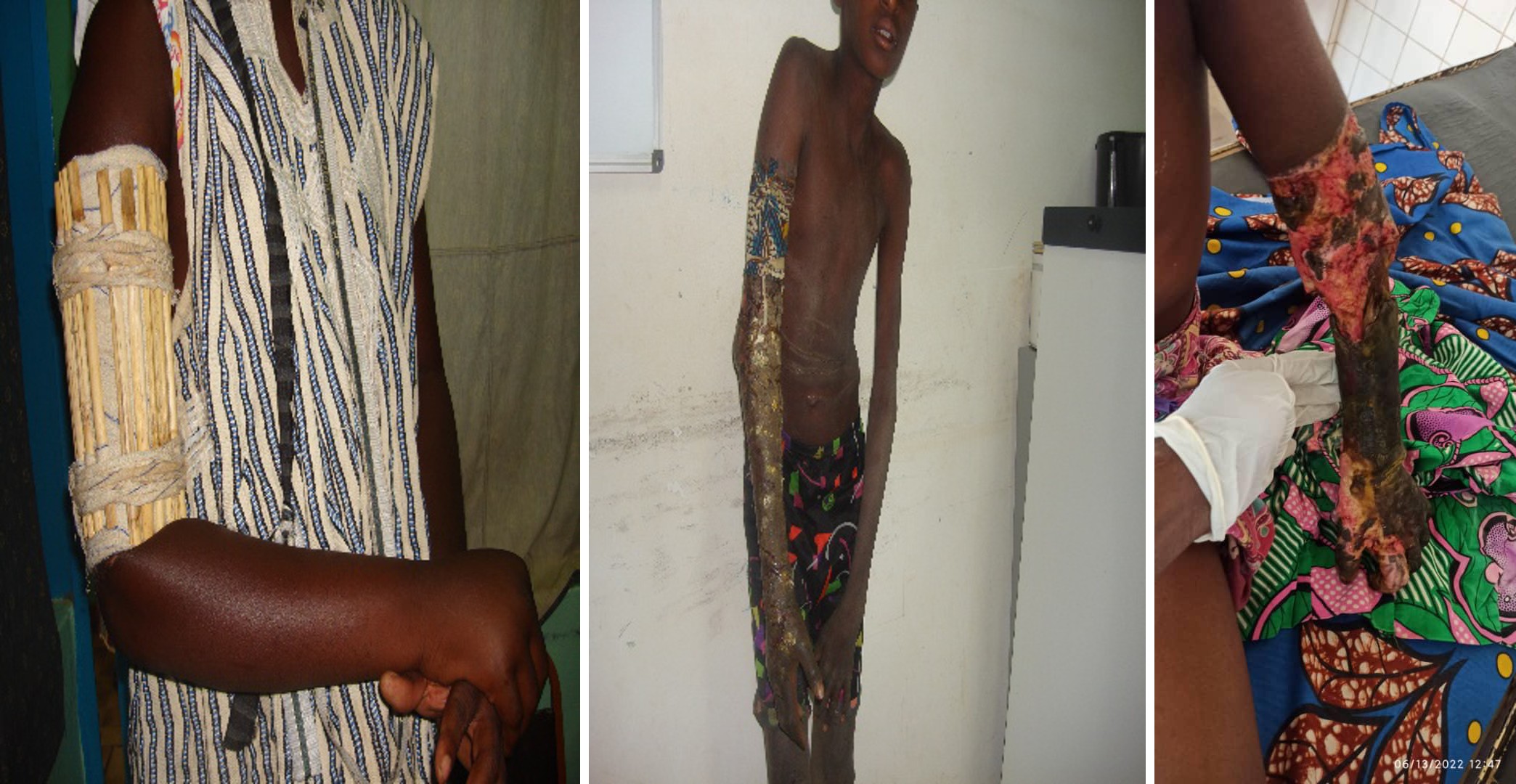
A B D C
were the most represented, accounting for 51.82% (n=114). In all cases (100%), recourse to traditional treatment was motivated by belief in this method, associated in 31.82% of cases (n=70) with lack of financial means. The injuries were located in the lower limbs in 75.45% of cases (n=166). Bone injuries were the most represented type, accounting for 55.45% of cases (n = 122), followed by soft tissue injuries with 34.55% (n = 76), and joint injuries in 10.00% of cases (n = 22).
Traditional treatment consisted of massage in 49.09% of cases, and immobilization with traditional splints in 43.64% of cases (Figure 1).
The most common type of complication was bone- related, representing 55.45% of cases (n = 122). Bone infection was the most frequent bone complication, seen in
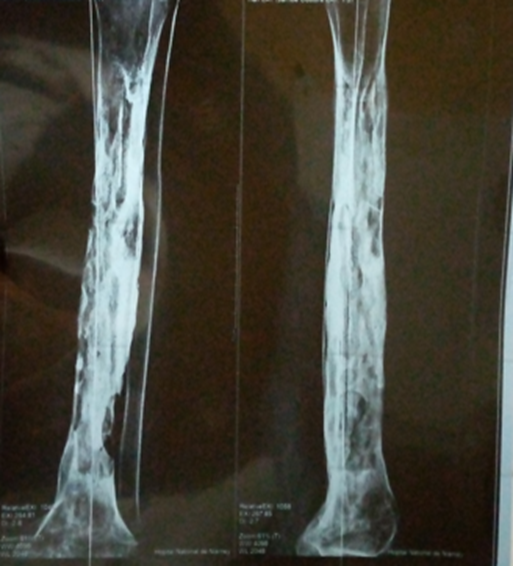
37.27% of cases (n = 82). Figure 2 illustrates a case of acute osteomyelitis treated by a traditional bone-setter, which evolved into chronic osteomyelitis.
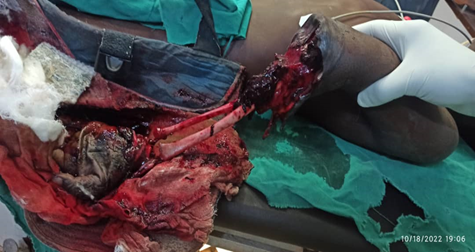
Soft tissue lesions accounted for 34.54% of cases (n=76), with gangrene being the most frequent soft tissue lesion, representing 29.09% (n=64). Figure 3 shows gangrene of the upper limb in a 14-year-old patient following traditional immobilization.
Joint complications accounted for 10.00% of cases (n=22). Table 2 shows the distribution of patients according to the type of complication.
| Total | Complication | Sub-total | Percentage | |
|---|---|---|---|---|
| Bone lesions | 122 | Pseudarthrosis | 10 | 4.55% |
| Bone lesions | 122 | Bone Infections | 82 | 37.27% |
| Bone lesions | 122 | Malunion | 30 | 13.64% |
| Soft tissue lesions | 76 | Contractures | 6 | 2.73% |
| Soft tissue lesions | 76 | Volkmann sequelae | 2 | 0.91% |
| Soft tissue lesions | 76 | Gangrene | 68 | 30.91% |
| Joint lesions | 22 | Stiffness | 2 | 0.91% |
| Joint lesions | 22 | Osteoarthritis | 6 | 2.73% |
| Joint lesions | 22 | Arthritis | 14 | 6.36% |
| Total | 220 | 220 | 100% |
Table 2: Distribution of patients by type of complication present at admission.
Surgical management consisted of sequestrectomy or resection of exposed bone in 37.72% of cases (n=83). Amputation was performed in 30.90% of cases (n=68), and osteosynthesis was carried out in 18.18% (n=40). Table 3 reports the distribution of patients according to the surgical treatment performed for the complication.
| Frequency | Percentage | |
|---|---|---|
| Sequestrectomy or bone resection | 83 | 37.72% |
| Amputation | 68 | 30.90% |
| Osteosynthesis | 40 | 18.18% |
| Open reduction of dislocations | 10 | 4.45% |
| Isolated debridement | 9 | 4.09% |
| Debridement followed by skin grafting | 6 | 2.73% |
| Orthopedic treatment | 2 | 0.91% |
| Osteosynthesis and joint immobilization | 2 | 0.91% |
| Total | 220 | 100% |
Table 3: Distribution of patients by surgical treatment performed for the complication.
The average duration of hospitalization was 30.31 days, with extremes ranging from 8 to 90 days. Postoperative outcomes were uncomplicated in 88.63% of cases (n=195) and complicated in 23 cases (10.45%), mainly due to surgical site infections in 13 cases (5.90%), joint stiffness in 5 cases, psychological complications in 3 patients, and 2 patient deaths. A follow-up at 7 months showed 7 cases of pseudarthrosis and 6 cases of osteitis.
According to the Olerud and Molander functional score, 80.45% of patients (n=177) were classified as having good outcomes, 17 cases (7.72%) as fair, and 2.72% (n=6) as poor.
Discussion
Complications from traditional treatment are common and account for 6.66% of all patients managed in our department. The rate of complications from traditional treatment found in our study is lower than that reported by Mensah [9] at 7.8% and significantly lower than the 13.7% found by Lamah [7] in Guinea. In our series, the average age was 18 years, ranging from 1 to 86 years. The 16–30-year-old age group was the most represented with 36.36% (n=80). These epidemiological findings are similar to those reported by some African authors [8, 10].
In our study, we found a male predominance with 152 men representing 69.09% (n=152). This male predominance was also reported by Lamah [7] in Guinea, Adendjingue [10] in Chad in 2022, and Souna [11] in Niger in 2007. This could be explained by the fact that in countries like Niger, men are more likely to go out to provide for their families, use two-wheeled vehicles more often, and are therefore more exposed to the risk of injury.
The majority of our patients came from rural areas in 55.45% of cases (n=122). Our results are comparable to those of Adendjingue [10] in Chad in 2022 and Somé in Burkina Faso [12], who found a predominance of rural patients in 65.62% and 80% of cases respectively. This could be explained by the rural population’s limited access to specialized centers and the easy accessibility of traditional treatment. Additional reasons include fear of surgery, belief in traditional healers, and especially the influence of family, particularly elders.
In our study, 51.82% of patients (n=122) were uneducated. Our results are similar to those of Kouassi [13], who found that 50.5% were uneducated. The level of education does not have a significant influence. While some authors [9, 13] argue that patients with little or no education have more trust in traditional medicine due to its low cost and quick results, others have found a belief in traditional medicine even among those with secondary and higher education. Indeed, in the studies of Aderibigbe [14] and Ekere [15] in Nigeria, most patients had a secondary or higher level of education. In Ekere’s study [15], this rate was 81.69%.
In our series, the use of traditional treatment was motivated by belief in the method in all cases (100%), and it was associated with other factors such as lack of financial means in 31.82% (n=70). As in our study, road traffic accidents were the leading cause of injuries in the series conducted by Ekere [15] (42.25%), Dada [16] (47%), Memon [17] (63.7%), and Ikpeme [18] (73%). This can be explained by increased road traffic and the lack of proper training in vehicle operation, especially in rural areas.
In our study, the average duration of traditional treatment was 8.6 months, with extremes ranging from 3 days to 132 months. This average duration varies between 2.25 and 9.25 months according to various authors [15, 16, 17, 19, 20]. This large variation in the duration of traditional treatment can be explained by the polymorphism of the lesions, whose healing times differ, leading to varying delays in recognizing treatment failure.
In terms of lesion location, 75.45% (n=166) were located in the lower limb. Our results are comparable to those of Traoré T [21], who found a higher involvement of the lower limb at 80.2%, but differ from those of Souna [11], who reported a predominance of lesions in the upper limb at 58.43%.
Bone lesions were the most common complications, observed in 55.45% of cases (n=122). This predominance of bone lesions was also reported by several authors [13, 17, 18]. In our study, among the bone lesions, bone infection was the most frequent complication, occurring in 37.27% of cases (n=82). Our results are comparable to those of Kouassi [13], who found a predominance of bone infection in 35.1% of cases. This high frequency of bone infections can be explained on the one hand by the high rate of acute osteomyelitis treated by traditional bone-setters that becomes chronic due to misdiagnosis and improper treatment, and on the other hand by the management of open fractures without adherence to aseptic principles.
After bone lesions, we observed a high frequency of soft tissue injuries in 34.54% of cases (n=76), dominated by gangrene in 29.09% of cases (n=64). The rate of gangrene in our study was significantly higher than those reported in the literature, which range between 4 and 12% [9, 13, 17, 21, 22, 23, 24]. This high rate can be attributed to the immobilization methods used by traditional bone-setters, which do not take into account the vascular supply of the limbs.
Therapeutically, sequestrectomy or resection of exposed bone was the most performed procedure in 37.72% of cases (n=83), followed by amputation in 30.90% of cases (n=68), and osteosynthesis in 18.18% of cases (n=40). Our results differ from those of most authors [9, 11, 13]. This difference may be explained by the variation in patient recruitment in the different studies. In our series, we included all locomotor system injuries treated by traditional bone-setters before resorting to conventional medicine. Most studies, however, focused on a specific aspect, such as bone or joint lesions, or late sequelae of various injuries.
The average duration of hospitalization was 30.31 days, ranging from 8 to 90 days, which is longer compared to the average duration reported by Souna [11] (18 days), and especially by Mahaisavaria [24], which was 7 days.
According to the Olerud and Molander functional score, patients were classified as having good outcomes in 80.45% of cases (n=177), fair in 7.72% (n=17), and poor in 2.72% (n=6). These results are comparable to those reported by most authors [13, 11].
Conclusion
The locomotor system is subject to various types of injuries. In our countries, the initial management of these injuries is often undertaken by traditional bone-setters. This approach carries numerous complications, including bone, joint, and soft tissue injuries. Our study reveals that these injuries typically affect young adult males, often unemployed, with a low level of education, and who believe in the virtues of traditional medicine. They are frequently victims of road traffic accidents, suffering trauma primarily to the lower limbs. The most common lesions are bone-related, and treatment was mainly surgical; even if the evolution of these lesions is most often favorable, it can lead to serious complications such as amputations and death. The most common lesions are bone-related, and treatment was mainly surgical, with favorable outcomes. The solution to this issue lies in raising awareness among traditional bone-setters and integrating them into the formal healthcare system, which would enable their training and supervision in treatment practices.
Ethics
We obtained ethical approval and informed consent from patients.
Conflict of Interest
None
References
-
OMS (2013) WHO Traditional Medicine Strategy 2014– 2023. Organisation mondiale de la Santé, Genève, pp: 75.
-
OMS (2018) Global status report on road safety 2018. WHO/NMH/NVI/18.20. 20.
-
OMS (1998) Promoting the Role of Traditional Medicine in Health Systems: African Strategy. Background information for reviewing the traditional medicine cabinet paper.
-
Hoekman P, Oumarou M, Djia A (1996) Injuries from motorized accidents: a public health problem in Niamey, Niger. Médecine Afr Noire, pp: 6.
-
Ariës M, Joosten H, Wegdam H, van der Geest S, et al. (2007) Fracture treatment by bonesetters in central Ghana: patients explain their choices and experiences. Trop Med Int Health 12(4): 564-574.
-
Olaolorun D, Oladiran I, Adeniran A. Complications of fracture treatment by traditional bonesetters in southwest Nigeria. Fam Pract 18(6): 635-637.
-
Lamah L, Handy D, Bah M, Onivogui F, Keita K, et al. (2013) Complications of traditional fracture treatment: epidemiological and clinical aspects. Rev Afr Chir Spéc 7(3): 31-35.
-
Olerud C, Molander H (1984) A scoring scale for symptom evaluation after ankle fracture. Arch Orthop Trauma Surg 103: 190-194.
-
Mensah E, Tidjani IF, Chigblo P, Lawson E, Ndeffo K, et al. (2017) Epidemiological and injury aspects of complications from traditional treatment of limb fractures in Parakou (Benin). Rev Chir Orthop Traumatol 103: 330-334.
-
Adendjingue D, Mouassede M, Madjirebaye K, SALIA O, AMONÉ-NÉ DO, et al. (2022) Complications of traditional treatments for limb trauma at the Good Samaritain University Hospital in Walia (N’Djamena, Tchad). Médecine Trop Santé Int 2(1).
-
Souna B, Danhaoua A (2007) Surgical treatment of sequelae from traditional limb fracture treatment (about 61 patients operated in Niamey). Rev Maroc Chir Orthop Traumato 31: 40-45.
-
Somé IB, Ouédraogo S, Ouangré A (2004) Complications and prognosis of limb injuries after traditional treatment in Burkina Faso. Health Res Afr 2(11): 68-72.
-
Kouassi (2024) Complications of traditional treatment of limb fractures in Bouaké. Health Res Afr 2(8): 61-65.
-
Aderibigbe SA, Agaja SR, Bamidele JO (2013) Determinants of utilization of traditional bone setters in Ilorin, North Central Nigeria. J Prev Med Hyg 54: 35- 40.
-
Ekere AU, Echem RC (2011) Complications of fracture and dislocation treatment by traditional bone setters: A private practice experience. Nigerian Health Journal 11(2): 59-66.
-
Dada A, Giwa SO, Yinusa W, Ugbeye M, Gbadegesin S (2009) Complications of treatment of musculoskeletal injuries by bone setters. West Afr J Med 28: 333-337.
-
Memon FA, Saeed G, Fazal B, Bhutto I, Laghari A, et al. (2009) Complications of fracture treatment by traditional bone setters at Hyderabad. J Pak Orthop Assoc 21: 58-64.
-
Ikpeme IA, Udosen AM, Okereke-Okpa I (2007) Patients’ perception of traditional bone setting in Calabar. Port Harcourt Med J 1: 104-108.
-
Ogunlusi JD, Okem IC, Oginni LM (2007) Why patients patronize traditional bone setters. Internet J Orthop Surg 4(2).
-
OlaOlorun DA, Oladiran IO, Adeniran A (2001) Complications of fracture treatment by traditional bonesetters in southwest Nigeria. Fam Pract 18: 635- 637.
-
Traore T, Toure L, Diassana M, Malle K, Diallo S, et al. (2021) Amputation of Limbs Following Traditional Treatment at Mopti Hospital (Mali). Medicine and Surgery in the Tropics 22(4): 76-80.
-
Odatuwa-Omagbemi DO, Enemudo RET, Enamine SE, Esezobor EE (2014) Traditional bone setting in the Niger Delta region of Nigeria. Niger J Med 23(2): 157- 161.
-
Nabeel D, Nausheen N, Kamran Khalid B (2012) Musculoskeletal injuries by bone setters. Prof Med J 19(4): 446-448.
-
Mahaisavaria B, Laupatarakasem W (1995) Late open nailing for neglected femoral shaft fracture. Scimagarind Hospital, Khon Kaen, Thailand, 26(8): 527-529.
- Return to Work Among Manual Workers After the Latarjet Procedure: A Cohort Study of 43 Patients
- Refractory Pelvic Collection Following Modified Stoppa Approach for Both-Column Acetabular Fracture Fixation: A Case Report
- Comparative Study of Dynamic Knee Phenotypes Under Loaded and Unloaded Conditions: Clinical Impact
- Locked Intramedullary Nailing of the Tibia Using a Humeral Nail: A Care Case Report
- Subtalar Dislocation: About a Case Report
- Surgical Site Infection in Orthopedics in a Country with LimitedResources: Indications, Treatment and Results