
Effect of Distance between Needle Tip and Collector on Nanofibers Morphology
In this undertaking, nanofibers anatase stage titanium dioxide (TiO2) was effectively manufactured utilizing the electrospinning (ES) technique natively constructed. This investigation intended to manufacture uniform and great anatase TiO2/PVP nanofibers (NFs) on glass substrate utilizing a minimal effort method and to decide the ideal conditions for uniform anatase TiO2/PVP NFs. Are investigated, X-ray diffraction (XRD) patterns show sharp and well-defined peaks identified as anatase phase, once again, the relative intensity of peaks varies with distance difference has been studied. Field Emission Scanning Electron Microscope (FESEM) images reveal the formation of nanofibers. Surface topography observations by atom force microscopy (AFM) indicates that the roughness is improved by an effect of the parameter selected. Results show that the nanofibers, that good for application towards biosensors better than previous studies due to nanostructure.
Introduction
Electrospinning as a technique is reliant on various processing standards like solution properties and processing parameters. Consequently, altering these parameters could exert a considerable degree of influence on the nanofiber size, shape and morphology. Thus, by controlling those parameters well, specific fibres can be produced to benefit various applications. However, in sensing, controlling the structural features of the electrospinning fibres such as the fibre diameter, the porosity, the volume ratio, the surface morphology and the mechanical properties, are essential issues [1, 2]. In recent times, thin-film metal oxide-based gas sensors constitute subjects of intensive study. Low cost and small size tend to characterize such semiconductor gas sensors. Because of its peculiar features, polyvinylpyrrolidone (PVP) was selected as an organic component for the hybrid materials. The PVP is very much soluble in polar solvents like alcohol; therefore it is favoured to avoid the case of phase separation in the reaction. Another plus point of using PVP is that it can be cross-linked [3, 4] thermally, giving rise to excellent thermal stability and high mechanical strength of the hybrid material. To add, the amorphous structure of PVP also incurs low scattering losses, which render it a very good polymer hybrid material for optical applications. Titanium dioxide (TiO2) is, one of the many semiconductor oxide materials, acknowledged to be a good sensing sensitizer [5]. Due to the fact that the cost is low, it has chemical and thermal stability, and good mechanical features it is also advantageous in practical applications. TiO2 establishes three crystalline structures: brookite, anatase, and rutile, extensively serving as a gas sensing material following its change in the electrical conductivity under analyte gas exposure. Known as titania, titanium dioxide (TiO2) has emerged as a promising photocatalyst in the current market with the following advantages which are relatively easy to produce and use, being photocatalytically stable, and reasonably inexpensive. It is a human and environmentally- friendly photocatalyst used for treating polluted air and water, and for splitting water to generate hydrogen [6].
Mohammad Ch and George S [7], They selected difference distances (5cm, 8 cm, and 11 cm) with 15 kV, they noted tip-collector distance has a direct influence on jet flight time and electric field strength. The shortens flight times and solvent evaporation time is happened due to decrease in this distance and increases the electric field strength, which results in increase of bead formation. Their results did show a diameter of nanofibers is decrease when the distance is increase with improve in morphology of nanofibers.
C. Henriques, et al. [8], utilized the PEO arrangement utilized was equivalent to the one for the feed rate study: a normal sub-atomic mass of 900 kg/mol and a grouping of 4 wt%.The feed rate was fixed at 0.1 ml/h and the good ways from the tip of the needle to the gatherer was shifted (15 cm, 20 cm, 25 cm, 30 cm, and 35 cm). The morphology of the strands was assessed from the SEM pictures; for the briefest separation utilized (15 cm) the filaments converge at their crossing points because of the fragmented vanishing of the dissolvable before the stream arrives at the authority. For the other four separations utilized, the strands look a lot of the same and the mean fiber diameter increments just somewhat with the separation to the collector.
In this research work, it was the electrospinning setup as shown in Figure. 1. Study the effect of using distance on the delay in the formation of nanofibers or/and nanoparticles, is investigated. Distance is considered as the most influential parameter playing a key role in controlling the diameter of fibers and their size distribution, initiating drop shape, the path of jet, Taylor cone, structure and deposition area [9, 10]. During shorter of distance, larger drops are formed, which leads to the increase the diameter of fibers. The aim of this study consists on the preparation of nanostructured TiO2/ PVP composite by electrospinning process, an investigated the effect of distance on the change of microstructure (morphology and size). To the best knowledge of authors, no previous research work investigating the effect of flow rate on the change of composite’s microstructure, has been reported in the literature. Also our studies proved to that flow rate have effect to change of the structure via electrospinning.
Experimental Part
Preparation of TiO2/PVP Nanocomposites
To study the effect of distance on the fiber morphology been chosen distances of 6 cm to 18 cm with the stability of all other parameters of the process of spinning, is investigated. Field emission scanning electron microscopy (FESEM) observations reveal the effect change the distance on fiber morphology. In this experiment 6 wt.% solution of Polyvinylpyrrolidone (PVP) in Ethanol and 0.4M titanium dioxide (TiO2) in Ethanol too , were used mats of fibres were electrospun at spinning distance of 6, 9, 12, 15 and 18 cm, high voltage 14 KV, needle (20 g), flow rate 1ml/h throughout the experiment.
Characterizations Techniques
Morphological surface observations and structural investigations were performed by field emission scanning electron microscopy (FESEM) model FEI Nova NanoSEM 450 and high resolution x-ray diffractometer (HR-XRD) using Philips X’Pert equipped with Cu-K radiation = 0.15419 nm), respectively. Raman spectra were measured at RT using JobinYvon HR 800 UV spectrometer system with 514.5 nm Ar+ laser as excitation source. Micro-Photoluminescence (m- PL) measurements were carried out at room temperature using HeCd laser with an excitation source of 325 nm. Atomic force microscopy (AFM), veeco NanoScope Analysis version 1.2
Results and Discussion
Structural and Morphological Characterization
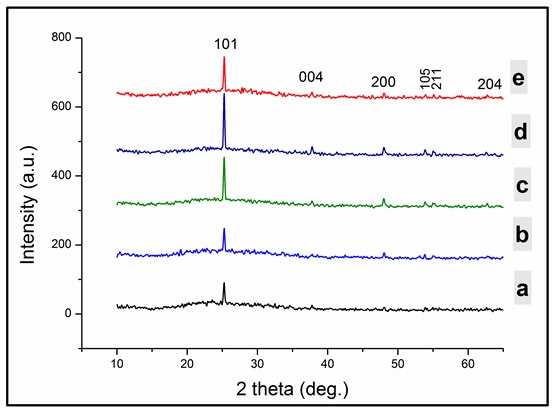
Figure 1 shows the evolution of XRD patterns of TiO2/ PVP thin films recorded for different distances. It can be noticed that the crystal structure and orientation of the nanocrystalline TiO2/PVP films deposited on the glass substrate vary with the variation of solution flow rate. The position of diffractions peaks is not affected while the relative intensity varies considerably. The peaks were indexed within a tetragonal crystal structure of TiO2 anatase phase, in conformity with some previously reported results [11, 12, 13, 14, 15]. It is also important to note that the peaks are sharp and well defined. Independently of the distance, six diffraction peaks can be observed at 2θ of 25.31º, 37.78º, 48.10º, 53.96º, 55.20º and 62.79° which correspond to (101), (004), (200), (105), (211), (204) reflections of TiO2 phases [6]; it has a tetragonal structure with lattice parameters a= 3.7850 Å, c= 9.5140 Å, and β=90°), respectively. At distance of 6 cm (Figure. 1a), the emergence of (101) and (200) peaks were observed, while at distance of 9 cm (Figure. 1b), the emergence of (101), (200), (105) and (211) peaks could be seen. Finally, at 12, 15 and 18 cm (Figure. 1c, d and e), seven peaks appeared confirming the formation of TiO2 anatase phase (101), (004), (200), (105), (211) and (204). At 15cm. (Figure. 1d) the peaks appeared confirming the formation of TiO2 anatase phase with higher intensity than was previously the case. It can be concluded that with change in the distance, alteration in the structure (phase stability) contributed to the emergence/ disappearance of new peaks, which is an indication also of the degree of crystallinity (change of peaks’ intensity) [16].
FESEM images as shown in Figure 5.6 showed that at the distance of 6 cm (Figure 2a) fiber structure was regular with a few fiber deposit and large diameter average. When the distance was increased, the structure is improved with decreasing in the diameter; this was due to the fact that distance was short and if there was not enough time for evaporating the solvent before deposition of the fibers on the collector, the fibers may merge. At distances of 9 and 12 cm Figure 2b and c, showed nanofibers more than in previous cases, but not many fibers because the distance was not enough; they have average diameter of 157 and 132 nm, respectively. The distance of 15 cm (Figure 2d) obtained the best results among the selected distances, where the fiber was formed on a regular basis with an average diameter of 69 nm less than what he got in the other distances. The stretching force was increased with decrease of the diameter and vice versa. These findings are consistent with R. Jalili et al and J. Ayutsede, et al. [17, 18]. At the distance of 18 cm (Figure 2e), there was a slight change in morphology and an increase in average fiber diameter of 84 nm. This was due to the decrease in the high voltage resulting in less stretching of the fibers before deposition on the collector [1, 19]. This change proves that the distance associated with the amount of high voltage, was not sufficient in this distance, which resulted in a decline in results from what it was when the distance was 15 cm.
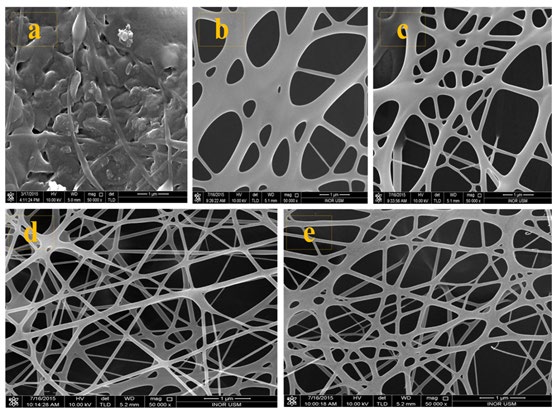
The distance and electric field strength has influence on the evaporation rate. The higher value of distance and electric field strength increase the evaporation rate. The distance should be appropriate to give enough time for the evaporation of the solvent, as well as to stretch before depositing on the collector [20, 21]. The distance had impact on the morphology and fibers diameter; an increase of distance had better results on morphology with lower average diameter.
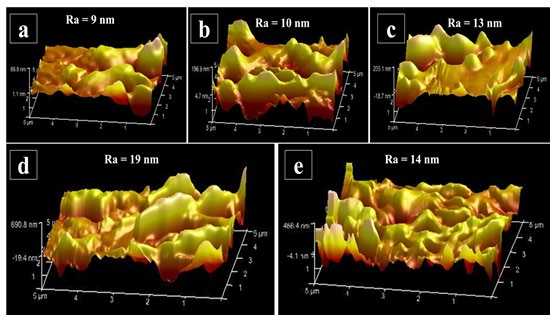
AFM images of a 5 × 5 μm 3D area of each nanostructured TiO2/PVP composites are shown in Figure. 5.7 The roughness was found to be very sensitive to the variation of distance during electrospinning process; the roughness increases with longest distance 9, 10, 13, 19 and 14 nm for 6, 9, 12, 15 and 18 cm, respectively, see Figure 3a, b, c, d and e. This indicates that the quality of the TiO2/PVP surface can be easily improved by using an optimum distance; resulting in good increase of grain size and hence improved (higher) roughness of nanostructured TiO2/PVP thin films. The sample grown at 15 cm exhibited a higher surface roughness (19 nm) compared with the others because of the reason is that the distance 15 cm was the optimum with selected parameters during electrospinning. Therefore, the parameters of growth are suitable for controlling the surface morphology as well as for increasing the surface roughness and density of the material distribution on the surface.
Conclusion
In this work, the effect of distance on the formation of nanostructures by electrospinning method was investigated. XRD and Raman characterisations confirm the formation of TiO2/PVP nanocomposites. FESEM observations show that the evolution of TiO2/PVP composite microstructure can be easily controlled by changing the starting distance, from nanoparticles into nanofibers. Long distance gives a sufficient time to form nanofibers with small diameter and regular shape, while short distance favours the formation of agglomerated nanoparticles. AFM analysis reveals that the surface topography is sensitive to distance, where the results of this work showed that it can be used PVP/TiO2 in biosensors and dye solar cells
Acknowledgment
We gratefully acknowledge the support of the school of physics University Science Malaysia under grant FRGS no 203/PFIZIK/6711349.
References
-
Al-Hazeem NZA (2018) Nanofibers and Electrospinning Method. Nanomater Synth Appl.
-
Li D, Xia Y (2004) Electrospinning of nanofibers: reinventing the wheel? Advanced materials 16(14): 1151-1170.
-
Yoshida M, Prasad PN (1996) Fabrication of channel waveguides from sol-gel- processed polyvinylpyrrolidone/SiO2 composite materials. Applied optics 35(9): 1500-1506.
-
Zheng M (2000) Preparation, structure and properties of TiO2–PVP hybrid films. Materials Science and Engineering 77(1): 55-59.
-
Al-Hazeem, NZ (2020) Hydrogen gas sensor based on nanofibers TiO2-PVP thin film at room temperature prepared by electrospinning. Microsystem Technologies, pp: 1-7.
-
Hanaor DA, Sorrell CC (2011) Review of the anatase to rutile phase transformation. Journal of Materials science 46(4): 855-874.
-
Chowdhury M, Stylios G (2010) Effect of experimental parameters on the morphology of electrospun Nylon 6 fibres. International Journal of Basic & Applied Sciences 10(6): 70-78.
-
Henriques C (2009) A systematic study of solution and processing parameters on nanofiber morphology using a new electrospinning apparatus. Journal of nanoscience and nanotechnology 9(6): 3535-3545.
-
Yarin AL, Koombhongse S, Reneker DH (2001) Taylor cone and jetting from liquid droplets in electrospinning of nanofibers. Journal of applied physics 90(9): 4836- 4846.
-
Vaseashta A (2007) Controlled formation of multiple Taylor cones in electrospinning process. Applied Physics Letters 90(9): 093115.
-
Ma W, Z Lu, Zhang M (1998) Investigation of structural transformations in nanophase titanium dioxide by Raman spectroscopy. Applied Physics A 66(6): 621-627.
-
Arbiol J (2002) Effects of Nb doping on the TiO2 anatase- to-rutile phase transition. Journal of Applied Physics 92(2): 853-861.
-
Ruiz AM (2004) Insights into the structural and chemical modifications of NB additive on TiO2 nanoparticles. Chemistry of materials 16(5): 862- 871.
-
Suresh C (1998) Anatase to rutile transformation in sol-gel titania by modification of precursor. Polyhedron 17(18): 3131-3135.
-
Gao Y (2004) TiO2 nanoparticles prepared using an aqueous peroxotitanate solution. Ceramics International 30(7): 1365-1368.
-
Shao H (2015) Effect of electrospinning parameters and polymer concentrations on mechanical-to-electrical energy conversion of randomly- oriented electrospun poly (vinylidene fluoride) nanofiber mats. RSC Advances 5(19): 14345-14350.
-
Jalili R, Hosseini SA, Morshed M (2005) the effects of operating parameters on the morphology of electrospun polyacrilonitrile nanofibres. Iranian Polymer Journal 14(12): 1074.
-
Ayutsede J (2005) Regeneration of Bombyx mori silk by electrospinning. Part 3: characterization of electrospun nonwoven mat. Polymer 46(5): 1625-1634.
-
Garg K, Bowlin GL (2011) Electrospinning jets and nanofibrous structures. Biomicrofluidics 5(1): 013403.
-
Reneker DH (2000) Bending instability of electrically charged liquid jets of polymer solutions in electrospinning. Journal of Applied physics 87(9): 4531- 4547.
-
Al-Hazeem, NZ, Ahmed NM (2020) Effect of Addition of Polyaniline on Polyethylene Oxide and Polyvinyl Alcohol for the Fabrication of Nanorods. ACS Omega 5(35): 22389-22394.
- Solution-Processed Chiral Perovskites for Biomedical Applications
- Nanotechnology in Health Chemistry and Medicine: Current Challenges and Future Directions
- Human Exposure to Micro- and Nanoplastics: Pathways, Toxicity, and Intervention Strategies
- Exosome Nanomedicine for Cancer Therapy
- Micro and Nanoplastics–Plastisphere, Biotoxicity, Impact on Human Health, and Mitigation Strategies
- Process Validation of Cefixime Powder for Suspension Dosage Form, 50 mL