
Removal of Oxytetracycline in Pharmaceutical Effluents by Using Synthetic Adsorbents
Simple, accurate, fast, and economical method for removal of OTC in pharma wastewater has been developed. The procedure is based on the adsorption mechanism which leads to the spectrophotometry. Bentone -34 clay is used as an adsorbent for removal of OTC. 0.1 N HCl was used as a mobile phase. The elute was determined spectroscopically, with a Cecil CE 2041 UV/VIS spectrophotometer, in a 1-cm cuvette cell at wavelength range 190−1100 nm, with resolution 0.5 nm. The linear calibration curve was established in the concentration range 0.214-1.070 mg/mL of OTC. From the analyzed data the following results for parameters were obtained linearity correlation R2 > 0.9984), accuracy (Recovery = 91−98 %), sensitivity (LOD = 42.3 mg/mL; LOQ = 48.3 mg/mL), and precision (RSD ≥ 2.0 %) in the respective linear concentration ranges. The method is successfully applied for the removal of OTC as the tested sample improves ICH parameters like accuracy, sensitivity, precision
Introduction
Antibiotics have saved countless lives since their discovery, large quantities of these drugs are widely administered and used as antimicrobial drugs throughout the world [1]. Antibiotic drugs are predominantly used to treat bacterial diseases in human therapy and as veterinary medicines to prevent diseases in animal husbandry, and function as growth promoters, mainly in livestock [1].
Oxytetracycline (OTC), (a natural metabolic product of a bacterium, Streptomyces Rimosus) [2]. As one kind of typical tetracyclines, possess a wide range of antimicrobial activity against gram-positive and gram-negative bacteria [3]. Tetracyclines is widely used in the clinical treatment and livestock industry, and as growth promoter due to its broad spectrum of activity and low cost [4]. Tetracyclines contribute approximately 50% of total antibiotics production [5]. Due to its wide antibacterial spectrum, Oxytetracycline (OTC) is a common antibiotic used to treat different food-producing animals such as cattle, pigs, sheep and poultry, as well as in dogs and cats and fish. Usually it is administered orally with feed dosage rate of 25–700 mg/kg [6] Oxytetracycline is ionized throughout the pH range, existing in the cationic form below pH 3.3, as a zwitterion between pH 3.3 and 7.7, and an anion above pH 7.7 [7]. Tetracyclines, generally act as bacteriostatic antibiotics, by inhibiting the protein synthesis by reverse binding the 30S ribosomal subunits of susceptible organisms, and preventing access of aminoacyl-tRNA to the acceptor site on the mRNA-ribosome complex. Tetracyclines also are believed to reversibly bind to 50S ribosomes and additionally alter cytoplasmic membrane permeability in susceptible organisms. In high concentrations, tetracyclines can also inhibit protein synthesis by mammalian cells [6]. The widespread production and use of natural tetracyclines in both human and animal medicine in the decades following their discovery led to emergence of resistance mechanisms and decreased effectiveness as front-line antibiotics [8]. OTC affected algae and other bacteria by decreasing their population numbers, while it could cause death to invertebrates and fish [2]. In a natural aquatic system, the available concentration for bioaccumulation depends on how fast the compound is degraded and how much the compound is sorbent in the sediment. Therefore, the bioavailability of OTC for the aquatic organism will vary with the environmental conditions and the consumption behaviors of each aquatic species [2]. The bioaccumulations of OTC in farm animals such as chicken, swine and cow were higher than that found in aquatic species. This is probably because they uptake OTC directly from their feed while aquatic species obtained OTC from their environment [2]. The ingestion of OTC contaminated food could pose a potential risk to human health. Varieties of toxic and irritation effects in humans have been reported ranging from minor effects such as sore throat, nausea and diarrhea to serious illness such as peripheral blood and liver injury [2]. Degradation of OTC is one factor that reduces its concentration in soil, water and sediment, hence decreasing its bioavailability and toxicity to the organism [2]. Several methods reported in the literature for the determination of tetracyclines are expensive, time consuming and are not useful for the routine analysis [3], but adsorption was an old scientific subject and adsorption-based technologies were industrially important that attracted people. As adsorption of tetracyclines, oxytetracycline in the present case, on isolated clays, organic clays, soils, organic matters and marine sediment has been previously investigated [9]. The present work involved a study of the adsorption process of the oxytetracycline (OTC) from aqueous solution by Bentone-34 as adsorbent material. (Bentone 34 is an organic derivative of a special smectite. It is manufactured by chemically modifying naturally occurring clays like bentonite) [10]. Choosing Bentone-34 as adsorbent because of its non-toxicity, adsorption properties and low-cost material. The aim of my study was to develop a simple, accurate, fast, and economical method for removal of OTC in pharma wastewater with minimal materials.
Materials and Methods
Apparatus and Spectrophotometric Conditions
Cecil CE 2041 UV/VIS spectrophotometer 1-cm quartz cell at wavelength range 190 - 1100 nm, with resolution 0.5 nm and scan rate of 1-4000 nm/min.
Required Chemicals
Standard Stock Solution of Oxytetracycline
A 1000 ppm standard stock solution of oxytetracycline (OTC) was prepared by mixing 50 ml of Oxytetracycline containing waste water in 50 mL of 0.1N HCl (standard soln.) in the 50 mL beaker.
$$50 \text{ ml (OTC)} \times 50 \text{ mL (0.1N HCl)} = 50 \text{ ml}/50 \text{ mL} = 1 \text{ ml}/\text{mL}$$
$$\frac{1 \times 1000}{ml \times 1000} = 1000 \text{ ppm}$$
Standard 0.1N HCl Solution
Add 4.5 ml of HCl in the 500ml conical flask and fill it to 500ml mark with distilled water to create a 0.1N HCl solution.
Preparation of 40ppm Sample Solution
A 40ppm sample solution of OTC was prepared by pipette out 2ml of stock solution in a 50ml beaker and then fill it to a 50 ml of 0.1N HCl standard solution.
$$2 \text{ ml (stock)} \times 50 \text{ mL (0.1N HCl)} = 2 \text{ ml}/50 \text{ mL}$$
$$\frac{2 \times 20}{50 \times 20} = \frac{40 \times 1000}{1000 \times \text{ml}} = 40 \text{ ppm}$$
Preparation of Different Sample Solutions
Different working sample concentrations were prepared identically as previously mentioned by pipetting out 4ml, 6ml, 8ml, 10ml respectively aliquots of stock solution into a separate beaker of 50ml.
Preparation of 80ppm Sample Solution
$$4 \text{ ml (stock)} \times 50 \text{ mL (0.1N HCl)} = 4 \text{ ml}/50 \text{ mL}$$
$$\frac{4 \times 20}{50 \times 20} = \frac{80 \times 1000}{1000 \times \text{ml}} = 80 \text{ ppm}$$
Preparation of 120ppm Sample Solution
$$6 \text{ ml (stock)} \times 50 \text{ mL (0.1N HCl)} = 6 \text{ ml}/50 \text{ mL}$$
$$\frac{6 \times 20}{50 \times 20} = \frac{120 \times 1000}{1000 \times \text{ml}} = 120 \text{ ppm}$$ Preparation of 160ppm Sample Solution 8ml (stock)_______50mL (0.1N HCl) = 8ml/50ml $$ \frac {8 \times 2 0}{5 0 \times 2 0} = \frac {1 6 0 \times 1 0 0 0}{1 0 0 0 \times m l} = 1 6 0 p p m $$
Preparation of 200ppm Sample Solution
10ml (stock)______50mL (0.1N HCl) = 10ml/50ml $$ \frac {1 0 \times 2 0}{5 0 \times 2 0} = \frac {2 0 0 \times 1 0 0 0}{1 0 0 0 \times m l} = 2 0 0 p p m $$
Procedure
Running of Standard 0.1N HCl through Column
The first step to check out any impurity in the benton-34 clay, 10ml standard 0.1N HCl solution was run through the column. Collect 5 ml -7ml of eluted sample in a separate beaker. To analyze any impurity in the clay, UV-VIS spectrophotometry has been done to the eluted sample.
Running of Sample Solution
In the next step 25ml of 40ppm sample solution of OTC (previously prepared) was run through the column. Collect 10ml -15ml of eluted sample in a separate beaker. To analyze the quantity of OTC removed, UV-VIS spectrophotometry has been done to the eluted sample.
Data Analysis
For determination of the statistical parameters, the Microsoft Office Excel is used.
Result and Discussion
ICH QC Method Validation
All of the analytical validation parameters for this proposed method were determined according to the ICH guidelines [11].
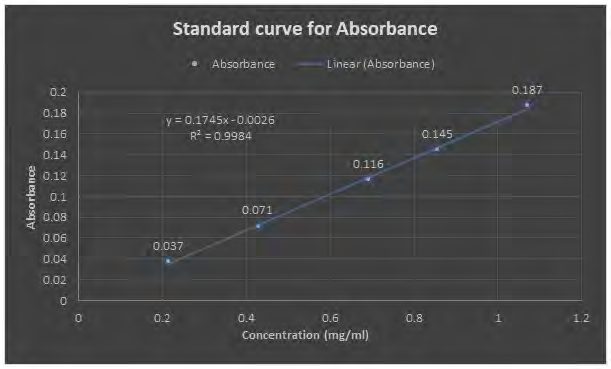
- Linearity Range: The Linearity of the proposed spectroscopic method was determined at 5 concentration levels ranging from 0.214 - 1.07 mg/ml, and calibration curve was constructed by plotting the respective concentrations at detector’s response i.e. absorption maxima (254 nm). Linear correlation in the above mentioned concentration range was confirmed and linear regression equation was y =0.1745x+0.0026 with the coefficient of correlation of R2= 0 .9984.
- Precision: The precision of the proposed method was estimated by calculating the relative standard deviation as the average of 5 measurements. The % RSD value is 3 found to be 2.73 for OTC in terms of analytical recovery calculations.
- Accuracy: The accuracy of the proposed methods was determined in terms of recovery as the average of 5 measurements. The recoveries calculated (91% to 98%) indicate that the proposed methods are accurate.
- Sensitivity: Both the Limit of Detection (LOD) determination at lowest concentration giving response and Limit of Quantification (LOQ) determination were estimated from the standard deviation of the response and the slope, based on the data of the calibration curve. The limit of detection (LOD) and limit of quantification (LOQ) were found to be 42.3 mg/mL and 48.3 mg/ml. The LOD and LOQ showed that this method is sensitive for OTC determination.
| Test no. | Concentration (mg/ml) | Absorbance | Found Concentration (mg/ml) | Recovery (%) |
|---|---|---|---|---|
| 1 | 0.214 | 0.037 | 0.19713467 | 92.1190049 |
| 2 | 0.428 | 0.071 | 0.391977077 | 91.58342929 |
| 3 | 0.692 | 0.116 | 0.649856734 | 93.90993259 |
| 4 | 0.856 | 0.145 | 0.816045845 | 95.33245856 |
| 5 | 1.07 | 0.187 | 1.056733524 | 98.76014246 |
| Mean | 94.34099356 | |||
| SD | 2.578336197 | |||
| SE of intercept | 0.002895499 | |||
| SD of intercept | 2.238963476 | |||
| LOD | 42.34142964 | |||
| LOQ | 48.3073625 |
Table 1a: Validation summary for determination of the statistical parameters, the Microsoft Office Excel.
| Analytical technique | UV/VIS Spectrophotometry | |
|---|---|---|
| Type apparatus for Validation | Cecil CE-2041 UV/VIS Spectrophotometer | |
| Validation parameters | Acceptance Criteria | Results |
| Range | min. acceptable 20-100% | 0.214 -1.07 mg/ml of OTC |
| Linearity | ≥ 0.9900 | 0.9984 |
| Correlation coefficient R2 | ||
| Sensitivity LOD | 42.3 mg/ml | |
| LOQ | 48.3 mg/ml | |
| Accuracy | 91-98% | Recovery = 94.3 % |
| Recovery | ||
| Precision (method repeatability) | RSD % | s=2.23 |
| ≥ 2.73 % |
Table 1b: Validation summary for all of the analytical validation parameters for this proposed method were determined according to the ICH guidelines standard/test solution.
Conclusion
In the present novel study the adsorption of the Oxytetracycline (OTC) from pharma wastewater on bentone-34 clay was investigated. The international council of Harmonization (ICH) guidelines was used for all the analytical validation parameters for this proposed method. For the determination of data analysis Microsoft Excel was used. Beer – Lambert’s law is obeyed in the range 0.214 -1.070 mg/ml. The linear calibration curve was established in the 5 concentration level ranges (0.214-1.070 mg/mL) of OTC. As from the analyzed data the following results for parameters were obtained, as linear regression equation was y =0.1745x+0.0026 with linearity correlation R2 > 0.9984), accuracy (Recovery = 91−98 %), sensitivity (LOD = 42.3 mg/mL; LOQ =48.3 mg/mL), and precision (RSD ≥ 2.0 %) in the respective linear concentration ranges. The method is successfully applied for the removal of OTC as the tested sample improves ICH parameters like accuracy, precision, sensitivity. The results of the present study are indicative of Bentone-34 as a new alternative low-cost adsorbent for removing the oxytetracycline from pharma wastewater.
References
-
Kebede TG, Dube S, Nindi MM (2019) Removal of multi- class antibiotic drugs from Wastewater using water- soluble protein of Moringa stenopetala seeds. Water 11(3): 595.
-
Jaruwan H, Boonsaner M (2016) Bioaccumulation of Oxytetracycline in Aquatic Organisms and Farm Animals and Its Risk on Human Health. Journal of Health Research 30(1): 53-58.
-
Prasad ARG, Rao VS (2010) Spectrophotometric methods for the microdetermination of oxytetracycline and hostacycline. Science World Journal 5(1): 1-4.
-
Nan W, Pan P, Zeng M, Wang W, Xu C, et al. (2018) Oxytetracycline removal from water by novel microbial embedding gel beads. In: IOP Conference Series: Earth and Environmental Science 108(4): 042004.
-
Bansal OP (2013) Sorption of Tetracycline, Oxytetracycline, and Chlortetracycline in Illite and Kaolinite Suspensions. ISRN Environmental Chemistry 2013: 1-8.
-
Naumoska M, Dimitrieska Stojković E, Stojković G (2012) Comparison of spectrophotometric and complexometric-spectrophotometric assay for determination of oxytetracycline in veterinary drugs. In: Book of Proceedings, Days of Veterinary Medicine, 3rd International Scientific Meeting, pp: 165-169.
-
Schmidt LJ, Gaikowski MP, Gingerich WH, Dawson VK, Schreier TM (2007) An environmental assessment of the proposed use of oxytetracycline-medicated feed in freshwater aquaculture. US Geological Survey, Biological Resources Division.
-
Pickens LB, Tang Y (2010) Oxytetracycline biosynthesis. Journal of Biological Chemistry 285(36): 27509-27515.
-
Harja M, Ciobanu G (2017) Removal of oxytetracycline from aqueous solutions by hydroxyapatite as a low-cost adsorbent. E3S Web of Conferences 22: 00062.
-
Elementis S (2018) Bentone -34 Elementis Specialties. 1st (Vol.).
-
(1995-2020) ICH guidelines. European Medicines Agency CPMP/ICH/381/95.
- Solution-Processed Chiral Perovskites for Biomedical Applications
- Nanotechnology in Health Chemistry and Medicine: Current Challenges and Future Directions
- Human Exposure to Micro- and Nanoplastics: Pathways, Toxicity, and Intervention Strategies
- Exosome Nanomedicine for Cancer Therapy
- Micro and Nanoplastics–Plastisphere, Biotoxicity, Impact on Human Health, and Mitigation Strategies
- Process Validation of Cefixime Powder for Suspension Dosage Form, 50 mL