
Survival and Growth of Escherichia Coli and Shigella Spp in Water Treated with Croton Oligandrus Hutch Extracts. (Euphorbiaceae): Reduction of Diarrhea Diseases in Yaoundé (Center - Cameroon)
Infectious diarrhea of bacterial aetiology are responsible for about 4 millions deaths each year. Conventional medicine use for its treatment, has been facing microbial resistance; thus requires the use alternative therapeutic measures. This study seeks to estimate the antibacterial activities of the ethanolic and aqueous extracts of Croton oligandrus Hutch against two sensitive bacterial strains (Escherichia coli and Shigella Spp.), isolated from well water in Yaounde, Cameroon. 300 g each of the powder, were separately extracted in 3L of water and ethanol for 48 hours; and the retrieved concentrate were subjected to qualitative phytochemical screening. The antibacterial activity were tested using the surface spread out and disk diffusion methods. The phytochemical screening of both the aqeous and ethanolic extracts revealed in common saponosides, alkaloids, tannins and polyphenols, while cardiac glycosides, resins, flavonoids, catechic tannins, quinones and mucilages were present only in the ethanolic extract. The ethanolic and aqueous extracts at dose 2000 mg/mL, significantly inhibited (98.04-100%) Shigella spp. and E. coli. Complete inhibition of E. coli was observed at doses of 1000 and 2000 mg/mL, with the ethanolic extract. At, 3 hours, the lowest inhibition potential were observed for both extracts at dose 500 mg/mL, against E. coli and Shigella spp., strains. At doses 500-2000 mg/mL, the diameter of inhibition for Shigella spp. varied from 15-25 mm (very sensitive to extremely sensitive) for the ethanolic extract and 10-16 mm (very sensitive to extremely sensitive) for the aqueous extract. At the same doses, the diameter of inhibition for E. coli, varied from 16-21 for the aqueous extract and 10-23 for the ethanolic extract. All the studied microorganisms were sensible to the different extracts with the éthanolic extract demonstrating greater antidiarrheal activity on both strains compared to the aqueous extract.
Introduction
Diarrhea is a major cause of child mortality and morbidity in emerging countries. The global average is estimated at 3.3 diarrhea episodes per child annually, with extreme values of more than 9 in poorer regions [1]. Eighty percent of diarrhea-related mortality occurs during the first two years of life. Dehydration accompanies all acute diarrhea, which is aggravated by each episode therefore, increasing the risk of death [1, 2]. Diarrhea could be caused by bacterial, viral or parasitic enteropathogenic agents, which might be transmissible by links to faecal peril and their epidemiological characteristics differ from one region to another according to the level of development of sanitary infrastructures [1]. Acute bacterial diarrhea may be self-limiting and therefore does not require microbiological investigation or antibiotic treatment. However, they can become very serious, requiring a coproculture to look for pathogenic bacteria and antibiotic treatment. Despite scientific advances in the pharmaceutical research, the problem of bacterial resistance to antibiotics remains [2].
According to the World Health Organization (WHO, 2011), nearly 80% of the world’s population rely on traditional medicine for health care. In China, traditional herbal preparations account for between 30 and 50% of total drug consumption. The exploitation of ethnobotanical sources to tackle communities’ health problems appears to be a focal point for pharmacological research [3]. For instance, plants of the Croton genus are used in ethno- medicine for the treatment of various diseases including ulcers, cancer, headache, convulsion, diabetes, urinary disorder, abscesses, rheumatism, inflammation etc. [4, 5, 6, 7]. In Cameroon, the decoction of the stem bark of C. oligandrus is taken orally to treat anaemia as well as microbial infections of pneumonia and splenomegaly [8, 9]. The use of C. oligandrus in treating pathogenic infections prompted us to investigate its antimicorbial potential against antibiotic resistant microcosm of water origin. Thus, in this studies, we seek to estimate the antibacterial activities of the ethanolic and aqueous extracts of Croton oligandrus Hutch against two sensitive bacterial strains (Escherichia coli and Shigella Spp.), isolated from well water in Yaounde, Cameroon.
Material and Methods
Plant Material
The plant parts were collected in Boumyebel in the Central region (Cameroon) and identified by a botanist at National Herbarium in Yaounde. The voucher specimen n° 66291 HNC (YA) was deposited at National Herbarium in Yaounde, Cameroon.
Operating Mode
The fresh stem bark of C. oligandrus was cut into pieces, air dried at room temperature for three weeks and ground to fine powder using a mechanical grinder. 300 g each of the fine powder were separately extracted using 3L of ethanol and water for 48 hours, and evaporated using a vacuum evaporator. Extraction yields were calculated using the following formula:
$$ \% Y i e l d = \frac {M a s s o f e x t r a c t o b t a i n e d}{M a s s o f i n i t i a l p o w d e r} \times 1 0 0 $$
Qualitative Phytochemical Screening
Phytochemical screening was carried out on the extract in order to determine the secondary metabolites present in the plant. The phytochemical tests were carried out according to protocol described by Harbone in 1973 [10].
Bacterial Material
In this study, two bacterial strains Shigella spp. and Escherichia coli, were isolated from well water in the city of Yaounde (Centre-Cameroon). The species were chosen because of their treat to public health both to children and the elderly.
Preparation of Extract Solutions
For each extract, the solutions were prepared at concentrations of 2000 μg/mL, 1000 μg/mL, 500 μg/mL, using sterilized distilled water. The solutions were first filtered on hydrophilic cotton then on sterile Whatman paper and finally through a filter membrane of porosity 0.45 μm. All this was carried out beside a Bunsen burner to limit any contamination [8].
Preparation 0f Bacterial Suspensions
For activation, a few bacterial colonies stored in glycerol at 5°C in the refrigerator were defrosted at room temperature (23±2°C). A 100 µL was taken and subcultured on regular agar (PCA) in Petri dish. One colony isolated after 24 h was picked with a sterile platinum loop and transferred to plain agar poured into slant tubes. After 18 hours of incubation at 37oC, bacterial suspensions were prepared by taking from this culture, colonies that were diluted in sterile distilled water until a turbidity corresponding to point 0.5 of the Mc Farland scale at concentration of 1.5x10⁸ CFU/ml was obtained [10, 11].
Experimental Protocol
Evaluation Of The Antibacterial Activity of C. Oligandrus Extracts On Microorganisms: a. Effect of Incubation Time on the Activity of C. Oligandrus: 24 vials were used for each of the bacterial species selected. These vials were divided into 4 series A, B, C, D. The 4 vials of series A contained 200 mL of physiological water (NaCl: 8.5 g/L), used as a control. Series B vials contained extract solutions of concentration 500 mg/mL, C had 1000 mg/mL and D extract solutions of concentration 2000 mg/mL. Each concentration of the extract was prepared in duplicate. A quality control of the extract was performed by subjecting the filtrate obtained to a culture test on Endo medium for Escherichia coli and on Hektoen for Shigalla spp. to ensure they do not contain any other bacterial cells.
In each vial is introduced 0.5 mL of suspension of each bacterium and this time is the initial time t0. The cell concentration in each vial at time t0 was 1.5 x 10⁸ CFU/mL. The incubation times were 3, 6, 9 and 24 hours, respectively. At the end of each incubation period, the bacterial suspension was spread until exhaustion on the surface of the culture media poured into Petri dishes. After 24 hours of incubation of the plates in an oven, the colony count was performed with an OSI colony counter. The results are expressed in CFU / 100mL.
b. Determination of Inhibition Diameters in Agar Medium (Sensitivity Test): For this test, the inoculum was inoculated by swabbing on Petri dishes containing Mueller-Hinton agar. Discs soaked with different concentrations of extracts were placed on the Petri dishes. The same was done for the reference drug ciprofloxacin at dose 5µg. Petri dishes were incubated at 37°C in the oven for 18 to 24 h. After this time the diameters were measured with a caliper [12].
The sensitivity of the bacteria to the different extracts according to the inhibition diameter were classified as follows [12]:
- Diameter of less than 8 mm (resistant) - Diameter between 9-14 mm (sensitive) - Diameter between 15-19 mm (very sensitive) - Diameter greater than 20 mm (extremely sensitive)
Data Analysis
The data collected for this study were analysed using micro-software EXCEL version 2010. The SPSS 23.0 software allowed us to evaluate the relationships between the evolution of the abundances of each of the two bacterial species as a function of the concentrations and the different incubation times. Comparisons between bacterial abundances were made using the Levens T Student test. The percentage of bacterial inhibition was evaluated according to the formula:
$$ P I = \left(\frac {N _ {0} - N _ {1}}{N _ {0}}\right) \times 1 0 0 $$
N0 = Bacterial abundance in saline water (Positive control) Nn = Bacterial abundance after antibacterial activities
Result and Discussion
Extraction Yields
300 g each of the powder were separately extracted in 3 L of water and ethanol. The different yields obtained are presented in the following Table 1.
| Type of extraction | Mass of powder | Mass of the dry extract | Yield obtained (%) |
|---|---|---|---|
| In aqueous phase | 300 g | 4,7 g | 1,57 |
| In ethanolic phase | 300 g | 3,4 g | 1,13 |
Table 1: Extraction yields.
The aqueous extraction presented a better yield to the ethanolic extraction, with a significant difference of 0.44%.
Phytochemical Characterisation of the Extracts
The results of phytochemical screening of the aqueous and ethanolic extract of C. Oligandrus are given in the Table 2. Both extracts, revealed the presence of saponosides, alkaloids, tannins and polyphenols. Cardiac glycosides, resins, flavonoids, catechic tannins, quinones and mucilages were present only in the ethanolic extract.
| Plants | C. oligandrus | |
|---|---|---|
| Class of secondary metabolites | AE | EE |
| Alkaloids | + | + |
| Polyphenols | + | + |
| Flavonoids | - | + |
| Cardiac Glycosides | - | + |
| Resin | - | + |
| Tannins | + | + |
| Quinones | - | + |
| Mucilage | - | + |
| Saponins | + | + |
| Catechic Tannins | - | + |
Table 2: Phytochemical screening of C. Oligandrus stem bark extracts.
–: absent; +: present; EE: Ethanolic extract; AE: Aqueous extract. Table 2: Phytochemical screening of C. Oligandrus stem bark extracts.
Evaluation of the Antibacterial Activity of C. Oligandrus Extracts on Microorganisms The antibacterial activities of the extracts against E. coli and Shigella Spp. strains were evaluated by the surface spreading method on agar medium and diffusion method on Mueller Hinton medium.
Influence of Incubation Time on the Activity of C. Oligandrus
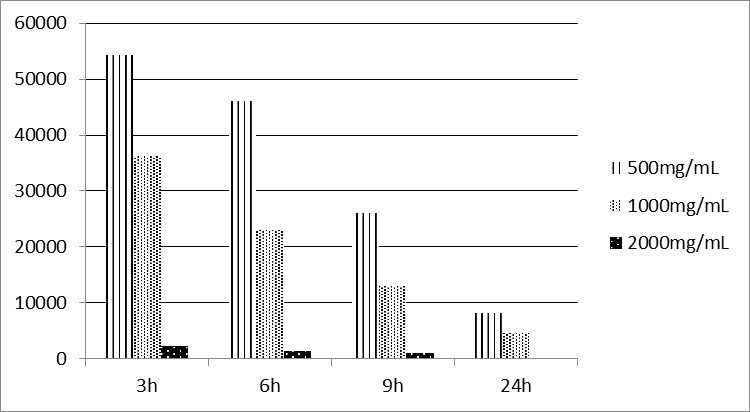
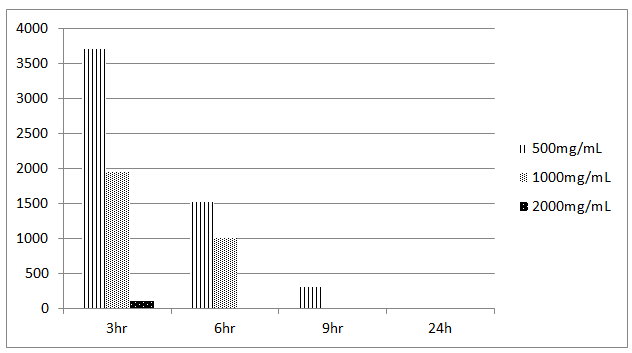
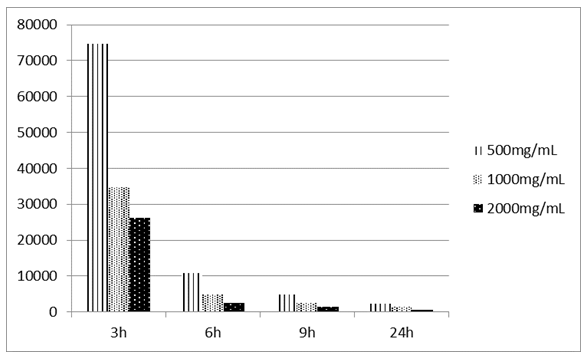
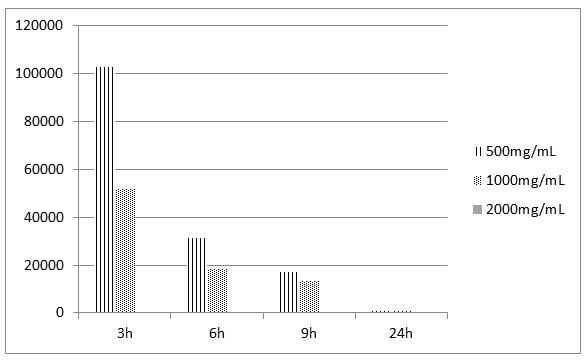
The cultivable bacteria, for each bacterial strain were counted at concentrations 500 mg/mL, 1000 mg/mL and 2000 mg/mL, at different incubation times 3 h, 6 h, 9 h and 24 h. Figure1, illustrate the effect of C. oligandrus extracts on the survival of microorganisms as a function of incubation time.
Antibacterial Activity of C. Oligandrus on E. Coli
Aqueous Extract: As a function of incubation time, the bacterial load of cultivable E. coli cells decreased from 1311 ×103 to 569 ×103 CFU/100 mL for the control solution (0.85% NaCl). At different concentrations of aqueous extract there was generally a decrease in bacterial load with increasing extract concentration. Bacterial abundances ranged from 543 ×103 to 0 CFU/100 mL, and the highest cell concentration was recorded in the suspension with 500 mg/mL after 3 hours of incubation. The lowest concentration was recorded in the suspensions with 2000 mg/mL, at 6, 9 and 24 hours of incubation respectively (Figure 1). Moreover, after 24 hours, a total inhibition of E. coli was observed with a Minimum Inhibitory Concentration (MIC) value of 2000 mg/mL.
Ethanolic Extract: As a function of incubation time, the bacterial load of cultivable E. coli cells decreased from 1311 ×103 to 569 ×103 CFU/100 mL in the control solution (0.85% NaCl). In the presence of the different concentrations of ethanolic extract, there was a general decrease in bacterial load from 3.7 ×10³ to 0 CFU/100 mL as the concentration of extract increases. The highest cell concentration was recorded in the suspensions at 500 mg/mL after 3 hours of incubation. The lowest concentrations were recorded at 1000 to 2000 mg/mL after 6, 9 and 24 hours of incubation, respectively (Figure 2). A complete inhibition of E. coli was observed at doses of 1000 and 2000 mg/mL at 9 and 24 hours, respectively.
Antibacterial Activity of C. Oligandrus Extract on Shigella Spp.
Aqueous Extract: Depending on the incubation time, the bacterial abundance of cultivable Shigella spp varied from 569 ×103 to 1311 ×103 CFU/100 mL in the control solution (0.85% NaCl). In the presence of the different concentrations of aqueous extract, the bacterial load decreased as the extract concentration increases. The cell abundances decreased from 746 ×103 to 0.6 ×10³ CFU/100 mL. The highest cell concentration was recorded in the suspensions having 500 mg/mL at 3 hours of incubation; and the lowest at 2000 mg/mL at 24 hours of incubation (Figure 3). No minimum inhibitory concentration (MIC) was observed with Shigella spp.
Ethanolic Extract: The bacterial load of cultivable Shigella Spp. cells varied from 569 ×103 to 1311 ×103 CFU/100 mL in the control solution (0.85% NaCl). At different concentrations of ethanolic extracts, the bacterial load decreased as the extract concentration increases. The cell abundances decreased from 10.29 ×10³ to 0 CFU/100mL. The highest cell concentrations was recorded in suspensions at 500 mg/ml after 3, 6 and 9 hours of incubation. The lowest concentration was recorded at 2000 mg/mL after 3, 6 and 9 hours of incubation, respectively (Figure 4). Significant inhibition of Shigella spp. cells with minimum inhibitory concentration (MIC) was observed at all incubation times for the ethanolic extract.
Percentage of inhibition of bacterial cells
The variation of inhibition percentages (IP), were observed for both bacterial species in the solution containing the aqueous and ethanolic extract of C. oligandrus, after exposure at 3, 6, 9 and 24 hours period, at concentrations of
500, 1000 and 2000 mg/mL, respectively. The ethanolic and aqueous extracts at dose 2000 mg/mL during 3, 6, 9 and 24 hours period inhibited (98.04-100%) of shigella spp and E. coli (Tables 3-6). The lowest IP in E. coli and shigella spp were observed at 500 mg/mL extract concentrations at 3 hours.
| Incubation time (h) | Aqueous extract (%) | Ethanolic extract (%) | |
|---|---|---|---|
| 500 | 3 | 95.79 | 99.69 |
| 500 | 6 | 95.97 | 99.85 |
| 500 | 9 | 96.76 | 99.96 |
| 500 | 24 | 98.45 | 100 |
| 1000 | 3 | 97.14 | 99.89 |
| 1000 | 6 | 97.98 | 99.91 |
| 1000 | 9 | 98.38 | 100 |
| 1000 | 24 | 99.14 | 100 |
| 2000 | 3 | 99.81 | 99.99 |
| 2000 | 6 | 99.87 | 100 |
| 2000 | 9 | 99.88 | 100 |
| 2000 | 24 | 100 | 100 |
| Concentration in (mg/ mL) | Incubation time (h) | Aqueous extract (%) | Ethanolic extract (%) |
| 500 | 3 | 94.25 | 92.05 |
| 500 | 6 | 99.04 | 97.39 |
| 500 | 9 | 99.33 | 97.93 |
| 500 | 24 | 99.51 | 99.35 |
| 1000 | 3 | 97.3 | 96.02 |
| 1000 | 6 | 99.52 | 98.46 |
| 1000 | 9 | 99.66 | 98.53 |
| 1000 | 24 | 99.7 | 99.79 |
| 2000 | 3 | 98.04 | 100 |
| 2000 | 6 | 99.76 | 100 |
| 2000 | 9 | 99.83 | 100 |
| 2000 | 24 | 99.88 | 100 |
Table 3: Percentage of inhibition of cultivable _E. coli_ bacteria.
PI= percentage Inhibition in % Table 3: Percentage of inhibition of cultivable E. coli bacteria.
Determination of Inhibition Diameters in Agar Medium (Sensitivity Test)
The different plant extracts and selected microorganisms showed a variable sensitivity from one germ to another. The variation in extract sensitivity was confirmed by the existence of different inhibition diameters on the tested extracts. At dose 500-2000 mg/mL, the diameter of inhibition on both bacteria strains varied from 12-25 mm (very sensitive to extremely sensitive) for the ethanolic and 10-21mm for the aqueous extracts.
| Concentration in mg/ mL | Aqueous extract | Ethanolic extract | ||
|---|---|---|---|---|
| 500 | 10 mm | S | 15 mm | VS |
| 1000 | 12 mm | S | 17 mm | VS |
| 2000 | 16 mm | VS | 25 mm | ES |
| Ciprofloxacine (5µg) | 32 mm | ES | 31 mm | ES |
Table 4: Diameter of inhibition on Mueller Hinton effect on Shigella sp.
S= Sensitive VS= Very sensitive; ES= Extremely Sensitive Table 5: Diameter of inhibition on Mueller Hinton effect on Shigella sp.
| Concentration in mg/ mL | Aqueous extract | Ethanolic extract | ||
|---|---|---|---|---|
| 500 | 16mm | VS | 12mm | S |
| 1000 | 17mm | VS | 16mm | VS |
| 2000 | 21mm | ES | 23mm | ES |
| Ciprofloxacine (5µg) | 32mm | ES | 31mm | ES |
Table 5: Diameter of inhibition on Mueller Hinton effect on E. coli.
S= Sensitive; VS = Very Sensitive ; ES= Extremely Sensitive Table 6: Diameter of inhibition on Mueller Hinton effect on E. coli.
Student’s T-Test for Comparison of E. Coli Abundances
Comparison of the Same Dose and at Different Incubation Times: Maintaining the dose of the aqueous and ethanolic extract at 1000 or 2000 mg/mL at different incubation time, resulted in a significant decrease (P≤ 0.01) of bacterial abundance of E. coli Comparison of Different Extract Doses and Same Incubation Time: The doses at 500, 1000 and 2000 mg/mL of the ethanolic and aqueous extract at the same incubation time, resulted in significant decrease (P≤ 0.01) in E. coli abundances.
Student’s T-Test for Comparison of Abundances of Shigella Spp
Comparison of Different Concentrations and the Same Incubation Times: At different concentrations of the extracts and at the same duration of incubation, a very significant decrease (P≤ 0.01) in the bacterial abundances of Shigella spp. was observed. The significant difference observed was valid for the comparisons made between the concentrations at 500 mg/mL and 1000 mg/mL of the aqueous and ethanolic extract at the same incubation duration. Comparison at the Same Dose and Different Incubation Times: When the concentration of the extract and the incubation time is increased, the bacterial abundance of Shigella spp. decreases significantly (P≤ 0.01). It is valid for the concentrations ranging from 1000 to 2000 mg/mL of the aqueous and ethanolic extract of C. oligandrus.
Discussion
The results obtained in the present study showed a strong antimicrobial activity of aqueous and ethanolic extracts of C. oligandrus on E. coli and Shigella spp. The extraction yields were 1.57% and 1.13% for the aqueous and ethanolic extracts, respectively. The calculated yield of the ethanolic extracts of C. oligandrus was lower to that of Dzotam, et al. [13] that yielded 3.95%. This difference could have been influenced by the geographical origin and the extraction method.
The phytochemical screening of the extracts of C. oligandrus revealed the presence of tannins, polyphenols, saponins, resin, flavonoids, and alkaloids. These results are similar to those reported in Croton Zambezicus, Croton leichleri and Croton tiglium [14]. Moreover, the ethanolic extract was richer in secondary metabolites to the aqueous extract; indicating the metabolites had greater affinity with ethanol as solvent.
At 24 hours period, the aqueous extract at doses 500 ≤ MIC ≤ 2000 mg/mL inhibited 98.45 -100 % of E. coli , while the ethanolic extract at doses 500 ≤ MIC ≤ 2000 mg/mL, completely inhibited E. coli. As concerns Shigella spp., at 24 hours, 100% inhibition was observed at dose 2000 mg/ mL, for the ethanolic extract, while the aqueous extract at dose 500 ≤ MIC ≤ 2000 µg/mL, inhibited 99.51-99.88 % of the bacteria strain. Therefore, the extracts in this studies showed moderate activity at MIC ≥500 µg/mL and significant activities at 1000 ≤ MIC ≤ 2000 mg/mL.
Polyphenols and alkaloids in extracts of plants are known to demonstrate interesting antimicrobial activity [15], and sometimes good bactericidal or bacteriostatic effects [16]. The variation in the composition of metabolites such as the presence of polyphenols, flavonoids and alkaloids in the ethanolic extracts could account for the significant increase in the antimicrobial activities of C. olingandrus. The results of antibacterial tests of C. olingandrus, ethanolic extract is comparable to that of Enerva et al., 2015 [17]. However, the aqueous extract of C. oligandrus showed no complete inhibition of Shigella spp. This might be due to the fact that the bacterial strain is resistant to the effect of this extract.
Previous studies had shown that, if the inhibition diameters are lower than 8 mm, the bacterial species used are said to be resistant [17]. In this studies, all the inhibition diameters are greater than the limit diameter (8 mm) of the zone of inhibition for which an extract is considered inactive. For instance, the aqueous and ethanolic extracts of C. oligandrus demonstrated inhibition diameters above 8 mm for bacteria strains. Hence, the ethanolic and aqueous extracts, were effective against E coli and Shigella spp strains.
Conclusion
The results of the phytochemical screening of both the aqeous and ethanolic extracts of C. oligandrus revealed in common saponosides, alkaloids, tannins and polyphenols, while cardiac glycosides, resins, flavonoids, catechic tannins, quinones and mucilages were present only in the ethanolic extract. The ethanolic and aqueous extracts at dose 2000 mg/mL during 3, 6, 9 and 24 hours period inhibited (98.04- 100%) S_higella spp. and _E. coli. Complete inhibition of E. coli, with the ethanolic extract was observed at doses of 1000 and 2000 mg/mL at 9 and 24 hours. The lowest inhibition potential for both extracts, were observed at dose 500 mg/ mL, at 3 hours for E. coli and Shigella spp. At doses 500-2000 mg/mL, the diameter of inhibition for Shigella spp. varied from 15-25 mm (very sensitive to extremely sensitive) for the ethanolic extract and 10-16 mm (very sensitive to extremely sensitive) for the aqueous extract. At the same doses, the diameter of inhibition for E. coli, varied from 16-21 for the aqueous extract and 10-23 for the ethanolic extract.
All the studied microorganisms were sensible to the different extracts with the éthanolic extract demonstrating greater anti-diarrheal activity on both strains compared to the aqeous extract. The present study indicates, C. oligandrus stem bark extract could be used in reducing the risk of waterborne disease such as diarrhea.
References
-
Moore SR, Lima AAM, Schorling JB, Barboza MS, Soares AM, et al. (2000) Changes over time in the epidemiology of diarrhea and malnutrition among the children in an urban Brazilian Shantytown, 1989 to 1996. Int J Infect Dis 4(4): 179-186.
-
Rice AL, Sacco L, Hyder A, Black RE (2001) La malnutrition : cause sous-jacente des décès de l’enfant par maladies infectieuses dans les pays en développement. Bull OMS 4(1): 97-110.
-
Adjanohoun EJ, Assi AL, Floret JJ, Guinko S, Koumaré M, et al. (1979) Médecine traditionelle et pharmacopée - Contribution aux études ethnobotaniques et floristiques au Mali. Agence de Coopération Culturelle et Technique, Paris, France, pp: 291.
-
Akintayo L, Ogundajo IA, Ogunwande HG, Gbadamosi, Rukayat G, et al. (2014) Chemical composition of the leaf essential oils of Croton zambesicus Mull.-Arg. grown in Lagos, South-West, Nigeria. European J Med Plants 4(12): 1524-1533.
-
Aubreville A (1983) Flore Forestiere Soudano-Guineenne A.O.F.: Cameroun, A.E.F. In: 2nd (Edn.), Champagne sur Seine (France): Societe d’Editions Geographiques, Maritimes et Coloniales, Paris, France.
-
Arbonnier M (2009) Trees, shrubs and lianas of the dry zones of West Africa. 3rd (Edn.), National Museum of Natural History, Paris; Quae, Versailles, pp : 576.
-
Yang L, Wu ZN, Zhang YB, Chen NH, Zhuang L, et al. (2017) Three new diterpenoids from Croton laui Merr. et Metc. Nat Prod Res 31(9): 1028-1033.
-
Betti LJ, Yongo DO, Mbomio OD, Iponga MD, Ngoye A (2013) An ethnobotanical and floristical study of medicinal plants among the Baka pygmies in the periphery of the Ipassa Biosphere Reserve, Gabon. EJMP 3(2): 174-205.
-
Jiofack T, Ayissi I, Fokunang C, Nguedje N, Kemeuze V (2009) Ethnobotany and phytomedicine of the upperNyong valley forest in Cameroon. Afr J Pharm Pharmacol 3(4): 144-150.
-
Harborne JB (1973) Phytochemical methods. In: A guide to modern techniques of plant analysis. Chapman and Hall Ltd, London. pp: 279_._
-
Clinical and Laboratory Standards Institute (2012) Methods for dilution antimicrobial susceptibility tests for bacteria that grow aerobically. 9th (Edn.), Wayne, Pa: CLSI document M07-A9.
-
Société Française de Microbiologie (2017) Les recommandations du Comité de l’Antibiogramme de la Société Française de Microbiologie 1(1): 128.
-
Dzotam JK, Touani KF, Kuete V (2016) Antibacterial and antibiotic-modifying activities of three food plants (_Xanthosoma mafaffa_ Lam., _Moringa_ _oleifera_ (L.) Schott and _Passiflora edulis_ Sims) against multidrug-resistant (MDR) Gram-negative bacteria. BioMed Central Complementary and Alternative Medicine 16(9): 2-8.
-
Stuart K, Byfield DY (1971) Alkaloids from _Croton_ _humilis._ phytochemistry 10(2): 460-462.
-
Uddin SJ, Shilpi JA, Alam SM, Alamgir M, Rahman MT, et al. (2005) Antidiarrhoea activity of the methanol extracts of the barks of _Xylocarpus_ _moluccensis_ in castor oil- and magnesium sulfate-induced diarrhea model in mice. Journal of Ethnopharmacology 101(1-3): 139-143.
-
Adesokan A, Akanji M, Yakubu M (2007) Antibacterial potentials of aqueous extract of _Enantia chlorantha_ stem bark. African Journal of Biotechnology 6(22): 2502- 2505.
-
Enerva LT, Atienza TV, Glifonea ZR, Villamor OB, Villa NA (2015) Cytotoxicity and Antimicrobial, Property of the Leaf Extract of _Euphorbia hirta_ (Tawa-Tawa). Open Journal of Social Sciences 3(3): 162-170.
- Solution-Processed Chiral Perovskites for Biomedical Applications
- Nanotechnology in Health Chemistry and Medicine: Current Challenges and Future Directions
- Human Exposure to Micro- and Nanoplastics: Pathways, Toxicity, and Intervention Strategies
- Exosome Nanomedicine for Cancer Therapy
- Micro and Nanoplastics–Plastisphere, Biotoxicity, Impact on Human Health, and Mitigation Strategies
- Process Validation of Cefixime Powder for Suspension Dosage Form, 50 mL