
What Should Nanotechnology be Human? Inclusive Information That Communicates the Meaning of the Technique
The development of nanotechnologies is at an accelerated stage, especially in the cosmetics sector in Brazil. Public Organizations that control development do not communicate or communication is insufficient about the risk to human health. One of the hypotheses of solution to this problem is the systematization of the process of inclusive communication of stakeholders, identified as being institutional information governance for decision-making on development and risk. The methodology applied has a systemic approach; deductive method and research techniques that include the bibliographic review, national and foreign, data collection and qualitative analysis. The research findings point in the direction that the absence of communication of nanotechnology risks by Public Organizations stems from the lack of maturity of the Institutional Governance of Information to fae the paradox: risk/development. As a result, information that communicates the meaning of development and risk to third parties affected by nanotechnology can impact on the shared management
Introduction
The scenario in which the development, use and application of nanotechnology is designed contains the structure that conforms the technoscientific system [1] in the light of the Law No. 13.243/2016 and the Federal Constitution of 1988: Companies, Universities, Government and Society, being that the Government is represented by its organizations, direct and indirect.
This implies that, since 2016, companies and universities have been appropriating the development, use and application of new technologies and innovation in products and process, and the Government, exercising its role as manager of this union, with public policies to foster, encourage, control, and supervise.
Once this system is structured, its operations have as a vision, to promote the socioeconomic development of the country in two contexts: local and global [2]. There is no way to promote the country’s development without including society and human development, according to the complexity and interdependence as a foundation established in Article 1
and subsections, of the Constitution of the Republic [3]. Brazil has nanotechnology as an entrepreneurial mobilization, innovation, and new business generation program. Given its diverse applications and potential to add value, it is considered strategic and key to the social and economic development of countries and economic blocks, including Brazil, with national initiatives in this regard.
It is one of the technical apparatuses developed, used, and applied by Universities and Companies for making up the set of new technologies appropriated by this system alongside those mentioned by the leader of the World Economic Forum, Klaus Schwab as being all the innovations and technologies that take advantage of the dissemination capacity of digitalization and Information technology [4, 5]. Nanotechnologies contribute to the construction of a Data World [6], as a place where the physical and the digital hybridise and are both transformed into information.
As nanotechnology is the research object cut out from this set, its analysis is restricted to the scope of nanotechnology linked to nanotoxicity. This, in turn, developed and applied as a productive input of materials for human use. In this point lies the reason for the concern with risks and harmful contingents to human health. The perspective of research is not in the legal question of use, but in the Information that makes known the risk of use.
Take for a single example that of “modern nanomaterials, such as graphene, which is about 200 times stronger than steel, millions of times thinner than a human hair and an efficient conductor of heat an electricity” [4], it is possible to claim that this technical apparatus is able to “disrupt manufacturing and infrastructure industries” [4] and greatly affect consumer expectations; in the respective consumption behaviour and, u=in the consumer’s own personality, demanding the best experience in quality of life and well-being. This implies, for the organizations involved, informational transparency and value delivery.
This scenario of development and applications of nanotechnologies intended for human use has risks. From the laboratory to disposal and reuse, the natural, human, and social sciences have been paying attention to the possibility of an unknown and unmeasurable contingent [6, 7] of nanotoxicity and consequently, damage to the living ecosystem without, however, the people and society, the addresses, participating in this process, since it is done in their name and benefit.
Therefore, in this context, the following research question emerges: on what conditions could people and stakeholders participate in the development and application of nanobiotechnologies beyond the use?
To answer this question, the general objective of the research is to demonstrate that Public Organizations correlated to this development should structure and make Institutional Information Governance work to enable the inclusion of people and stakeholders in this process.
As specific objectives, the research aims to (i) outline the conjectural approach to nanotechnology development, application, and use; (ii) map the informational absence of stakeholders on nanotechnology and risk; (iii) demonstrate that the Institutional Governance of Information within Public Organizations can promote the inclusion of people and stakeholders in the nanobiotechnology development process.
During the construction of the discourse, the research relies on technical categories such as system as communication between the parties involved who seek a language that has common sense, known and intelligible to communicate and improve their joint processes; organizations as legal structures assembled able to identify an entity; Institutional Governance of Information as an organization that sees the information as a vehicle of communication able to understand the value of who receives the communication and, with this, there is the alignment of the language of meaning able to include the receiver of communication in the system of the organization, becoming part of it; people and stakeholders categories of citizens, individuals and civil society organizations representing collective interests; and inputs and outputs as informational categories exchanged by the interlocutors able to irritate the system of the organization; interdependence relationship as a category that explains the dependency attention to the demands of other systems once they are related to its performance with the aim of evolving society for the better. These categories used as a method of approach are extracted from the Social System Theory [8].
The methodology applied has a systemic approach; deductive method and research techniques that include the bibliographic review, national and foreign, data collection and qualitative analysis.
The research findings point in the direction that the absence of communication of nanotechnology risks by Public Organizations stems from the lack of maturity of the Institutional Governance of Information to fae the paradox: risk/development.
Conjectural Contexts of the Development, Application and Use of Nanotechnology
The context of development, use and application of nanotechnology, in Brazil, has as its main sector, the cosmetics industry, therefore, nanobiotechnology. The cosmetics that most go throughout the nanotechnological transformation and improvement process include those for skin hydration; botanical active ingredients; with prolonged action; with vitamins and minerals; that accelerate the time and speed of biochemical yields; anti-ageing products; antioxidants; with ultraviolet protection; and products without additives or preservatives, among others.
The reason why the cosmetics industry inserts nanotechnology as input in this production processes stems from the perspective of improving the properties of the actives and respective performances of skin care products, such as solubility, permeation, bioavailability, and increased stability; in addition to improving product administration by users, such as reducing the necessary dose and side effects. Also, the marketing issue.
According to the Brazilian Agency for Industrial Development in partnership with the National Confederations of Industry and the Federation of Industries of the State of Santa Catarina, they stated that nanotechnology is the best of companies that have been earning more than R$ 40 million per year and conquering foreign markets. Besides, in Brazil, the invoicing of the 52 companies that supply nanotechnology inputs already exceeds R$ 175 million, with a growth of 27% per year, an average much above that financial market. The State of Santa Catarina alone, holds 26 companies of this total [9].
At a global level, the numbers are astronomical and, according to the Ministry of Science, Technology, and Innovations (MCTI), it is estimated that nanotechnology should involve almost 13.000 companies from 56 countries and, move US$ 3 trillion annually [9].
In 2021, Brazil occupied the 13th global position in research publications, according to Web of Science and, 3rd place when it came to nanotechnology focused on cosmetics [10].
In relation to the cosmetics market, in Brazil, according to the Market Data Panel of the Brazilian Association of the Personal Hygiene, Perfumery and Cosmetics Industry, in 2020, the sector had a growth of 5.8%, even in the face of crisis of the year [10].
These growth data represent the impacts felt by the industry when appropriating the application of nanomaterials in their processes because it is insoluble or bio persistent material; manufactured with one or more external dimensions or, an internal structure, with the scale of 1 to 100 nanometres and have the function of transporting the encapsulated biochemicals. Also, by the fact the nano ingredients as solid ingredients intended to be added to cosmetics to enhance the impacts on the use by the user. Nanotechnology, in turn, is the manufacturing process that involves manipulation and human contact to obtain nanostructures. From this perspective, persistent and non- biodegradable nanoparticles are nano toxic to human health.
MCTI defines nanotechnology as a scientific- technological field that is transversal, disruptive and pervasive, dedicated to the understanding, control, and use of properties of matter at the nanoscale (1.0x10⁻⁹m, equivalent to 1 billionth of a meter) capable of presenting new properties and differentiated characteristics that can be explored for several technological application. Among the most common are nanoparticles, nanomembranes, carbon nanotubes, fullerenes etc [11].
According to MCTI Directive No. 1.122, of 2020/03/19, nanotechnology is one of the enabling technologies considered a priority for the promotion of Planning, Development and Innovation (PD&I) projects for the period from 2020 to 2023, whose action by the Agency aims to crate and nurture a collaborative environment between industry and academy, combining skills in science, technology and innovation, focused on ethics and the continued promotion of the full sustainable development of the nanotechnology ecosystem [11].
As a result, a system was structured based on the Brazilian Nanotechnology Initiative (IBN) as the main strategic program to encourage nanotechnology and the CT&I Action Plan for Converging and Enabling Technologies [11].
The IBN, launched in 2013, aims to crate, integrate, and strengthen government actions in nanotechnology, with a focus on promoting innovation in the Brazilian industry and socioeconomic development. However, by Ordinance No. 3.459, of 2019/07/29, it was given the strategic condition and public policy of the country, contributing with the construction of the legal framework of nanotechnology for the increment of traditional processes and products and the increase of global competitiveness [11].
Among the MCTI actions that stand out in the scope of the IBN, are the organization of the National System of Nanotechnology Laboratories (SisNANO); the creation of Networks of Innovation Centres in Nanotechnology to reach the Brazilian Technology System (SIBRATEC); Brazil’s participation in the Global NANOReg Program (2013-2017) focused on the scientific support for the regulatory process and regulation, as well as its continuation with the project for certification of nanoproducts; support for international cooperation projects, especially the Brazil-China Centre for Research and Innovation in Nanotechnology and the Brazil- Argentine Centre for Nanotechnology; among others [11].
The IBN comprises the alignment of the MCTI Strategic Objectives 2020 to 2023 and the Objectives established in the STI Action Plan for Converging and Enabling Technologies and contributes to the strengthening of RD&I in nanotechnologies; the support to the regulation and regulation process of nanotechnology; the promotion of initiatives that contribute to the formation and training of human resources; grater dissemination and popularization of nanotechnology and its applications; expansion of the number of projects of entrepreneurship and innovation in nanotechnology; strengthening of national and international partnerships; availability of multi-user and open access infrastructure to public and private users; and, optimization of budget resources [11].
The National System of Nanotechnology Laboratories (SisNANO) is made up of a group of laboratories dedicated to research, development and innovation in nanoscience and nanotechnology, which receives R&D&I project proposals or service requests.
The SisNANO was established by the MCTI through Ordinance No. 245 of 2012/04/05, which was amended by Ordinance No. 2376 of 2019/05/16, which included it as one of the strategic axes of the IBN. Currently, the SisNANO is regulated by the Normative Instructions of No. 11, of 2019/08/02 and, composed of 23 laboratories allocated in 8 strategics; 12 associated and 3 strategics partners; occupies space in the CT&I Action Plan for Convergent and Enabling Technologies in nanotechnologies for the period 2018 to 20222, with defined attributions of: (i) supporting the establishment of regulatory framework; (ii) providing subsidies for the implementation of a national Nano safety program; (iii) promoting the training of human resources; (iv) strengthening innovative environments; and, (v) intensifying international cooperation [11].
Furthermore, it contributes to the MCTI’s strategics objectives of strengthening the SNCTI by investing in multi- user laboratories, with open access to researchers and companies that make up the SisNANO; it promotes expansion in the number of multi-users laboratories in all five regions of the country, especially in the North, Centre-West and Northeast; promotes innovation in processes, products and services involving nanotechnology; strengthening the RD&I ecosystem involving nanotechnology through greater integration of laboratories; greater accessibility to advanced infrastructure for RD&I in nanotechnology; by better directing investments in the nanotechnology area, thus avoiding the pulverization of resources; as well as improving laboratory infrastructure; increasing the number of R&D&I projects developed in partnership with the productive sector and with institutions in other countries; strengthening national and international partnership involving nanotechnologies increase in the number of professionals trained to act in nanotechnology; greater dissemination of nanotechnology and the services offered under the scope of the SisNANO to the productive sector and society in general; and, support for the process of regulation and regulation of nanotechnology and nanotechnology products [11].
It is seen that the development, use and application of nanotechnologies will enable “the convergence of molecular biology, materials engineering, computational approaches and mathematical modelling and will produce impacts on our society, the industrial landscape and the global environment” (SCHWAB; DAVIS, 2018, p. 230). As a reflection of this, it is pressing to “carefully consider the consequences of our actions as we move towards a sophisticated biotechnological future” [5].
This implies stating that the contingent risks to human health, especially about developing countries, including Brazil, have aggravated perspective because of the greater appetite for risk in the compensation of scarcity and distributional conflicts [12] visually represented by the figure bellow:
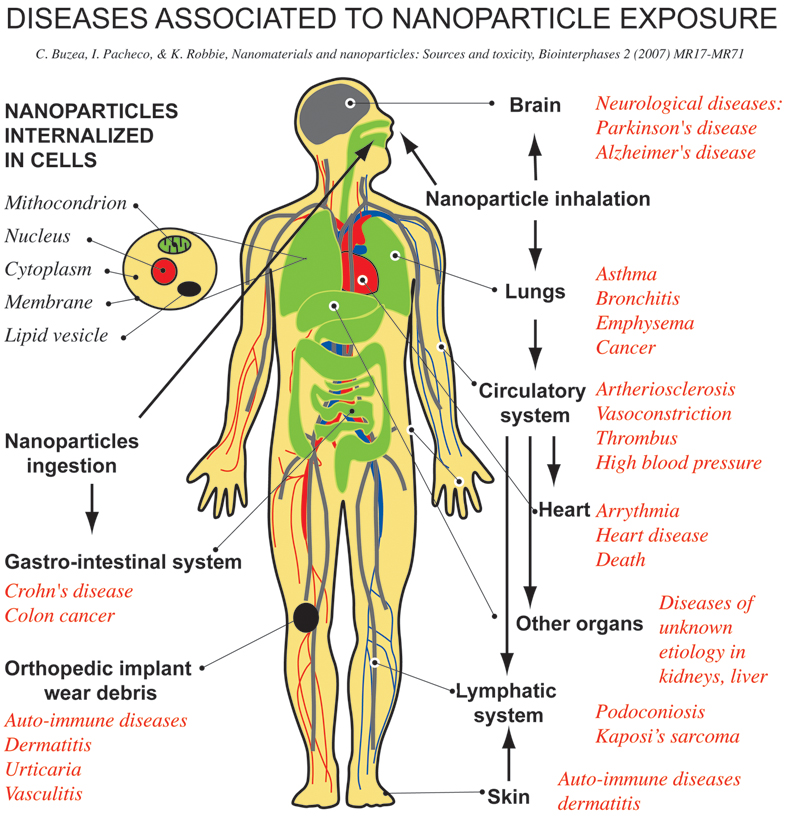
Source: AHMED, 2014, p. 38[13]. Figure 1: Diseases associated with exposure of Nanoparticles.
Even though this well-structured techno-scientific system, which is labelled as promising because it intends to change the future and human nature [5], the risks remain with little scientific and/or regulatory treatment and an absence of information that makes sense to society and stakeholders about the health impacts; above all, an absolute silence about the communication of this development.
In a comparative study and very similar to the Brazilian scenario mentions the same informational deficit in countries like Italy, Europe, and the United States [14]. It is, according to him, more evident and verifiable when the artefacts in questions are pharmaceuticals since their known harmful potential is not always perfectly known or communicable which means damage to health. This deficit is characterized by the absence of information that communicates the meaning of nanotechnology language to society and stakeholders and, therefore, outside the field of cognition and decision on the assumed risk, especially, in pharmaceuticals.
It is in this same understanding of the unpredictability of damage that considers that “not everything is foreseeable, but experimentation and experience allow us to make expectations about the outcome of our basic technological practices” [15]. In this sense, it is not exaggeration to predict that nanotechnology can effect, considerably, the human race and its existence, precisely, because it deals with the manipulation of atoms and molecules and cellular interactions with cellular robots, which have as programmed vision, transhumanism [16] and immortality [5] as a mission, pursue the fusion between the biological and the digital [5]. This may represent one of the problems of humanity in this century through the excess of technical performance over precautionary policy [6], with nanobiotechnology regulation and governance regimes especially responsible for building public support and trust “through dialogue among all stakeholders” [5].
The Nanotechnology Information Gap as an Institutional Problem
In this aspect of this paradoxical scenario of development, use and application of nanotechnology that is not new [17], even though, it has received new perspectives in the national policy in 2019 [11] and, under to the national strategy as convergent and enabling technology with the purpose of gaining space in the global competitiveness scenario, one has that, this priority and strategic reallocations of the system gives, then, to the agents of the Triple Helix: Companies, Universities and Government [6, 18] the responsibility for the conditions in which this implemented beyond the legal structure of Law No. 13.243/2016 that authorizes them to operate this system aimed the consolidation of the knowledge society as the basis of the economy [19].
But the incentive, fomentation and promotion of nanotechnology development is not enough, not even the union of efforts, when the motivation is innovation for the economy. Society and stakeholders are outside the process. So, the proposal is incomplete and unsatisfactory. With the financial volume registered by companies without, however, including the citizen in the information it communicates, one gets the impression that the addressed is outside the process.
If the entire technical apparatus has as its mission, the narrative of meeting the citizen’s desires and its vision, the narrative of promoting an increase in the quality of life and well-being through the use of nanotechnology-based goods this implies affirming that there is a direct relationship between nanotechnology risk decision-making and the citizens; between Public and Private Organization and the duty to inform the citizen; between the Organization and the inclusive and cognitive education of the citizen in the process of which he/she is a beneficiary or impacted part. It is the concept of ethics of responsibility as a basic principle of Governance required of Organizations, whether public [20, 21] or private [3].
As to the Organizations that mediate the entire process, from the development of and applications of nanotechnology to the availability for citizen use within this system, they are the National Institute of Metrology, Quality and Technology (INMETRO) and the Health Surveillance Agency (ANVISA), which are directly related to this entire process and have the scope to ensure that quality of life, well-being and safety are delivered to citizens. Such Organizations represent one of the links of the Triple Helix: The Government. Universities develop science and technology; the Companies apply them to the innovation of products and process; and the Government exercises its functional prerogatives outlined in the caput of Article 174 of the Constitution of the Republic [3]: to regulate and supervise added to the recent mandatory activity of institutionalizing values and social participation in its process [21].
Now, to demonstrate what is being considered as the lack of proper functioning of Governmental Organizations that cooperate with the worsening of the risk to society, a brief survey on Google search, on 2022/06/14, using the keywords “INMETRO and Nanotechnology”, shows that the Organization is located on the website www.gov.br. This is repeated when searching for the keywords “ANVISA and Nanotechnology”. This means that the databases of booth Organizations are being managed by the Federal Executive Branch that created them.
Thus, when accessing the INMETRO database, with the keyword “Nanotechnology”, the search brought 100 results, 67 of them being news and the remaining 33, other information of similar nature. Once selected in the “news” database, the “filter” “date (newest first)”, the system informed the following results: 2 news published until June
15th, 2022; 2 news published in 2021; 4 news published in 2020; 58 news published in 2019. The remaining 33 were not possible to identify because the system does not separate them from the 67 for reading, but they are similar in nature with documents of accountability of the Organizations among others.
But, of the available information, its contents are focused on the development of nanotechnology at the level of science and application; international agreements; awards to INMETRO researchers; courses offered; advances of the Organizations etc.
Also, in the INMETRO database search, the following keywords were used: “nanotechnology and risk”. The system returned 24 results, none of which provided any information on the subject. On the contrary, there are unintelligible documents and other information about the Body’s accountability in pdf format; information about annual management reports; and an agreement with China.
The same data search process with the same sequence of keywords was done with the term “ANVISA”. The first result presented was a total of 86 information; 18 of which qualified as “news”. Once the first filter was applied, the news was distributed as follows; 3 news items in 2020; 2 news items in 2019; 2 news items in 2018; 1 news item in 2016; and 10 items in 2015. The others 68, contained in the general database could not be read because the database does not separate them from the whole, but they have similar nature and documents of accounts among others.
From 18 news it was diagnosed that they are diversified among courses, research awards, regulatory initiatives, research events, internal process improvement, public calls. Highlight for the year 2015 with 3 interesting news: Institution of ANVISA’s Internal Committee on Nanotechnology; Debate on Nanotechnology in food; and, Database on Nanotechnology and Toxicity.
When accessing the news published on “Debate on Nanotechnology and Toxicity” to read and verify the communication of information came across the following content published on 2015/06/25, by ANVISA Press [22]: it was about the 2nd Thematic Workshop “Nanotoxicity and Risk Analysis”, promoted by ANVISA and the Brazilian Agency for Industrial Development, whose focus was aimed at health and the development of the Health Industrial Complex that needed specific policies to strengthen innovation capacity and international competition.
The news includes the testimony of Professor Zulmira Lacava, of the Institute of Biological Sciences of the University of Brasilia, who reported that the tests that have been carried out since 1997, to investigate the toxicity of the interaction between nanostructures and healthy and tumour cells is still incipient, to the extent that in pre-clinical tests, the responses were not immediate and, in the long term, the toxicity disappeared and reappeared [22].
Already, the researcher, José Maria de Montserrat of the Federal University of Rio Grande do Sul considered that the increasingly intensive use of nanotechnology will bring these structures in the environment hence the importance of knowing the impact of this [22].
The news also informed that the debate was part of the Cycle of Dialogues on Nanotoxicity that brought together the Government, Industry and Academia to discuss the country’s position in the global context of nanometrology: the science of measuring on a nanometric scale that allows the reliable use of nanotechnology techniques. For the head of ANVISA’s Education, Research and Knowledge Centre, Daniella Guimaraes de Araújo, the debate was fundamental to analyse the risks related to nanotechnology considering the institutional mission of protecting health on a large scale.
From the perspective of the director of ABDI Mrs. Maria Luisa Campos Machado, the idea of the dialogue cycles is to obtain “the industry’s perception on the impacts of nanotoxicity and discuss methodologies for analysis and risks on the productive and RD&I process that use nanotechnology” [22].
The information, although adherent to the subject complained of, did not have the power to communicate to the network user, society and interested parties, the meaning of the development of nanotechnology and its associated risks, even because no data in this regard was informed, i.e., published matter that communicated nothing, only informed the event.
This means that both Organizations responsible for direct communication with society and interested parties do not disseminate technical information translated into accessible language, not even clear, directed at citizens; above all, of an institutional nature on nanotechnology and the actions of the Government in the inclusion of the citizen in the process; at least, in a fast, intuitive, simplified way and that communicates the meaning of technique as a value, since Brazilian society is knowledge and informational [2].
There is, therefore, a Constitutional deficit of information regarding nanotechnology, its benefits and risks by the Governmental Organizations that operate the executive tasks. In turn, there is an Institutional deficit of these public Organizations in the inclusion of the citizen within the nanotechnology development process, when it is their national and global mission. This implies in affirming that, once again, the country is institutionally and socially backward, although economically strong.
Inclusive Information Communicating the Meaning of the Technique
Even so, dealing with Organizations and the expectations of citizens in relation to them is to claim the presence of Governance, understood as a system of communicating management, of inputs and outputs for the alignment of interests; humanization of relation; peaceful negotiations, active participation, and improvement of technological development processes. This issue of lack institutional with the public affected by the organizational activity is a serious and unacceptable problem that denies the validity of individual and fundamental rights and guarantees, as well as leaves aside on of the foundations of the Republic (sic).
Such a communication structure should occupy a position of primacy in this process. A discussion like this proposal has already been considered with the inclusion of the Fourth Helix as an integral part of the Triple Helix system: Companies, Universities, Governments and Citizens (Human Rights), in Canada and in the United States [23, 24], The Governmental Organizations are bound, by Decree [21], to Governance as an inclusive public policy of social participation in the cognitive process of technological development, with legal backing of obligatory nature of the State, as seen (sic). Furthermore, it is one of correct exercises of Economic Freedom the regulatory and normative action of the State.
Although Brazil is a developing country, economically strong, with global projection, occupying the 6th attractive position to foreign investments [25] it is considered with little systemic maturity of consolidation of the democratic process of social participation in the management of internal processes [12]. This qualified social participation beyond representativeness (single paragraph of art. 1; BRASIL, 1988) or the Constitutional forms of popular participation [3] would be able to promote human development from the perception of the risk of development, following the example, including recommendations of the OECD [26].
This becomes inherent to Public Organizations of executive nature due to the fact that the States of the 21st century, creates markets and assumes technological risk entrepreneurship [12, 27] and, therefore, co=responsible alongside Universities and Companies in the mission, vision and purpose (sic); implies, directly, the inclusion of people in the process of the knowledge economy [26] through the Institutional Governance of Information because, “while the delivery channel of the benefits of new technologies is mainly carried out through the private sector, the quality and distribution of these benefits are linked to how technologies are governed” [5].
In this sense, the understanding of Institutional Governance of Information that one wants to confirm as a solution, has a sense of language and understanding, presence of Government, existence of formal structures of norms of conduct, definition of desired standards, construction of social norms that “may restrict or endorse the use […]” [5] of nanotechnologies, in order to ensure that “[…] democratic participation and citizen action are preserved, taking into account the predictive and influential power of emerging technologies” [5].
Now, this informational deficiency, expensive for Governance as a process of inclusive communications, is rooted in our context of historical construction and the supremacy of economic exploitation [28] and, therefore, the desired social participation makes up the cost-benefits, when by Governance, it would make up the value chain, which reflects directly in the little systemic maturity of the Public Organizations themselves by delaying this process.
The Institutional Information Governance that communicates the meaning of the technique can be understood from the information that makes it known and, therefore, communicates the entire development and risk process by making people and stakeholders an integral part of this decision-making process in character of shared management and responsibility. This goes beyond mere labelling with incomprehensible technical information on goods intended for consumption; it goes beyond mere compliance with a formality imposed by law, even if it is not useful and its purpose is relegated to fulfilling an obligation.
The respective absence of this information or the information that does not communicate and, consequently, extracts the citizen’s cognition and decision, enhances social insecurity in the adherence to the development process and, on the contrary, communicates the generalized idea of defect of the process or the product, increasing the sense of risk [13]. In this, the system is immature, closed and without any relationship of interdependence with society by procrastinating initiatives to leverage the social perception [29].
To deal with this and reduce the internal paradox of this system between money vs. value; economy vs. society; development vs. risk [8], is that Public Organizations should be encouraged to adopt as a mission, the institutionalization of value to the citizen using as a foundation, the ethics of responsibility [6, 30] with the visions of transforming the nanobiotechnology perception of risk into sustainable development; as a purpose, to occupy a global position of competitiveness, in a turn of the key of what is there. This is due, including, to the legal binding, structure of ANVISA, according to § 1 of article 10 of Law No. 13.848/2019 and, of INMETRO, according to arts. 2 and 4, XI, both of Decree No. 9.203/2017 [21].
And, in what both legislations do not communicate in the sense of Institutional Governance of Information to the citizen, they are linked, obligatory, to the arts. 4, I, V; art. 7, VII; both of Law No. 12.527/2011 which determine that the Institutional Governance of Information should be built based on informational transparency. With this, reduce the asymmetry and make known to society for the qualified participation of all organizational processes.
This functional challenge, dressed up as recent, is not so. For this reason, the predicate of organizational and institutional backwardness is considered a voluntary political decision.
The concept of participatory democracy as a Constitutional model of mandatory decision-making (Brazilian model) brought into the Public Governance system seeks, “essentially, to make compatible the problems of scale for direct inclusion in the decision-making process and self-determination of the population” [31]. So, it can be stated that this constitutional process marks the beginning of maturity of a social system.
However, in the deliberative perspective there is the desirable and ideal degree of maturity of social participation that as corollary the structuring and functioning of Organizational Governance around “an ideal of political justification, which is based on the public argumentation among free and equal citizens” [31], which occupy the space of deliberative citizenship. Then, this process can be affirmed as ideal and able to consolidate the maturity of a social system.
The deliberative citizenship that is wanted within the Institutional Governance of Information can be understood as the process of legitimacy of political decisions that stems from the management of discussions guided by the principles of inclusion, pluralism, participatory equality, autonomy and the common good Machado LS, et al. [31] representative of sectors and organized civil classes; citizens and stakeholders. This would imply, however, in absorbing the variable of time of construction of this complexity time that does not exist for technological advances and implementations Beck U [12] whose impact is to insist on the development relegating people and stakeholders of the process under the criticism that it is a developing country whose democratic structures are not yet well consolidated, although, the formal structures exist.
For this to happen, it is only necessary to have efficient institutional designs and methodologies within the organizations geared towards this end, whole protagonist lies in the discourse as an essential tool for the quality of this institutional arrangement for the cognition and persuasion of those interested in adhering to the process. If social participation derives from the dissuasion system (obligatory); in the deliberative system from persuasion (voluntary), constructed through cognitive processes capable of transforming culture and behaviour, resulting in maturity [32].
From this, it necessarily follows the “intentional intervention that establishes or reorganizes institutional and procedural structures to achieve the desired results” [30, 31]. And, therefore, there is the need for the Public Organization to assess the context in which citizens will occupy space within the system and in facing the paradoxes (sic), since their entry will be forced from the cognition of development and risk; consequently, included in the round of deliberation throughout Governance, whose expected impact is to mitigate “social and political forces, exercised by political and economic elites, seem to determine far more decisively the directions of the country than any arrangements, regardless of how formally institutionalized they are” [31].
For this reason, it is that the “deliberative results do not depend only on variables related to the internal procedures that structure the argumentative and decision-making process, but also on its relationship with exogenous factors and prior to the deliberation” [31] such as the information that communicates the perspective of risk and the discourse that enables the relationship of interdependence between the system and society [8].
To systematize the play of forces in question, is that the theory of discursive neo institutionalism developed as a reaction to the mandatory participatory perspective aiming to build the deliberative – and, this includes, for the present research, persuasion Orlando VBS [32] has a assumption the “idea that institutions affect the behaviour of social actors and the political and social results” [31]. For this result, highlights the role of ideas and discourse, both for maintenance and institutional confrontation for being the central component in the systema of Institutional Governance of Information in Organizations should include variables such as: aspects, categories and ideas of (i) particular conjectures; (ii) judgments; (iii) contentions; (iv) dispositions; (v) intentions; and, (vi) aptitudes; all linked to public organizational mission, vision and purpose under the aegis of the ethics of responsibility and foundation of the Republic [30].
Oliveira, et al. [31] explain that “discourse is not only what is said. However, it includes who you say it to, how, why, and where in the process of building public policy and political communication in the public sphere”.
This proposal for Institutional Governance of Information that should promote deliberative participation as a search for greater and more maturity of the system by promoting the inclusion of people and stakeholders in the development process points to the achievement of the goals set by Government/MCTI (sic).
The Table 1 below schematically demonstrates how the proposal of this Institutional Governance of Information that communicates nanobiotechnology works within Public Organizations, whose mission is to include people and stakeholders in deliberative decision-making processes on development and risk.
| Government | Governance | |
|---|---|---|
| Domain | Public Affairs | Collective Affairs |
| Environment | Scarcity | Abundance |
| Horizon | War | Peace |
| Spirit | Vertical/Hierarchical | Horizontal/Democratic |
| Decision-making models | Order/Instruction | Negotiation/Processes |
| Purpose | Maintenance/Unit | Creativity/Diversity |
| Control/Supervision | State | Independent Authorities/State as a final resource |
Source: VILLAS BÔAS FILHO, 2016, p. 678 [33]. Table 1: The contrast between Government and Governance.
This hypothesis has the power to directly affect the country’s global competitiveness and domestic development, precisely contrary to the discourse or procrastination that Public Organization have been adopting as a development policy and, in this, corroborates the global discourse of the World Economic Forum when considering that “regional differences in biotechnology governance could have to trade disruptions and the perpetuation of injustice and social inequality” [5].
For this institutional Governance of Information to be successful, in the perspective of [33], it is important that there is “permanent surveillance to curb deviations which, in turn, implies the presence of the indispensable conditions for the full implementation of citizenship”. This means, inclusive and cognitive process capable of transforming behaviour and culture towards democratic maturity, that is, persuasion by incentives [32].
Finally, the research does not need to address the methodology for the implementation of this structure, which is already available since the issue of Decree No. 10.411/2020 (BRASIL, 2020), which regulated the Regulatory Impact Analysis, whose recipients of the rule, according to §1, article 1, are the Public Organizations of the Direct Administration, Autarchical and Foundational, among them, INMETRO e ANVISA [34, 35, 36, 37, 38, 39, 40, 41, 42, 43].
ANVISA has already been organizing its Agenda,
but it is very far from developing the potentiality of the Institutional Governance of Information to reach citizens and stakeholders, because it only uses social participation through the categories of hearing and consultation advised on the website. As for INMETRO, it does not even have the primary structures determined by the Decree available on this website.
This contributes to the confirmation of the initial hypothesis that Public Organizations have a maturity deficit and Institutional Governance can serve to help this process of democratic inclusions in the deliberative management of development processes and risk management with people and stakeholders when it comes to nanobiotechnology.
Final Considerations
The research had as object the scenario of complexity that permeates the development and application, by the industry; and, the use, by humans, of nanobiotechnology. From this scenario, it was highlighted that the risk of nanotoxicity resulting from the use represents a problem for investigation and, as a working hypothesis, the affirmation that the Institutional Governance of Information within Public Organizations may be the missing piece to leverage this system, if it considers, politically, within its Public Governance environment, the inclusion of people and stakeholders in the processes of cognition and deliberative participation, evolving the system that is there.
During the investigation, the hypothesis was confirmed by the fact that the executive Public Organizations of the Government are bound, by several normative regime, to the implementations of the Governance system that determines, among other issues, the inclusion of people and interested parties in public consultation and hearing in their decision- making processes.
However, it was demonstrated that this system is not mature enough to face the nano-biotechnological development and risk because the people and interested parties are not able to participate in these processes due to an absolute lack of information and communication that makes sense and translates the language of the development and risk of which they are part.
Therefore, the initial hypothesis that Public Organizations should structure and make the Institutional Governance of Information system work is confirmed to the extent that, the application of available methodologies as a tool to enable the inclusion of people and stakeholders to feel part of the process and, therefore, responsible for it is possible from the cognition and persuasion for the qualified deliberations on the development, application and use of nanobiotechnology. This implies going beyond the duty of informational transparency arising from legislation and indicator of a high degree of systemic and social maturity, meeting global experience expectations, including.
Is this achieved, the paradox of risk vs. development; economy vs. society; cost-benefit vs. value will be overcome in the face of positive, joint, and deliberative construction by all those involved: Companies, Universities, Government and People/Stakeholders/Human Rights.
As research findings, however, unfortunately, both ANVISA and INMETRO are very far from implementing the necessary bases to start their inclusive processes, even primary, of public consultation and participation which will say, to make known in a transparent, ethical and responsible way, the language of meaning of nanobiotechnology and nanotoxicity, without which, we will be, once again, before formalities that empty the democratic sense, of little or no organizational and social maturity, impacting directly on the worsening of the risk and the possibilities of harmful contingents of nanotoxicity, when, then, it will be too late.
References
-
Pellin D (2019) Regulated self-regulation of the Triple Helix: the framework for good governance in nanoscience and nanotechnology. Meritius: NOVA Academic Editions.
-
Information Society in Brazil Green Book (2000) Ministry of Science and Technology (MCT). Edition: MCT. Tadau Takahashi.
-
Constitution of the Federative Republic of Brazil of 1988.
-
Schwab K (2016) The Fourth Industrial Revolution. Translation: Daniel Moreira Miranda. Sao Paulo: Edipro.
-
Schwab K, Nicholas D (2018) Applying the Fourth Industrial Revolution. Translation: Daniel Moreira Miranda. Sao Paulo: Edipro.
-
Pellin D (2021) Mother Nature in a Given World: Solving the Problem of Nanotechnology Precaution. In Nanotechnology and the Environment: Risks and “PREVPREC” pp: 118-148.
-
Fundacentro (2021) Nanotechnologies. Bayesian networks can help in the occupational risk assessment of nanomaterials. Edition: FUNDACENTRO.
-
Niklas L (2018) Systems Theory in Practice. Edition: Leopoldo Waizbort. Translation: Patricia da Silva Santos. Petrópolis, Rio de Janeiro: Voices 1: 2018
-
Brazilian Agency for Industrial Development (ABDI) (2018) “ABDI.” Nano, a market of macro opportunities. Edition: Bruna de Castro.
-
SCC10 (2021) Technology and inovation. Entrepreneurship in Brazil: use of new technologies can boost business. Product.
-
Brasil (2020) Northeast Strategic Technologies Center.” Nanotechnology. Edition: CETENE. Product Technology and Innovations (MCTI) Ministry of Science. Brazil.
-
BECK U (2011) Risk Society: towards another modernity. Translation: Sebastião Nascimento. São Paulo, Brazil, pp: 34.
-
Ahmed MI Niyas (2014) Ecotoxicity Concert of Nano- Zero Valent Iron Particles. Journal of Critical Reviews 1(1): 36-39.
-
Guerra G, Muratorio A, Pariotti E, Piccinni M, Ruggiu D (2011) New drugs and (new) risks: manufacturer’s liability for lack of information: a comparative analysis with the North American experience. In Forms of responsibility, regulation and nanotechnologies. Milan: The Mill pp: 253-284.
-
Grigenti F, Muratorio A, Pariotti E, Piccinni M (2011) Promethean Ambivalence and Nanotechnologies. Em Forms of responsibility, regulation and nanotechnologies pp: 27-38.
-
Pinto, Vieira A (2002) The Concept of Technology. Vol. II. Rio de Janeiro: Contratempo, 2005. White Paper: science, technology and innovation. Brazil.
-
Etzkowitz H (2008) The Triple Helix: University- Industry-Government Innovation in Action In: (1st Edition), London and New York, Routledge, USA, pp:180.
-
Mensah MSB, Enu-Kwesi F (2018) Research Colaboration for a Knowledge-based economy: towards a conceptual framework. Triple Helix 5(1): 2-17.
-
Henry R (2008) Business Ethics: the virtuous cycle of business. Rio de Janeiro: Elsevier.
-
Brasil (2017) Presidency of the Republic: General Secretariat: Sub-Command of Legal Affairs.” Decree No. 9, 203.
-
Brazil (2015) Nanotechnology and toxicity mobilize researchers, government and industry.
-
Metha M (2005) Regulating Biotechnology and Nanotechnology in Canda: a post-normal sciense approach for inclusion of the Fourth Helix. Presented at the International Workshop on Sciense, Technology and Society: lessons and challenges. Singapore.
-
Carayannis EG, Campbell DFJ (2012) Mode 3 Knowledge Production in Quadruple Helix Innovation Systems. Springer Briefs pp: 1-63.
-
Brazil S (2022) Brazil returns to the 6th place in foreign investments in the world.
-
Paunov C (2013) Innovation and Inclusive Development: a discussion of the main policy issues, In: 1st (Edn.), OECD Publishing, France, pp: 1-62.
-
Mazzucatto M (2014) The Entrepreneurial State: Debunking the Myth of the Public vs. private sector. Profernandogama pp: 1-237.
-
Prado C (1885) Formação do Brasil Contemporâneo. São Paulo: Companhia das Letras. pp: 1-390.
-
Luhmann N (2007) The Society of the Society. Mexico, Herder pp: 1-955.
-
Pellin D, Engelmann W (2021) The governmentality applied to nanotechnological economic enterprises: NanoEthics. Latin American Journal of Development pp: 1031-1321.
-
Oliveira (1996) Roberto Cardoso de, and OLIVEIRA LRC de. Anthropological Essays on Morals and Ethics. Rio de Janeiro: Brazil.
-
Machado LS, Maria A (1997) The process of persuasion and the behavior of persuading. Psychology, science and profession pp: 28-34.
-
VILLAS BÔAS FILHO O (2016) Governance in its multiple forms of expression. Journal of Institutional Studies pp: 673-698.
-
(2020) DECREE No. 10,411: regulates the regulatory impact analysis and art. 6 of Law No. 13848/19 and art. 5 of Law No. 13874/19.
-
(2017) Provides for the Governance Policy of the Direct Federal, Autarchic and Foundational Public Administration.
-
(2019) Law 13.848/2019: provides for the management, organization, decision-making process and social control of regulatory agencies.
-
(2019) Economic Freedom Law No. 13.874/2019.
-
(2011) Law No. 12,527: Regulates access to information and makes other arrangements.
-
Brazil (2020) Converging and Enabling Technologies. Nanotechnology: concept and application areas. Product MCTI. Brazil.
-
Lemos MAC, Vieira DM (2021) Discourse as a determinant of the effectiveness of social participation: beyond institutional design and context. Public Management and Citizenship Notebooks 26(85): 1-20.
-
Castro EG, Santos PS (2019) Systems Theory in Practice. Edition: Leopoldo Weizbort.. Petropolis, Rio de Janeiro: Voices 2.
-
Luhmann N (1997) Organization and decision: autopoiesis, action and communicative understanding. Iberoamerican University pp: 1-98.
-
Klein S (2016) Social Systems: outline of a general theory. São Paulo: Voices. Resenhas pp: 349-367.
-
Accoto C (2020) The Given World: five short lessons in digital philosophy. Translation: Eliete da Silva Pereira. Sao Paulo: Paulus.
- Solution-Processed Chiral Perovskites for Biomedical Applications
- Nanotechnology in Health Chemistry and Medicine: Current Challenges and Future Directions
- Human Exposure to Micro- and Nanoplastics: Pathways, Toxicity, and Intervention Strategies
- Exosome Nanomedicine for Cancer Therapy
- Micro and Nanoplastics–Plastisphere, Biotoxicity, Impact on Human Health, and Mitigation Strategies
- Process Validation of Cefixime Powder for Suspension Dosage Form, 50 mL