
Density Functional Theory Approach to Evaluate the Structure Of Modified Titania/Graphene Composite and Photooxidation Products of 9-(N,N-Dimethylaminomethyl) Anthracene System
The current work reports the modification of graphene/titania composite by metal and non-metal to improve the photocatalytic activity in visible region. The M-RGO-TiO2-N system was prepared by Hummer’s method followed by hydrothermal technique. On reaction, tertiary amine appended anthracene and its phenyl derivative yielded anthraquinone as the major product with almost 90% yield. Photo-oxidation of phenyl protected derivative of 9-NN-dimethyalaminomethyl anthracene yielded a very stable intermediate, 9-hydroxy 9-phenyl anthrone over a short span of time. All the products were separated by silica column chromatography using 70:30 hexane/DCM as the mobile phase. The separated compounds were characterized by 1HNMR. Theoretical investigations on the structure of the catalytic system and photo oxidation products of anthracene compounds were studied in detail by using Density functional theory calculations. Significant reduction in band gap of titania was observed from 2.84 eV to 1.84 eV after the modification of titania/graphene heterojunction with metal ions. The geometry optimized structures and energy calculations unmistakably confirmed various interactions of titania and graphene via metal ion and feasibility of the photo oxidation reaction, respectively.
Introduction
Recent years have witnessed the extensive use of Graphene as a base structure to develop highly efficient semiconductor based composite systems for environmental remediation. The ‘2D’ honeycomb lattice structure with excellent electronic properties makes graphene as a perfect cocatalyst with prominent capability to slow down the recombination of photo generated electron-hole pairs, increase the transport of electrons and enhance the surface adsorption of chemical molecules through π–π interactions [1, 2]. Especially, exemplary conducting nature of the graphene makes it a suitable system to enhance the photocatalytic performance of semiconductor materials [3]. Optimization of charge carrier transfer across the boundary between graphene and semiconductor and tighter contact between them play a vital role in ameliorating the photocatalytic performance [2, 4, 5, 6, 7, 8, 9, 10, 11]. So, it is very important to increase the carrier life time and transfer efficiency across the interface between graphene and semiconductor material. On the other hand, the shielding effect due to high weight addition of graphene makes the solution opaque, which adversely affects the photocatalytic efficiency [2, 3, 4, 12, 13, 14, 15, 16]. In order to curtail down the shielding effect, weight content of graphene into the semiconductor matrix should not be more than 5% [4, 5, 14, 15, 16, 17]. TiO2 is a well-known photocatalyst for the removal of recalcitrant chemicals in a sustainable manner, which has minimal environmental impact. Applications of TiO2 were extensively studied during the last three decades on photo degradation as well as photo-oxidation for environmental pollution control. High chemical stability, low toxicity, good activity, and cost effectiveness make TiO2 as the most favored photocatalyst [18, 19]. Absorption maximum in the ultraviolet region of the electromagnetic spectrum and high electron-hole recombination rate due to low mean free path of carrier hinders its widespread applications [19, 20]. This traditional semiconductor has been modified by various methodologies to overcome the limitations. In recent days, various allotropes of carbon including carbon nanotubes, graphene, fullerene and activated carbon have been used to couple with TiO2 to refine its properties as well as photocatalytic performance [21, 22, 23]. Selection of a coupling material to the semiconductor (TiO2) is a key factor to inflate the performance of the whole system. Energy levels, amount and morphology of the coupling material must be tuned to get good activity. Graphene is a promising modifier for photocatalysts, due to its excellent properties. Large BET surface area of graphene offers a good platform to anchor TiO2 nanoparticle and it intensifies the adsorption of various pollutants [24]. Partially oxidized graphene oxide (GO) can act as semiconductor and its band gap is tunable in nature, but completely oxidized system shows insulating nature [25, 26]. Photocatalytic performance of the bare GO was studied in detail by various research groups [26].
Polycyclic aromatic hydrocarbons (PAHs) are one of the constituents of dyes, plastics, pesticides etc. and effluents from choir and textile industry mainly contain anthracene- based PAHs, which contaminates the drinking water, thereby reduces the water quality [27]. PAHs are known as potent carcinogens according to environmental protection agency and world health organization. Photodegradation and conventional methods are not sufficient to remove PAHs due to its extreme stability. Semiconductor catalysis mediated by light and molecular oxygen can have the ability to convert harmful aromatics to less harmful products in a cost-effective and sustainable manner. Photocatalysis plays a very significant role in organic synthesis, which reduces the number of steps, eliminates the use of toxic chemicals, favors mild reaction condition, and improves the product yield by suppressing undesirable side reactions. This work reports interfacial composition engineering by introducing small amount of metal ions at the interfacial layer matrix between graphene and semiconductor to boost the visible light induced photocatalytic activity of the composite system. Nitrogen also was doped into the titania system to extend the light response from UV to visible region. The activity of the prepared system (M-RGO-TiO2-N) was checked in the photo-oxidation of Anthracenemethanamines and its phenyl protected derivative. The entire photo-reaction was carried out with M(1wt%)-RGO-TiO2-N(2 wt%),because the said system showed maximum activity for the photodegradation of dye, Rhodamine B. M(1wt%)-RGO-TiO2-N(2 wt%) system has transformed the substrates to Anthraquinone, a compound having less toxicity and has applications in industrial as well as medicinal fields. Activity of the modified system was found to be very high compared to pristine TiO2 and Graphne/TiO2 system. Our group has already reported the transformation of Anthracenemethanamine derivatives using Ag,N co-doped and Gd,N co-doped TiO2 systems [27, 28]. But the current system was very superior to the co-doped systems, which carried out the transformation effectively in a short span of time. Reports on this organic transformation using modified graphene/TiO2 system are very rare. The current work mainly aims to explain the theoretical investigations of the catalytic structure and the photo oxidation products.
Preparation of M (1 wt%)-RGO-TiO2-N (2 wt%) System
Graphite oxide (GO) was prepared by modified Hummer’s method [29]. 0.05g of the prepared GO was taken in 100ml of isopropanol and 0.001g of copper nitrate was added to it. The whole solution was sonicated for 3h to get a light brown dispersion of metal modified Graphene oxide and considered as solution A. 3.5ml of titanium (IV) isopropoxide was taken in 100 ml of ethanol and 0.2 g of urea in water was mixed with it. The entire solution was stirred for 5h continuously, aged for about 24h to get stable gel and called as solution B. Both the prepared solutions (A and B) were mixed and stirred for 24h in room temperature. Then the above solution was transferred to a 500 ml Teflon-lined stainless-steel autoclave and applied a temperature of 180ºC for 24 hours. The mixture was washed several times with distilled water and dried at 90ºC. The product obtained is designated as M(1wt%)-RGO- Ti-N(2wt%) and the concentration of graphene oxide in the composite system is 5%.
Results and Discussion
Photocatalytic Reactions
Photocatalytic reactions were carried out in an Oriel Arc lamp system designed to produce uniform illumination. The diameter of the collimated beam is around 1 inch (2.54 cm) and the work plane is 2.6 inches (6.65 cm) from the lower end of the beam tuning assembly. In order to control the temperature for the lamp environment, uniform illuminator was equipped with fan cooled lamp housing. The light source was 150 W Xe ozone free lamps with average life of 1,500h. A 420–630 nm dichoric mirror (cold mirror) filter was used in order to get visible radiation, which gave an irradiance of 96.8 mW/cm2 (150 W) respectively. Photo-oxidation reactions were carried out as follows. 9-(N,N-dimethylaminomethyl) anthracene systems in CH3CN(0.03 M) were taken in a 100 ml beaker and 0.1 g of the catalyst was added to it. The mixture was stirred for about 30 minutes to achieve an adsorption/ desorption equilibrium before placing under the lamp setup. Then, the suspension was irradiated for 3 h. As a control, the same reaction was carried out without the catalyst. The resultant mixture was centrifuged and filtered using a Whatman filter paper. This was further purified by silica column chromatography using 70:30hexane/DCM mixtures as the mobile phase. Isolated products were thoroughly characterized using melting point measurements and 1H NMR spectroscopy. Scheme of the photo reaction is shown below.
Density functional theory (DFT) has emerged as a reliable standard tool to theoretically study the geometrical and electronic properties of various compounds including large molecules and metal complexes [29]. It has become the foremost method of choice for computational studies and quite successful in predicting TiO2 properties and correlating with the experimental data [30, 31]. DFT calculations on the Graphene-TiO2 cluster and Graphene-TiO2 cluster with Cu2+ sandwiched between them were performed using the generalised gradient approximation (GGA) using the parametrisation of Perdew, et al. [32] with an added fraction of Hartree-Fock exact-exchange with a choice of α = 0.25, in the ‘PBE0’functional [33]. Since this is a large system, at the optimized geometries, total energy was calculated considering the important dispersion contribution using Grimme’s dispersion correction D3 functional [34].
The basis set used was the 6–31G(d) as implemented in the Gaussian 09 quantum chemical package, which is a valence double zeta set augmented with d polarization functions and s and p diffuse functions for each atom except for hydrogen. Bond lengths, Mulliken atomic charges, frontier orbitals and main electronic energies have been obtained from the direct calculation of the energies of the relevant points on the potential-energy surfaces.
Tio2 Cluster –Graphene and With Cu2+ Sandwiched Between Cluster and Graphene
The molecular geometry optimizations were carried out by starting from the initial geometries by avoiding symmetry restrictions with density fitted DFT/PBE0 level of theory with dispersion corrections at D3 level. First, a (TiO2)8 cluster and a simple graphene were separately geometry optimized. This is followed by placing the (TiO2)8 cluster over the graphene and optimized to study the nature of adsorption. The Figure 1a shows the minima of (TiO2)8 cluster adsorbed at carbon site of graphene. The graphene surface is a structure, where each carbon atom is bound to three surrounding carbon atoms. In graphene, adsorption can be possible over a carbon atom, two bridged carbon atoms and a hollow part surrounded by six carbon atoms.
In the optimized minima, all the ‘Ti’ atoms are tetra coordinated except one, which is tri coordinated. All the oxygen atoms are double coordinated except one, which is single-coordinated. The smallest Ti-O distance is 1.65 Å for the single coordinated Ti-O, and other Ti-O distances were found to be around 1.84 Å. The Ti-C distances, the distance of closest carbon in graphene to a ‘Ti’ atom in cluster vary between 2.5-2.72 Å. The existence of multiple close energy minima reflects the mobile nature of (TiO2)8 cluster over the graphene surface. The results obtained are well in agreement with the previous report on the interaction of TiO2 with graphene [35].
Introduction of Cu2+ to graphene leads to the possibility of strong interactions with the Oxygen atoms in the TiO2 clusters. It can be seen from Figure 1b that the added ‘Cu’ atom could serve as ‘anchor’ sites for the TiO2 cluster. The single coordinated oxygen atom of the cluster was found to be attached to the Cu2+ site preferably.
Further, HOMO–LUMO gap was calculated to elucidate the electronic properties. The band gap was calculated to be 2.78 eV, 2.63 eV, and 1.84 eV for simple (TiO2)8 cluster, (TiO2)8 cluster on graphene, and (TiO2)8 on graphene with Cu2+ at the interface (Figure 1b), respectively. The band gap of the pristine titania and with copper modified graphene was calculated to be 3.2 eV and 1.72 eV, respectively from UV-Visible DRS data. The experimental values are in well agreement with theoretical calculations. DFT functionals do have some limitations for perfect band gap calculation and hence the relatively computationally expensive hybrid functional PBE0 was adopted here to get the most feasible band gap value compared to the previous reports of TiO2
clusters. The larger band gap of (TiO2)8 confirms its light in the ultra violet region.
The interactions of (TiO2)8 cluster with graphene surface alone and with Cu2+ attached graphene changes the energies of the highest occupied molecular orbital (HOMO) and lowest unoccupied molecular orbital (LUMO), thereby reduced the band gap.
The pristine graphene surface does not provide adsorption sites for strong binding, since the ‘C’ atoms of graphene essentially have filled sp2 orbitals. Van der Waals forces are the dominant force of interaction for (TiO2)8 cluster rather than strong covalent bonding. This is reflected in the small lowering of band gap of pure (TiO2)8 clusters from 2.78 eV to 2.63 eV.
As mentioned earlier, (TiO2)8 is essentially mobile over pristine graphene, and this cluster can move over the graphene surface until it encounters a Cu2+ ion on the graphene surface. Strong interaction of metal ions with the more electronegative single coordinated ‘O’ in the (TiO2)8 cluster make it immobile over the surface as shown in Figure 1b. This interaction accounts for the decrease in band gap to around 1.84 eV. Furthermore, the Ti-O distance increases from 1.65 Å to 1.87 Å, when Oxygen atom is closer to Cu2+. It is obvious from the Figure 1b that the two-coordinated oxygen atom next to the single coordinated Oxygen atom (which has strong interaction with Cu2+), is also pointing towards the Cu2+ with further interaction. The most stable adsorption site of (TiO2)8 cluster over graphene and (TiO2)8 cluster with Cu2+ sandwiched between cluster and graphene is shown in Figure 1.
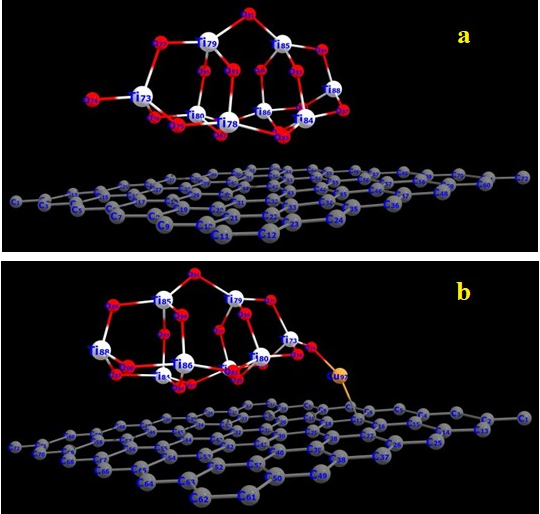
The Cu2+ functionalized graphene-(TiO2)8 cluster interaction thus modified the band gap to lower value and made the system active in the visible region of electromagnetic spectrum. So, the photo-oxidation reaction could be carried out under visible region rather than UV region. It can be cautiously thought of as a probable mechanism of interaction of Cu2+ ions to Oxygen atom(s) in the clusters leading to the anchoring of clusters preferably to these sites. The feasibility of anchoring the clusters over graphene vacant sites was reported elsewhere [36]. It is also noted that for varying cluster sizes, it need not necessarily be one single coordinated Oxygen atom that could attach to Cu2+, which can strongly interact with Cu2+ attached graphene. In larger (TiO2)n cluster sizes, multiple uncoordinated ‘O’ atoms that could interact with Cu2+ are viable, which would make the interactions even stronger.
Theoretical Investigations on Photo Oxidation Reaction
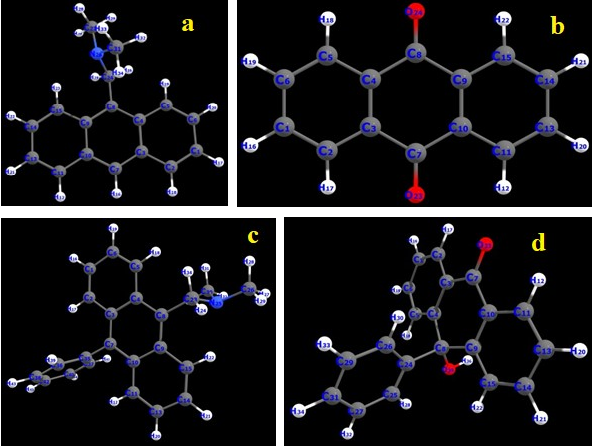
The present research show that, Cu2+-attached graphene/titania composite has high catalytic activity compared to the bare systems for the conversion of 9-(N,N-dimethylaminomethyl)anthracene system. The molecular geometries of bare and phenyl substituted 9-(N,N-dimethylaminomethyl)anthracene, the intermediate species 9-hydroxy 9-phenyl anthrone and the product, anthraquinone were optimized separately with DFT using the B3LYP functional, which has Becke’s three-parameter hybrid exchange functional combined with the Lee–Yang– Parr correlation functional [36, 37]. The energetics of all the viable products is given in Table 1. DFT geometry optimized Structures of the studied molecules, Figure 2a, 9-(N,N-dimethylaminomethyl)anthracene, Figure 2 (b), anthraquinone, Figure 3c, phenyl protected derivative of 9-(N,N-dimethylaminomethyl) anthracene and figure 2d, intermediate 9-hydroxy 9-phenyl anthrone are shown below.
| Molecule | Energy/ hartree |
|---|---|
| (a)9-(N,N-dimethylaminomethyl) anthracene | -712.7989823 |
| (b) anthraquinone | -688.7791251 |
| (c) phenyl protected derivative of 9-(N,N-dimethylaminomethyl) anthracene | -943.8486042 |
| (d) 9-hydroxy 9-phenyl anthrone | -921.0150149 |
Table 1: The energy of the geometry optimized structures is shown below.
Conclusion
Heterogeneous semiconductor mediated photocatalysis is as an exemplary substituent for non-catalytic and traditional homogeneous reactions in organic transformations. It can selectively convert the recalcitrant and toxic water pollutants to products having industrial importance. Stable, efficient, and green TiO2/RGO composite modified with metals and non-metals were prepared and effectively applied for the organic transformation of some carcinogenic anthracene derivatives. Various interactions between the scaffold, graphene, and titania via the metal ion at the interface was evaluated thoroughly by DFT calculations. The geometry optimized structures and energy calculations unambiguously confirmed the feasibility of the photo oxidation reaction. The geometry optimized structures unmistakably revealed various interactions of titania and graphene via metal ion at the interface. The theoretical energy calculations support the feasibility of the photooxidation reaction under visible region.
References
-
Geim (2009) Graphene: Status and Prospects. Science 324(5934): 1530-1534.
-
Lee JS, You KH, Park CB (2012) Highly Photoactive, Low Bandgap TiO2 Nanoparticles Wrapped by Graphene. Adv Mater 24(8): 1084-1088.
-
Arshad A, Iqbal J, Mansoor Q, Ahmed I (2017) Graphene/ SiO2 nanocomposites: The enhancement of photocatalytic and biomedical activity of SiO2 nanoparticles by graphene. Journal of Appl Phys 121(24): 244901-244911.
-
Zhang Y, Tang ZR, Fu X, Xu YJ (2011) Engineering the Unique 2D Mat of Graphene to Achieve Graphene- TiO2 Nanocomposite for Photocatalytic Selective Transformation: What Advantage does Graphene Have over Its Forebear Carbon Nanotube. ACS Nano 5(9): 7426-7435.
-
Li Q, Guo B, Ran J, Zhang B, Yan H, et al. (2011) Highly Efficient Visible-Light-Driven Photocatalytic Hydrogen Production of CdS-Cluster-Decorated Graphene Nanosheets. J Am Chem Soc 133(28): 10878-10884.
-
Yang MQ, Xu YJ (2013) Selective photoredox using graphene-based composite photocatalysts. Phys Chem Chem Phys 15: 19102-19118.
-
Zhang N, Zhang Y, Xu YJ (2012) Recent progress on graphene-based photocatalysts: current status and future perspectives. Nanoscale 4: 5792-5813.
-
Xiang Q, Yu J, Jaroniec (2012) M Graphene-based semiconductor photocatalysts. Chem Soc Rev 41: 782- 796.
-
Huang X, Qi X, Boey F, Zhang H (2012) Graphene-based composites. Chem Soc Rev 41: 666-686.
-
Tu, W Zhou Y, Zou Z (2013) Versatile Graphene‐ Promoting Photocatalytic Performance of Semiconductors: Basic Principles, Synthesis, Solar Energy Conversion, and Environmental Applications. Adv Funct Mater 23: 4996-5008.
-
Du J, Lai X, Yang N, Zhai J, Kisailus D, et al. (2011) Hierarchically ordered macro-mesoporous TiO₂- graphene composite films: improved mass transfer, reduced charge recombination, and their enhanced photocatalytic activities. ACS Nano 5(1): 590-596.
-
Zhang Y, Tang ZR, Fu X, Xu YJ (2010) TiO2-graphene nanocomposites for gas-phase photocatalytic degradation of volatile aromatic pollutant: is TiO2- graphene truly different from other TiO2-carbon composite materials. ACS Nano 4(12): 7303-7314.
-
Akhavan O, Ghaderi E (2009) Photocatalytic Reduction of Graphene Oxide Nanosheets on TiO2 Thin Film for Photoinactivation of Bacteria in Solar Light Irradiation. J Phys Chem C 113: 20214-20220.
-
Xiang Q, Yu J, Jaroniec M (2012) Synergetic Effect of MoS2 and Graphene as Cocatalysts for Enhanced Photocatalytic H2 Production Activity of TiO2 Nanoparticles. J Am Chem Soc 134(15): 6575-6578.
-
Liang YT, Vijayan BK, Gray KA, Hersam MC (2011) Minimizing graphene defects enhances titania nanocomposite-based photocatalytic reduction of CO2 for improved solar fuel production. Nano Lett 11(7): 2865-2870.
-
Liang YT, Vijayan BK, Lyandres O, Gray KA, Hersam MC (2012) Effect of Dimensionality on the Photocatalytic Behavior of Carbon–Titania Nanosheet Composites: Charge Transfer at Nanomaterial Interfaces. J Phy Chem Lett 3(13): 1760-1765.
-
Drunka R, Grabis J, Jankovica D, Krumina A, Rasmane D (2015) Microwave-assisted synthesis and photocatalytic properties of sulphur and platinum modified TiO2 nanofibers. Mater Sci Eng B 77: 012010.
-
Tang B, Chen H, Peng H, Wang Z, Huang W (2018) Graphene Modified TiO2 Composite Photocatalysts: Mechanism, Progress and Perspective Nanomaterials 8(2): 105.
-
Asahi R, Morikawa T, Ohwaki T, Aoki K, Taga Y (2001) Visible-Light Photocatalysis in Nitrogen-Doped Titanium Oxides. Science 293(5528): 269-271.
-
Yu J, Ma T, Liu G, Cheng B (2011) Enhanced photocatalytic activity of bimodal mesoporous titania powders by C60 modification. Dalton Trans 40(25): 6635-6644.
-
Wang F, Zhang K (2012) Physicochemical and photocatalytic activities of self-assembling TiO2 nanoparticles on nanocarbons surface. Curr Appl Phys 12(1): 346-352.
-
Li D, Müller MB, Gilje S, Kaner RB, Wallace GG (2008) Processable aqueous dispersions of graphene nanosheets. Nat Nanotechnol 3: 101-105.
-
Xu Z, Gao H, HuG (2011) Solution-based synthesis and characterization of a silver nanoparticle–graphene hybrid film. Carbon 49 (14): 4731-4738.
-
Loh KP, Bao Q, Eda G, Chhowalla M (2010) Graphene oxide as a chemically tunable platform for optical applications. Nat Chem 2: 1015-1024.
-
Krishnamoorthy K, Mohan R, Kim SJ (2011) Graphene oxide as a photocatalytic material. Appl Phys Lett 98: 244101-244103.
-
Mothi KM, Soumya G, Salim AH, Sugunan S (2014) Visible light active Ag, N co-doped titania in the photo- oxidationof some 9-(N,N-dimethylaminomethyl) anthracene systems. J Sol-Gel Sci Technol 71: 549-556.
-
Mothi KM, Soumya G, Honey MJ, Sugunan S (2014) Visible light responsive Gd, N co-doped mesoporous titania in the photo-oxidation of some novel 9-(N,N- Dimethylaminomethyl)anthracene systems. J Porous Mater 21: 975-983.
-
Marcano DC, Kosynkin DV, Berlin JM, Sinitskii A, Sun Z, et al. (2010) Improved synthesis of graphene oxide. ACS NANO 4(8): 4806-4814.
-
Kohn W, Sham LJ (1965) Self-consistent equations including exchange and correlation effects. Phys Rev 140: 1133-1138.
-
Geerlings P, De Proft F, Langenaeker W (2003) Conceptual Density Functional Theory. Chem Rev 103(5): 1793- 1874.
-
Perdew JP, Burke K, Ernzerhof M (1996) Generalized Gradient Approximation Made Simple. Phys Rev Lett 77: 3865.
-
Bukowski B, Aaron Deskins N (2015) The interactions between TiO2 and graphene with surface inhomogeneity determined using density functional theory.Phys Chem Chem Phys 17(44): 29734-29746.
-
Adamo C, Barone V (1999) Toward reliable density functional methods without adjustable parameters: The PBE0 model. Chem Phys 110: 6158-6170.
-
Grimme S, Antony J, Ehrlich S, Krieg H (2010) A consistent and accurate ab initio parametrization of density functional dispersion correction (DFT-D) for the 94 elements H-Pu. J Chem Phys 132: 154104.
-
Dai G, Chen L, Zhao X (2018) Tungsten-Embedded Graphene: Theoretical Study on a Potential High-Activity Catalyst toward CO Oxidation. Materials 11(10): 1848.
-
Lee C, Yang W, Parr RG (1988) Development of the Colle- Salvetti correlation-energy formula into a functional of the electron density. Phys Rev B 37: 785.
-
Becke AD (1992) Density‐functional thermochemistry. I. The effect of the exchange‐only gradient correction. J Chem Phys 96: 2155-2160.
- Solution-Processed Chiral Perovskites for Biomedical Applications
- Nanotechnology in Health Chemistry and Medicine: Current Challenges and Future Directions
- Human Exposure to Micro- and Nanoplastics: Pathways, Toxicity, and Intervention Strategies
- Exosome Nanomedicine for Cancer Therapy
- Micro and Nanoplastics–Plastisphere, Biotoxicity, Impact on Human Health, and Mitigation Strategies
- Process Validation of Cefixime Powder for Suspension Dosage Form, 50 mL