
Determination of Fatty Acid Composition, Functional Group, and Compounds Found in Cocoplum (Chrysobalanus icaco L) Seed Oil Using GC-FID, FTIR, and GC-MS Instrument: Extractions, Physicochemical and Phytochemical Parameters
Seed oil has been used as an alternative cooking oil due to its bioactive components and nutritional properties, which benefit human health. The cocoplum, a genus of Chrysobalanus icaco L, is a seed rich in oil containing dietary fatty acids to prevent oxidative damage, blood lipid, and cardiovascular diseases. This study aimed to provide information on the physicochemical parameters, percentage (%) composition of fatty acids present, functional groups assignment, and phytochemistry of cocoplum seed oil. The physicochemical analysis was investigated, and the result of parameters such as the density (0.9583 g/cm3), moisture content (7.4%), refractive index (1.479 at 40 oC), acid value (5.34 mg KOH/g), saponification value (194.1 mg KOH/g), peroxide value (ranging from 3.02 to 6.50, 5.02 to8.95 and 6.02 to 10.05 when the oil was exposed to contact air, temperature, and combination of contact air/temperature during the storage period) and iodine value (5.219 g) were obtained. The Origin Pro 2019 statistical software was used for data analysis. The oil sample extracted from the cocoplum has a golden yellow color with a pleasant odor. The oil sample has a pH of 7.23, which is safe for human consumption. The phytochemistry screening revealed that cocoplum seed oil contains flavonoids, alkaloids, terpenes, quinones, cardiac glycosides, and betacyanin, which improve the human heart and reduce blood pressure and cholesterol levels. The FTIR of the cocoplum seed oil indicated the presence of aldehydes, aliphatic hydrocarbons, and esters. The GC-FID instrument determining the % composition of fatty acids revealed that seed oil has four primary abundant fatty acids. They include stearic (24.99%), oleic (20.5%), linoleic (13.1%), and palmitic (5.99%). These compounds are vital in preventing the human body from chronic diseases and other oxidative damage. Therefore, it can be concluded that cocoplum (Chrysobalanus icaco L) seed oil can be recommended as the best dietary oil due to its therapeutic properties, nutritional value, affordability, and safety.
Introduction
A healthy lifestyle should be an essential priority in human lives. According to the World Health Organization, healthy lifestyles prevent chronic diseases and long-term illnesses such as cardiovascular diseases, diabetes, obesity, high cholesterol, respiratory diseases, and cancer [1, 2]. These chronic diseases develop in humans after being exposed to an unhealthy lifestyle for a long time. Individuals should generally avoid unhealthy dietary habits that contribute to increased morbidity and mortality rates [3]. Good nutrition and diets, including physical activity, contribute to a healthy life. They generally maintain a healthy weight and reduce the risk of cardiovascular diseases. Food rich in nutrition contains a nourishing substance that provides nutritional support to the life and growth of humans and animals [4]. They also prolong the lifespan of every human and animal. Seven (7) food classes contribute to a healthy lifestyle. One of the food classes is fats and oil. Fats and oil should be consumed cautiously because of their health-related consequences for humans [5, 6]. Besides, fats and oil are good sources of energy and one of the essential components of a balanced diet.
Fat and oil foods are the leading causes of cardiovascular diseases, obesity, and high cholesterol. Cardiovascular disease (CVD) has been implicated in several deaths worldwide, and it is a disease of the 21st century [7]. About 80% of deaths and disabilities recorded in low and middle-income countries are caused by CVD because it affects vital organs such as the brain, heart, etc. Murray CJ, et al. [8] predicted that more deaths and disabilities would occur in the 21st century due to CVD. Obesity is another public health challenge of the 21st century. It has become an epidemic among lower- and higher-income adults, causing severe health problems and reducing the quality of life [9]. It significantly caused several disease conditions, such as psychological distress, low self-esteem, eating disorders, substance abuse, truancy, and breast cancer in women [10]. Unhealthy cholesterol in humans is attributed to poor diets, such as consuming high saturated fats in meats and dairy foods [11].
Saturated fats and oil (SFO) raise blood LDL (low- density lipoprotein) or “bad “cholesterol level and lower HDL (high-density lipoprotein) or “good” cholesterol. For a long time now, people have been advised to reduce saturated fats and oil intake due to the risk of cardiovascular diseases and high cholesterol, which can be linked to obesity [12]. Saturated fats are found in tropical oil, meant for cooking purposes. Such tropical oil includes coconut, palm, palm kernel, and cocoa butter [13]. Providing unsaturated fats and oil for cooking may reduce the morbidity and mortality rates caused by the high consumption of saturated fats and oil. Unsaturated fats and oil are classified as monosaturated (one double bond) and polyunsaturated (more than one double bond) fatty acids [12]. One of the examples of unsaturated fats and oil is seed oil.
Seed oil is a nutritional oil for household cooking and industrial and pharmaceutical formulations [14]. These seed oils are derived from the endosperm of some plants rather than the pericarp. Some common examples of seed oil include soybean oil, corn oil, olive oil, coconut oil, cottonseed, palm oil, palm kernel, castor oil, African nutmeg oil, sunflower oil, cocoplum seed oil, peanut oil, sesame oil, and rice bran oil. Among these, cocoplum (Chrysobalanus Icaco L) seed oil is an excellent choice due to the low content of omega six and other therapeutics properties that would improve the human health system [15].
Cocoplum (Chrysobalanus Icaco L) seed oil should be incorporated into everyday food because of its nutritional and medicinal properties. Its health benefits include building cell membranes, combating cancer, reducing the risk of heart attack, improving eye vision, skin health, and healthy bones. Cocoplum (Chrysobalanus icaco L) is an anthocyanin-rich polyphenol native seed from coastal areas around South Florida, Nigeria, the Northern region of Brazil, the Bahamas, and the Caribbean [16, 17]. The tree grows to 9 m (30 feet) tall with roundish, shiny green leaves and clusters of white flowers. The Chrysobalanacaceae family consists of 17 genera and 525 species of shrubs and trees distributed across tropical and sub-tropical regions of the world [18]. It is a native seed of coastal and subtropical areas called abajuru, guajure, and gbafilo in the coastal areas of the American and African continents. The leaves and the roots possess antifungal, antimicrobial, and anti-inflammatory properties that treat diseases such as leukorrhea, hemorrhages, and chronic diarrhea [19, 20].
The seed and the bark can be used as stimulants to treat constipation and stomachache. Incorporating the seed as spices assists in blood purification, especially after childbirth. The seed reportedly has high oil content with unsaturated fatty acid [21]. It can be used as a preservative in food, cosmetics, etc. In the eastern and western hemispheres, the cocoplum is used as an ornamental plant for dune and soil stabilization [18]. Cocoplum (Chrysobalanus icaco L) seed contains mineral components such as calcium, potassium, magnesium, and sodium with concentrations of 93.4, 340, 173, and 30 mg/g, respectively [22]. These mineral constituents assist in regulating cell membranes, permeability, muscle contraction, heart function, blood clotting, protein, and red blood cell synthesis. They also assist in bone formation and teeth, maintain osmotic balance, regulate nerve irritability, control glucose homeostasis, and adequately function the central nervous system [23]. A study highlighted the percentage (%) compositions and most abundant fatty acids in cocoplum seed oil; these fatty acids are stearic, oleic, linoleic, and palmitic acid [21]. These fatty acids are essential in reducing cardiovascular disease, inflammation, blood lipids, etc. Additional studies have highlighted the effectiveness of cocoplum in reducing body weight and fat accumulation in the liver [24]. Our previous study investigated the effects of emulsion stability, shelf life, and microbial activities of cosmetic emulsions using cocoplum seed oil as a formulating oil [16]. The study showed that cocoplum seed oil increased the shelf life of the emulsion and prevented the emulsion from microbial attack during the study period. With its constituent, seed oil can improve human life by fighting against chronic diseases. This study aims to determine the therapeutic components of cocoplum seed oil. Such components include the physicochemical, phytochemical, functional groups, and compounds in the cocoplum (Chrysobalanus icaco L) seed oil. We hypothesized that possessing phytochemicals, physiochemicals, and % composition of fatty acids might reduce the risk of cardiovascular diseases, high cholesterol, and obesity in humans.
Seed Oil Processing and Laboratory Analysis
Identification and Certification
Cocoplum (Chrysobalanus icaco L) seeds were purchased at Agbara market, Ogun state, Nigeria. The seeds were taken to the herbarium center at the University of Lagos Akoka, Nigeria, for identification and certification before the commencement of the study.
Chemicals
Acetic acids, chloroform, ethanol, potassium iodide, sodium thiosulphate, ethyl alcohol, phenolphthalein indicator, potassium hydroxide, and hydrochloric acids were purchased from Merck chemicals (Hayward, CA USA) of Esota store Oshodi, Lagos, Nigeria. All the chemicals used in this study were of analytical grades.
Apparatus and Laboratory Glassware
Automatic oil press machine (450 W, TFCFL, USA.) Benchtop pH meter (S213), grinding machine, Digital weighing scale (EMB 1200-1Kern), Autoclave sterilizer (3D model), Schlenk flasks, amber bottles, conical flask, beakers, round bottom flask, test tubes, petri-dish, laboratory mortar, and pestle.
Oil Extraction Procedure
Cocoplum (Chrysobalanus icaco L) seed was transported to the laboratory for oil extraction. The core of the 10kg seed was removed, sun-dried for five weeks, rough ground, and weighed using a digital weighing scale. The rough ground seed was poured into the automatic oil press machine pre- heated and allowed to squeeze for 20 minutes. Then, the pure oil obtained was stored in an amber bottle to avoid rancidity and further experimental procedures.
Determination of Physical Properties Analysis
The physical analysis was investigated, including the pH, refractive index, and color. The percentage (%) yield, the density, and the moisture content of the oil sample were determined by the equations stated below:
( ) ( ) ( )
Weight of oil 100 Percentage % yieldof oil Weight of Sample
g × = (1) g ( ) ( ) ( )
Weight of oilsample Density The volumeof relativedensitybottle mL g ρ = (2)
( ) ( ) 2 1 Ws W -W Moisturecontent % 100 Ws = × (3)
Where W1 = Weight of dried crucible (g) WS = Weight of sample + crucible (g) W2 = Weight of sample + crucible after drying at 135oC
Determination of Chemical Properties Analysis
Iodine Value: The iodine value was determined according to the method adopted by the Association of Official Analytical Chemistry (AOAC) standard described by Hasan M, et al. [25] with slight modification. 20 mL of oil extract was dissolved in 10 mL of CHCl3. 25 mL of Wijs solution instead of hanus solution was added to the mixture and kept in the dark for 1hr:30 mins at constant stirring. 20 mL of potassium iodide (KI) solution and 10 mL of distilled water were added and allowed to stir for 5 mins. Afterward, the iodine solution previously titrated with 0.1N of standard Na2S2O3 was gradually added until the blue color was seen. Then, a few drops of the starch indicator were added drop by drop until the blue color solution changed to a colorless solution. This marks the endpoint of the reaction. A blank experimental solution was calculated alongside the sample using the equation stated below:
( ) ( ) ( ) ( )
2 2 3 2 2 3 mLof Na S O blank mL Na S O sample 0.1N 12.96 Iodine value IV Weight of oil g − × × = (3) Where 0.1 N = Normality concentration of Na2S2O3 expressed as equivalent of iodine. 12.96 = Constant related to the equivalent weight of iodine. Peroxide Value: The quality and stability of fats and oils can be determined by investigating the peroxide value of the oil or fats sample. It measures the oxidative rancidity in unsaturated fats and oil, i.e., the extent to which the oil extract undergoes primary oxidation when exposed to air, moisture, UV light, sunlight, and deep heat. Determination of the peroxide value of the cocoplum seed oil was achieved according to the Association of Official Analytical Chemistry (AOAC) method described by Jurid LS, et al. [26]. During the storage period of 28 days, the oil sample was investigated based on the three variables that increase high peroxide levels in oil, i.e., the temperature at 60oC, contact air, and the combination of temperature/contact air. The experimental procedure involved measuring 15 mL of oil sample dissolving into 20 mL of acetic acid and 10 mL of chloroform. Then, 10 mL of potassium iodide was added to the mixture. The amount of iodine liberated from KI was determined by titrating 0.1 N of sodium thiosulphate against the oil sample mixed with an acetic-chloroform solution using starch as an indicator. Blank titration was achieved by repeating the same procedure without the oil sample. The peroxide value was calculated using the equation stated below:
( ) ( ) ( ) TVS TVB N 1000 Peroxidevalue PV W
− × × = (4)
Where TVS = Titration value of the sample TVB = Titration value of the blank N = Normality of sodium thiosulphate (Na2S2O3) W = Weight of sample (g) Acid Value, Percentage Free Fatty Acid (% FFA), and Oil Purity: The acid value of the oil extract was determined by the titrimetric method described by the AOAC standard for oils and fats 10 g of the oil extract was measured into 200 mL of a conical flask, and 20 mL of ethyl alcohol was added and shaken vigorously. The solution was kept in a water bath for 45 mins. An acid-base titration was conducted in a non- aqueous solvent against a standardized potassium hydroxide (KOH) solution. The pink color was observed at the endpoint and persisted for 30 seconds, as stated by Ekwu FC, et al. [27]. The acid value was calculated using the equation below:
N 56.1 V Acid value W × × =
Where N = Normality of KOH. 56.1 = Equivalent weight of KOH V = Volume of the standard KOH expressed in mL. W = weight of the oil extract in g.
Percentage-free fatty acids (% FFA), usually denoted as oleic acid, were determined by mixing 1 mL of the oil sample with 10 mL of isopropyl alcohol. A few drops of phenolphthalein were added as an indicator. This mixture was titrated against 0.1 N KOH until a pale pink color indicated the endpoint. Then, % FFA was calculated with the equation below:
( ) v-b N 28.2 %FFA W
× × = Where v = volume of titrant b = blank volume N = Normality (usually 0.1 N) W = Weight of the oil sample (gram) 28.2 kg/mol = Molecular weight of oleic acid (282 divided by 10).
The purity of the oil sample was also determined by adding a spoonful of yellow butter to the 2 mL of the oil sample, and changes were observed with the naked eye. This was conducted to test its suitability for human consumption. Saponification Value: The saponification value was achieved by measuring according to the method described by Hasan M, et al. [25] 25 mL of alcoholic 0.5 N of KOH into a conical flask containing 1.0 g of oil extract. The solution was heated under a condenser for 35-45 minutes to dissolve completely. A few drops of phenolphthalein indicator were added on cooling and titrated against 0.2 M HCL until the pink color was observed, which indicated the endpoint of the reaction. A blank was prepared using the same procedure [25].
blank oilsample mLHCL -mlHCL N 56.1 Saponification value W
× × = Where N = Normality of HCL 56.1 = Equivalent weight of KOH W = Weight of oil sample in gram
Instrumental Analysis
Determination of Fatty Acid Composition: The fatty acid composition was determined using Agilent 7820A Gas Chromatography with HP-5 fused silica capillary column (30 m × 0.320 mm i.d. × 0.250-µm film thickness) and flame ionization detection (GC-FID), a method described by the AOAC Official method. The GC-FID detected the carbon compound representing each fatty acid in the oil sample. The instrument condition was as follows: 240 ℃ for injector temperature, 2 µL for injection volume, split ratio 1:100, the column oven temperature was 190 ℃ for 15 mins and further raised to 240 ℃ at the rate of 20 ℃/min for 5.5 mins, helium gas was maintained at a flow rate of 1.0 mL/min and detector temperature was at 285 oC. The retention time was determined by injecting a standard solution containing a mixture of fatty acid esters. The standard solution was prepared by measuring 0.1g of methyl esters into 10 mL of the volumetric flask containing 5 mL of n-hexane. After complete dissolution, the solution was homogenized. The cocoplum oil (triacylglycerol) samples were subjected to a transesterification procedure. This procedure converted the oil sample (triacylglycerol) into fatty acid methyl esters. It was achieved by 50 mg of oil sample reacted with 2 mL (0.25 M) of a sodium hydroxide solution, heated, and refluxed for 20 min. Afterward, 5 mL of the boron trifluoride was dissolved in 0.15 mL of methanol. The mixture was added to the solution and heated for 4 mins. Then, the solution was allowed to cool at room temperature, and 20 mL (100 mmol) of sodium chloride solution was added. Finally, the methyl esters were extracted from the reaction mixture with 10 mL of n-hexane and subjected to GC-FID analysis. The samples were performed in duplicate, and the average of the two was adopted. Assessment by FTIR: Fourier Transform Spectroscopy (FTIR) analysis (Perkin-Elmer Universal ATR 100) was used to identify the functional groups in the oil sample. The instrument was maintained automatically to diminish water vapor interference. The instruments covered the wavelength range from 2.5 µm to 15 µm. A few drops of the oil sample were made to contact attenuated total reflectance (ATR) at ambient temperature. All FTIR spectra were recorded from 4000 to 500 cm-1. After the scanning, a new reference background spectrum was taken. The ATR plate was cleaned or scrubbed with n-hexane twice, followed by acetone. These spectra were recorded as % transmittance versus the wavelength (cm-1). The procedure was repeated two times to validate the first set of spectra.
Determination of Phytochemicals
The phytochemistry of cocoplum (Chrysobalanus icaco L) seed oil was investigated using the approved methods.
Result and Discussion
Physicochemical Parameters
Physical Analysis: The results of the physical parameters, such as percentage yield (%), density, moisture content, pH, and refractive index of the oil sample, are presented in Table 1. The oil sample is golden yellow with a pleasant aroma. The pH 7.23 of the oil sample indicates that it is neutral and corresponds to the pH value of other cooking oils (sunflower, palm, coconut oil, etc.), which offers some health benefits. The percentage (%) yield of the oil sample is 38.04%, which is higher than % yield of some seed oil [28]. The oil sample has a density value of 0.9583 g/cm3 at 25 ℃, indicating that the consumer will highly appreciate it. An oil with a low- density value prevents the development of atherosclerosis in humans. The moisture content of the oil sample is 7.4 %. The oil is fit for cooking purposes because the higher the moisture content value of oil, the greater the value for frying, food texturing, baking, manufacturing of soap, and detergents as well as an alternative oil for the formulation of cosmetic emulsion [16, 25]. The value for refractive index (RI) is 1.479 at 40 ℃. The value of RI shows that the rate of light rays traversing through the material medium will be prolonged and reduce the spoilage rate due to oxidation.
| Physical analysis | Result |
|---|---|
| Odor | Pleasant |
| Color | Golden yellow |
| pH | 7.23 |
| density | 0.9583 g/cm3 at 25oC |
| Moisture content | 7.40% |
| Refractive index (RI) | 1.479 at 40oC |
Table 1: Physical Analysis of the Essential Oil from Cocoplum (_Chrysobalanus icaco L_) Seed Oil.
Chemical Analysis
Iodine Value: The iodine value measures the degree of unsaturation present in fatty acids. It is widely used to characterize fats and oil by determining the rate of absorbed iodine. It also determines the stability of the oils to oxidation and allows the qualitative measurements of total unsaturated fat [29]. The unsaturation is a double bond (C=C) that reacts with iodine compounds. The oil sample shows an iodine value of 54.219 g due to the high content of unsaturated fatty acid (Table 3). The iodine value obtained shows that the seed oil sample has good stability, quality of plant oil, and is fit for cooking. The high iodine value prevents the deterioration of the oil [30, 31]. It increases the stability of the oil during storage by reducing the rate of oxidative and chemical changes that may produce harmful compounds and toxic by- products. A decrease in iodine value indicates a decrease in double bonds, which occurs when the oil undergoes oxidative rancidity [32]. Oxidative rancidity in oil can occur in three (3) stages, as represented in the equation below:
Initiation Oil + Ultraviolet light/ Heat/Air/Moisture → Rancidification (R) Propagation * * 2 2 R +O RO → (1) (2) *ROO+RH R-OO+R → Termination (3) * * R + R R R → − (4) * * ROO+ R R OO-R → −
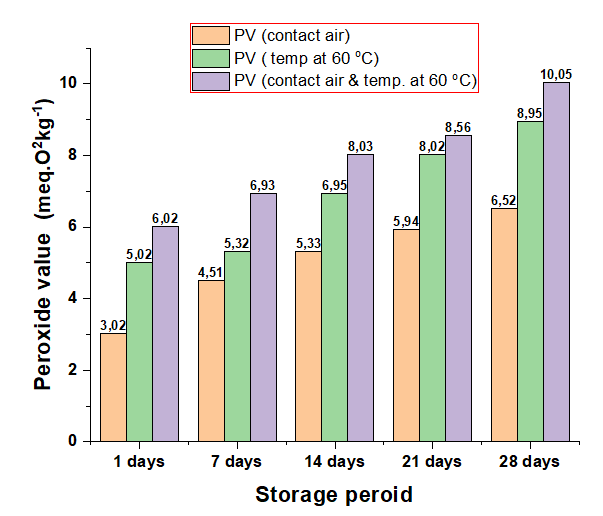
The more the oil can resist oxidative rancidity, the better for cooking. High iodine value in oil promotes the development of thyroid hormones, which control the human body’s metabolism and proper functioning of the human organ [33, 34]. It contributes to proper bones and brain development during pregnancy and infancy. Peroxide Value: Determination of peroxide value (PV) investigates the extent of rancidity the oil or fat has gone through during storage. It also shows the quality and stability of the oil and fats. It is described as a measurement of total peroxide and hydroperoxide formed during the storage time, expressed in meq.O2kg-1 [35]. Factors influencing rancidity in the oil include temperature, time, light, contact air, exposed surface, moisture, nitrogenous organic material, and trace metals [36]. Nitrogenous organic material and trace metals can be found in plant tissue. Because PV is the most common chemical method of determining the oxidative deterioration of the oil, the PV of the oil sample (Chrysobalanus icaco L) was investigated from seven (7) to twenty-eight (28) days of storage period. This experimental investigation was based on the three factors that induced high peroxide values in oil (the temperature at 60oC contact air, and a combination of temperature and contact air). The experimental result is described in Figure 1 below: From the study, the PV of the seed oil exposed to contact air, temperature (60℃), and combination of temperature at 60oC/contact air during the storage period show the range of 3.02 to 6.52, 5.02 to 8.95 and 6.02 to 10.05 meq O2Kg-1 respectively. The oxidative rancidity is often discernible from PV 20 meq O2 Kg-1 upwards [36, 37]. The detection of high PV in the oil samples indicates a rancid fat that can damage or weaken the human cells and deplete vitamin B and E sources, leading to severe health defects such as botulism, cancer, and other digestive disorders. Moderate PV indicates peroxide depletion due to high concentration, and low PV shows a good oil quality and preservation status. The PV result obtained at different conditions is within the acceptable limit of 10 meq O2 Kg-1 approved by Fao FOJ, et al. [38]. It indicates that cocoplum seed oil (Chrysobalanus icaco L) will be suitable for cooking.
Acid Value, Percentage Free Fatty Acid (% FFA), and Oil Purity: Acid value, % FFA, and oil purity are essential in considering the quality, lifespan, edibility, and sustainability of fats and oils suitable for human consumption [39]. The acid value of the cocoplum seed oil (Chrysobalanus icaco L) is 5.34 mg KOH/g, and the value is within the acceptable limit of ≤10.0 mg KOH/g oil considered by Fao FOJ, et al. [38]. The FFA value of cocoplum seed oil is 3.0 % (0.03), and this value is within the standard limit of ≤5.0% (≤ 0.05) of cooking oil [38]. The lower the acid value and % FFA, the better the oil quality. High acid and % FFA values cause rancidity due to inadequate oil processing, moisture, and storage conditions such as relative humidity and high temperature [40, 41]. The oil purity was conducted, and no color changes were observed. By inference, the experimental result obtained from acid value, % FFA, and oil purity implies that oil extracted from cocoplum seed is of better quality, is pure, and is safe for human consumption. Saponification value: Saponification value can be seen as the inverse proportion of the average molecular weight or chain length of fatty acids present as triglycerides in fats and oil samples [29, 39]. It measures the content of ester linkages effectively and the amount of free fatty acids in food. The saponification value obtained from the cocoplum seed oil is 194.1 mg KOH/g. The result obtained is within the range of SV for olive oil (187-196 mg KOH/g), soybean oil (189 -195 mg KOH/g), and peanut oil (184-196 mg KOH/g) [42, 43, 44]. All these values, including cocoplum seed oil, are within the acceptable limit reversed and approved by the CODEX Alimentarius Commission standard for named vegetable oil [38]. The low SV obtained indicates that cocoplum seed oil has a longer fatty acid chain and a higher molecular weight. The SV test’s primary purpose was to determine its suitability in soap-making and wet chemicals for fire extinguishers, converting burning fats and oil into non-combustible soap. From the experimental result, the oil is not fit for soap making or as a wet chemical due to its low saponification value. The higher the SV, the better the soap-making and wet chemicals abilities. Oil or fats with high saponification values, such as coconut and palm oil or palm kernel oil, are best fit for soap- making and wet chemicals due to their high SV.
Instrumental Analysis
Fatty Acid Composition: The percentage (%) fatty acid compositions present in cocoplum seed oil as detected from GC-FID analysis are presented in Table 2. Stearic, oleic, linoleic, and palmitic were the most abundant fatty acids found in the triglycerides of cocoplum seed oil, while arachidonic and trans-oleic were at the same percentage concentration ratio. Others, such as myristic, margaric, linolenic, and Eicosanoic, have a percentage concentration in the triglycerides of the oil sample tested.
| Fatty acid detected | Abbreviation | Percentage (%) composition | Structure |
|---|---|---|---|
| Myristic | C14:31 | 0.07 | H C OH 3 O |
| Palmitic | C16:0 | 5.99 | H3C OH O |
| Margaric | C17:0 | 0.065 | OH H3C O |
| Stearic | C18:0 | 24.99 | H3C OH O |
| Oleic | C18:1 | 20.5 | O CH 3 HO |
| Linoleic | C18:2 | 13.1 | O CH 3 HO |
| Trans-linoleic | C18:2 | 1.35 | O OH |
| Linolenic | C18.3 | 0.65 | O OH |
| Arachidonic | C20:0 | 1.16 | O OH |
| Eicosanoic | C20:1 | 0.49 | O OH |
| Not detected | 31.8 | Not available |
Table 2: Fatty Acid Compositions and the Structures of Hydrolyzed Triglycerides Found in Cocoplum (Chrysobalanus icaco L) Seed Oi
Consumption of oil rich in dietary stearic acid (C18:0) would assist in reducing the LDL cholesterol level and avoid the risk of atherosclerosis in humans and animals. It also reduces abdominal and total body fats. Stearic acids are necessary emulsifiers, emollients, and lubricants that can soften skin and prevent the emulsion from separating into two distinct phases. It is the reason for its recommendation by the US Food and Drug Administration (FDA) as an additive and emulsifier in the formulation of skincare products [45]. In our previous study, cocoplum seed oil was used as an alternative oil in the formulation of cosmetics emulsion. The result confirmed that the high percentage composition of stearic acid found prevented the emulsion from separating into two distinct phases throughout the study period [16]. Oleic acid is one of the significant and abundant fatty acids detected in the oil sample. It is regarded as a healthier source of fats and can replace animal fat sources in diets [46]. Substitution of dietary saturated fats with oleic acid reduces the risk of cardiovascular disease by reducing blood lipids, mainly LDL cholesterol and other triglycerides found in the human body’s fat cells. Daily oil consumption rich in oleic acid may prevent essential fatty acid deficiencies. Linoleic acid, one of the significant fatty acids found in the oil sample, is described as a polyunsaturated omega-6 fatty acid essential for average growth and improves insulin sensitivity in humans [47].
Deficiency of linoleic fatty acid in humans leads to poor growth, fatty liver, skin lesions, and reproductive failure. Palmitic acid, also detected in the oil sample, is an important fatty acid used as a food additive, emollient, or surfactant that improves the texture of skincare formulations. From the analysis, the incorporation of cocoplum seed oil as an alternative cooking oil would reduce LDL cholesterol, the risk of cardiovascular disease, inflammation, and blood lipids due to the significant contents of stearic, oleic, and linoleic fatty acid present in the seed oil. Spectral Analysis: FTIR determination in fats and oil plays a vital role in identifying molecular structures and possible absorption bands, vibrational modes, and intensities related to functional groups. The intensities of bands and exact frequency are determined by the concentration and absorbance or transmittance of bands that appeared according to the nature and composition of the oil sample [29, 48]. The oil composition affects the bands’ exact position and produces a shift when it undergoes chemical changes, thermal stress, or when the proportion of fatty acids changes. It provides information on the characteristics, compositions, chemical changes, and oxidative state, especially when the oil undergoes thermal stress [49, 50]. FTIR spectra of the cocoplum seed oil were recorded at room temperature with a wavelength between 4000 and 500 cm-1. In the FTIR of fats and oils, triglycerides are the principal components that dominate the spectra of either the oil or fat samples.
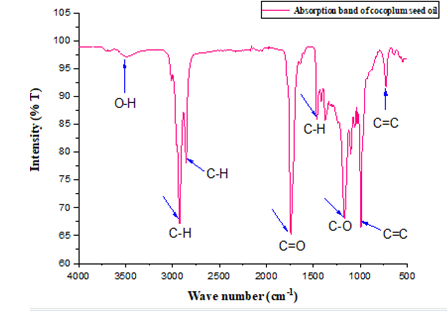
These spectra obtained at different frequencies (cm-1) represented are attributable to functional group assignment [29, 50] Figure 2 indicated the FTIR of cocoplum (Chrysobalanus icaco L) seed oil at room temperature. The spectra obtained from the seed oil represent the typical characteristics of absorption bands found in common triglycerides. The FTIR spectra obtained are similar to coconut seed oil [50, 51]. The analytical assessment of the spectra obtained from the seed oil sample is shown in Table 3.
| Frequency (cm1) | Functional group assignment | Class of compounds | Intensity |
|---|---|---|---|
| 3495 | O-H stretching | Alcohol | Broad |
| 2920 | Asymmetrical and symmetrical stretching vibration of a methylene group (-CH ) 2 | Alkane | Sharp |
| 2830 | C-H stretching vibration | Aldehydes (doublet) | Medium |
| 1735 | Stretching vibration of 6- 6-membered lactone (C=O) | Esters | Strong |
| 1450 | C-H bending vibration | Alkane (methyl group) | Medium |
| 1163 | C-O stretching vibration | Esters | Strong |
| 995 | C=C bending vibration | Monosubstituted alkene | Strong |
| 721 | C=C bending vibration | Trisubstituted alkene | Medium |
Table 3: Analytical Evaluation of IR Spectra Obtained from Cocoplum (Chrysobalanus Icaco L) Seed Oil.
From Table 3, it is clear that four (4) spectra (2920,1450, 995, and 721 cm-1) among the eight (8) belong to aliphatic hydrocarbons with asymmetrical and symmetrical stretching and bending vibration, and this is similar to the IR spectrum obtained from mustard seed oil and corn oil [29]. It is a clear indication that fatty acids detected in the cocoplum seed oil consist of long, chain hydrocarbons with a carboxylic group attached at one end. The C=C bending vibration at band 995 cm-1 indicates that the oil has a high proportion of oleic fatty acids. The band at 2830 cm-1 associated with stretching vibration is due to aldehydes and other secondary products responsible for their oxidized odor after heating for a long time [52, 53]. The peak at 1735 cm-1 is an intermolecular ester of corresponding hydroxyl fatty acids responsible for the oil’s aroma. The peak at 3495 cm-1 represents the O-H group of alcohol glycerol, a fatty acid component responsible for the insolubility of the oil sample in water. The peak at 1163 cm-1 is due to the carbonyl functional group of the triglycerides responsible for the high percentage composition of stearic, oleic, linoleic, and palmitic acid, the most abundant fatty acids detected in the oil sample. The evaluated result showed that the degree of unsaturation or index of hydrogen deficiency is low at room temperature. As a result, seed oil is safe for human consumption. Also, the height of some specific bands indicated the high quality of the cocoplum seed oil. Chromatographic Analysis: The chromatographic result of the oil sample obtained from the automatic oil press machine was conducted with GCMS-Agilent 5977B (single quadrupole). The oil extract was analyzed by gas chromatography coupled to mass spectroscopy (GC-MS) using a chromatography model series II triple-axis detector (Agilent Technologies) with helium as a carrier gas. The literature data (WILEY 275 library) [54] and standard mass chromatogram library were used to identify compounds in cocoplum seed oil. The chromatogram obtained from cocoplum (Chrysobalanus icaco L) seed oil through the GC- MS instrument is represented in Figure 3.
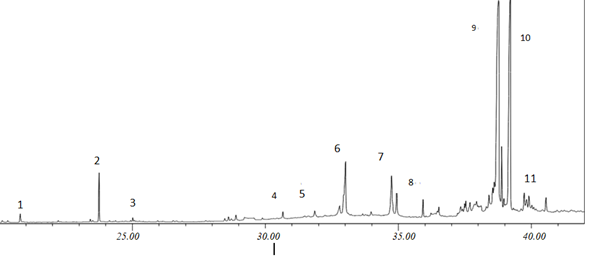
These chromatograms, represented by numbers at different retention times, are the compounds detected from the oil extract of the cocoplum (Chrysobalanus icaco L) seed. The analytical evaluation of each chromatogram is represented in Table 4. These compounds play a vital role in dietary fats and oil. For example, they can reduce oxidative stress and protect lipids and lipids containing foodstuff from oxidation damage during storage, thus prolonging their shelf life [55, 56]. They can maintain the structure and the functioning of the human heart. Some of these compounds prevent a microbial attack on foodstuff during storage.
| S/N | RT(min) | Name | MS | % Area |
|---|---|---|---|---|
| 1 | 18.15 | Tridec-2-en-1-ol | 1.25 | |
| 2 | 24.18 | phytol isomers (diterpene) | HO | 0.78 |
| 3 | 25 | Tetrahydro -3,4 phenantrenedione | O O | 0.45 |
| 4 | 32.5 | Heptacosane-6,8- diol | OH OH | 0.8 |
| 5 | 33.15 | Octacosane-1,2-diol | OH OH | 1.14 |
| 6 | 34.5 | Squalene | 5.45 | |
| 7 | 35.2 | n-Nanocosane | 12 | |
| 8 | 36.2 | n-triacontanol (myricyl alcohol) | HO | 4.15 |
| 9 | 39.5 | Stigmasta-5,22- diene-3-ol | H H H HO | 1.16 |
| 10 | 39.9 | Tritriacontane | 5.01 | |
| 11 | 40.5 | Stigmasta-5-ol | H H H OH | 4.01 |
Table 4: Compounds Found in Cocoplum (Chrysobalanus Icaco L) Seed Oil Using GC-MS.
RT = retention time; MS = molecular structure of the compounds detected; S/N = number of the compound’s peaks and %A = percentage area. Table 4: Compounds Found in Cocoplum (Chrysobalanus Icaco L) Seed Oil Using GC-MS.
Phytochemicals of Cocoplum (Chrysobalanus Icaco L) Seed Oil Extract: The phytochemical/bioactive components of the cocoplum seed oil extract and its health benefits are shown in Table 5.
| Phytochemicals | Health benefits | Reference |
|---|---|---|
| Alkaloids | They are anti-inflammatory, anticancer, and analgesic active substances. | Filali I, et al. & Souza CRM, et al. [57, 58] |
| Flavonoids | Protect retinal pigment and human red blood cells from oxidative damage and prevent cardiovascular diseases. | Yang D, et al. [59] |
| Phenolic | Responsible for relieving pains and irritation caused by soar throat and mouth soars. | Blasa M, et al. & Parkinson L, et al. [60,61] |
| Tannins | Stabilizes blood pressure, reduces blood clotting, and promotes rapid healing. | Hafeji A, et al. & Li N, et al. [62,63] |
| Saponins | It reduces cholesterol levels, strengthens the immune system, reduces diabetes, and inhibits tumor growth. | Desai SD, et al. & Marston A, et al. [64,65] |
| Steroids | Decreases body fat percentage and increases red blood cell production | Klein HG, et al. [66] |
| Cardiac glycosides | It improves heart failure and certain irregular heartbeats. | Newman RA, et al. & Stockl G, et al. [67,68] |
| Terpenes | They are antimicrobials, antiviral, anti-inflammatory, and anti- tumor agents. | Cör D, et al. & Yang W, et al, [69,70] |
| Betacyanin | Prevent hypertension, cancer, and cardiovascular diseases. | Manpreet Kaur P, et al. & Rahimi P, et al. [71,72] |
| Quinones | Fight against free radicals from energy breakdown that can damage human cells. | Ezeuko AS, et al. & Banki MB, et al. [16,73] |
Table 5: The Phytochemistry of Cocoplum (Chrysobalanus Icaco L) Seed Oil.
Conclusion and Recommendation
Seed oil, as an alternative cooking oil, has gained prominence due to its therapeutic properties, affordability, and safety for human consumption [74]. One such oil is cocoplum (Chrysobalanus icaco L) seed oil, which contains essential components that can prevent cardiovascular diseases, stabilize blood pressure, and reduce blood lipids and other chronic diseases that cause oxidative damage to human bodies [75]. The oil is rich in squalene, an important antioxidant that can fight skin damage and free radicals that may lead to aging. The presence of quinones indicated that oil could be used as a preservative or food additive and effective against microbial attacks. Linoleic (13.1%) and linolenic (0.65%) fatty acids play a vital role in treating chronic diseases such as blood pressure, diabetes, metabolic syndrome, eczema, cancer, cardiovascular diseases, and atherosclerosis [76]. The high percentage of stearic fatty acid softens and smooths the skin surface and can be an alternative oil for skin care formulations [77]. The oil is rich in squalene, which contains anti-inflammatory properties that reduce redness and swelling. One of the phytochemicals detected is responsible for reducing body fat percentage. Therefore, further study is needed to ascertain the effectiveness and the level of fat reduction and if it will be recommended in treating obesity [78].
Acknowledgments
The authors wish to express their sincere gratitude to the management and staff of the chemistry department, Covenant University Ota, Ogun State, for their valuable support in this study.
Declaration Of Competing Interest
The authors declare no known competing financial interests or personal relationships that could influence the work reported in this paper.
References
-
Adefegha SA (2018) Functional Foods and Nutraceuticals as Dietary Intervention in Chronic Diseases; Novel Perspectives for Health Promotion and Disease Prevention. Journal of Dietary Supplements15(6): 977- 1009.
-
Minuti A, Patrone V, Giuberti G, Spigno G, Pietri A, et al. (2014) Nutrition and Ageing. Stud Health Technol Inform 203: 112-121.
-
WHO (2014) Informe de Las Enfermedades No Transmisibles.
-
Welch RM, Graham RD (2000) A new paradigm for world agriculture: Productive, sustainable, nutritious, healthy food systems. Food Nutr Bull. 21(4): 361-366.
-
Kaur J, Kaur G (2015) An insight into the role of citrus bioactive in the modulation of colon cancer. J Funct Foods 13: 239-261.
-
Liberati A, Altman D, Tetzlaff J, Mulrow C, Gotzsche P, et al. (2018) Good Fats versus Bad Fats: A Comparison of Fatty Acids in the Promotion of Insulin Resistance, Inflammation, and Obesity. Nature 114(4).
-
Guilbert JJ (2003) The world health report 2002-Reducing risks, promoting healthy life Educ. Heal 16: 230.
-
Murray CJ, Lopez AD (1996) Global Burden of Disease and Injury Y Series the Global Burden of Disease. Oms 1-46.
-
Adewole KO, Ogunfowokan AA, Olodu M (2021) Influence of health literacy on health-promoting behavior of adolescents with and without obesity. International Journal of Africa Nursing Sciences 15: 100342.
-
Rosner B, Eliassen AH, Toriola AT, Chen WY, Hankinson SE, et al. (2017) Weight and weight changes in early adulthood and later breast cancer risk. Int J Cancer 140(9): 2003-2014.
-
Ivanovic S, Pavlovic I, Pisinov B (2016) The quality of goat meat and its impact on human health. Biotechnol Anim Husb 32: 111-122.
-
Singh RJ (2018) Fats and oils: The health concerns and issues- A review. Asian J Dairy Food Res 37(2): 109-113.
-
Dian NLHM, Hamid RA, Kanagaratnam S, Isa WRA, Hassim NAM, et al. (2017) Palm oil and palm kernel oil: Versatile ingredients for food application. Palm oil and palm kernel oil: Versatile ingredients for food apply. J Oil Palm Res. 29: 487-511.
-
Afolayan M, Fausat A, Idowu D (2014) Extraction and physicochemical analysis of some selected seed oils. International Journal of Advanced Chemistry 2(2): 536- 541.
-
Kozłowska A, Dzierżanowski T (2021) Targeting Inflammation by Anthocyanins as the Novel Therapeutic Potential for Chronic Diseases: An Update. Molecules 26: 4380.
-
Ezeuko AS, Bamgboye OA, Oyeagu CE, Lewu FB (2020) Extraction and Formulation of Oil in Water (O/W) Emulsion with Coco Plum (Chrysobalanus icaco) Seed Oil: Physicochemical and Microbiological Evaluations, pp: 16-21.
-
Venancio VP, Almeida MR, Antunes LMG (2018) Cocoplum (_Chrysobalanus icaco L_.) decreases doxorubicin-induced DNA damage and downregulates Gadd45a, Il-1β, and Tnf-α in vivo. Food Res Int 105: 996-1002.
-
Onilude HA, Kazeem MI, Adu OB (2021) Chrysobalanus icaco: A review of its phytochemistry and pharmacology. J Integr Med 19(1): 13-19.
-
de Oliveira GA., de Castilhos F, Renard CMGC, Bureau S (2014) Compare NIR and MIR spectroscopic methods to determine individual sugars, organic acids, and carotenoids in passion fruit. Food Res Int 60: 154-162.
-
Kaplan ROC, MAC (2011) Phytochemical Study and Antimicrobial Activity of Chrysobalanus Icaco. Chemistry of Natural Compounds 47(436): 2011.
-
Medeiros De Aguiar T, Luo R, Mello AA, Hess Azevedo- Meleiro C, Ubirajara A, et al. (2017) Regulatory Science Chemical Characterization of Cocoplum (Chrysobalanus icaco, L) Seed Oil and Seeds. Journal of Regulatory Science 5(2): 15-28.
-
Aguiar TMD, Sabaa-Srur AUO, Samico GF (2011) Nutritional Potential and Physical and Chemical Characteristics of Abajeru. Tropical Agricultural Research 41(1): 102-109.
-
KO S, CO O, OE O (2016) The importance of mineral elements for humans, domestic animals, and plants: A review. African J Food science 4: 1-23.
-
White PAS, Araújo JMD, Cercato LM, Souza LA, Barbosa APO, et al. (2016) _Chrysobalanus icaco L_. leaves normalized insulin sensitivity and blood glucose and inhibits weight gain in high-fat diet-induced obese mice. J Med Food 19(2): 155-160.
-
Hasan M, Jahan R, Alam M, Khatun M, Al-Reza S (2016) Study on Physicochemical Properties of Edible Oils Available in Bangladeshi Local Market Arch Curr Res Int 6: 1-6.
-
Jurid LS, Zubairi SI, Kasim ZM, Kadir IAA (2020) The effect of repetitive frying on physicochemical properties of refined, bleached, and deodorized Malaysian general palm olein during deep-fat frying. Arab J Chem 13: 6149- 6160.
-
Ekwu FC, Ngoddy PO, Uvere PO (2014) Effect of processing on the quality of flour, Abacha slices and its flour derived from cassava (Manihot esculenta Crantz) TMS 97/4779. African J Food Sci 8: 476-483.
-
Crowe TD, White PJ, (2001) Adaptation of the AOCS official method for measuring hydroperoxides from small-scale oil samples. JAOCS J Am Oil Chem Soc 78: 1267-1269.
-
Zahir E, Saeed R, Hameed MA, Yousuf A (2017) Study of physicochemical properties of edible oil and evaluation of frying oil quality by Fourier Transform-Infrared (FT- IR) Spectroscopy. Arab J Chem 10(2): S3870-S3876.
-
Okolie P, Uaboi-Egbenni PO, Ajekwene AE (2012) Extraction and quality evaluation of sandbox tree seed (Huracrepitan) oil. World Journal of Agricultural Sciences 8(4): 359-365.
-
Sorkheh K, Kiani S, Sofo A (2016) Wild almond (Prunus scoparia L.) as potential oilseed resource for the future: Studies on the variability of its oil content and composition. Food Chem 212: 58-64.
-
Alireza S, Tan CP, Hamed M, Che Man YB (2010) Effect of frying process on fatty acid composition and iodine value of selected vegetable oils and their blends. International Food Research Journal 17(2): 295-302.
-
Akpan UG, Jimoh A, Mohammed AD (2012) Extraction And Characterization Of Castor Seed Oil. The Internet Journal of Nutrition and Wellness 8: 43-52.
-
Kieliszek M, Błazejak S (2016) Current knowledge on the importance of selenium in food for living organisms: A review. Molecules 21(5): 609.
-
Henry LN (2016) Effect of Light and Air on the Quality and Stability of Selected Vegetable Oils. Int J Innov Res Sci Eng Technol 5(5): 6609-6615.
-
Zhou Y, Zhao W, Lai Y, Zhang B, Zhang D (2020) Edible Plant Oil: Global Status, Health Issues, and Perspectives. Front Plant Sci 11: 1-16.
-
Shrestha A (2017) Roasting time-temperature optimization for preparation of peanut butter and study on its shelf life, In: (Edn.), Dspace Home, Tribhuvan University, Nepal.
-
Fao FOJ, Programme S, Alimentariu C, Cig S, Kuala F, et al. (2019) WHO/ FAO: Food Standards Programme Codex Alimentarius Commission: 42.
-
Barku VYA, Nyarko HD, Dordunu P (2012) Studies on the Physicochemical Characteristics, Microbial Load and Storage Stability of Oil From Indian Almond Nut ( Terminalia Catappa L .). Food Science and Quality Management 8: 9-18.
-
Onilude AA, Igbinadolor RO, Wakil SM (2010) Effect of varying relative humidity on the rancidity of cashew (Anacardium occidentale L.) kernel oil by lipolytic organisms. African J Biotechnol 9: 4890-4896.
-
Tiwari U, Gunasekaran M, Jaganmohan R, Alagusundaram K, Tiwari BK (2009) Quality Characteristic and Shelf Life Studies of Deep-Fried Snack Prepared from Rice Brokens and Legumes By-Product. Food Bioprocess Technol 4: 1172-1178.
-
Ahmed SW, Anwer H (2017) The Thermodynamic Parameters Of Olive Oil In The Presence Of Strong Electrolytes. FUUAST Journal of Biology 7(1): 81-87.
-
Ajayi IA (2021) Physicochemical attributes of oils from seeds of different plants in Nigeria. Angew. Chemie Int Ed 6(11): 951-952.
-
Cheikhyoussef N, Kandawa-Schulz M, Böck R, Koning CD, Cheikhyoussef A, et al. (2018) Schinziophyton rautanenii (Manketti) nut oil from Namibia is rich in conjugated fatty acids and tocopherol. Journal of Food Composition and Analysis 66: 152-159.
-
Cox S, Sandall A, Smith L, Rossi M, Whelan K (2021) Food additive emulsifiers: A review of their role in foods, legislation and classifications, presence in the food supply, dietary exposure, and safety assessment. Nutr Rev 79(6): 726-741.
-
Stewart JE, Newman LP, Keast RSJ (2011) Oral sensitivity to oleic acid is associated with fat intake and body mass index. Clin Nutr 30(6): 838-844.
-
Simopoulos AP (2016) An increase in the Omega-6/ Omega-3 fatty acid ratio increases the risk for obesity. Nutrients 8(3): 128.
-
Rakesh P, Charmi P, Rajesh K (2014) Quantitative Analytical applications of FTIR Spectroscopy in Pharmaceutical and Allied Areas. J Adv Pharm Educ Res 4: 145-157.
-
Van De Voort; A, A.I.J.S. and G.E., 1997. 092 1994 - Monitoring the oxidation of edible oils by Fourier Monitoring the Oxidation of Edible Oils.
-
Rohman A, Man YBC (2010) Fourier transforms infrared (FTIR) spectroscopy to analyze extra virgin olive oil adulterated with palm oil 43(3): 886-892.
-
Marina AM, Che Man YB, Amin I (2009) Virgin coconut oil: emerging functional food oil. Trends Food Sci. Technol 20: 481-487.
-
Guillén MD, Cabo N (1999) The usefulness of the frequency data of the Fourier transforms infrared spectra to evaluate the degree of oxidation of edible oils. J Agric Food Chem 47(2): 709-719.
-
Türker-Kaya S, Mutlu O, Çelikyurt IK, Akar F, Ulak G (2016) Tianeptine, olanzapine, and fluoxetine show similar restoring effects on stress-induced molecular changes in mice brain: An FT-IR study. Spectrochim. Acta - Part A Mol Biomol Spectrosc 161: 178-185.
-
Adams RP, (1997) Components Mass Spectroscopy. Spectrum 0305.
-
Montero-Prado P, Rodriguez-Lafuente A, Nerin C (2011) Active label-based packaging to extend the shelf-life of “Calanda” peach fruit: Changes in fruit quality and enzymatic activity. Postharvest Biol Technol 60(3): 211- 219.
-
Ribeiro JS, Santos MJMC, Silva LKR, Pereira LCL, Santos IA et al. (2019) Natural antioxidants used in meat products: A brief review. Meat Sci 148: 181-188.
-
Filali I, Bouajila J, Znati M, Bousejra-El Garah F, Ben Jannet H (2015) Synthesis of new isoxazoline derivatives from harmine and evaluation of their anti-Alzheimer, anticancer and anti-inflammatory activities. J Enzyme Inhib. Med Chem 30(3): 371-376.
-
Souza CRM, Bezerra WP, Souto JT (2020) Marine alkaloids with anti-inflammatory activity: Current knowledge and future perspectives. Mar Drugs 18(3): 147.
-
Yang D, Jiang Y, Wang Y, Lei Q, Zhao X, et al. (2020) Improvement of Flavonoids in Lemon Seeds on Oxidative Damage of Human Embryonic Kidney 293T Cells Induced by H2O2. Oxid Med Cell Longev.
-
Blasa M, Candiracci M, Accorsi A, Piacentini MP, Piatti E (2007) Honey flavonoids as protection agents against oxidative damage to human red blood cells. Food Chemistry 104(4): 1635-1640.
-
Parkinson L, Keast R (2014) Oleocanthal, a Phenolic Derived from Virgin Olive Oil: A Review of the Beneficial Effects on Inflammatory Disease. Int J Mol Sci 15: 12323- 12334.
-
Hafeji A, Danckwerts MP (2020) Formulation of a Topical Tannic Acid and Chitosan Gel Haemostatic Drug Delivery System for Treatment of Wounds and Abrasions. J Pharm Res Int 32: 109-119.
-
Li N, Yang X, Liu W, Xi G, Wang M, et al. (2018) Tannic Acid Cross-linked Polysaccharide-Based Multifunctional Hemostatic Microparticles for the Regulation of Rapid Wound Healing. Macromol Biosci 18: 1-16.
-
Desai SD, Desai DG, Kaur H (2009) Saponins and their biological activities. Pharma Times 41: 13-16.
-
Marston A (2000) Saponins in Food, Feedstuffs, and Medicinal Plants. Sapon. Food, Feed. Med. Plants.
-
Klein HG, Spahn DR, Carson JL (2007) Red blood cell transfusion in clinical practice. Lancet 370: 415-426.
-
Newman RA, Yang P, Pawlus AD, Block KI (2008) Cardiac Glycosides as Novel Cancer Therapeutic Agents. Mol Interv Publ 8(1): 36-49.
-
Zugck C, Martinka P, Stockl G (2018) Ivabradine Treatment in a Chronic Heart Failure Patient Cohort: Symptom Reduction and Improvement in Quality of Life in Clinical Practice. Nature 31(9): 961-74.
-
Cör D, Knez Ž, Hrnčič MK (2018) Antitumour, the antimicrobial, antioxidant and antiacetylcholinesterase effect of Ganoderma Lucidum terpenoids and polysaccharides: A review. Molecules 23(3): 1-21.
-
Yang W, Chen X, Li Y, Guo S, Wang Z, et al. ( 2020) Advances in Pharmacological Activities of Terpenoids. Nat Prod Commun (15).
-
Manpreet Kaur P, Mimi Sakinah A, Zularisam A (2014) Adsorption Study of Betacyanin on Fibre. pp: 1-8.
-
Rahimi P, Mesbah-Namin SA, Ostadrahimi A, Separham A, Asghari Jafarabadi M (2019) Betalain- and betacyanin- rich supplements’ impacts on the PBMC SIRT1 and LOX1 genes expression and Sirtuin-1 protein levels in coronary artery disease patients: A pilot crossover clinical trial. J Funct Foods 60: 103401.
-
Banki MB, Ismail HN (2015) Understanding the characteristics of family-owned tourism micro businesses in mountain destinations in developing countries: Evidence from Nigeria. Tourism Management Perspectives 13: 18-32.
-
(2002) Oils and Fats.
-
(2019) Standard for named vegetable oils. Codex Alimentarius pp: 1-19.
-
Ferreira-Machado SC, Rodrigues MP, Nunes APM, Dantas FJS, De Mattos JCP et al. (2004) Genotoxic potentiality of aqueous extract prepared from Chrysobalanus icaco L leaves. Toxicol Lett 151: 481-487.
-
Rohman A (2017) Infrared spectroscopy for quantitative analysis and oil parameters of olive oil and virgin coconut oil: A review. Int J Food Prop 20(7): 1447-1456.
-
Shaikh JR., Patil M (2020) Qualitative tests for preliminary phytochemical screening: An overview. Int J Chem Stud 8(2): 603-608.
- Solution-Processed Chiral Perovskites for Biomedical Applications
- Nanotechnology in Health Chemistry and Medicine: Current Challenges and Future Directions
- Human Exposure to Micro- and Nanoplastics: Pathways, Toxicity, and Intervention Strategies
- Exosome Nanomedicine for Cancer Therapy
- Micro and Nanoplastics–Plastisphere, Biotoxicity, Impact on Human Health, and Mitigation Strategies
- Process Validation of Cefixime Powder for Suspension Dosage Form, 50 mL