
Periodontal Vaccine-Armour against Periodontitis
The main etiologic factor of periodontitis is oral biofilm comprising of various microorganisms. Studies have shown that there is considerable potential for intervention with the host immune system. Periodontal vaccination is indicated in patients with severe periodontal disease with advanced bone loss. Immunization can be brought about by both whole bacterial cells or one or more of its antigenic components. However, complexity of periodontal pathogenic flora poses a complication in the determination of antigen for the vaccine. Numerous invitro studies and animal studies have proved beyond doubt the efficacy periodontal vaccination. The challenge we face today is the translation of similar results in humans.
Introduction
Periodontitis and its Genesis
Periodontitis is defined as ‘an inflammatory disease of the supporting tissues of teeth caused by specific microorganisms or group of microorganisms resulting in progressive destruction of the periodontal ligament and alveolar bone with pocket formation, recession or both [1].
The main etiologic factor of periodontitis is oral biofilm with anaerobic bacteria [2, 3]. The biofilm is a dynamic entity comprising of various microorganisms [4]. These include bacteria of the red complex including Porphyromonas gingivalis, Treponema denticola and Tanerella forsythia [5] and others such as Aggregatibacter actinomycetemcomitans, Ekenella corrodens and Provotella intermedia [5]. Both human and animal studies have shown that there is considerable potential for intervention with the host immune system [6].
Vaccination and Immunization
Vaccine is a material that induces an immunologically mediated resistance to a disease [6]. Vaccines are generally composed of killed or attenuated organism or subunits of organism or DNA encoding antigenic proteins of pathogens [3, 7, 8]. Louis Pasteur, who developed the first vaccine against rabies, established in 1881 the basic paradigm for vaccine development, which included the isolation, inactivation and injection of the causative microorganism. These basic principles have guided vaccine development during the twentieth century.
Vaccination is the development of immunity or resistance to infection, after a secondary response that is adequate to consider the individual immune to a subsequent infection [9]. Vaccination is based on the principle of adaptive immunity. There are two key elements involved- specificity and memory. The antigen(s) of a vaccine induce clonal expansion in specific T- cells and/or B cells thus leaving behind a lineage of memory cells. On subsequent encounter with the same antigen(s), a more rapid and effective immune response is generated by the host [4, 8, 10].
Vaccines produced following Pasteur’s principles allowed the control and, in some cases, the eradication of many important infectious diseases. Despite several successes, the Pasteur’s approach to vaccine development took a long time to generate vaccines against those pathogens for which the solution was feasible, but failed to produce vaccines for those bacteria and parasites that do not have obvious immunodominant protective antigens or for as yet uncultivable microorganisms.
Requisite of a Periodontal Vaccine
The mouth and the nose are the principal portals of entry of infectious agents and allergens into the human body. Approximately two‑thirds of all the pathogens infect humans via these routes. The combined mucosal surfaces of the body comprise a considerable area of some 400 m2 to which mouth contributes about 240 cm2, which must be protected from invasion by infectious agents and penetration by toxins and allergens. Periodontal vaccination is the need of the hour, as periodontal disease is a major cause of tooth loss worldwide [4]. Periodontal bacteria are capable of evading host immune responses and invading tissues [11]. These bacteria can enter systemic circulation-P. gingivalis can hide from the elements of local gingival immune system by invading epithelial cells and can escape into systemic circulation by invading endothelial cells. A. actinomycetemcomitans invades epithelial and endothelial cells, facilitating entry into circulation and offers a base from which it can seed into other tissues. Periodontal vaccination is imperative to decrease the incidence of periodontal related systemic diseases. Periodontal disease results in elevated systemic levels of inflammatory markers thus predisposing the individual to various conditions like myocardial infarction [12], cerebrovascular stroke [13, 14] and preterm-low birth weight infants [15].
A practical vaccine for humans must be absolutely safe. It should not elicit unwanted immune responses or any other danger to human health. The current approach has been aimed at developing synthetic peptide vaccines against viral infections. Since immunization against whole P. gingivalis cells inhibited the progression of periodontitis, vaccination could become an important immunotherapy to help prevent periodontal diseases. However, it is also possible to induce periodontal destruction by immunization; i.e., the immune system has the potential to induce destructive changes. The demand for a safer vaccine has led to the development of a component vaccine. In the development of a defined and specific component vaccine, it is essential, therefore, to identify the key virulence factors of the pathogen. The role of the outer membrane proteins in induction of a protective immune response has been studied extensively in various bacterial infections (Table 1).
| Bacteria | Bacterial Component | Effect on human tissues |
| Porphyromonas gingivalis | Proteases | Degrades serum antibacterial components |
| Porphyromonas gingivalis | Capsule | Inhibition of phagocytes |
| A. actinomycetemcomitans | Leukotoxin | Toxic to host immune cells |
| F. nucleatum | Heat sensitive protein | Apoptosis of PMNs |
| T. forsythia | Heat sensitive surface protein | Arrests lymphocyte cell cycle |
Table 1: Effects of periodontal bacteria and their components on human tissues.
In the early 20th century, three periodontal vaccines were employed [8, 9, 16] pure cultures of streptococcus and other organism, autogenous vaccines and stock vaccines eg. Vancott’s vaccine, Inava endocarp vaccine.
Indications of Periodontal Vaccination
Periodontal vaccination is indicated in patients with severe periodontal disease with loss of bone and teeth, inflammation and association with oral bacterial infection
Characteristics of an Effective Vaccine
a) Safety b) Protectivity c) The ability to provide sustained protection d) The ability to produce neutralizing antibodies e) Stimulation of protective T-cells which provides cell mediated immunity
Mechanism of Action
1. Active Immunization
- Whole bacterial cells
- Subunit vaccines
- Synthetic peptides as antigens b) Passive Immunization
- Murine monoclonal antibodies
- Plantibodies c) Genetic Immunization
- Plasmid vaccines
- Live, viral vector vaccines
- Whole bacterial cells: The entire cell with its components is inoculated into a host to bring about active immunization.
- Outer components: A part of bacterial cell is used for immunization either outer component or fimbriae is used.
- Synthetic peptides: These require synthesis of linear and branched polymers of 3-10 amino acids based on known sequences of microbial antigens. They are weakly immunogenic by themselves and need to be coupled to large proteins to induce antibody response.
- Murine monoclonal antibodies: obtained by inoculating antigens into mice. Then injected into the host.
- Plantibodies: Molecular biological technique to express bacterial or viral antigens in plants which could be used as orally administered vaccines.
- Plasmid vaccines: DNA doesn’t have the ability to grow whereas plasmids have the ability to grow because plasmids are fused with DNA of pathogens of interest and inoculated in animal for the production of antibodies. It is then transferred to the host for immunization.
- Live, viral vector vaccines: Infections but non-disease causing DNA or RNA viruses or bacteria have been engineered to express the proteins of a disease producing organisms. The vector enters the body cells where the proteins are generated and then induce humoral or cellular immune responses.
| Author & Year | Animal Used | Vaccine Administered | Results of Study | ||||||||
|---|---|---|---|---|---|---|---|---|---|---|---|
| Ebersole, et al. (1991) [17] | Primate | Whole cell antigen of P. gingivalis and P. intermedia | Two fold increase in serum Ig G, Ig M and IgA antibody that was highly specific for these immunogens. | ||||||||
| Page R (2000) [18] | Macaca fasicularis | P. gingivalis and Bacteroids forsythus | Produced active immunity but it wasn’t sustained | ||||||||
| Breivik T, et al. (2000) [19] | Wistar rats | SRL 172 (heat killed Mycobacterium vaccae) | Significantly decreased loss of periodontal attachment fibers and bone | ||||||||
| Nakagawa, et al. (2003) [20] | Rabbits | Gingipains of P.gingivalis | Antibodies significantly enhanced PMN mediated bacterial killing of four P.gingivalis stereotypes | ||||||||
| Tsurumi, et al. (2003) [21] | Rabbits | Outer membrane protein of P.gingivalis | Antibodies reacted with P.gingivalis strains but not with other bacterial pathogens | ||||||||
| Roberts, et al. (2004) [22] | Macaca fasicularis | Formalin killed P.gingivalis | Suppression of PGE levels 2 | ||||||||
| Person G (2005) [23] | Primate model | P. gingivalis | Decreased rate and severity of bone loss | ||||||||
| Takahashi et al (2007) [24] | Mice | Fimbriae of P.gingivalis and rCTB | Significant release and serum Ig A levels | ||||||||
| Nakao R, et al. (2011) [25] | Mice | Outer membrane vesicles of P.gingivalis | OMVs of P.gingivalis elicit specific humoral immune responses. | ||||||||
| Posch G, et al. (2013) [26] | Invitro (human macrophages) | Lipopolysaccharide from T. forsythia | Production of pro-inflammatory cytokines IL-1, IL- 6, TNF- β in a dose dependent manner. | ||||||||
| Puth S, et al. (2019) [27] | Invitro | Divalent mucosal vaccine consisting of a mixture of FlaB-tFomA and Hgp44-FlaB fusion proteins targeting virulence factors of Fusobacterium | Antisera inhibited F. nucleatum- mediated biofilm formation, co- aggregation of P. gingivalis and Treponema denticola, and P. |
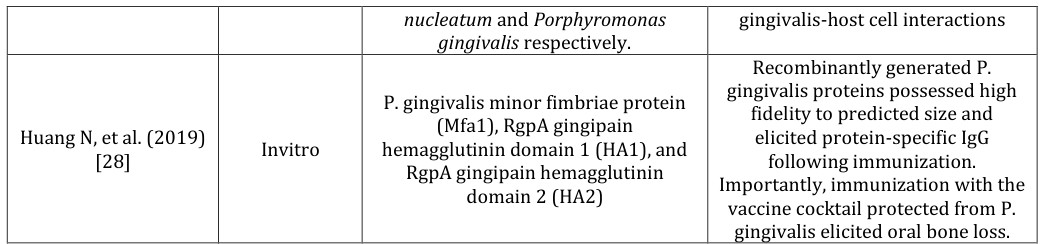
| Huang N, et al. (2019) [28] | Invitro | P. gingivalis minor fimbriae protein (Mfa1), RgpA gingipain hemagglutinin domain 1 (HA1), and RgpA gingipain hemagglutinin domain 2 (HA2) | P. gingivalis proteins possessed high fidelity to predicted size and elicited protein-specific IgG following immunization. Importantly, immunization with the vaccine cocktail protected from P. gingivalis elicited oral bone loss. |
| Liu J, et al. (2019) [29] | Invitro | Outer membrane vesicles from F. nucleatum | Of 98 proteins consistently identified from duplicate analyses, 60 were predicted to localize to the outer membrane or periplasm via signal peptide driven translocation. |
Table 3: Vaccines.
Complexity of periodontal pathogenic flora poses a complication in the determination of antigen for the vaccine [10]. Maintaining antibodies long enough to generate an adequate immune response also presents an obstacle [9]. It should be taken into account that antigenic determinants in bacterial whole cells may possess high risk of cross reactivity with human counterparts [4]. Vaccines may be contaminated with unwanted proteins or viruses4. Patient may have hypersensitivity reaction to the proteins. Animal models for vaccine trials may pose inconsistencies with human models [4]. Practical considerations like cost effectiveness, biological stability and minimum side effects [8].
Recent Advances in the Sphere of Periodontal Vaccination
Of late, distinct literature is coming forth that highlights the ongoing efforts to develop an effective, biocompatible and practical mode of periodontal vaccination. Based on the rationale that periodontal diseases are complex oral inflammatory diseases initiated by keystone bacteria, Huang, et al. [28] investigated cell- free protein synthesis as a platform to produce vaccinable targets suitable for efficacy testing in a P. gingivalis- induced murine oral bone loss model. They reported recombinantly generated P. gingivalis minor fimbriae protein, RgpA gingipain hemagglutinin domain 1, and RgpA gingipain hemagglutinin domain 2, possessed high fidelity to predicted size and elicited protein-specific IgG following immunization. Importantly, immunization with the vaccine cocktail protected from P. gingivalis elicited oral bone loss.
Other contemporary research groups have also consistently reported the prevention of the development of periodontitis by aiming vaccination strategies specifically against the periopathogen P. gingialis and its components. O Brien Simpson, et al. [30] reported parenteral or intraoral administration of KAS2-A1- specific polyclonal antibodies protected against the development of P. gingivalis-induced bone resorption. In another study, the efficacy of vaccination by recombinant and native RgpA in modulating the early local anti- inflammatory and immune responses and periodontal bone loss were examined. Recombinant RgpA shifted the humoral response toward high IgG1 and low IgG2a titers, representing an in vivo anti-inflammatory response [31].
Periodontal Vaccine-What Does Tomorrow Hold?
The foremost step in vaccine development is recognition of an antigenic element from numerous organisms that can provide immune protection. Cataloging of aforesaid antigen is made difficult by the fact that no single type or groups of types of periodontopathogens have been documented to cause human periodontitis. Numerous invitro studies and those undertaken in animal models have proved beyond doubt the efficacy of these vaccines. Translation of similar results in humans and their subsequent application in clinical scenarios is the daunting next step in the field of periodontal vaccination.
In the last decade genomics has revolutionized vaccine research. Since the publication of the first complete genome sequence of a living microorganism, the rate of genomic discoveries has grown exponentially. New DNA
sequencing technologies are emerging everyday which have significantly advanced our understanding of the physiology and pathogenicity of many microbes. While genomic and genome-based technologies applied to viral, bacterial and parasite pathogens are important from a scientific perspective, they also have significant potential to aid in the development of novel diagnostics, therapeutics and vaccines.
The new approach of the genomic era, to develop vaccines starting from the genomic information rather than growing the causative microorganism has expanded in order to include multi-representatives of the same species and this pan-genome approach has shown tremendous potential for making vaccines that once might have been impossible to design.
Conclusion
The current treatment of periodontitis is nonspecific and is centered on the removal of subgingival plaque by mechanical debridement. This ongoing therapy is costly, painful and has variable prognosis, in part due to poor compliance of the patients. The elucidation of the specific bacterial etiology of periodontitis suggests that the development of specific treatment modality to target site colonization or virulence of P. gingivalis, T. denticola, T. forsythia and A. actinomycetemcomitans is now a more rational approach to treat disease. The development of multispecies vaccine that is able to target all four prime bacterial species, which have been implicated in the development of periodontitis, may be more successful than a vaccine against a single species.
References
-
Caranzza’s clinical Periodontology, 10th (Edn.).
-
Kesic L, Milansin J, Igic M, Obradovic R (2008) Microbial etiology of Periodontal Disease- mini review. Medicine and Biology 15(1): 1-6.
-
Krishna M (2010) Vaccine for Periodontitis- scope for human use (Based on experimental Studies). Healtalk pp: 21-24.
-
Cholan PK, Mythireyi D, Anand Mohan CS, Rajapriya P (2012) Periodontal Vaccine: A short synopsis. SRM Res Dent Sci 3(4): 240-246.
-
Socransky SS, Haffajee AD, Cugini MA, Smith C, Kent RL (1998) Microbial complexes in subgingival plaque. J Clin Periodontol 25(2): 134-144.
-
Gupta S, Deo V, Gupta HL (2014) Antigens specificities and characterization of antibodies against major periodontopathogenic bacteria: Aggregatibacter actinomycetemcomitans and _Porphyromonas_ _gingivalis_. J Cranio Max Dis 3(1): 32-42.
-
Saroja CH, Lakshmi PK, Bhaskaran S (2011) Recent trends in vaccine delivery systems: a review. Int J Pharm Investig 1(2): 64-74.
-
Thomas G, Annie KG, Saumya J, Anupa T (2015) Periodontal Vaccine: A therapeutic modality on the horizon. The Saudi Journal for Dent Res 6(2): 73-78.
-
Kundyar N, Dani N, Mahale S (2011) Periodontal Vaccine: A dream or reality. J Indian Soc Periodontol 15(2): 115-120.
-
Sharma N, Khuller N (2010) Periodontal Vaccine: A New Paradigm for Prevention of Periodontal Diseases. J Oral Health Comm Dent 4: 23-28.
-
Malhotra R, Kapoor A, Grover V, Tuli AK (2011) Periodontal Vaccine. Indian J Dent Res 22(5): 698- 705.
-
Van Dyke TE, Starr JR (2013) Unraveling the link between periodontitis and cardiovascular disease. J Am Heart Assoc 2(6): e000657.
-
Lafon A, Pereira B, Duform T, Rigouby V, Giroud M, et al. (2014) Periodontal disease and stroke- a meta- analysis of cohort studies. Eur J Neurol 21(9): 1155- 1161.
-
Pradeep AR, Hadge P, Arjun Raju P, Shetty SR, Shareef K, et al. (2010) Periodontitis as a risk factor for cerebrovascular accident: A case control study in the Indian population. J Periodontal Res 45(2): 223-228.
-
Jacob PS, Nath S (2014) Periodontitis among poor rural Indian mothers increase the risk of low birth weight babies: a hospital based case control study. J Periodontol Implant Sci 44(2): 85-93.
-
Kumar A, Sharnamma B, Dutt P, Gupta G (2014) Periodontal vaccine-A boon in Periodontics. IOSR- J Dent Med Sci 13(4): 54-59.
-
Ebersole JL, Brunsvold M, Steffenson B, Wood R, Holt SC (1991) Effects of immunization with _Porphyromonas gingivalis_ and _Provotella intermedia_ on progression of ligature induced periodontitis in the nonhuman primate _Macaca fasicularis_. Infec Immun 59(10): 3351-3359.
-
Page RC (2000) Vaccination and periodontitis: myth or reality. J Int Acad Periodontol 2(2): 31-43.
-
Breivik T, Rook G (2000) Prevaccination with SRL172 (heat killed Mycobacterium vaccae) inhibits experimental periodontal disease in Wistar rats. Clin Exp Immunol 120(3): 463-467.
-
Nakagawa T, Saito A, Hosaka Y, Ishihara K (2003) Gingipains as candidate antigens for _Porphyromonas_ _gingivalis_ vaccine. Keio J Med 52(3): 158-162.
-
Tsurumi Y, Hayakawa M, Shibata Y, Abiko Y (2003) Production of antibody against a synthetic peptide of _Porphyromonas gingivalis_ 40- kDa outer membrane protein. J Oral Sci 45(2): 111-116.
-
Roberts FA, Houston LS, Lukehart SA, Mancl LA, Persson GR, et al. (2004) Periodontitis vaccine decreases local prostaglandin E2 levels in a primate model. Infec Immun 72(2): 1166-1168.
-
Persson GR (2005) Immune responses and vaccination against periodontal infections. J Clin Periodontol 32: 39-53.
-
Takahashi Y, Kumada H, Hamada N, Haishima Y, Ozono S, et al. (2007) Induction of immune responses and prevention of alveolar bone loss by intranasal administration of mice with Porphymonas gingivalis fimbriae and recombinant cholera toxin B subunit. Oral Microbiol Immunol 22(6): 374-380.
-
Nakao R, Hasegawa H, Ochiai K, Takashiba S, Ainai A, et al. (2011) Outer Membrane vesicles of _Porphyromonas gingivalis_ elicit a mucosal immune response. PLoS One 6(10): e26163.
-
Posch G, Anrukhov O, Vinogradov E, Lindhe B, Messner P, et al. (2013) Structure and immunogenicity of the rough type lipopolysaccharide from the periodontal pathogen _Tannerella forsythia_. Clin vaccine Immunol 20(6): 945-953.
-
Puth S, Hong SH, Na HS, Lee HH, Lee YS, et al. (2019) A built-in adjuvant-engineered mucosal vaccine against dysbiotic periodontal diseases. Mucosal Immunol 12(2): 565-579.
-
Huang N, Shimomura E, Yin G, Tran C, Sato A, et al. (2019) Immunization with cell-free-generated vaccine protects from _Porphyromonas gingivalis_- induced alveolar bone loss. J Clin Periodontol 46(2): 197-205.
-
Liu J, Hsieh CL, Gelincik O, Devolder B, Sei S, et al. (2019) Proteomic characterization of outer membrane vesicles from gut mucosa-derived _fusobacterium nucleatum_. J Proteomics 195: 125-137.
-
O Brien Simpson NM, Holden JA, Lenzo JC, Tan Y, Brammar GC, et al. (2016) A therapeutic _Porphyromonas gingivalis_ gingipain vaccine induces neutralising IgG1 antibodies that protect against experimental periodontitis. NPJ Vaccines 1: 16022.
-
Wilensky A, Potempa J, Houri Haddad Y, Shapira L (2017) Vaccination with recombinant RgpA peptide protects against _Porphyromonas gingivalis_-induced bone loss. J Periodontal Res 52(2): 285-291.
- Diagnosis and Management of Mental Nerve Paresthesia Secondary to Apical Periodontitis of Mandibular Second Premolar: A CBCT Based Case Report
- A Randomized, Double Blinded Clinical Trial to Compare the Effect of Oral Premedication (Diclofenac Potassium or Dexamethasone) on Post-Operative Pain Following Pulpectomy
- Modified Lip Repositioning Technique for the Management of Excessive Gingival Display
- Integral Role of Non-Dental Providers and Fluoride Dissemination
- Root Canal Treatment Rate in Deciduous Teeth Among 6-Year- Olds in the Era of Discontinuing Water Fluoridation - Historical Cohort Study
- The Impact of the Notch1 on the Migratory Capacity and the Expression of E-Cadherin and CyclinD1 in Ameloblastoma Cells