
Knowledge, Attitude and Practice of Cervical Cancer Screening and its Associated Factors among Women of Reproductive Age Group at Batu Health Center, Batu Town, Ethiopia
Introduction: Cervical cancer remains a major cause of morbidity and mortality among women in the world. According to world health organization projections, over 500,000 new cases of cervical cancer, of which over 90% occur in developing countries. Worldwide, the mortality rate from cervical cancer is 52%. Objective: To assess knowledge, attitude, practice of cervical cancer screening and its associated factors among women of reproductive age group attending maternal health services at Batu health center, 2018. Methods: A cross-sectional study design was conducted from May to June 2018. A total of 269 women attending maternal services were included in the study. Systematic sampling techniques were used to select women. Interviewer based structured questionnaire were employed to collect data. Data were entered into statistical software EPI-info version 3.5.1 and analyzed by SPSS version 21. Descriptive analysis to describe study population and binary logistic regression analysis were used to identify associated factors. Finally Multivariate logistic regressions were conducted to identify the factors of cervical cancer screening then Strength of association was measured using odds ratio, and 95% confidence intervals, Statistical significance was declared at P value
Introduction
Cervical cancer is a malignant tumor of the cervix, most of which stem from infection with HPV. Compared with other gynecologic malignancies, cervical cancer develops in a younger population of women. As per WHO projections, over 500,000 new cases of cervical cancer, of which over 90% occur in developing countries. Worldwide, the mortality rate from cervical cancer is 52% [1].
Breast and cervical cancer are the most frequently occurring type of reproductive cancers in women worldwide. Cancer of the cervix uteri is the 4th most common cancer among women worldwide, with an estimated 527,624 new cases and 265,653 deaths. Cervical cancer (CC) is the 2ndmost common cancer in women age 15 to 44 years worldwide. More than 84% of the new cases occurring least developed countries [2].
Well-organized programs of regular gynecological screening and treatment of precancerous lesions have been very effective in preventing squamous cancer which is the most kind of CC [3]. Moreover, high mortality from CC has been linked to inadequate screening for precancerous lesions particularly in sub-Saharan Africa, which makes it the most frequent cancer in women in the region.
One major determinant for the prognosis of cervical cancer is the stage at which the patient presents [4]. CC is preventable and, in most cases, curable, if identified in its early stages [4, 5]. Cervical cancer can be prevented either by focusing on primary prevention of HPV infection and/ or secondary prevention based on the early detection and treatment of precancerous lesions before they progress to invasive cancer [6].
Studies have identified multiple factors contributing to inefficient screening of cervical cancer in low-income countries. Some of these factors are related to illiteracy, low level of awareness and attitude of patients about the diseases [6, 7]. Moreover, there is inadequacy or inexistence of a national screening system, poorly developed health services, the low access of the impoverished population to health care, the lack of technical and laboratory expertise have been documented to contribute to inefficient screening of cervical cancer [8, 9].
Very few women in sub-Saharan Africa are ever screened for cervical cancer. Low levels of awareness and poor knowledge of cervical cancer coupled with unavailability and inaccessibility of cervical cancer screening services are responsible for the very small number of women being screened in sub-Saharan Africa and in other developing countries [10].
For timely checkup and timely detection, it helps to have knowledge. Women with a better familiarity of cancer of cervix were highly likely to seek screenings. Lack of knowledge about cancer of cervix remains a critical barrier in women’s access to the screening services. Most study findings show practice of screening is followed by awareness of cancer of cervix and knowledge of screening. This all show the need of information touching on aspects that are linked with cervix cancer, awareness and promoting screening uptake for cancer of cervix [11].
Screening has shown to effectively reduce the incidence of this malignancy in developed countries but in developing countries screening coverage is still low ranging from 2.0% to 20.2% in urban areas and 0.4% to 14.0% in rural areas. Low screening coverage cause most patients to present to hospital with advanced disease. Low screening coverage could be due to, among other reasons, lack of knowledge on cervical cancer and screening for premalignant cervical lesion among women, especially in sub-Saharan Africa and other developing countries [12].
Cervical cancer ranks as the 2nd most frequent cancer among women in Ethiopia and the 2nd most frequent cancer among women between 15 and 44 years of age. As it was estimated that 27.19 million women above the age of 15 years were at risk of developing Cervical Cancer in Ethiopia and the estimated annual number of Cervical Cancer cases and deaths was 7,095 and 4,732, respectively [13].
Regarding the importance of early detection and treatment of precancerous cervical lesions, it may lead to a better & healthier way of life. Cervical cancer remains a major cause of morbidity and mortality among women in the world. However, there is limited information on the basic knowledge and practice of early screening for cervical cancer at study setting. Therefore this study aims to determine knowledge, attitude and practice concerning cervical cancer screening and early treatment to decrease mortality and morbidity rate of cervical cancer as it is non-communicable and silent killer of women in reproductive age group Batu town.
Methods and Materials
Study Area and Period
The study was conducted in Batu town in Batu health center which was established in 1977G C, it was the only health facility 16yrs back, now a day it has 72 staffs, 45 of them are health professional and others are administrative and supportive workers. The health center is found in North East part of Batu town ,now a day the service given in the health center are out patient service, antenatal service, delivery service, post natal service, TB/HIV service, and the new service of cervical cancer screening and treatment service which was started in 2016. Batu town is located in Oromia national regional state and to the south of Addis Ababa with a distance of 160kms. Batu town was established in 1956 E.C. It is a flat land area located at an altitude of 1646m above sea level .According to data obtained from the projection of central statistical Authority indicates that the population of Batu town is estimated to be 47,204. Out of which 24,960 are male and 22,244 are female. The population growth rate is 2.9%. The crude population density of the town is 46 people per square Km. The town have a great potential for residential, tourist and investment attraction. The study was conducted during August 1-31, 2018. Study Design: Descriptive institutional based cross-sectional study design was employed. Source populations: All women of reproductive age group visiting Batu health center. Study population: All selected reproductive age women who come for reproductive health service during the study time. Inclusion criteria: All clients who were seeking maternal health care service at the time of data collection. Those women who are volunteer and not critically sick. Exclusion Criteria: Those women who are critically sick at the time of data collection and Total hysterectomy, cervical umbeletron, Previous treated was excluded from the study. Sample Size Determination and Sampling Procedures Sample size determination: The single population proportion formula was used to calculate the study subjects. Having the assumptions: previous proportion based on the study conducted in Butajira Town [14]. Considering the assumption of a 95% confidence level, a 5% margin of error and 5% non-respondent rate.
( ) ( ) 2
2 / 2 1 Z p p n d α − =
Where n= Sample size z/2 = The standard normal value at 95% Confidence level (1.96) p= Expected proportion d= margin of error (0.05) Based on above formula sample size was n =(1.96)2 *0.28(1- 0.28)/0.052= 310 Since source population is <10,000 we need correction formula. Cf=n/1+n/N = 310/1+310/1500=256 Then finally adding 5% non-response rate = 5%*256+256=269 women receiving maternal services was selected.
Sampling procedure: Systematic sampling technique was used to select each client. According to the data of the same month achievement at last year, 1500 reproductive age women received maternal services. Hence, the first women selected by lottery method and then every kth (K=N/ n=1500/269=5.58~6) which mean that it was interviewed every 6 woman come to the maternal services.
Variables of the Study
Dependent variable: Knowledge, attitude and practice towards cervical cancer screening. Independent variables: Socio-demographic variables such as: Age, Educational status, Religion, Income, Marital status. Obstetric factors: gravidity, parity, still birth, abortion. Gynecologic factors: age during 1st sexual intercourse, age at menarche, any abnormal vaginal discharge/bleeding.
Operational Definitions
Cervical cancer: A growth or abnormal proliferation of cells on the opening of the uterus. Cancer screening: A procedure that is performed to identify the presence of abnormal cell in Particular tissue. Cervical cancer screening practice: those who ever had got a Papanicolaou/VIA test once in a life time considered as having screening practice and those who never screened were regarded as having no screening practice. Knowledge on cervical cancer: From overall 14 knowledge questions their responses were summed up and a total scored was obtained for each respondent so they were categorized having good knowledge (if they scored >7) and poor knowledge if scored <7 correct answers to the question. Attitude: From overall the five attitude questions their responses was summed up and a total scored was obtained for each respondent so they were categorized having positive (if they scored equal to greater than average score and Negative Attitude scored less than the average value. Maternal Services: maternal service is services provided at health center for women in reproductive age whether she is a mother of or not (Family planning, ANC and Mothers coming for Child immunization).
Data Collection (instruments, personnel, measurements): The data collection instrument were was adopted from pervious study and modified after reviewing different literature. The questionnaire were written in English and translated into Afan Oromo. Finally the Afan Oromo version translated to English version by language experts of Afan Oromo language for keeping the consistency of the questions and using understandable words. It
composed of four parts. The first part of questioner contain information on the socio- demographic characteristics of the study participants, The second part of questioner contained information on the reproductive history of respondents, The third part of questioner was used to assess knowledge of study participants about cervical cancer screening, the fourth part of questioner was used to evaluate their attitude towards cervical cancer screening while the fifth part were concerned with the practice of Cervical cancer screening.
The data collectors were two female diploma midwives and one supervisors who have a first degree in Midwives with possible experience in data collection in previous similar studies. Training were given for data collectors and supervisor before the pretest on the objective of the study, the contents of the questionnaire, issue related to the confidentiality of the response and the right of the respondents. Before conducting the main study, a pre-test were performed on 5% of the sample size from Marie stop international Batu branch, which is not included in the main study. Finally data reviewed and checked for completeness and consistency by the supervisors and principal investigator after data collection.
Data quality control : To ensure the validity of the study, appropriate size and representative type of study units were be selected and maximum effort applied to minimize chances of bias using the following strategies: Before conducting the main study, a pre-test were performed on 5% of the sample size from Marie stop international Batu branch. Based on the pre-test, questions were revised and edited. Data processing and analysis: Data were checked for completeness and consistency, Coded and entered into Epidata 3.5.1 version. For data analysis, SPSS version 21 was used. Frequency distribution tables were used to describe most of the findings and other descriptive summaries were calculated. Univar ate and then multivariate analysis was carried out. Odds ratio (OR) with confidence intervals and p-values was calculated and tests of association for categorical variables was made. Binary logistic regression test to control confounding variables and identify major factors determining utilization of cervical cancer screening services were carried out. The output of the analysis was given and odds ratio with their respective confidence intervals. P value of 0.05 was taken as level of significance. Ethical Considerations: Ethical clearance was obtained from Adama General Hospital and Medical College ethical review board. Each study participant was adequately informed about the objective of the study and anticipated benefit and risk of the study by their data collector. Verbal consent was obtained from study participants for protecting autonomy and ensuring confidentiality. Respondents were also told the right not to respond to the questions if they didn’t want to respond or to terminate the interview at any time.
Results
Socio-Demography Characteristics of the Study Participant
Out of the planned 269 respondents, 259 were achieved with response rate of 96.3%. The mean (±Standard Deviation) age of participants was 25.3+5.72(SD) years old. Around three fifth of the respondents, 155(59.8%) were age equal/greater than 25 years old. Out of 259 respondents, 100(38.6%) are Protestant followed by Orthodox 83(32.0%). Around two fifth of the respondents, 111(42.9%) were Oromo Ethnic group and almost all of the respondents, 256(98.8%) were married. One fifth of the respondents, 22(8.5%) were illiterate and 65(25.1%) had college/above education level (Table 1).
| Variables | Frequency(N) | Percentage (%) |
|---|---|---|
| Age of respondent (years) | ||
| <25 | 155 | 59.80% |
| ≥25 | 104 | 40.20% |
| Religion | ||
| Orthodox | 83 | 32.00% |
| Protestant | 100 | 38.60% |
| Muslim | 76 | 29.30% |
| Ethnicity | ||
| Oromo | 111 | 42.90% |
| Amhara | 54 | 20.80% |
| Walayita | 49 | 18.90% |
| Others | 45 | 17.40% |
| Marital status | ||
| Married | 256 | 98.80% |
| Not Married | 3 | 1.20% |
| Education | ||
| Illiterate | 22 | 8.50% |
| Primary (1-8) | 78 | 30.10% |
| Secondary (9-12) | 94 | 36.30% |
| College/above | 65 | 25.10% |
Table 1: Socio-demography characteristics among women of reproductive age group at Batu town, Ethiopia, 2018.
Sexual and Reproductive Characteristics
Regarding with sexual activity, the age at first sexual intercourse ranged from 12 to 20 years with the mean of
15 years (SD±1.36) and 179(69.1%) had their first sexual intercourse after 18 years. One hundred-seven (13.4%) of the study participants had first sexual intercourse before 18 years. On the other hand, 77(29.7%) of respondents had more than one sexual partner. Around two third, 171(66.0%)
| Age at first sex | Frequency | Percent |
|---|---|---|
| ≤18 | 80 | 30.90% |
| >18 | 179 | 69.10% |
| Number of sexual partner | ||
| Multiple | 77 | 29.70% |
| Single | 182 | 70.30% |
| Ever pregnant | ||
| Yes | 171 | 66.00% |
| No | 88 | 34.00% |
| Ever given birth | ||
| Yes | 141 | 54.40% |
| No | 118 | 45.60% |
| Ever practiced abortion | ||
| Yes | 87 | 33.60% |
| No | 172 | 66.40% |
| Ever used hormonal contraception | ||
| Yes | 159 | 61.40% |
| No | 100 | 38.60% |
Table 2: Sexual and reproductive characteristics among women of reproductive age group at Batu town, Ethiopia, 2018.
were ever pregnant and 141(54.4%) had given birth before. Around one third, 87(33.6%) were ever practiced abortion and 159(61.4%) were ever used hormonal contraception (Table 2).
Awareness about Cervical Cancer
Despite all of the respondents ever heard about cervical cancer, only around one fifth of the respondents, 48(18.5%) mentioned that cervical cancer is categorized as the problems of the female genital tract while majority. Regarding source of information about cervical cancer, 57(24.9%) had information from health workers and 52(22.7%) had information about cervical cancer from media (Table 3).
| Variables | Frequency | Percent |
|---|---|---|
| Knowing the problems of the female genital tract | ||
| Leucorrhoea | 15 | 5.80% |
| Infection | 43 | 16.60% |
| Cervical Cancer | 48 | 18.50% |
| Ovarian Cyst | 0 | 0.00% |
| Uterine Tumor or Myoma | 3 | 1.20% |
| I Don’t Know | 150 | 57.90% |
| Ever heard about cervical cancer | ||
| Yes | 259 | 100% |
| No | 0 | 0 |
| Source of information heard about cancer of the uterine cervix | ||
| Media | 52 | 22.70% |
| Brochures, posters and other printed | 6 | 2.60% |
| Health worker | 57 | 24.90% |
| Family | 25 | 10.90% |
| Religion leaders | 0 | 0.00% |
| Teacher | 9 | 3.90% |
| Other | 80 | 34.90% |
Table 3: Awareness about cervical cancer among women of reproductive age group at Batu town, Ethiopia, 2018.
Causes, Symptoms and Treatment of Cervical
Regarding with causes of cervical cancer, 215(83.0%) did not know the causes while only the rest mentioned at least one of the existed causes, i.e., 17(6.6%) mentioned cervical cancer can be caused through sexual intercourse, 12(4.6%) mentioned through having multiple sexual partner and 3(1.2%) mentioned that it is caused by human papilloma virus. Around four fifth of the respondents, 223(86.1%) did not know the symptoms of cervical cancer and 232(89.6%) also did not know how cervical cancer can be treated. However, 43(16.6%) mentioned that outcome of cervical cancer if not treated early is death (Table 4).
| Variables | Frequency | Percent |
|---|---|---|
| Causes of cervical cancer | ||
| Any sexual Partner | 3 | 0.012 |
| Early initiation of sexual intercourse | 3 | 0.012 |
| Having multiple sexual partner | 12 | 0.046 |
| Partner having sex with cervical cancer female | 3 | 0.012 |
| Sexually transmitted disease | 17 | 0.066 |
| Human Papilloma virus | 3 | 0.012 |
| Old age | 3 | 0.012 |
| Don’t know | 215 | 0.83 |
| Symptom of cervical cancer | ||
| Vaginal bleeding | 6 | 0.023 |
| Post coital bleeding | 0 | 0 |
| Vaginal foul smelling discharges | 15 | 0.058 |
| Painful coitus | 12 | 0.046 |
| Post-menopausal bleeding | 3 | 0.012 |
| Weight loss | 0 | 0 |
| Don’t know | 223 | 0.861 |
| Methods of Cervical cancer treated | ||
| Surgery | 3 | 0.012 |
| Chemotherapy | 24 | 0.093 |
| Radiotherapy | 0 | 0 |
| Don’t Know | 232 | 0.896 |
| Outcome of cervical cancer if not treated early | ||
| Metastasis | 21 | 0.081 |
| Chronic illness | 3 | 0.012 |
| Bleeding | 0 | 0 |
| Death | 43 | 0.166 |
| Don’t know | 192 | 0.741 |
Table 4: Responses about causes, symptoms and treatment of cervical among women of reproductive age group at Batu town, Ethiopia,
Prevention Methods of Cervical Cancer
Out of the total 259 respondents, 226(87.3%) did not know how can cervical cancer be prevented while 30(11.6%) mentioned that it can be prevented through avoiding multiple
| Variables | Frequency | Percent |
|---|---|---|
| Prevention methods of cervical cancer | ||
| Avoiding multiple sexual partners | 30 | 11.60% |
| Avoiding human papilloma virus infection | 3 | 1.20% |
| Vaccination | 0 | 0.00% |
| Don’t know | 226 | 87.30% |
| Ever heard about cervical smears | ||
| Yes | 48 | 18.50% |
| No | 211 | 81.50% |
| Screening procedures to detect early stages of cervical cancer | ||
| Yes | 42 | 16.20% |
| No | 24 | 9.30% |
| Don’t know | 193 | 74.50% |
| Screening procedures to detect early stages of cervical cancer | ||
| Visual inspection of cervix with acetic acid | 32 | 12.40% |
| Pap smear | 10 | 3.90% |
| Don’t know | 217 | 83.70% |
| Who should be screened | ||
| Women of 25yrs/above | 48 | 18.50% |
| Elderly Women | 6 | 2.30% |
| Others | 3 | 1.20% |
| Don’t know | 202 | 78.00% |
| Screening for cancer cervix is free | ||
| Yes | 36 | 13.90% |
| No | 223 | 86.10% |
Table 5: Awareness on the prevention methods of cervical cancer among women of reproductive age group at Batu town, Ethiopia, 201
sexual partners. Forty-eight (18.5%) of the respondents’ m ever heard about cervical smears and 42(16.2%) mentioned that visual inspection of cervix with acetic acid or pap smear are screening procedures to detect early stages of cervical cancer. Only around one tenth, 36(13.9%) mentioned that screening for cancer cervix is free of charge (Table 5).
Overall Knowledge Level
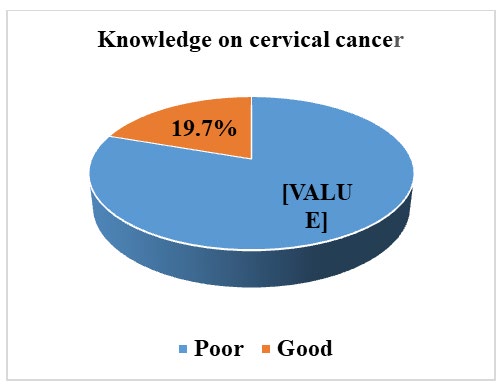
Over all knowledge status was calculated using the average score for question assessing the knowledge of respondents on cervical cancer. It was revealed that out of 259 respondents, 19.7% at 95% CI (15.1, 24.7) had good knowledge level on cervical cancers (Figure 2).
Attitude towards Screening of Cervical Cancer
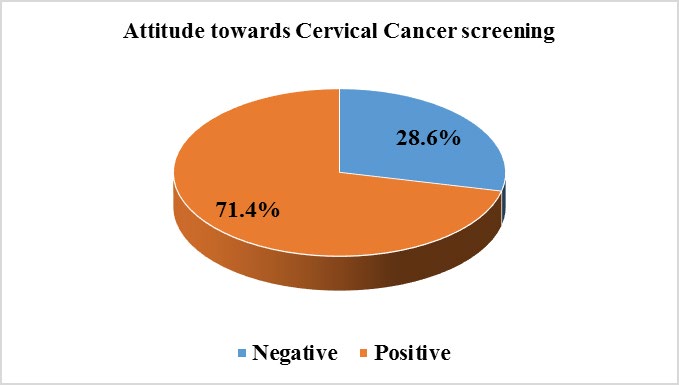
As shown in Table 6, 185(71.4%) of the respondents agreed that consulting a medical doctor is important in case of vaginal bleeding between periods is important. However, 181(69.9%) of the respondents agreed that having a smear test is not as such important to detect cervical cancer. In the another side, 188(72.6%) had agreed on the importance to made available national cervical cancer screening program in the future and the importance to take vaccine against human papilloma virus if available (Table 6). Overall, 71.4% had positive attitude towards the screening of cervical cancer (Figure 1).
| Variables | Attitude status of the study participant on Like RT scale | ||||
|---|---|---|---|---|---|
| Strongly Disagree | Disagree | Neutral | Agree | Strongly Agree | |
| Consulting a medical doctor is important in case of vaginal bleeding between periods is important | 6 (2.3%) | 6 (2.3%) | 26 (10.0%) | 185 (71.4%) | 36 (13.9%) |
| It is important to consult a medical doctor regularly for screening of cervical cancer | 4 (1.5%) | 9 (3.5%) | 26 (10.0%) | 184 (71.0%) | 36 (13.9%) |
| Having a smear test is not as such important to detect cervical cancer | 4 (1.5%) | 9 (3.5%) | 27 (10.0%) | 181 (69.9%) | 38 (14.7%) |
| It will be important to made available national cervical cancer screening program in the future | 3 (1.2%) | 12 (4.6%) | 23 (8.9%) | 188 (72.6%) | 33 (12.7%) |
| It is important to take vaccine against human papilloma virus if available | 6 (2.3%) | 9 (3.5%) | 23 (8.9%) | 188 (72.6%) | 33 (12.7%) |
Table 6: Attitude towards screening of cervical cancer among women of reproductive age group at Batu town, Ethiopia, 2018.
Practice towards Screening for Cervical Cancer
Of all the study participants, 74(28.6%) ever had any gynecological examination within the last two years (23.0%), more than three years (59.5%) and within the last four years (17.6%). Regarding with the screening practice, 37(14.3%) ever got a papanicolaous test (Pap) smear /VIA test either one times (73.3%) or two times (27.0%) within the past 3-6 years (Table 7).
| Variables | Frequency | Percent |
|---|---|---|
| Ever had any gynecological examination | ||
| Yes | 74 | 28.60% |
| No | 185 | 71.40% |
| Time of last gynecological examination (n=74) | ||
| Less than two years | 17 | 23.00% |
| More than three years | 44 | 59.50% |
| In the last four years | 13 | 17.60% |
| Ever got a Papanicolaous test (Pap) smear/VIA test | ||
| Yes | 37 | 14.30% |
| No | 222 | 85.70% |
| How many times got smear test (n=37) | ||
| One times | 27 | 73.00% |
| Two times | 10 | 27.00% |
| Ever used chemicals of plants for intimate care | ||
| Yes | 12 | 4.60% |
| No | 247 | 95.40% |
Table 7: Screening practice of cervical cancer among women of reproductive age group at Batu town, Ethiopia, 2018.
Factors Associated with Screening Practice of Cervical Cancer
In order to identify factors associated with screening practice of cervical cancer, bivariate and multivariate binary logistic regression analysis were conducted. At bivariate level seven variables: age, age at first sex, ever given birth, ever practiced abortion, Knowledge on cervical cancer and ever had any gynecological examination were significantly associated with screening practice of cervical cancer. All of the variables with p-value less than 0.25 at bivariate analysis were incorporated in the final multivariable logistic regression model. After controlling for the effects of potentially confounding variables using multivariate logistic regression model, three variables: ever practiced abortion, knowledge on cervical cancer and ever had any gynecological examination were significantly associated (p-value less than 0.05) factors with screening practice of cervical cancer.
Odds of having screening practice of cervical cancer among those ever practiced abortion was 8.27 times higher as compared to those did not ever practiced abortion with adjusted odds ratio [AOR =8.27, 95%CI (2.69- 25.40)]. Women had good knowledge on cervical cancer had 15.82 times higher odds of screening practice as compared to those who had poor knowledge on cervical cancer [AOR= 15.82, 95%CI (3.67- 68.22)]. Those who had any gynecological examination before had 3.16 times more likely odds of screening practice as compared to those who did not had any gynecological examination [AOR= 3.16, 95%CI (1.08- 9.25)].
| Variables | Screened for Cervical cancer | AOR (95%CI) | P-value | |
|---|---|---|---|---|
| Yes | No | |||
| Age (years) | ||||
| <25 | 6(3.9) | 149(96.1) | RC | |
| ≥25 | 31(29.8) | 73(70.2) | 2.83(0.76, 10.46) | 0.12 |
| Age at first sex | ||||
| ≤18 | 5(6.3) | 75(93.8) | RC | |
| <18 | 32(17.9) | 147(82.1) | 2.51(0.58, 10.71) | 0.215 |
| Ever given birth | ||||
| Yes | 28(19.9) | 113(80.1) | 1.24(0.37, 4.18) | 0.734 |
| No | 9(7.6) | 109(92.4) | RC | |
| Ever practiced abortion | ||||
| Yes | 28(32.2) | 59(67.8) | 8.27(2.69, 25.40)** | <0.001 |
| No | 9(5.2) | 163(94.8) | RC | |
| Knowledge on cervical cancer | ||||
| Poor | 7(3.4) | 201(96.6) | RC | |
| Good | 30(58.8) | 21(41.2) | 15.82(3.67, 68.22)** | <0.001 |
| Ever had any gynecological examination | ||||
| Yes | 27(36.5) | 47(63.5) | 3.16(1.08, 9.25)* | 0.036 |
| No | 10(5.4) | 175(94.6) | RC |
Table 8: Multivariate Logistic regression analysis to identify factors affecting practice of women of reproductive age towards ce
Discussion
In this study knowledge, attitude and practice and factors associated with practice of cervical cancer screening were examined in Batu health center. It was revealed that out of 259 respondents, 19.7% at 95% CI (15.1, 24.7) had good knowledge level on cervical cancers. The finding was concordant with other similar studies from Tanzania (21.1%) [15]. As well as similarly with data in Adis Ababa 19% [15]. However, the result was lower than study from Bishoftu town, Ethiopia which showed that about 51.2% had good knowledge on cervical cancer and its screening [16]. This might be due to different measurement of knowledge level of participants.
This study showed that, more than 71.4% of the respondent had a positive attitude towards screening of cervical cancer. This finding was lower from study from Zimbabwe (80%) [10] and study from Bishoftu town which revealed that 74.9% of the women had favorable attitude towards cervical cancer screening [16]. This discrepancy is due to difference of study area and study period. However, a study done in UK showed majority women had negative attitude [5]. In some studies, Latinos and women of Asian descent endorsed more misconceptions about cancer and fatalistic beliefs [6].
Finding of the study indicates that reproductive age group in Batu health center who had ever screened of cervical cancer was 14.3%. The finding was concordant with similar study from Tanzania 14.2% [14, 15] and Butajira Town, Ethiopia (15.1%) [14]. However, the finding was higher than studies conducted in Nigeria 7.1%, in Democratic republic Congo (9%)[10] and Addis Ababa 2008 6.5% [11] and Bishoftu Town (5.8%) [16, 17]. The finding was higher might be due to the currently country’s health policy increased its focus towards the chronic disease prevention and treatment.
The study finding showed that having screening practice of cervical cancer among those ever practiced abortion was more likely as compared to those did not ever practiced abortion. This could be due to the attendance or had the opportunity to visit gynecologist while getting abortion services. Analysis of data from a study conducted in Netherlands showed that women’s beliefs about cervical screening and attendance are the best predictors of screening uptake [18].
Women had good knowledge on cervical cancer were more likely practice cervical cancer screening compared to those who had poor knowledge on cervical cancer. This study finding was supported with study from Nigeria which showed that Pap smear utilization was very low and there was a wide gap between their personal knowledge and uptake of Pap test [17]. Study from Bishoftu Town, Ethiopia was also showed women who had poor knowledge on cervical cancer and its screening were 7.2 times less likely to avail for screening services than women who had good knowledge [16]. This could be possible that having good knowledge on something would ensure uptake too.
The study also revealed that women’s history of gynecological examination is also implicated in screening practice. Those who had any gynecological examination before had 3.16 times more likely odds of screening practice as compared to those who did not had any gynecological examination. This could be possible that having opportunity to contact the gynecologist might increase their awareness about cervical cancer and advantage of its screening.
Conclusion
Knowledge on cervical cancer screening and screening practice among women of reproductive age group at Batu town is low. However, majority had positive attitude towards the screening of cervical cancer and had agreed on the importance to made available national cervical cancer screening program in the future and the importance to take vaccine against human papilloma virus when available. Had ever practiced abortion, had good knowledge on cervical cancer and had experienced any gynecological examination were factors associated with screening practice.
Disclosure
The authors declared that they have no any competing interests.
Declaration
Authors declare that this article has not been published or submitted anywhere for publication.
Authors’ contributions
Abenet Menene and Genet Behabtu Conceived and designed the protocols. Genet behabtu performed data collection and analysed the data. Genet Behabtu &Aliye Kediro wrote the draft paper: Abenet Menene &Teresa Kisi prepared the manuscript and finally all authors approved the final manuscript.
Acknowledgments
We would like to acknowledge Adama general hospital and medical college, Batu health office, data collectors, study participants, family members and colleagues for their support.
References
-
Anorlu RI (2008) Cervical cancer: the sub-Saharan African perspective. Reproductive Health Matters 16(32): 41-93.
-
Bruni L, Barrionuevo-Rosas L, Albero G, Aldea M, Serrano B, et al. (2015) Human Papillomavirus and Related Diseases in the World. ICO Information Centre on HPV and Cancer (HPV Information Centre).
-
Chew GK, Cruickshank ME, Rooney PH, Miller ID, Parkin DE, et al. (2005) Human papillomavirus 16 infection in adenocarcinoma of the cervix. Br J Cancer 93(11): 1301- 1304.
-
Gakidou E, Nordhagen S, Obermeyer Z (2008) Coverage of cervical cancer screening in 57 countries: low average levels and large inequalities. PLoS Med 5(6): e132.
-
Hamad HM (2006) Cancer initiatives in Sudan. Ann Oncol 17(S8):viii32-viii6.
-
Yusufu LMD (2004) Early diagnosis of breast cancer. Ann Afr Med 3(2): 95.
-
Denny L, Quinn M, Sankaranarayanan R (2006) Screening for cervical cancer in developing countries. Vaccine 24(S3): 71-77.
-
Yu CK, Rymer J (1998) Women’s attitudes to and awareness of smear testing and cervical cancer. Br J Fam Plann 23(4): 127-133.
-
James John (2011) Assessment of knowledge attitude, practice and perceived barriers towards screening premalignant lesions among aged 18 years and above in songue urban, ruvama[dissertation] Muhimbili University of Health and Allied Sciences.
-
Ali-Risasi, Mulumba P, Verdonck K, Vanden Broeck D, Praet M, et al. (2014) knowledge, attitude and practice about cervical cancer of the uterine cervix among women living in Kinshasa, democratic republic of Congo. BMC Women’s Health 14(1): 30.
-
Anim JT (1993) Breast cancer in sub-Saharan African women. Afr J Med MedSci 22(1): 5-10.
-
Grace x.ma, Carolyn.fang, ziding feng et al: (2012) Correlates of cervical cancer screening among Vietnamese American women. Infectious Diseases in Obstetrics and Gynecology, Article ID 617234.
-
ICO Information Centre on HPV and Cancer (2014) Human Papillomavirus and Related Cancers Ethiopia, Fact Sheet.
-
Mohammed Deresse, Kidus Yosef, Brihan Abera (2018) Study on Knowledge, Attitude and Practice towards Cervical Cancer and Screening among Women in Butajira Town: A Cross Sectional Study; International Journal of Scientific and Research Publications (IJSRP) 8(12): 410- 418.
-
Nwozor CM, Oragudosi AL (2013) Awareness and uptake cervical cancer screening among women in Onitsha, southeast Nigeria. Greener Journal of medical sciences 3(8): 283-288.
-
Worku Dechassa Heyi, Temesgen Tilahun Bekabil, Gemechu Gudeta Ebo (2018) Knowledge, Attitude And Practice Of Cervical Cancer Screening Among Women Aged 15-49 Years In Bishoftu Town, East Shewa Zone, Oromia Region, Ethiopia. Ethiopian journal of reproductive health 10(2): 42-52.
-
Waktola EA, Mihret W, Bekele L (2005) HPV and burden of cervical cancer in east Africa. Gynecol Oncol 99(3S 1): S201-S202.
-
Gharoro EP, Ikeanyi EN (2006) An appraisal of the level of awareness and utilization of the Pap smear as a cervical cancer screening test among female health workers in a tertiary health institution. International Journal of Gynecology Cancer 16(3): 1063-1068.
- Postpartum Maternal Mental Health - A Narrative Review
- Beta HCG in Cervico-Vaginal Secretion as a Predictor of Preterm Delivery
- Successful Management of Mid Trimester Foetal Death with Major Placenta Previa by Expectant Management Followed by Induction of Labour
- To Evaluate the Expression of Egr2 Gene in Term Low Birth Weight Newborns
- Impact of Maternal Obesity on Maternal and Foetal Outcomes: A Prospective Cohort Study from Northern India
- ‘’Benefit of Pulsatile GnRH Therapy in Treatment of Functional Hypothalamic Amenorrhea (FHA) and Congenital Hypogonadotropic Hypogonadism(CHH) in Infertile Patients Over Canonical Gonadotropins with IVF –A Short Communication’’