
Biodegradation Capability of Native Fungi Present in the Effluent of a Local Pharmaceutical Industry near Lahore, Pakistan
Wastes generated by the pharmaceutical industries can contaminate the environment, so their treatment is necessary. Different techniques are under use, but they have some drawbacks like economical and environmental sustainability and further these techniques are not able to completely degrade all the pollutants, present in the effluents. Bioremediation of toxic wastes serves as an effective and economical method by using different microorganisms. Fungal biomasses have huge capability of degrading effluents discharged from various industries. The aim of this work was to treat pharmaceutical effluent by the micromycetes. Four species belonging to Aspergillus fungus i.e., A. niger, A. flavus, A. fumigatus and A. alliaceous were identified and selected for this bioremedial studies. Experimental conditions were optimized for fungal species. Although all four species were known to bring bioremediation which had been confirmed by measuring the percentage of reduction potential in pH, EC, TDS, BOD and COD; but A. niger revealed maximum upto pH (39.65%), EC (11.06%), TDS (9.16%), BOD (50%) and COD (44.08%) under the optimal conditions of this study. The extracellular enzymatic activities of this fungal species evidenced an excellent evaluation of experimental data to propose A. niger as a cost effective solution to treat the effluents from pharmaceutical industry.
Introduction
Industries producing wastes are causing environmental pollution at a great level. Their disposal Biodegradation Capability of Native Fungi Present in the Effluent of a Local Pharmaceutical Industry near Lahore, Pakistan into soil and water are constantly polluting environment and effecting both aquatic and terrestrial life including human beings as well [1]. Pharmaceutical industries generate a variety of wastes during manufacturing, maintenance and housekeeping. With the diversity of processes comes a diverse set of waste stream [2]. Environmental pollution is a constant threat faced by humanity and all living beings [3, 4, 5]. Industrial effluents J Mycol Mycological Sci
entering into the surface water are one of the most important sources of toxic contamination in the environment. An effective treatment of these wastes is necessary. Pharmaceutical effluents are usually resisting to the standard biological treatments, due to the complex aromatic compounds and extreme chemico-physical parameters, so their treatment requires information about the characteristics and composition of the waste [6, 7].
Typically, pharmaceutical wastewater is characterized by high chemical oxygen demand (COD) concentration, and some pharmaceutical wastewaters can have COD as high as 80,000 mg/L [8]. Fungi, their biology, economic value and their capabilities are not new to human society. They have been used from fermentation of foods to production of pharmaceuticals. Fungi can tolerate extreme environmental habitats because of their enzyme system [9]. These are involved in the biodegradation of pollutants and convert them into harmless, tolerable or useful products [10].
Therefore the present study is designed to isolate local fungal species by using malt extract and agar medium from pharmaceutical effluents and analyze their capabilities for bioremediation of pharmaceutical wastewater. Also the most efficient species for bioremediation were also validated through the comparison of values obtained for the parameters such as pH, electrical conductivity (EC), total dissolved solids (TDS), biological oxygen demand (BOD) and chemical oxygen demand (COD).
Materials and Methods
Sample Collection
Samples were collected from a local pharmaceutical industry located near Lahore, Pakistan. The collected samples were transferred into a labeled, sterile plastic container that have been pre washed with 10% nitric acid and rinsed with de-ionized water and brought immediately to the laboratory and maintained at 4°C for further studies.
Isolation, Screening and Growth Characteristics of Micromycetes
One ml of each sample was cultured in a sterile petri plate which contains Malt Extract and Agar medium (MEA) by pour plate method and incubated at room temperature for 5-7 days. Fungal species developed on the medium were observed periodically. Microscopic morphology of fungal species i.e. hyphae, conidiophores, conidia etc. were noticed. The species were identified, with the help of following important literature i.e., Dictionary of the fungi [11], Fungi of Pakistan [12], Mycology [13]. Among all isolated fungi only potential species were selected.
Degradation Studies
Immediately after the collection of effluent, biological parameters such as BOD and COD were measured. Effluent collected from the pharmaceutical industry was autoclaved at 121°C for 15 minutes to make them sterile before inoculating the selected fungal strains. Then cultures of selected fungi were aseptically inoculated into 250ml conical flasks containing 100ml effluent samples. The flasks were incubated at 27°C ± 1°C. Degradation studies were carried out after few days. Then same biological parameters were measured again to evaluate and compare their individual bioremediation efficiency. Initially physico-chemical parameters and biological parameters were also measured. Experiments were carried out for six days under laboratory conditions and everyday measurements for pH, EC, TDS were carried over for a regular interval of 2 hours. pH was tested using digital pH meter, model no. WTW 3110. EC and TDS were determined by standard procedure [14].
Results and Discussion
Efficiency of Fungal Species Controlling pH, EC and TDS
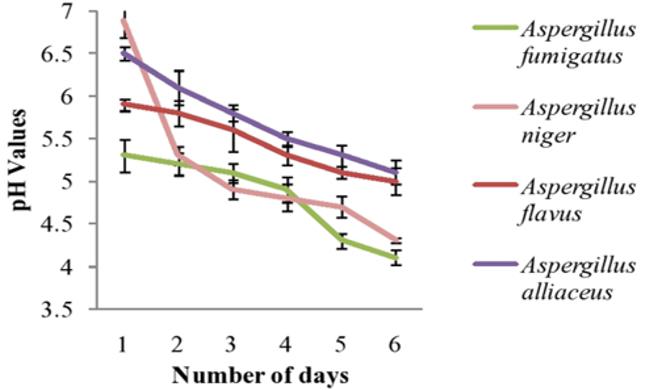
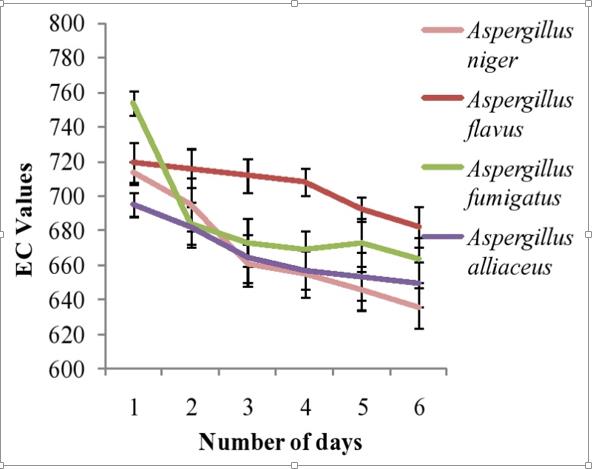
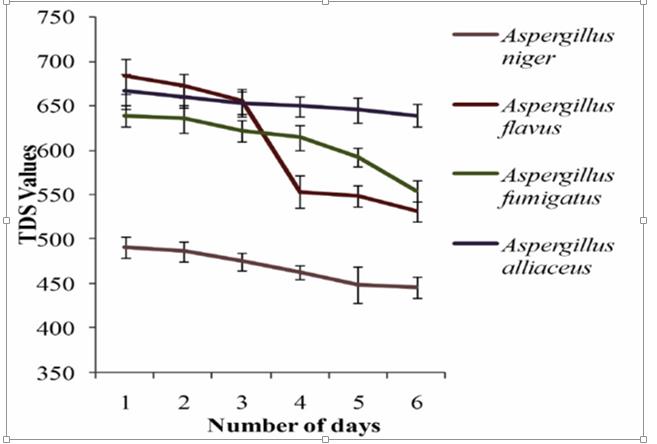
The treatment efficiency was validated by calculating the percentage reduction of all the parameters measured (Table 1, Figures 1-3). Pharmaceutical effluent Sample which was inoculated with Aspergillus niger Sensu Auct. there was a decrease in pH from 6.9 to 4.3, EC decreased from 714 µS/cm to 635 µS/cm and TDS decreased from 491 mg/L to 446 mg/L; with Aspergillus fumigatus Fresen. pH decreased from 5.3 to 4.1, EC deceased from 754 µS/cm to 653 µS/cm and TDS decreased from 639mg/L to 554mg/L; with Aspergillus flavus Link pH decreased from 5.9 to 5.0, EC decreased from 719 µS/cm to 682 µS/cm and TDS decreased from 683mg/L to 531mg/L and with Aspergillus alliaceous Glins., Thamavit & Sittir. The value of pH decreased from 6.5 to 5.1, EC decreased from 695 µS/cm to 649 µS/cm and TDS decreased from 666mg/L to 639mg/L.
- Days
- Effluents Treated with Various Species of Aspergillus
- A. niger
- A. fumigatus
- A. flavus
- A. alliaceus pH
- TDS
- EC pH
- TDS
- EC pH
- TDS
- EC pH
- TDS
- EC
- 1
- 6.9
- 491
- 714
- 5.3
- 639
- 754
- 5.9
- 683
- 719
- 6.5
- 666
- 695
- 2
- 5.3
- 486
- 695
- 5.2
- 635
- 684
- 5.8
- 672
- 716
- 6.1
- 659
- 682
- 3
- 4.9
- 475
- 660
- 5.1
- 622
- 673
- 5.6
- 655
- 712
- 5.8
- 652
- 664
- 4
- 4.8
- 463
- 655
- 4.9
- 614
- 669
- 5.3
- 553
- 708
- 5.5
- 649
- 657
- 5
- 4.7
- 449
- 645
- 4.5
- 592
- 673
- 5.1
- 549
- 692
- 5.3
- 645
- 653
- 6
- 4.3
- 446
- 635
- 4.1
- 554
- 653
- 5
- 531
- 682
- 5.1
- 639
- 649
Table 1: Variations in pH, Electrical Conductivity (EC) and Total Dissolved Solids (TDS) in the effluent from
Variation in BOD and COD during Bioremediation of Effluents Treated with Various Fungus Species
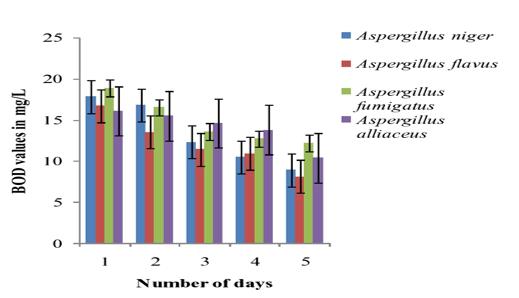
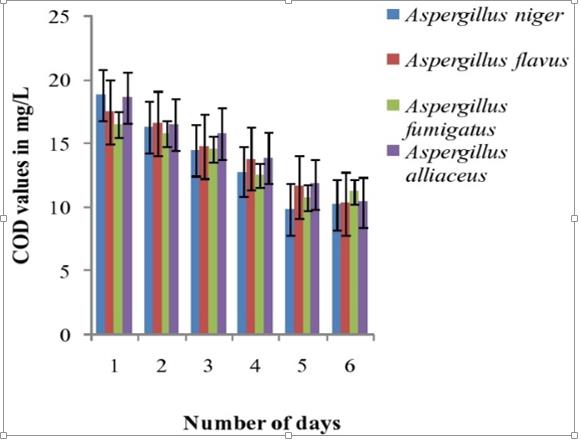
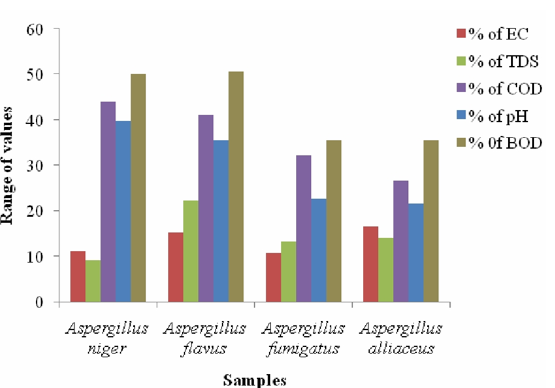
The process of bioremediation is generally understood with higher percentage of reduction accompanied with BOD and COD. These values were noted for samples of effluents inoculated with various fungus species (Table2, Figures 4-5). Significant reduction in BOD and COD values noted were 50% and 26.78% respectively for the samples inoculated with Aspergillus niger; 50.63% and 41.14% for the samples inoculated with A. flavus; 35.5% and 32.1% for samples inoculated with A. fumigatus and 35.4% and 44.08% for samples inoculated with A. alliaceous. These values shows reduction trends.
| S. No. | Sample | % of pH reduction | % of EC reduction | % of TDS reduction | % of BOD reduction | % of COD reduction |
| 1 | Aspergillus niger | -39.65 | 11.06 | 9.16 | 50 | 26.78 |
| 2 | Aspergillus flavus | -35.49 | 15.4 | 22.25 | 50.63 | 41.14 |
| 3 | Aspergillus fumigatus | -22.64 | 10.74 | 13.3 | 35.5 | 32.1 |
| 4 | Aspergillus alliaceus | -21.53 | 16.61 | 14.04 | 35.4 | 44.08 |
Table 2: Variation In Biological Oxygen Demand (Bod) And Chemical Oxygen Demand (Cod) In The Effluent From Table 2: Variation In
The percentage reduction potential noted for all parameters pH, EC, TDS, BOD and COD (Table 3, Figure 6) for Aspergillus niger was -39.65, 11.06, 9.16, 50 and 26.78
| S. No. | Sample | Parameters | |||||
| S. No. | Sample | BOD (mg/L) | COD (mg/L) | ||||
| S. No. | Sample | Initial | Final | % Reduction | Initial | Final | % Reduction |
| 1 | Aspergillus niger | 17.8 | 8.9 | 50 | 18.8 | 10.2 | 45.74 |
| 2 | Aspergillus flavus | 16.7 | 8.1 | 51.4 | 17.5 | 10.3 | 41.14 |
| 3 | Aspergillus fumigatus | 18.9 | 12.2 | 35.5 | 16.5 | 11.2 | 32.1 |
| 4 | Aspergillus alliaceus | 16.1 | 10.4 | 35.4 | 18.6 | 10.4 | 44.08 |
Table 3: Variation in physico - chemical parameters in terms of percentage.
Comments
Wastewater from pharmaceutical industry characterizes high values of BOD, COD, TDS and pH [15]. Pharmaceutical wastewater if disposed with insufficient treatment may leads to great damage to the environment and groundwater resources. General treatment cannot be used for every pharmaceutical wastewater due to its variable composition. Therefore, specific treatment is required for specific type of wastewater [16]. Inoculation of Aspergillus fumigatus with the pharmaceutical effluent, the decrease in pH, EC and TDS was observed in terms of percentage was 22.64%, 10.74% and 13.30% respectively. Similar results have been described by Van der Westhuizen and Pretorius [17] showing that co-efficient of A. fumigatus reduced the percentage of TDS from 0.44% to 0.33% and a reduction in pH from 6.1 to 5.0 when incubated for several days (5-7). Similar results had been found in literature while using A. fumigatus for treating wet corn-milling wastewater [18] and affectivity of same fungus for decolorization of anaerobically treated wastewater from pharmaceutical industry [19]. Inoculation of A. alliaceous with the pharmaceutical effluent, the decrease in pH, EC and TDS was also observed. The decrease in these parameters in terms of percentage was 21.53%, 16.61% and 14.05% respectively as described by different researchers [20, 21, 22]. Reduction in BOD and COD values were noted for effluent samples inoculated with A. flavus, A. fumigatus, A. alliaceous and A. niger for the purpose of bioremediation. Among all these four fungal species A. niger proved to be the best in potential for pollution reduction as reported by White, et al. when he worked with group of different species [23]. The reason of efficiency may be the enzymes evolved from A. niger offer higher protons to diffuse the pollutants 23 and good for the reduction. Another important factor is the species growth rate which seems comparatively high so it can survive in very harsh acidic and basic environments [24]. To select the fungal isolate with the higher bioremediation potential, out of the four fungal species isolated from the pharmaceutical industrial effluent the percentage of reduction potential produced in different parameters were compared. It was understood that there was a higher reduction percentage of pH, EC, TDS, BOD and COD when the pharmaceutical effluent was inoculated with A. niger as compared to other fungal species. These results also supported by literature i.e., Buvaneswari, et al. [25] reported the percentage reduction potentials of three fungal species A. niger, Penicillium sp_. and _Fusarium sp_. and found that the potential of _A. niger was greater than the other species.
Conclusion
During this research work, it was concluded that although some negative effects are associated with fungal species, but they are also useful for many purposes. Fungal species were inoculated and tested for individual bioremedial efficiency present in pharmaceutical wastewater. Only four species of Aspergillus were identified which have ability to survive in most unfavorable conditions. Out of the four species A. niger has the maximum degrading potential i.e. pH 39.65%, EC 11.06%, TDS 9.16%, COD 26.78% and BOD 50%. So this species can be used at large scale for bioremediation processes.
References
-
1 Ainsworth GC, Bisby GR (1995) Common wealth Mycological Institute Kew, Survey, UK. Dictionary of the fungi_,_ pp: 445. 2 Alexopoulos CJ, Mims CW, Well MB (1996) Introduction to Mycology. 4th (Edn.), John Wiley and Sons, New York, USA, pp: 449. 3 Amezcua-Allieri MA, Lead JR, Rodriguez-Vazquez R (2005) Changes in Cd and Cr fluxes during the bioremediation of phenanthrene. Soil Use and Management 21(3): 337-339. 4 Aust SD (1990) Degradation of environmental pollutants by Phanerochaete chyrosporium. Microbial Ecology 20(1): 197-209. 5 Bennet JW, Klich M (2003) Clinical Microbiology Reviews. Mycotoxins 16(3): 497-516. 6 Bhole BD, Ganguly B, Madhuram A, Deshpande D, Joshi J (2004) Biosorption of methyl violet, basic fuchsin and their mixture using dead fungal biomass. Current Science 86(12): 1641-1645. 7 Boyd GR, Palmeri JM, Zhang S, Grimm DA (2004) Pharmaceuticals and personal care products (PPCPs) and endocrine disrupting chemicals (EDCs) in stormwater canals and Bayou St. John in New Orleans, Louisiana, USA. Sci Total Environ 333(1-3): 137-148. 8 Buvansewari S, Damudarkumar S, Murugesan S (2013) Bioremediation studies on sugar mill effluent by selected fungal species_._ International Journal of Current Microbiology and Applied Scienc_es_ 2(1): 50- 58. 9 Carballa M, Fink G, Omil F, Lema JM, Ternes T (2008) Determination of the solid–water distribution coefficient (Kd) for pharmaceuticals, estrogens and musk fragrances in digested sludge. Water Research 42(1-2): 287-295. 10 Chen H, Wang P, Ding W (2008) Using liquid chromatography–ion trap mass spectrometry to determine pharmaceutical residues in Taiwanese rivers and wastewaters. Chemosphere 72(6): 863- 869. 11 Cripps C, Bumpus JA, Aust SD (1990) Biodegradation of azo and heterocyclic dyes by Phanerochaete chyrosporium. Appl Environ Microbiol 56(4): 1114- 1118. 12 El-Gohary FA, Abou-Elela SI, Aly HI (1995) Evaluation of Biological Technologies for Wastewater Treatment in the Pharmaceutical Industry. Water Science and Technology 32(11): 13-20. 13 Frank, Hund (1998) Memorandum: The COD of Pharmaceutical Wastewaters, from Frank and Hund to public record. 14 Godfrey E, Woessner WW, Benotti MJ (2007) Pharmaceuticals in On-Site Sewage Effluent and Ground Water, Western Montana. Ground Water 45(3): 263-271. 15 Gupta R, Mukerji KG (2001) Bioremediation: Past, Present and Future. In: Role of microbes in the management of environmental pollution. A.P.H. Publishing Corp, New Delhi, pp: 73-81. 16 Hai FI, Yamamoto K, Nakajima F, Fukushi K (2008) Factors governing performance of continuous fungal reactor during non-sterile operation-The case of a membrane bioreactor treating textile wastewater. Chemosphere 74(6): 810-817. 17 Jasti N, Khanal SK, Pometto AL, Van L, Hans J (2006) Fungal treatment of corn processing wastewater in an attached growth system. Water Practice and Technology 1(3): 115. 18 McGuire JL, Hasskarl H, Bode G, Klingmann I, Zahn M (2007) Pharmaceuticals, General Survey. 7th (Edn.), Ullmann's Encyclopedia of Chemical Technology. Weinheim: Wiley VCH. 19 Mohammad P, Azarmidokht H, Fatollah M, Mahboubeh B (2006) Application of response surface methodology for optimization of important parameters in decolorizing treated distillery wastewater using Aspergillus fumigatus UB2 60. International Biodeterioration and Biodegradation 57(4): 195-199. 20 Prigione V, Varese GC, Casieri L, Marchisio VF (2008) Biosorption of simulated dyed effluents by inactivated fungal biomasses. Bioresource Technology 99(9): 3559-3567. 21 Richards LA (1954) Diagnosis and improvement of saline and alkali soils. Hand Book 60, United States Department of Agriculture, USA. 22 Rosales E, Pazos M, Sanroman MA (2011) Comparative efficiencies of the decolourisation of leather dyes by enzymatic and electrochemical treatments. Desalination 278(1-3): 312-317. 23 Sultan A, Iqbal SH, Khalid AN (1997) Fungi of Pakistan. Department of Botany, University of Punjab, Quaid-e- Azam Campus, Lahore Pakistan. 24 Van der Westhuizen TH, Pretorius WA (1998) Use of filamentous fungi for the purification of industrial effluents. WRC report No. 535/l/98, Pretoria, South Africa. 25 White C, Sayer JA, Gadd GM (1997) Microbial solubilization and immobilization of toxic metals. Key biogeochemical processes for treatment of contaminants. FEMS Microbiol Rev 20(3-4): 503-516.
- Diversity of Candida sp and Antifungal Susceptibility Patterns in Digestive Candidiasis among People Living with HIV in CHU of Libreville, Gabon
- Vulvovaginal candidiasis: Retrospective study (2019- 2021) at the Centre Hospitalier National de Pikine, Suburban Dakar, Senegal
- Identification of Environmental Fungal Species in Clinical Services of University Hospital of Angre, Abidjan (Cote d’Ivoire)
- New Location of some Gasteroid Basidiomycetes in Western Kazakhstan
- Evaluation of Various Extracellular Enzymes of Ectomycorrhizal Mushrooms
- Morphology and Phylogeny of Lactarius Wallichianae sp. nov and Xerula magnispora sp. nov. from India