
The Fascinating Spongiforma Mushroom (Spongebob Mushroom)
Mushrooms are generous source of nutritional and medicinal compounds. SpongeBob fungi are a group of mushrooms belonging to Basidiomycota; Class; Agaricomycetes; Order Boletales; Family: Boletaceae. Their name derived from the Nickelodeon cartoon character SpongeBob Square Pants. They are considered from the Basidiomycetes mushrooms all over the world. It is usually found in Malaysia, in moisture environments even can survive in dried air. SpongeBob mushrooms Edibility, not clear. This review aims to Spongiforma (gastroid boletes) mushrooms under light spot through describing their morphology and ecology especially of the most common fungus, Spongiforma thailandica.
Introduction
The need to improve the life quality together with the increase in the frequency of treating diseases direct the attention of many scientists to view food as a source of nutritional and therapeutically agents. Nature is considered an important source for the discovery of new medicines. A vast diversity of important biologically active compounds have arisen in the natural world, shaped by evolution and spanning a large diversity of species across different kingdoms. In the fungi kingdom, medicinal mushrooms have long been used for the treatment of pathogens and disease [1, 2, 3, 4, 5]. Since ancient times, several mushrooms have been reported as a nutritious food with valuable medicinal properties. Wild mushrooms have been consumed since ancient times due to their good taste and nutritional values. Also, mushrooms have the advantage of being rich in vital components such as proteins, vitamins, chitin, fibers, iron, zinc, selenium, sodium, and other [6, 7, 8, 9, 10].
Mushrooms are abundant natural resources that have structurally unique compounds with diverse bioactivities. Mushrooms are generally basidiomycetes mostly and ascomycetes. Mushrooms have been reported to be from the most valuable microbes to humankind [11, 12, 13, 14, 15]. Investigations on the therapeutic and nutritional properties of mushrooms are on-going throughout the world. Mushrooms still need to be worked out for their biological activities [16, 17, 18, 19, 20]. Thanks to the richness of mushrooms in bioactive compounds that belong to different chemical classes such as phenols, terpenes, proteins, fatty acids, flavonoids, polysaccharides, polyketides, alkaloids, steroids, and other compounds. On the other hand, many studies have described the activities of the fruiting bodies, crude extracts, and purified compounds originated from mushrooms [21, 22, 23, 24, 25].
Many researchers are providing vital data on the collection of biologically active secondary metabolites originated from mushrooms. Mostly, mushrooms grow wild in many environments around the world and are also commercially cultivated for pharmaceutical and nutritional purposes. Nutritionally, mushrooms are healthy food which is rich in nutrients and vitamins. Alternatively, mushrooms have pharmaceutical and medical applications from centuries especially in Asian countries [26, 27, 28, 29]. Recently, isolation and purification of biologically active secondary metabolites from mushrooms has been conducted mainly on the products of fruiting bodies. However, collection of fruiting bodies is a difficult work and is limited by collecting season and area. Also the small amounts of the collected samples are limited to find metabolites from mushrooms. Therefore, mycelial culture of basidiomycetes and ascomycetes originated from wild edible and non-edible mushrooms would be suggested as an alternative, reliable, and manageable method that can obtain various bioactive metabolites from mushrooms [30, 31, 32, 33, 34, 35, 36, 37, 38, 39, 40].
An unusual sponge-shaped (cf. Spongia, Porifera), terrestrial fungus was encountered by Peay, et al. [41], during a recent study of ectomycorrhizal community structure in the dipterocarp-dominated forest of the Lambir Hills in Sarawak, Malaysia. The form of the sporocarp was unusual enough that before microscopic examination the collectors were uncertain whether the fungus was a member of the Ascomycota or the Basidiomycota. This review aims to but Spongiforma (gastroid boletes) mushrooms under light spot through describing their morphology and ecology especially of the most common fungus, Spongiforma squarepantsii.
The genus Spongiforma squarepantsii (SpongeBob fungi) ecology and description
The genus name Spongiforma refers to the sponge-like nature of the fruit body, while the specific epithet (Species name) squarepantsii is a Latinisation of the well-known Nickelodeon cartoon character SpongeBob Square Pants, whose shape was purported to share a resemblance to the fungus. Additionally, the authors note that the spore-bearing surface, when viewed with scanning electron microscopy, somewhat resembles a seafloor covered with tube sponges, reminiscent of the fictitious home of SpongeBob. SpongeBob mushrooms Edibility, not clear [42, 43].
Spongiforma squarepantsii is a species of fungus in the family Boletaceae, genus Spongiforma. Found in Malaysia (On the ground of Lambir Hills National Park, Sarawak State, Malaysia), temperatures ranging from 24 to 32 °C. The structure of the fruit body allows it to quickly revive when dry by absorbing moisture from the air. The distinctive odour of the species may indicate that spore dispersal is mediated by animals [42, 43]. It was described as new to science in 2011. It produces sponge-like, rubbery orange fruit bodies that have a fruity or musky odour. The fruit bodies reach dimensions of 10 cm (3.9 in) wide by 7 cm (2.8 in) tall. Like a sponge, they will resume their original shape if water is squeezed out. The spores, produced on the surfaces of the hollows of the sponge, are almond-shaped with rough surfaces, and measure 10 12.5 μm by 6 7 μm. The name of the fungus is derived from the Nickelodeon cartoon character SpongeBob Square Pants from the show of the same name. S. squarepantsii is one of two species in Spongiforma; it differs from Spongiforma thailandica in its colour, odour, and spore structure [42, 43].
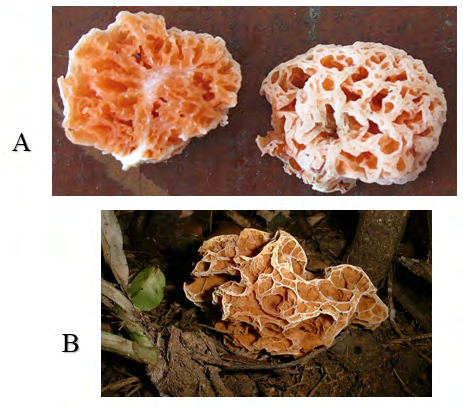
The fruit body of Spongiforma squarepantsii is bright orange coloured, roughly spherical to oval. The fruit body lacks a stipe, it has a rudimentary columella; a small cord of sterile tissue that extends to the centre of the fruit body. The surface of the fruit body has deep ridges and folds somewhat resembling a brain. It is sponge-like and rubbery (If water is squeezed out, it will resume its original shape). The surface has irregular, relatively large cavities, lined with fertile (spore-producing) tissue. The locules are between 2 and 10 mm in diameter. The ridges of the locules are pale orange or lighter and ciliate (having hair-like projections). Fruit bodies have a strong odour described as “vaguely fruity or strongly musty” [42].
Spores are a reddish-brown or deep mahogany colour. The edibility of the fruit body is unknown. The almond- shaped spores are typically 10–12.5 μm by 6–7 μm with thick walls measuring between 0.5–1.2 μm (Figure 1). They have a small central apiculus. When mounted in distilled water, they have a coarsely warty surface and appear rusty brown in colour. The basidia are club-shaped, and four-spored with sterigmata up to 9.5 μm long. The ridges of the locules comprise erect cystidia mixed with chains of erect cylindrical hyphae measuring 4–6 μm in diameter. The cystidia are roughly cylindrical, and have dimensions of 20–60 μm by 4–9 μm [42].
Similar species
The related species Spongiforma thailandica (Belonging to Basidiomycota; Class; Agaricomycetes; Order Boletales; Family: Boletaceae), newly described in 2009, differs from Spongiforma squarepantsii in several ways: it has larger fruit bodies, 5–10 cm (2.0–3.9 in) wide by 4–7 cm (1.6–2.8 in) tall; its gleba is initially pale greyish-orange to brownish-grey before darkening to reddish-brown or dark brown; and it smells of coal tar (Figure 1). Microscopically, S. thailandica has spores with less prominent surface warts [42].
The genus Spongiforma squarepantsii (SpongeBob fungi) as source of biologically active compounds Screening of fungi for antimicrobial substances, antitumor substances and others in particular has been greatly enhanced. Ascomycetes
and Basidiomycetes mushrooms are known to produce wide range of secondary metabolites. Spongiforma (SpongeBob mushrooms), until now much studies on these mushrooms group.
Conclusion
Due to appearance of new diseases, and spreading of lethal ones. The scientists are keeping investigating all possible natural sources in an attempt to find efficient compounds capable of healing diseases and decrease mortality rates. SpongeBob fungi (Spongiforma mushrooms) worth studying as new sources of compounds that could be of medical or biological control applications but until now no mush studies on this group. Repurposing such species can contribute in finding new cure or supporting used drugs in our battle against currently spreading diseases. Further researches and clinical trials have to be carried out to confirm SpongeBob fungi (Spongiforma mushrooms) as sources of bioactive compounds responsible for different biological agents in their extracts. Further research is required in order to isolate and identify these bioactive compounds.
References
-
ALKolaibe AG, Elkhateeb WA, Elnahas MO, El Manawaty M, Deng CY, et al. (2021) Wound Healing, Anti-pancreatic Cancer, and α-amylase Inhibitory Potentials of the Edible Mushroom, Metacordyceps neogunnii. Research Journal of Pharmacy and Technology 14(10): 5249-5253.
-
Daba GM, Elkhateeb W, ELDien AN, Fadl E, Elhagrasi A, et al. (2020) Therapeutic potentials of n-hexane extracts of the three medicinal mushrooms regarding their anti- colon cancer, antioxidant, and hypocholesterolemic capabilities. Biodiversitas Journal of Biological Diversity 21(6): 1-10.
-
El Hagrassi A (2020) In vitro bioactive potential and chemical analysis of the n-hexane extract of the medicinal mushroom, Cordyceps militaris. Malays J Microbiol pp: 40-48.
-
Elkhateeb W, Elnahas M, Daba G (2021) Infrequent Current and Potential Applications of Mushrooms. CRC Press pp: 70-81.
-
Elkhateeb W, Elnahas MO, Paul W, Daba GM (2020) Fomes fomentarius and Polyporus squamosus models of marvel medicinal mushrooms. Biomed Res Rev 3(1): 119.
-
Elkhateeb W, Thomas P, Elnahas M, Daba G (2021) Hypogeous and Epigeous Mushrooms in Human Health. Advances in Macrofungi pp: 7-19.
-
Elkhateeb WA, Daba GM (2022) Bioactive Potential of Some Fascinating Edible Mushrooms Flammulina, Lyophyllum, Agaricus, Boletus, Letinula, and Pleurotus as a Treasure of Multipurpose Therapeutic Natural Product. Pharm Res 6(1): 1-10.
-
Elkhateeb WA, Daba GM (2022) Bioactive Potential of some Fascinating Edible Mushrooms Macrolepiota, Russula, Amanita, Vovariella and Grifola as a Treasure of Multipurpose Therapeutic Natural Product. J Mycol Mycological Sci 5(1): 1-8.
-
Elkhateeb WA, Daba G (2020) The endless nutritional and pharmaceutical benefits of the Himalayan gold, Cordyceps; Current knowledge and prospective potentials. Biofarmasi Journal of Natural Product Biochemistry 18(2): 70-77.
-
Elkhateeb WA, Daba GM, Gaziea SM (2021) The Anti- Nemic Potential of Mushroom against Plant-Parasitic Nematodes. Open Access Journal of Microbiology & Biotechnology 6(1): 1-6.
-
Elkhateeb WA, Daba GM, Elmahdy EM, Thomas PW, Wen TC, et al. (2019) Antiviral potential of mushrooms in the light of their biological active compounds. ARC J Pharmac Sci 5(2): 45-49.
-
Elkhateeb WA, Daba GM, Elnahas M, Thomas P, Emam M (2020) Metabolic profile and skin-related bioactivities of Cerioporus squamosus hydromethanolic extract. Biodiversitas J Biological Div 21(10).
-
Elkhateeb WA, Daba GM, Elnahas MO, Thomas PW (2019) Anticoagulant capacities of some medicinal mushrooms. ARC J Pharma Sci 5(4): 1-9.
-
Elkhateeb WA, Daba GM, Thomas PW, Wen TC (2019) Medicinal mushrooms as a new source of natural therapeutic bioactive compounds. Egypt Pharmaceu J 18(2): 88-101.
-
Elkhateeb WA, Daba GM (2019) The amazing potential of fungi in human life. ARC J Pharma Sci AJPS 5(3): 12-16.
-
Elkhateeb WA, Daba GM (2020) Termitomyces Marvel Medicinal Mushroom Having a Unique Life Cycle. Open Access Journal of Pharmaceutical Research 4(1): 1-4.
-
Elkhateeb WA, Daba GM (2021) Mycotherapy of the good and the tasty medicinal mushrooms Lentinus, Pleurotus, and Tremella. Journal of Pharmaceutics and Pharmacology Research 4(3): 1-6.
-
Elkhateeb WA, Daba GM (2021) The Fascinating Bird’s Nest Mushroom, Secondary Metabolites and Biological Activities. International Journal of Pharma Research and Health Sciences 9(1): 3265-3269.
-
Elkhateeb WA, Daba GM (2021) Highlights on the Wood Blue-Leg Mushroom Clitocybe Nuda and Blue-Milk Mushroom Lactarius Indigo Ecology and Biological Activities. Open Access Journal of Pharmaceutical Research 5(3): 1-6.
-
Elkhateeb WA, Daba GM (2021) Highlights on the Golden Mushroom Cantharellus cibarius and unique Shaggy ink cap Mushroom Coprinus comatus and Smoky Bracket Mushroom Bjerkandera adusta Ecology and Biological Activities. Open Access Journal of Mycology & Mycological Sciences 4(2): 1-8.
-
Elkhateeb WA, Daba GM (2021) Highlights on Unique Orange Pore Cap Mushroom Favolaschia Sp. and Beech Orange Mushroom Cyttaria sp. and Their Biological Activities. Open Access Journal of Pharmaceutical Research 5(3): 1-6.
-
Elkhateeb WA, Daba GM (2022) Muskin the Amazing Potential of Mushroom in Human Life. Open Access Journal of Mycology & Mycological Sciences 5(1): 1-5.
-
Elkhateeb WA, El Ghwas DE, Gundoju NR, Somasekhar T, Akram M, et al. (2021) Chicken of the Woods Laetiporus Sulphureus and Schizophyllum Commune Treasure of Medicinal Mushrooms. Open Access Journal of Microbiology & Biotechnology 6(3): 1-7.
-
Elkhateeb WA, El-Ghwas DE, Daba GM (2021) A Review on Ganoderic Acid, Cordycepin and Usnic Acid, an interesting Natural Compounds from Mushrooms and Lichens. Open Access Journal of Pharmaceutical Research 5(4): 1-9.
-
Elkhateeb WA, Elnahas M, Wenhua L, Galappaththi MCA, Daba GM (2021) The coral mushrooms Ramaria and Clavaria. Studies in Fungi 6(1): 495-506.
-
Elkhateeb WA, Elnahas MO, Thomas PW, Daba GM (2020) Trametes Versicolor and Dictyophora Indusiata Champions of Medicinal Mushrooms. Open Access Journal of Pharmaceutical Research 4(1): 1-7.
-
Elkhateeb WA, Elnahas MO, Thomas PW, Daba GM (2019) To Heal or Not to Heal? Medicinal Mushrooms Wound Healing Capacities. ARC Journal of Pharmaceutical Sciences 5(4): 28-35.
-
Elkhateeb WA, Karunarathna SC, Galappaththi MCA, Daba GM (2022) Mushroom biodegradation and their role in mycoremediation. Studies in Fungi, (Under press).
-
Elkhateeb WA (2020) What medicinal mushroom can do?. Chem Res J 5(1): 106-118.
-
Soliman G, Elkhateeb WA, Wen TC, Daba G (2022) Mushrooms as efficient biocontrol agents against the root-knot. Egyptian Pharmaceutical Journal 21(1): 68- 74.
-
Thomas PW, Elkhateeb WA, Daba G (2019) Truffle and truffle-like fungi from continental Africa. Acta Mycol 54(2): 1-15.
-
Thomas P, Elkhateeb W, Daba G (2021) Industrial Applications of Truffles and Truffle-like Fungi. Advances in Macrofungi pp: 82-88.
-
Daba GM, Elkhateeb WA, Wen TC, Thomas PW (2019) The continuous story of truffle plant interaction pp: 375-383. In: Kumar V, et al. (Eds.), Microbiome in Plant Health and Disease.
-
Zhang X, Zhang X, Gu S, Pan L, Sun H, et al. (2021) Structure analysis and antioxidant activity of polysaccharide-iron (III) from Cordyceps militaris mycelia. International Journal of Biological Macromolecules 178: 170-179.
-
Elkhateeb WA, Daba GM, El-Dein AN, Sheir DH, Fayad W, et al. (2020) Insights into the in-vitro hypocholesterolemic, antioxidant, antirotavirus, and anticolon cancer activities of the methanolic extracts of a Japanese lichen, Candelariella vitellina, and a Japanese mushroom, Ganoderma applanatum. Egyptian Pharmaceutical Journal 19(1): 67-73.
-
Elkhateeb WA, Daba GM, Sheir D, El Dein AN, Fayad W, et al. (2019) GC-MS analysis and in-vitro hypocholesterolemic, anti-rotavirus, anti-human colon carcinoma activities of the crude extract of Ganoderma spp. Egyptian Pharmaceutical Journal 18(2): 102-110.
-
Elkhateeb WA, Daba GM (2022) Medicinal mushroom what should we know. International Journal of Pharmaceutical Chemistry and Analysis 9(1): 1-19.
-
Elkhateeb WA, EL Ghwas DE, Daba GM (2022) Mushrooms as Efficient Enzymatic Machinery. J Biomed Res Environ Sci 3(4): 423-428.
-
Elkhateeb WA, Daba GM (2022) The wild non edible mushrooms, what should we know so far?. International Journal of Advanced Biochemistry Research 6(1): 43-50.
-
Zhang X, Zhang X, Gu S, Pan L, Sun H, et al. (2021) Structure analysis and antioxidant activity of polysaccharide-iron (III) from Cordyceps militaris mycelia. International Journal of Biological Macromolecules 178: 170-179.
-
Peay KG, Kennedy PG, Davies SJ, Tan S, Bruns TD (2010) Potential link between plant and fungal distributions in a dipterocarp rainforest: community and phylogenetic structure of tropical ectomycorrhizal fungi across a plant and soil ecotone. New Phytol 185(2): 529-542.
-
Desjardin DE, Binder M, Roekring S, Flegel T (2009) Spongiforma, a new genus of gastroid boletes from Thailand. Fungal Diversity 37: 1-8.
-
Desjardin DE, Peay KG, Bruns TD (2011) Spongiforma squarepantsii, a new species of gasteroid bolete from Borneo. Mycologia 103(5): 1119-1123.
- Diversity of Candida sp and Antifungal Susceptibility Patterns in Digestive Candidiasis among People Living with HIV in CHU of Libreville, Gabon
- Vulvovaginal candidiasis: Retrospective study (2019- 2021) at the Centre Hospitalier National de Pikine, Suburban Dakar, Senegal
- Identification of Environmental Fungal Species in Clinical Services of University Hospital of Angre, Abidjan (Cote d’Ivoire)
- New Location of some Gasteroid Basidiomycetes in Western Kazakhstan
- Evaluation of Various Extracellular Enzymes of Ectomycorrhizal Mushrooms
- Morphology and Phylogeny of Lactarius Wallichianae sp. nov and Xerula magnispora sp. nov. from India