
The Road to Perfectionism in the Surgical Field: How Resident/ Young Ophthalmologist can become Perfect Ophthalmic Surgeon?
Medicine is a field where one needs to consistently aim for perfection in order to build their competitive edge and retain optimum perfection. Surgery, ophthalmology and medicine all require a lifetime of learning, and learning requires repetition with aim of perfection. Entering into the surgical field (ophthalmology) is another critical stage where your life is on the verge of transformation as you make a career choice that is for the rest of your life. Moreover, ophthalmic surgery is a field that demands nothing less than perfection as even the most little mistake can lead compromised vision or even blindness. During recent years most of the ophthalmic residents are not getting sufficient surgical cases for learning/mastering the eye surgery in most of the training institutes in India. What are the qualities of perfect surgeon? How resident or young ophthalmologist can learn these qualities? Why do we need to become perfect surgeons – especially when it comes to eye surgery and ophthalmology? Ophthalmologic surgeries are very delicate, highly crucial in nature. Any minor mistake can lead the patient to irrevocable damage in form of blindness or other serious visual impairment. This makes eye surgeries riskier than any other and require perfect surgeons on the list to execute surgeries and minimize the damage risk. In this article the authors share some pearls for learning and mastering eye surgery to become a perfect ophthalmic surgeon.
The Qualities of a Perfect Ophthalmic Surgeon
Perfection requires a surgeon to have a number of qualities to become best at what they do. Having these qualities make them a surgeon who is not only professionally competent, but personality-wise too. To become a competent surgeon in ophthalmology, the resident/young ophthalmologist needs to have following skills and qualities:
Learn and Master Surgical Skills
The surgical skills can be learned and refined by watching surgical videos on YouTube and using wet-lab training, training on surgical simulators before operating on real patients. This is the first quality that is extremely necessary to make you a perfect surgeon. You cannot expect to become an impeccable surgeon without having the mandatory set of skills require for your field of practice. Only if you are well- practiced and well-aware of the true skills of ophthalmology only then will you succeed in the field. With skills comes the precision of knowing how and when to utilize these skills in which situation [1, 2] so, with your skills, you have to be highly precise too in using those skills.
The Art of Patient Satisfaction
Now this is something that is rare among surgeons yet highly sought after. Not every surgeon is as good at satisfying patients as they are with performing surgical procedures. This requires the surgeon to have highly proficient communication skills that can help them convey their message effectually to the patients and address any concerns they may have pertinent to their condition or the surgical procedure. Eye is a sensitive organ and visions a sheer blessing to gain the trust of the patients, ophthalmologic surgeons need to be convincing in their communication to satisfy them.
Know the Advances and Innovations of your Field
In the medical field, you can never be knowledgeable enough to say that you know everything and there is need for nothing more. The learning process for doctors is continuous, and a surgeon aiming for perfection knows the importance of this process. They continuously work on increasing their knowledge base to ensure that optimum care service is delivered to the patients [3]. Ophthalmology is witnessing inventions and innovations in the surgical procedures and discoveries of ophthalmologic conditions rather frequently. To become a perfect ophthalmologic surgeon you have to keep up with these advancements and discoveries to ensure you stay abreast of the research and deliver accordingly.
Tips to Become the Perfect Ophthalmic Surgeon
Becoming the perfect surgeon requires you to practice consistently and work relentlessly on refining your skills and knowledge to make yourself as updated as possible. Being an ophthalmologist, you need to further refine your skills because there is practically no (very minimal) room for mistakes. As you learn and perform delicate eye surgery as resident-in-training, you put your patients at risk. This is a tough truth and we all have dealt with it while training. The question is how to limit (minimize) that risk and add value to the patient who has agreed to let you operate on them. In most residency programs the resident get chance to perform surgery comes in the last year. However, it is better to start practicing surgery from the beginning of residency, which includes getting both hands going under the operating microscope in your practice lab, minor room or operating room. Resident should practice suturing, phacoemulsification on animal eyes or model eyes (Kitaro Kit or other surgical simulator) as this is helpful for hand eye coordination under the operating microscope. Practice using both right and left hands and assist the surgery (as much as you can) while keenly observing all minute details. During conference, never miss opportunity to participate in organized wet lab and simulation sessions seriously. Structured learning limits your risk to the patients.
Here are Some Useful Tips That Can Help Make You a More Responsible and Ultimately Perfect Ophthalmic Surgeon
Carry Out a Pre-Op Preparation
A comprehensive pre-operative examination and investigations are very important before surgery as there is nothing worse than going into a surgery ill-prepared. It ultimately impedes your confidence level and curbs your from performing optimally. It is important that you take substantial time before the surgical procedure and give attention to the case you are about to perform. Talk to the patient, take their consent and listen carefully to what they have to say [4]. This will enable you to know what thought process they are going through and how you can acquire their trust and satisfaction subsequently. Besides studying your case and talking to patients, the details of the operating room is another important thing you need to be watchful for. Having all your surgical items and other adjuncts (for example capsular dyes, high density viscoelastic chondroitin sulfate solution etc for doing a case of white cataract) in place and conducting your own survey of the room helps you prepare better while doing surgery.
Be Observant while Assisting Surgery
The best quality you can cultivate in yourself during your medical school and training years is that of observation and information absorption while in class room or in the operating room assisting surgery. These two skills are going to get you to the level of perfectionism. When you observe things and acquire information from them, it ultimately makes you more vigilant in your doing and careful in how you execute your procedures. So have a sharp eye for details so that you know what to be careful of and what mistakes you need to avoid.
Practice Makes Perfect
To nail your ophthalmic career, you need to develop a thorough habit of reading, discussing with your mentors, colleagues, watching surgical videos and practicing it a lot in wet lab or in the operation theater. Reading articles about ophthalmology, recently published cases and research studies about discoveries and trials can help expand your knowledge base and compel you towards critical thinking [5]. Never miss opportunity to participate in eye camps or assisting emergency ophthalmic surgery (for example repair of corneal trauma) during the odd hours. Learn to use operating microscope and other surgical instruments and practice the art of suturing. Learn to respect delicate ocular tissues and never go for the short cut by following the dictum “do no harm”. All this exercise will help you to refine your skills as a surgeon and makes you more abreast of what is happening in the field so that you can mold your practice accordingly and offer the optimum care.
Find a Mentor, Give Respect to Get Respect
There are many great teachers who are willing to mentor young ophthalmologists. You have to give respect to your peers, subordinates and patients to earn back their respect. A perfect resident is not the one who is perfect in the surgical room. He is perfect in all aspects outside the surgical room, too. As a matter of fact, you can only perform optimally in the surgical room if you are able to develop trust of those whom you work with and those you work for. So, bear this reciprocal method all the time – you are going to get what you give out.
Minimize Error by Following the Surgical Safety Checklist
The surgical safety checklist was developed after extensive consultation aiming to decrease errors and adverse events, and increase teamwork and communication during the surgery. The surgical safety checklist has gone to show significant reduction in errors and is now used by majority of surgeons worldwide.
Perfection for Left-Handed Surgeon?
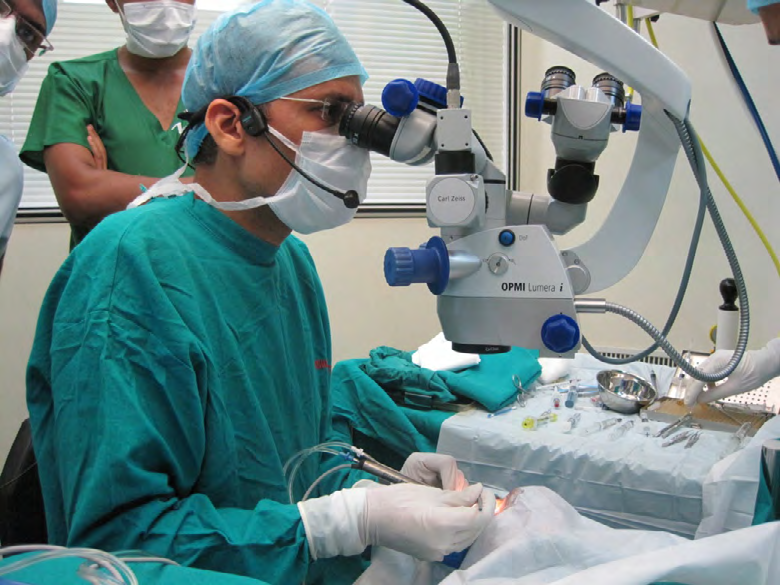
It is a rather common question to ask whether left- handed people can become a perfect surgeon or not. Well, the answer is yes, they definitely can. Being perfect is not a skill or a certain art that needs to be learned. It is actually a matter of practice – a whole lot of a practice. The process may not be as easier for the left-handed people because the apparatuses and tools are designed keeping in mind right-hand users majorly, but nothing is impossible to do if there is consistent practice behind it. Any art can be mastered when you keep doing it consistently. Left-handed surgeons, however, have to face more difficulties as patients are not much comfortable with their laterality [6]. One of us (Dr. Suresh K. Pandey) is the left-handed surgeon. Dr. Pandey remember that during childhood his mother or other relatives used to interrupt him again and again for eating with his left hand. While working as an ophthalmologist, Dr. Pandey found it difficult to learn eye surgery but fortunately, he had the opportunity to learn eye surgery from a well-known left-handed (ambidextrous) eye surgeon from Sydney, Australia, Dr. E. John Milverton. Dr. Milverton shared his experience telling me that he was left- handed but teachers in Australia tried to convert him into a right-handed person. Dr. Pandey was inspired from him to became an ambidextrous surgeon. Dr. Suresh K. Pandey successfully performed more than one lakh surgery and participated in more than 20 ophthalmology conferences doing live surgery (Figure 1).
In summary, a perfect surgeon needs to learn how to operate, when to operate and when not to operate. It is not just the medical profession they need to get a grip on, but should be able to integrate attributes of other professions, too. Having good memory and excellent accuracy, extensive knowledge and a curious soul, precision like an engineer and vision like a keen observer, reckoning like a lawyer and wisdom like a philosopher; a surgeon should be a know-it- all person having the essence of several professions to do the most crucial job in the world [7, 8, 9]. Ophthalmic surgeons must be technically sound; make sensible, logical decisions; communicate well with their patients; and know when (and when not) to operate.
- Perfection is the process of repeated practice. Resident in training, learn about using operating microscope, practice surgical steps in the wet lab using surgical simulator (or animal eyes) and then practice continuously to become a surgeon who is perfect in your field.
- With skills, work on precision as well to master the surgical procedures. Precision allow you to use your skills wisely and appropriately with accordance to the situation.
- A perfect ophthalmic surgeon has tremendous communication and interpersonal skills which they use for building patient satisfaction and developing competent team.
- Work continuously on increasing your knowledge base to ensure that optimum care service is delivered to the patients.
- During the surgical procedure, pay attention to the patient and talk to them about what and how they are feeling. Also focus on the details of the operating room to make process easier for you.
- Have a good eye for details. Observe things and acquire information from them, and keep yourself abreast of all the recent developments.
References
-
Jupiter J (2014) The Making of a Great Surgeon. Tech Hand up Extrem Surg 18(2): 61.
-
Anjum SN, Quinn P, Anwar R (2005) Qualities of a surgeon. British Medical Journal 331: 1176.
-
Sachdeva AK (2005) The new paradigm of continuing education in surgery. Arch Surg 140(3): 264-269.
-
Street RL, Makoul G, Arora NK, Epstein RM (2009) How does communication heal? Pathways linking clinician– patient communication to health outcomes. Patient Educ Couns 74(3): 295-301.
-
Apramian T, Cristancho S, Watling C, Ott M, Lingard L (2016) “They have to adapt to learn”: Surgeons’ perspectives on the role of procedural variation in surgical education. Journal of surgical education 73(2): 339-347.
-
Dobson R (2005) The loneliness of the left handed surgeon. British Medical Journal 330(7481):10.
-
Pandey SK (2019) Secrets of Successful Doctor: The Complete Guide to a Fulfilling Medical Career. Maple Press, New Delhi, India, pp: 524.
-
Pandey SK, Sharma V (2020) A Hippocratic Odyssey: Lessons From a Doctor Couple on Life, In Medicine, Challenges and Doctorpreneurship. Bloomsbury India, New Delhi, India, pp: 476.
-
Pandey SK (2021) Entrepreneurship for Doctors: How to Build Your Own Successful Medical Practice. Maple Press, Noida, India, pp: 432.
- Screening of Hospital Staff During World Glaucoma Week in a Tertiary Eye Care Centre
- Angioid Streaks with Macular Neovascularization: Clinical Insights from Two Cases
- Giant Kissing Naevus: An Oculoplastic Challenge
- Why Freedom of Vision Should Not Cost the Freedom of Feeling - LASIK in the Climate of Change
- Asymmetric Optic Nerve with Small Disc and Large Cup: A Rare and Challenging Case of Unilateral Optic Nerve Hypoplasia
- Large Angle Exotropia in a Child: A Case Report