
To Study the Morbidity Pattern of Patients Attending the Ophthalmology OPD of Tertiary Eye Care Centre with Reference to Age
Background: Vision is the most important special sense in human being. Normal vision is essential for normal physical, mental, psychological development and education. In developing countries like India lower socioeconomic status and lack of proper eye care are responsible for increase in the number of preventable and avoidable causes of blindness as compared to developed countries of the world therefore early detection and treatment of ocular morbidity is important. Aim: To assess the morbidity pattern of ocular disease with respect to age, this will show the trend of ocular morbidities in different age groups. Material and Method: The entire patient in ophthalmology OPD of tertiary eye care center in the past 1 year, were enlisted in this study with their consent. The patients were seen in ophthalmic OPD by ophthalmologist, proper anterior and posterior segment evaluation was done. Patients were divided into different groups according to the age and diagnosis of the disease. Result: Majority of the patients 16441 (46.05%) were found to be in the age group of 31-60 years which shows that common eye diseases are usually linked with age. There was a high prevalence of refractive errors 12098 (33.89%)in the age group till 60 years and cataract 5206 (14.58%) in age group of more than 60 years. Conclusion: It has been observed that majority of patients attending the ophthalmology OPD were between the age group of 31-60 years and beyond and majority were suffering from refractive errors and cataract. Thus this study gives the picture of morbidity pattern of ocular disease in the tertiary health care centre, which is helpful in planning and management of the diseases and denotes that creating awareness among the population is necessary for early diagnosis and treatment of these diseases.
Introduction
Sense of sight is supreme among all the senses provided. The eye is a very important sensory organ of the body. The frequency of eye diseases has been suggested to start increasing around 40 years of age, with an even steeper Commentary increase beginning around 60 years of age. A proper understanding of the magnitude of ocular diseases and the factors associated with their occurrence in the community would help in planning for proper eye care services Hence it is important to study the morbidity pattern of ocular diseases. The present study was undertaken to assess the morbidity pattern of ocular disease with respect to age, which will show the trend of ocular morbidities in different age groups in a tertiary eye care center.
Material and Method
This is a retrospective study has been conducted in a tertiary eye care center. A total of 37500 patients who attended ophthalmology OPD were taken under study in the duration of one year from January 2018 to December 2018. Each person was tested for visual acuity using Snellen charts. Improvement of vision using pinhole was recorded as the best visual acuity. An external eye examination was done using torchlight and a confrontation test was performed to detect any gross diminution of field of vision. Slit lamp examination was done for all patients. Fundoscopy was carried out by direct ophthalmoscope with dilatation of pupils whenever a person was found to have the visual acuity less than 6/9. Lacrimal sac disorders were diagnosed based on clinical signs and symptoms. Probing and syringing was performed to assess the patency of lacrimal ducts among the symptomatic subjects. Diagnosis of retinal diseases were based on clinical findings and dilated fundus examination with an indirect ophthalmoscope and OCT. Glaucoma cases and suspects were diagnosed with help of tonometer and gonioscopy
Result
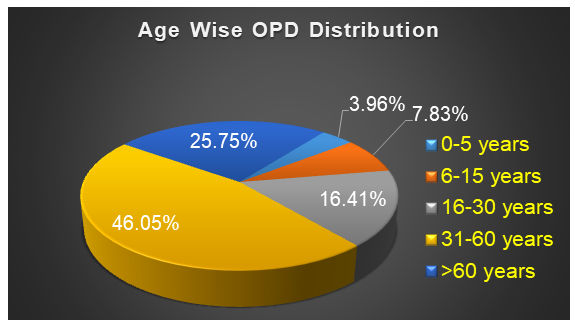
Out of 37500 patients majority of the patients, about 16441 (46.05%) were present in the age group of 31-60 years, followed by 9192 (25.75%) in age group of >60 years, 5857 (16.41%) patients in the age group of 16-30 years, 2796 (7.83%) patients in 6-15 years and 1415 (3.96%) patients in age group of 0-5 years being the least (Table 1 & Figure 1).
| Age Group | Patients | Percentage |
|---|---|---|
| 0-5 years | 1415 | 3.96% |
| 6-15 years | 2796 | 7.83% |
| 16-30 years | 5857 | 16.41% |
| 31-60 years | 16441 | 46.05% |
| >60 years | 9192 | 25.75% |
Table 1: Distribution of Patients Attending OPD According to Age.
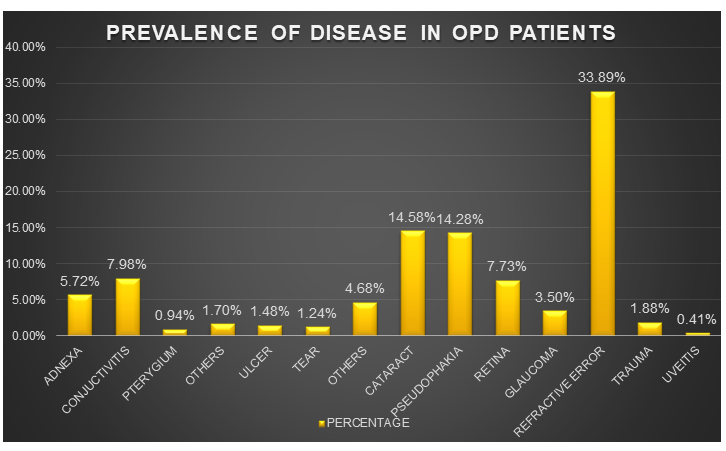
The prevalence of Refractive errors was found to be maximum in 12098 patients (33.89%) followed by cataract in 5206 (14.58%) patients. Prevalence of Disease in the 35000 patients were as follows (Table 2 & Figure 2).
| Disease | Total No. of Patients | Percentage |
|---|---|---|
| Adnexa | 2042 | 5.72% |
| Conjuctivitis | 2848 | 7.98% |
| Pterygium | 334 | 0.94% |
| Others (Conjunctival Diseases) | 607 | 1.70% |
| Corneal Ulcer | 527 | 1.48% |
| Corneal Tear | 443 | 1.24% |
| Others (Corneal Diseases) | 1672 | 4.68% |
| Cataract | 5206 | 14.58% |
| Pseudophakia | 5099 | 14.28% |
| Retina | 2759 | 7.73% |
| Glaucoma | 1249 | 3.50% |
| Refractive Error | 12098 | 33.89% |
| Trauma | 670 | 1.88% |
| Uveitis | 146 | 0.41% |
Table 2: Prevalence of Various Diseases.
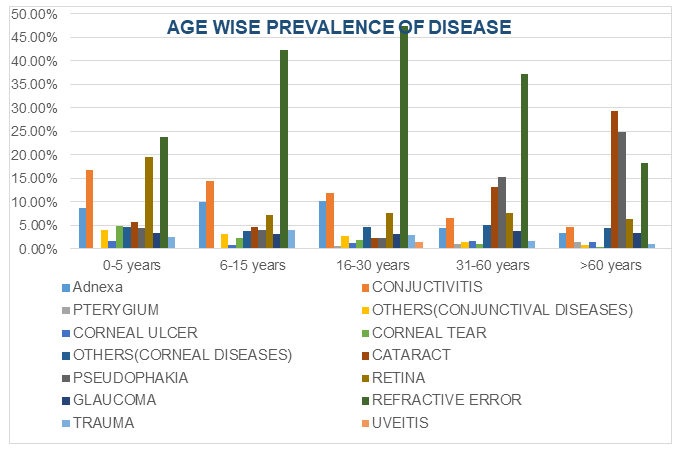
Age wise distribution showed prevalence Refractive error to be present maximum in all the age groups till 60 years (33.89%) followed by cataract in 5206 (14.58%) patients beyond 60 years of age. Ocular trauma was mostly seen in age group of 6-15 years (3.91%).Corneal tear being most prevalent in 0-5 years (4.90%) Uveitis mostly seen in 16-30 years (1.47%) (Table 3 & Figure 3).
| Adnexa | 8.75% | 9.99% | 10.24% | 4.37% | 3.45% |
|---|---|---|---|---|---|
| Conjuctivitis | 16.77% | 14.50% | 11.94% | 6.55% | 4.63% |
| Pterygium | 0.00% | 0.00% | 0.50% | 1.00% | 1.53% |
| Others (conjunctival diseases) | 4.01% | 3.23% | 2.69% | 1.40% | 0.78% |
| Corneal ulcer | 1.65% | 0.83% | 1.21% | 1.71% | 1.42% |
| Corneal tear | 4.90% | 2.34% | 1.84% | 0.95% | 0.48% |
| Others (corneal diseases) | 4.60% | 3.68% | 4.54% | 5.07% | 4.41% |
| Cataract | 5.64% | 4.66% | 2.23% | 13.18% | 29.42% |
| Pseudophakia | 4.45% | 4.06% | 2.30% | 15.22% | 24.95% |
| Retina | 19.58% | 7.21% | 7.55% | 7.61% | 6.39% |
| Glaucoma | 3.25% | 3.22% | 3.18% | 3.81% | 3.26% |
| Refractive error | 23.89% | 42.37% | 47.30% | 37.30% | 18.15% |
| Trauma | 2.52% | 3.91% | 3.01% | 1.59% | 0.94% |
| Uveitis | 0.00% | 0.00% | 1.47% | 0.24% | 0.21% |
Table 3: Prevalence of Diseases According to Age.
Discussion
This study shows Refractive errors are the most common cause of ocular morbidity with cataract being second, maybe because of higher mean age of the patients presenting to OPD. Omotoye reported 26% of cataract in a study, similar to ours [1]. Study by Haq, et al. reported that refractive error was present in 25% [2]. Study by Singh, et al. in rural setting reported that prevalence of refractive error to be 40.8% [3]. Second most common cause of ocular morbidity was cataract, the prevalence of cataract is significantly lesser in <30 years of age, as it is an age related disease. Adeoye and Omotoye however reported higher figures of 26% for cataract in their study [1]. Haq, et al. also reported that cataract prevalence was 21.7% in their study [2]. Study by Singh, et al. stated that cataract prevalence was 40.4% [3]. Third most common were 5099 patients (14.28%) who had pseudophakic eyes. Most of them came for refraction and some of them came with nonspecific complaints. According to a study conducted in hilly areas of Nepal, the commonest ocular morbidity encountered after ocular examination was refractive error, followed by dry eyes, ocular allergy, cataract, degenerative conjunctival conditions, and corneal opacity etc [4].
Conclusion
The leading causes of ocular morbidity in our study were Refractive errors (33.89%) till age of 60 years, and Cataract (14.58%) beyond 60 years of age. A large number of OPD patients were constituted by follow ups of cataract surgeries. Ocular trauma was most common in 6-15 years of age (3.91%) and corneal tear most prevalent in 0-5 years (4.90%) mostly in the months of April to June.
Take Home Message
- The high prevalence of refractive errors and cataracts shows that hospital still requires an improved infrastructure with spectacle provision to the patients and mobile eye care units to collect cataract patients from hilly areas for operating them in hospital.
- To increase awareness among population regarding refractive errors and other ocular morbidities.
- Training school teachers and staff for early diagnosis and treatment of refractive errors in childhood at primary level.
- Ocular trauma was most common in 0-15 years, in months of summer .Thus special care to be taken by the children and their parents while playing or doing other activities.
- Programs should be put in place following the guidelines and strategies of vision 2020 to help in reducing the burden of ocular diseases.
Funding: No funding sources.
Conflict of Interest: None declared.
References
-
Adeoye AO, Omotoye OJ (2007) Eye disease in Wesley Guild Hospital, Ilesa, Nigeria. Afr J Med Med Sci 36(4): 377-380.
-
Haq I, Khan Z, Khalique N, Amir A, Jilani FA (2009) Prevalence of common ocular morbidities in adult population of aligarh. Indian J Community Med Off 34(3): 195-201.
-
Singh MM, Murthy GV, Venkatraman R, Rao SP, Nayar S (1997) A study of ocular morbidity among elderly population in a rural area of central India. Indian J Ophthalmol 45(1): 61-65.
-
Bastola P (2012) The Pattern of Ocular Morbidity, Findings from a Study Conducted in Western Remote Hilly Region of Nepal. Nepal J Med Sci 1(1): 35-38.
- Screening of Hospital Staff During World Glaucoma Week in a Tertiary Eye Care Centre
- Angioid Streaks with Macular Neovascularization: Clinical Insights from Two Cases
- Giant Kissing Naevus: An Oculoplastic Challenge
- Why Freedom of Vision Should Not Cost the Freedom of Feeling - LASIK in the Climate of Change
- Asymmetric Optic Nerve with Small Disc and Large Cup: A Rare and Challenging Case of Unilateral Optic Nerve Hypoplasia
- Large Angle Exotropia in a Child: A Case Report