
Ocular Traumas among Artisans Received at the University Teaching Hospital in the Suru-Lere Zone of Cotonou, Benin
Introduction: Authors investigated the epidemiological, clinical, therapeutic, and evolutionary aspects of ocular traumas among artisans received at the Suru-Lere University Teaching Hospital (CHUZ-SL) in Cotonou, Benin. Method: A retrospective study was conducted over a 5-year period at the Suru-Léré University Teaching Hospital by exhaustive recruitment of 715 patients consulting for ocular trauma during the period. Included in the study were the records of artisan patients received for ocular trauma during their activities. Results: In total, 89 cases of ocular traumas among artisans were collected, representing a frequency of 12.45%. The mean age of the patients was 30.60 ± 10.47 years. Male artisans were the most numerous (97.8%) with a sex ratio of 43.5. The most exposed professions were welders, accounting for 36%, followed by carpenters at 15.7%. The average consultation delay was from 24 hours to one week (61.8%). The right eye was the most affected, accounting for 51.7%. In the majority of cases, it was a trauma due to the projection of a superficial foreign body (84.30%). Predominant initial lesions were bulbar hyperemia (53.93%) and corneal ulcer (34.5%). Most patients underwent medical and surgical treatment (62.9%). Sequelae included corneal opacities (75.4%). Conclusion: Ocular traumas among artisans are quite frequent and can be prevented by the use of personal protective equipment
Introduction
Ocular traumas pose a significant public health problem [1, 2]. They encompass all ocular conditions resulting from trauma [3].
Projectile ocular traumas among artisans are injuries occurring due to the projection of a foreign body into the eye during the execution of their work. These are highly frequent occupational accidents and constitute an ophthalmological emergency [2].
These projectile ocular traumas among artisans are characterized by a variety of anatomical lesions. They may involve open globe injuries (OGIs) if there is a full-thickness wound of the sclera and/or cornea. Otherwise, one observes lamellar lacerations, contusions, and superficial foreign bodies: these are closed globe injuries (CGIs), which are the most common [2, 3]. Ocular traumas represent a significant cause of monocular blindness in young adults in full professional activity [4].
In Benin, several studies have been conducted on ocular traumas in general [5, 6], but none have focused on projectile ocular traumas among artisans, hence the importance of this study. The overall objective was to investigate the epidemiological, clinical, and therapeutic characteristics of projectile ocular traumas among artisans at the Suru-Léré University Teaching Hospital (CHUZ-SL).
Study Design and Methods
This was a cross-sectional and descriptive study with retrospective data collection over a period of 5 years, from January 1, 2018, to December 31, 2022. It was conducted in the ophthalmology department of the Suru-Lere University Teaching Hospital (CHUZ-SL) in Cotonou. Included in the study were all artisan patients listed in the consultation registers from January 1, 2018, to December 31, 2022, who were seen for projectile ocular trauma related to their profession. Patients excluded from the study were those who visited the department for non-work-related trauma and those who presented with trauma but were not artisans.
| N | % | |
|---|---|---|
| 20-Nov | 20 | 22,5 |
| 21-30 | 26 | 29,2 |
| 31-39 | 26 | 29,2 |
| 40-49 | 13 | 14,6 |
| 50 et + | 4 | 4,5 |
| Total | 89 | 100,0 |
Table 1: Distribution of patients by age group (CHUZ-SL; 2023).
The variables studied included epidemiological, clinical, therapeutic, and evolutionary characteristics.
Data collection was conducted using the Kobo Collect application. Data processing and analysis were performed using SPSS 25 software. Quantitative variables were presented as mean ± standard deviation or median. Qualitative variables were expressed as absolute and relative frequencies.
Results
Epidemiological Characteristics
Frequency: During the period of our study, the ophthalmology department received 715 consultations for ocular trauma, of which 89 cases were projectile ocular traumas among artisans, representing a proportion of 12.45%. Sex and Age: Male gender predominated with 87 men (97.8%) and 2 women (2.2%), resulting in a sex ratio of 43.5. The mean age was 30.60 ± 10.47 years with extremes ranging from 12 to 65 years. Younger subjects were the most exposed, with age groups of 21 to 30 years and 31 to 39 years each representing 29.2%. Table 1 shows the distribution of patients by age group.
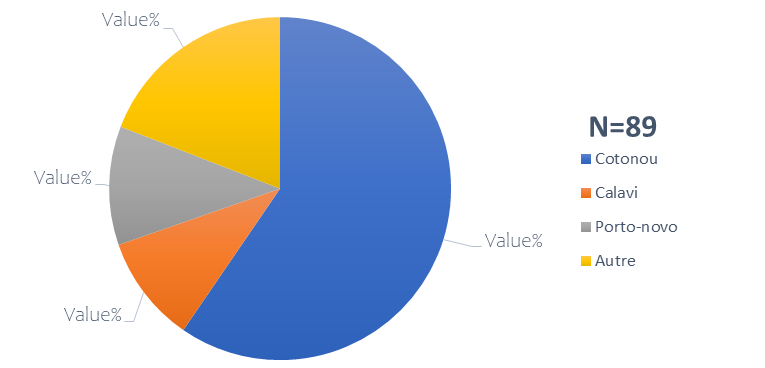
Place of Origin : Figure 1 shows the distribution according to place of origin. The majority of patients came from Cotonou, i.e. 59.6%.
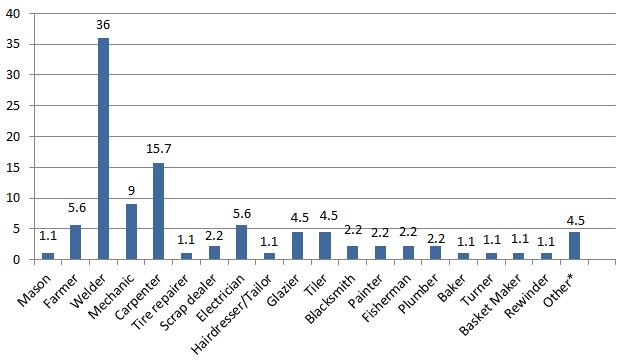
Profession: The most exposed profession was welding, accounting for 36%, followed by carpentry at 15.7%. Figure 2 illustrates the distribution of patients according to their profession.
Clinical Aspects
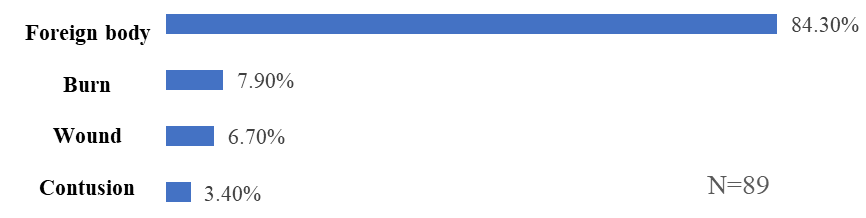
Type of Trauma: The predominant type of trauma was superficial foreign body projection traumas, accounting for 84.30% of cases. Figure 3 illustrates the distribution of patients according to the nature of the trauma.
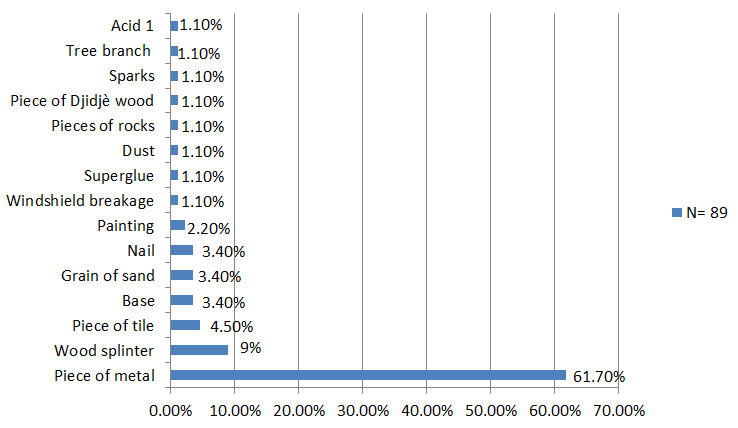
Nature of the Traumatizing Agent: The most implicated traumatizing agent was a piece of metal (n=55), accounting for 61.7%. Figure 4 depicts the distribution of patients based on the traumatizing agent.
Consultation Delay
Patients predominantly consulted within a period of 24
| N | % | |
|---|---|---|
| < 6h | 5 | 5,6 |
| 6h-24h | 5 | 5,6 |
| 24h-1 week | 55 | 61,8 |
| > 1 week | 24 | 27,0 |
| Total | 89 | 100,0 |
Table 2: Distribution of patients based on the consultation delay (CHUZ-SL; 2023).
hours to 1 week (61.8%). Table 2 presents the distribution of patients based on the consultation delay.
Laterality
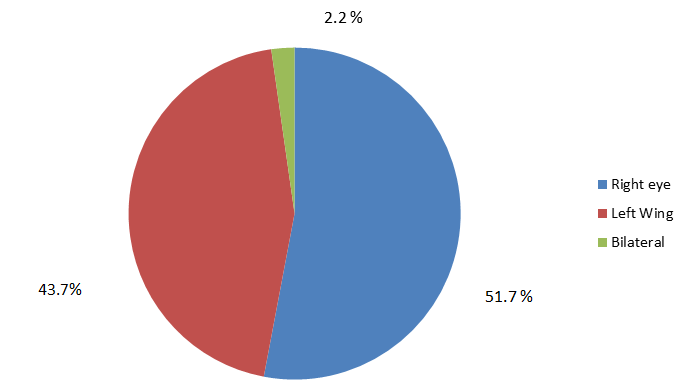
The trauma was monocular in most cases. The right eye was most commonly affected, accounting for 51.7%. Two cases of bilaterally, representing 2.2% of cases, were found. Figure 5 depicts the distribution of patients based on laterality.
| N | % | |
|---|---|---|
| Hyphema | 3 | 5,5 |
| Hypopyon | 2 | 3,6 |
| Iris hernia | 4 | 7,3 |
| Cataract | 5 | 9,1 |
| Intraocular hemorrhage | 1 | 1,8 |
| Corneal ulcer | 19 | 34,5 |
| Corneal abscess | 7 | 12,7 |
| Athalamia | 3 | 5,5 |
| Acute conjunctivitis | 2 | 3,6 |
| Tarsal foreign body | 1 | 1,8 |
| Corneal melting / Athalamia | 1 | 1,8 |
| Hyphema | 2 | 3,6 |
| Iridodialysis / Hyphema | 1 | 1,8 |
| Retro Descemet’s precipitates / Anterior chamber Tyndall / Hyalitis | 3 | 5,4 |
| Anterior synechiae / Athalamia | 1 | 1,8 |
| Total | 55 | 100,00 |
Table 4: Distribution of patients based on the initial distance visual acuity (CHUZ-SL; 2023).
Initial Distance Visual Acuity
The initial distance visual acuity was between 8/10 and 10/10 in the majority of cases, accounting for 46.06%. Table 3 displays the distribution of patients based on the initial distance visual acuity.
| N | % | |
|---|---|---|
| Visual Acuity | ||
| PPL-1/20 | 18 | 20,22 |
| 2/10 - 3/10 | 12 | 13,48 |
| 4/10- 7/10 | 18 | 20,22 |
| 8/10-10/10 | 41 | 46,06 |
| Total | 89 | 100,0 |
Table 3: Distribution of patients based on the initial distance visual acuity (CHUZ-SL; 2023).
Distribution according to Initial Lesions
Corneal ulcer was the most frequently found initial lesion, accounting for 34.5%. Table 4 shows the distribution of patients according to the nature of the initial lesions.
Lesions of the Annexes
Bulbar hyperemia (53.93%) was the most frequently found associated annexal lesion, followed by perikeratic circle (20.23%). Annexal lesions were not found in 10 patients (11.25%). Table 5 reveals the distribution of patients according to annexal lesions.
| N | % | |
|---|---|---|
| Eyelid wound | 2 | 2,25 |
| Bulbar hyperemia | 48 | 53,93 |
| Perikeratic circle | 18 | 20,23 |
| Subconjunctival hemorrhage | 8 | 8,99 |
| Eyelid edema/ecchymosis | 1 | 1,12 |
| Tarsal papillae | 1 | 1,12 |
| Eyelid swelling | 1 | 1,12 |
| No lesions of the adnexa | 10 | 11,25 |
| Total | 89 | 100,00 |
Table 5: Distribution of patients according to annexal lesions (CHUZ-SL; 2023).
Therapeutic Aspects
Most patients, 62.9%, underwent medical-surgical treatment, while 37.1% received medical treatment only.
Surgical Treatment
Surgical treatment was performed in 63 patients. Corneal foreign body extraction was the most frequently performed surgical procedure, accounting for 87.3% of cases, involving 55 patients. The following table illustrates the distribution of patients according to surgical treatment (Table 6).
| N | % | |
|---|---|---|
| Suturing of corneal/scleral wound | 4 | 6,3 |
| Foreign body extraction | 55 | 87,3 |
| Eyelid suture | 2 | 3,2 |
| Vitrectomy | 1 | 1,6 |
| Iris reinsertion | 1 | 1,6 |
| Total | 63 | 100,0 |
| Corneal opacity | 43 | 75,4 |
| Corneal dystrophy | 3 | 5,3 |
| Adherent leukoma | 2 | 3,5 |
| Phthisis bulbi | 1 | 1,8 |
| Leukoma | 1 | 1,8 |
| Nebula | 1 | 1,8 |
| Corneal staphyloma | 1 | 1,8 |
| Persistent corneal ulcer | 1 | 1,8 |
| Total | 57 | 100 |
Table 8: Distribution of patients according to surgical treatment (CHUZ-SL; 2023).
Evolutionary Aspects
Final Distance Visual Acuity
The final distance visual acuity after treatment was mostly good (8/10-10/10), accounting for 56.18%. It was poor in 26.97% of cases. Patients lost to follow-up accounted for 20.22%. The table below shows the distribution of patients according to the final distance visual acuity (Table 7).
| N | % | |
|---|---|---|
| Visual Acuity | ||
| NLP-1/20 | 24 | 26,97 |
| 2/10 - 3/10 | 7 | 7,86 |
| 4/10- 7/10 | 8 | 8,99 |
| 8/10-10/10 | 50 | 56,18 |
| Total | 89 | 100,0 |
Table 6: Distribution of patients according to the final distance visual acuity (CHUZ-SL; 2023). NLP: No light perception.
Complications
Complications were present in 14 out of 89 patients, accounting for 15.74%, including corneal abscess (35.7%), post-traumatic cataract (21.4%), and corneal perforation (21.4%). Table 8 illustrates the distribution of patients according to complications.
| N | % | |
|---|---|---|
| Corneal abscess | 5 | 35,7 |
| Corneal perforation | 3 | 21,4 |
| Post-traumatic cataract | 3 | 21,4 |
| Uveitis | 2 | 14,3 |
| Endophthalmitis | 1 | 7,1 |
| Total | 14 | 100,0 |
Table 7: Distribution of patients according to complications (CHUZ-SL; 2023).
Sequels
Sequels were found in 57 patients after recovery (64.04%). Corneal opacity was the most observed sequel (75.4%). Table 9 presents the distribution of patients according to sequels.
Discussion
Epidemiological Aspects
Frequency: Projectile ocular traumas among artisans represent 12.45% of all ocular traumas at the ophthalmology department of CHUZ-SL. This proportion is lower than that found by Wapeng W, et al. [7] in south-central China in 2017 and Bounsif Z, et al. [8] in 2015 in Casablanca, who found percentages of 42.9% and 69%, respectively. However, our results are almost similar to the 20.47% found by Ramanarivo NM, et al. in Antananarivo in 2017 [9]. The low frequency in our study could be explained by the fact that self-medication is widely practiced in sub-Saharan Africa, and patients do not always present to the hospital. Sex: A strong male predominance was found in our study, at 97.8%. This is consistent with the literature data from Fekih O, et al. [4] at 81.4%, Wapeng W, et al. [7] (84.4%), Bounsif Z, et al. [8] in Casablanca at 98%, and Ramanarivo NM, et al. [9] at 95.81%. This could be justified by the fact that men engage more in risky artisanal occupations compared to women. Age: The most affected age group in our study was 21 to 30 years and 31 to 39 years, each representing 29.2%. These results are similar to those of Kamaté in Mali, who noted that the age groups of 30-39 years and 20-29 years were the most exposed, with 38% and 34.4%, respectively [10], as well as in Ramanarivo NM, et al’s study in Antananarivo [9], which found that young adults were the most affected, at 29.77%. These results could be related to the fact that young artisans engage more in risky activities and do not take adequate precautions like older artisans. Profession: The most exposed professions were welders (36%) followed by carpenters (15.7%). These results are identical to those of Ramanarivo NM, et al. [9] in Antananarivo, who stated that welders and metalworkers were the most frequent professions, at 20% and 15.81%, respectively. This high rate found in our study and in Ramanarivo’s study prove that workers in the metallurgical sector are more at risk of projectile ocular trauma.
Clinical Aspects
Nature of the Traumatizing Agent
The most incriminated traumatizing agent in our series was metal fragments, accounting for 61.9%. In Tunisia, Fekih O, et al. [4] also found in their study that the most frequent causal agent was metal bodies in 34% of cases and metal splinters in 24.7% of cases. The same observation was made by Bounsif Z, et al. [8] in Morocco, who noted metallic foreign bodies as the main traumatizing agent, at 64.7%. This would support the fact that workers in metalwork are the most exposed.
Consultation Delay
Patients predominantly consulted within a period of 24 hours to one week, accounting for 61.8% of cases. The same observation was made by Kamaté C, et al. [10] in Mali, who noted that 81% of patients consulted after 24 hours. This could be due to self-medication, resorting to traditional medicine, and lack of financial means or information.
Laterality
In our series, the right eye was most affected (51.7%). Fekih O, et al. [4] also reported a predominance of the right eye in 58.8%. In contrast, Ramanarivo NM, et al. [9] in Antananarivo found a predominance of the left side, at 48.37%. The laterality of the trauma could be justified by the right-handedness of patients. Thus, during work, the projectile could be directed towards the right eye directly.
Initial Visual Acuity
The initial visual acuity was good between 8/10 and 10/10 in the majority of cases, at 46.06%, and 20.22% of cases were blind. Bounsif Z, et al. [8] in Casablanca reported similar findings, noting that the initial visual acuity was good in 91.9% of cases, poor in 5.3% of cases, and blindness was found in 2.9% of cases. This could be justified by the fact that most patients did not have deep initial lesions, but some patients only came to the hospital at the stage of complications.
Type of Trauma
Superficial foreign body projection trauma was the most frequent (84.30%). Fekih O, et al. [4] in Tunis and Cai in southern China [11] also found superficial foreign body projection as the most frequent type of trauma, with
44.3% and 59.4%, respectively. This result would be related to the fact that the cornea is the most external structure of the eye and therefore immediately in contact with external aggressions.
Initial Lesions
Corneal ulcer (34.5%) and bulbar hyperemia (53.93%) were the most frequent initial lesions. This is consistent with the results of Fekih O, et al. [4] in Tunis, who found 48.5% of cases of conjunctival hyperemia and 46.4% of cases of corneal lesions. Bounsif Z, et al. [8] in Casablanca noted corneal lesions as the most frequent, at 84.9%, followed by conjunctival lesions in 6% of cases. This can be explained by the fact that the cornea is the outermost tunic of the eyeball and is therefore more exposed to external aggressions like the conjunctiva.
Treatment
In our series, 37.1% of patients received medical treatment only, and 87.3% underwent medical-surgical treatment. These results are consistent with those of Cao H, et al. [12] in Chaoshan, China, who found 22.2% of patients treated solely with medications and 77.8% who underwent surgical treatment in addition.
The most performed surgical procedure in our series was corneal foreign body extraction, accounting for 87.3%. In contrast, Cao H, et al. [12] noted more cases of ocular wall repair (37%) followed by crystalline extraction (15.6%) in their series. Our results could be explained by the higher percentage of superficial foreign body projections in our study compared to Cao’s study, which found more open globe ocular traumas.
Outcome
Final Visual Acuity
The final distance visual acuity after treatment was mostly good, at 56.18%, and poor in 26.97% of cases. These results were similar to those of Fekih O, et al. [4] in Tunis, who noted an improvement in visual acuity in 51.8% of cases but 21.9% who had a poor final visual prognosis. The poor visual prognosis observed in some patients could be explained by the longer consultation delay and by the nature of some more severe lesions such as ulcer and corneal abscess.
Sequels
In our series, corneal opacity was the predominant sequel in 75.4% of cases. Our results are similar to those of Kamaté C, et al. [10] in Mali, who noted 69% of sequels and a predominance of corneal opacities (39.7%). This high rate of corneal opacities would be the consequence of the predominance of corneal lesions.
Conclusion
Projectile ocular traumas are common among artisans in our context. They mainly affect young male subjects. The most exposed profession was that of welders. These ocular traumas sometimes lead to severe injuries with serious consequences for artisans and society in general, highlighting the importance of prevention, which is crucial and involves wearing protective eyewear during their activities.
References
-
Pandita A, Merriman M (2012) Ocular trauma epidemiology: 10-years retrospective study. NZMJ. 125(1348): 61-69.
-
Maaloum L, Moustaine O, Allali B, Elkattani A, Amraoui A, et al. (2014) Eye Trauma In The Workplace. Journal de la Société Marocaine d’Ophtalmologie 23 : 80-84.
-
World Health Organization (WHO) (2012) Global Initiative to Eliminate Avoidable Blindness: Action Plan 2. J Fr. Ophtalmol 35 : 445-453.
-
Fekih O, Zgoli H, Mabrouk S, BenAbdelfatah G, Zeghal I, et al. (2021) Traumatismes oculaires en milieu professionnel : à propos de 110 cas. Tunis Med 99(8): 881-885.
-
Sounouvou I, Zoumenou E, Alamou S, Tapsoba Y, Tchogang, et al. (2014) Eye trauma at the University Emergency Reception Clinic of the CNHU-HKM in Cotonou. RAMUR 19(2): 23-26.
-
Tchabi S, Sounouvou I, Yèhouessi L, Facoundé F, Doutétien C, et al. (2010) Eye contusions at the National University Hospital Center of Cotonou, about 654 cases. J Fr Ophthalmol. 33(7): 450-454.
-
Wapeng W, Yalan Z, Jun Z, Meng S, Baihua C (2017) Epidemiology and clinical characteristics of patients hospitalized for ocular trauma in south-central China. Acta Ophthalmol 95 (6): 503-510.
-
Bounsif Z, Elbehadji M, Mabo A, Mchachi A, Benhmidoune I, et al. (2017) Primary prevention of occupational eye injuries: current situation and recommendations. JSMO 26: 87-92.
-
Ramanarivo NM, Rafanomezantsoa R, Volamarina F, Wangata Shadi J, Raobela L, et al. (2017) Eye injuries due to work accidents in two hospitals in Antananarivo. Black Afr Med. 69(04) : 435-442.
-
Kamate C (2010) Ocular trauma in the workplace in Koulikoro from 2003 to 2006 [Thesis]. Bamako: University of Bamako Faculty of Medicine and Odontostomatology pp: 87.
-
Cai M, Zhang J (2015) Epidemiological characteristics of work-related ocular trauma in southwest Region of China. Int. J. Environ. Res. Public Health 12(8): 9864- 9875.
-
Cao H, Li L, Zhang M (2012) Epidemiology of patients hospitalized for ocular trauma in the Chaoshan Region of China, 2001-2010. Plos One 7(10): e48377.
- Screening of Hospital Staff During World Glaucoma Week in a Tertiary Eye Care Centre
- Angioid Streaks with Macular Neovascularization: Clinical Insights from Two Cases
- Giant Kissing Naevus: An Oculoplastic Challenge
- Why Freedom of Vision Should Not Cost the Freedom of Feeling - LASIK in the Climate of Change
- Asymmetric Optic Nerve with Small Disc and Large Cup: A Rare and Challenging Case of Unilateral Optic Nerve Hypoplasia
- Large Angle Exotropia in a Child: A Case Report