
Ethno Veterinary Medicine in Poultry Health Management
Traditionally, the practice of using herbal medicines for diseases of livestock and poultry has given numerous benefits to the farmers. Since poultry are reared intensively, a high incidence of diseases poses a big threat to small-scale poultry production systems. The major poultry diseases prevalent among chicken include Avian influenza, Marek's disease, Coccidiosis, Fowl typhoid, Ranikhet disease and Chronic respiratory disease. In order to control the disease occurrence and prevent huge mortality, farmers are opening up to alternatives such as ethno veterinary medicine as they provide a substitute to newer expensive poultry drugs.
Introduction
India is a country where herbs are being used as medicine for generations. Nearly 70% of the population in rural areas rely on traditional medicinal knowledge to cure many ailments in livestock and poultry [1]. It is to be noted that even the modern medicines have come from plants that were first used traditionally. Medicinal plants and their products are increasingly gaining recognition worldwide as herbal therapies, against conventional drugs as they are natural, readily accessible, inexpensive and apparently effective [2]. This review gives an outline of some of the commonly available plants used for treating poultry diseases.
Acorus calamus (Vasambu)
Acorus calamus is a perennial plant with grass like foliage found growing in tropical and sub-tropical climates. The active constituents present in its rhizomes and leaves include sugars - maltose, glucose and fructose; fatty acids - myristic, palmitic, palmitoleic, stearic, oleic, linoleic, arachidic; essential oils - β-asarone, acorenone, isocalamendiol; lignans - epieudesmin, galgravin; and other compounds such as eugenol, linalool and terpenes. The rhizomes are reported to relieve gastric disorders and asthma, while the leaves are known for their anthelmintic, insecticidal and anti-bacterial properties [3]. In poultry, it is used as medicated water for dipping and disinfection of sheds.
Aloe vera
Aloe vera is a perennial herb found in many geographical regions and is known to be effective against a wide range of ailments. The herb has several pharmacological properties including anti-inflammatory, anti-allergy, antibacterial, antifungal, antivenin and immune boosting. It contains glycoproteins, Open Access Journal of Veterinary Science & Research
anthraquinones and polysaccharides like pectin, hemicellulose, glucomannan, acemannan and mannose derivatives [4]. The leaves of Aloe vera are harvested, cleaned, crushed and given as medicated water to unhealthy birds until they show signs of good health.
Garlic is a bulbous crop cultivated in both temperate and tropical regions. It is used as a flavouring agent in several dishes. Traditionally, garlic has a place in folk medicine in many countries. It is found to be hypolipidemic, antithrombotic, antihypertensive and anticarcinogenic. It is a rich source of protein, carbohydrate, some minerals and the bioflavonoid, quercetin. The major antimicrobial component present in garlic is Allicin. Other constituents like allistalin, garlicin, diallyl disulfide, diallyl trisulfide, and essential oils possess insecticidal, anthelmintic and molluscicidal activites [6]. In poultry, it is used as a prebiotic to enhance growth and also as disinfectant during Ranikhet disease outbreak (Figures 1-4).
Allium cepa (Onion)
Allium cepa is a worldwide culinary and therapeutic spice. It is the second most important horticultural crop and a source of various biologically active compounds such as phenols, flavonoids and thiosulfinates. Pharmacologically, it is known for its antioxidant, antidiabetic, anticancer, antimicrobial, antidiabetic, antiplatelet, carminative, diuretic and cardiovascular effects. Studies have shown that onion can replace a significant amount of destructive LDL cholesterol with cardioprotective HDL cholesterol [5]. In poultry, it (1) (2) (3) (4)
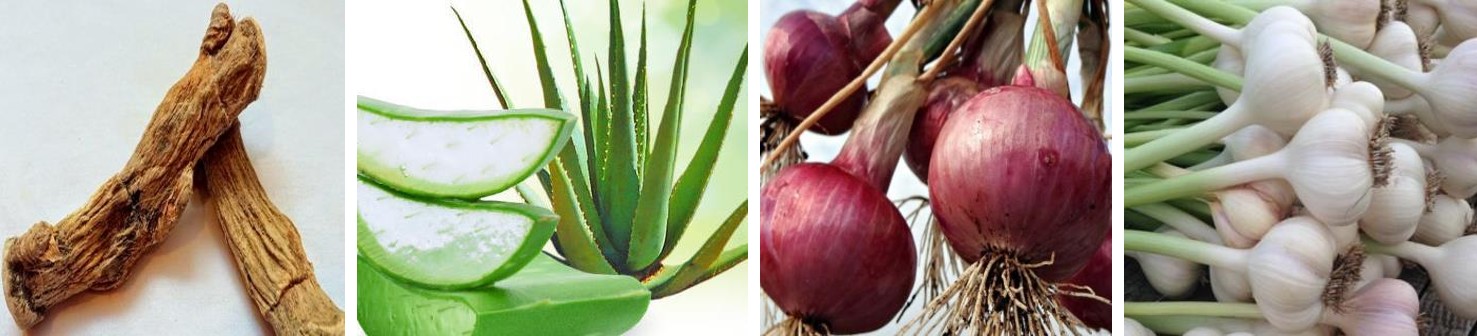
Acorus calamus Aloe vera Allium cepa Allium sativum
Azadirachta indica (Neem)
Neem is a fast-growing tree found abundantly in tropical and semi-tropical regions. It is traditionally used in Chinese, Unani and Ayurvedic medicines worldwide. Its therapeutic role is attributed to azadirachtin, one the most important active constituents present in neem.Other compounds possessing antioxidant, anti-inflammatory, antiseptic, antidiabetic, antimicrobial, antiviral, antimalarial, anticancer and immunomodulatory properties are nimbolinin, , nimbin, nimbidin, nimbiol, nimbidol, nimbandiol, nimbolide, nimbanene, gedunin, salannin and quercetin[7]. In poultry, it is effective against Ranikhet disease and fowl pox. It is also used as an immunostimulant.
Andrographis paniculata (Nilavembu)
It known as the King of Bitters, Nilavembu is one of the most popular medicinal plants used traditionally in many favourably influences the growth performance of chicks and is hence used as a growth promoter.
Allium sativum (Garlic)
Asian continents. Many phytoconstituents such as diterpenoids, flavonoids, quinic acids, xanthones, rare noriridoids and other miscellaneous compounds have been isolated from this plant. A.paniculata possesses a wide spectrum of pharmacological effects including anticancer, anti-diarrheal, anti-hepatitis, ant- ihyperglycemic, antimicrobial, anti-inflammatory, antimalarial, antioxidant, cardiovascular,hepatoprotective and immunostimulatory[8]. In poultry, it is an effective anthelmintic.
Cuminum cyminum(Cumin)
Cumin is an aromatic herb and one of the most commonly used spice condiment in Asian culinary, in traditional medicine. The essential oil of the fruit is known for its effective antiseptic property besides other uses. It contains cuminaldehyde as the chief component apart from octanol, limonene, thymol, anisyl alcohol, Open Access Journal of Veterinary Science & Research
anethole and vanillin. The organic acids present in cumin are aspartic, citric, malic, tartaric, propionic, ascorbic, oxalic, maleic and fumaric acids and phenolic compounds include limonene, pinene, cineole, cymene, terpinene, safranal, linalool, salicylic acid, gallic acid, cinnamic acid, hydroquinone, resorcinol, p-hydroxybenzoic acid, rutin, coumarine and quercetin. Cumin has astringent, carminative, diuretic, antioxidant, antimicrobial, antihyperglycemic, anticancer and antinociceptive effects [9]. In poultry, it is effective against fowl pox and Ranikhet disease.
(5) (6) (7) (8)
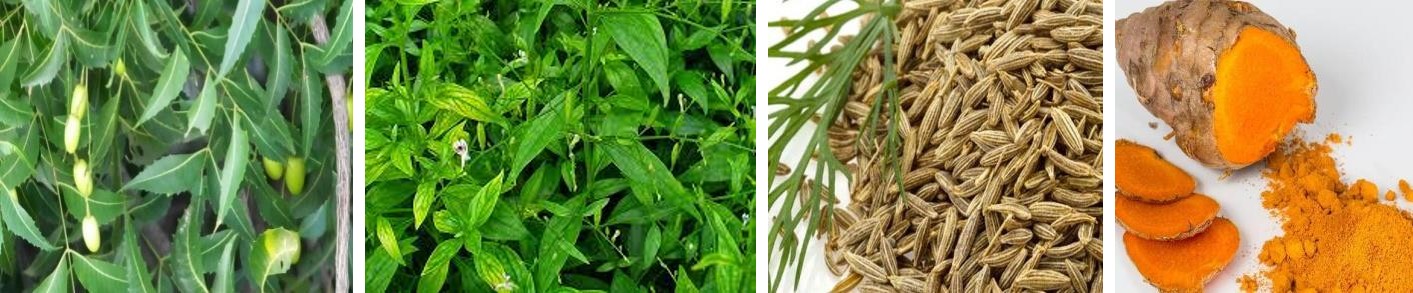
Azadirachta indica Andrographis paniculata Cuminum cyminum Curcuma longa Ocimum basilicum & Ocimum sanctum Ocimum basilicum (Sweet Basil) and Ocimum sanctum (Holy Basil) are aromatic perennial plants native to the Indian subcontinent. They are largely responsible for their therapeutic potentials as antibacterial, antiviral, antifungal, antidiarrheal, analgesic, antipyretic, anti- inflammatory, anti-allergic, antioxidant, antiasthmatic, antiulcer, hepatoprotective, chemopreventive and immunomodulatory activities attributable to essential oils, phenolic acid, terpenoids, flavonoids, tannins and saponins [11, 12]. In poultry, basil is used for respiratory problems and also as growth promoter.
Phyllanthus amarus (Keezhanelli)
Phyllanthus amarus is a small herb used worldwide for its medicinal properties. It is an important plant of the Indian Ayurvedic system of medicine. It contains many valuable compounds such as lignans, flavonoids, tannins (ellagitannins), polyphenols, triterpenes, sterols and alkaloids. It has wide spectrum of pharmacological activities including antiviral, antibacterial, antiplasmodial, anti-inflammatory, antimalarial, antimicrobial, anticancer, antidiabetic, hypolipidemic, antioxidant, hepatoprotective nephroprotective and diurectic properties [13]. In
Curcuma longa (Turmeric)
Curcuma longa is a perennial herb cultivated extensively in tropical regions. Its rhizome is used medicinally in Chinese and Ayurvedic systems of medicine. Curcumin is the main chemical component of turmeric proven for its antioxidant, hepatoprotective, anti-inflammatory, anticarcinogenic, anti-nociceptive, anti-flatulent, anti-haemorrhagic, antimicrobial, anticancerous, antimutagenic, hypolipidemic properties besides being effective in cardiovascular disease and gastrointestinal disorders [10]. In poultry, it is effective in respiratory diseases, wing rot, fowl pox and also as a growth promoter (Figures 5-8).
poultry, it is very effective as a liver stimulant and hepatoprotectant.
Phyllanthus emblica (Amla)
Known as the Indian gooseberry, Phyllanthus emblica is an important herbal drug used in Unani and Ayurvedic systems of medicine. The plant is used both as a medicine and also to increase vitality. The plant is an important dietary source of Vitamin C, amino acids, minerals and also contains phenolic compounds, tannins, phyllembelic acid, phyllembelin, rutin, curcum-inoids, and emblicol. Various plant parts have shown antidiabetic, hypolipidemic, antibacterial, antioxidant, antiulcerogenic, hepatoprotective, gastroprotective, and chemopreventive effects [14]. In poultry, it is given as an anti-stressor supplemented through feed during summer.
Piper nigrum (Pepper)
Piper nigrum is a valuable medicinal plant grown in many tropical regions. It is the most commonly used spice condiment worldwide and is known as the King of Spices. It contains major pungent alkaloids like piperine, pipene, piperamide and piperamine that possesses diverse pharmacological activities like antihypertensive, Open Access Journal of Veterinary Science & Research
antiplatelets, antioxidant, antitumor, antiasthmatic, antipyretic, analgesic, anti-inflammatory, anti-diarrheal, antispasmodic, anxiolytic, antidepressants, hepato- protective, immuno-modulatory, antibacterial, antifungal, insecticidal and larvicidal activities. Other phytochemicals (9) (10) (11) (12)

Ocimum basilicum Ocimum sanctum Phyllanthus amarus Phyllanthus Emblica (13)
Piper nigrum
Conclusion
Traditional medicinal systems are very popular due to their diverse pharmacological properties. They have always been a form of therapy for livestock and poultry among resource poor farmers. However, due to lack of documentation of their uses, they are viewed unreliable. With the development of microbial resistance to existing drugs, ethno-veterinary medicine may be consistent as herbs have lesser side effects in biological systems.
References
-
Balasubramaniam A, Dorairajan N (2009) Influence of season on occurrence of poultry diseases in Namakkal region of South India. Indian Journal of Field Veterinarians 4(4): 27-29.
-
Marizvikuru M, Evison B, Michael C, Tinyiko EH (2005) Use of Herbal Plants in Poultry Health Management in the Mushagashe Small-Scale present are Phenolics, flavonoids, alkaloids, amides and steroids, lignans, neolignans, terpenes, chalcones [15]. In poultry, it is effective in chronic respiratory distress (Figures 9-13). [INLINE_FIGURE:3:3] [INLINE_FIGURE:3:4] Commercial Farming Area in Zimbabwe. International Journal of Applied Research in Veterinary Medicine 3(2): 163-170.
-
Balakumbahan R, Rajamani K, Kumanan K (2010) Acorus calamus: An Overview. Journal of Medicinal Plant Research 4(25): 2740-2745.
-
Surjushe A, Vasani R, Saple DG (2008) Aloe vera: A Short Review. Indian Journal of Dermatology 53(4): 163-166.
-
Kuete V (2017) Allium cepa. Medicinal Spices and Vegetables from Africa, pp: 353-361.
-
Roy SK, Chakrabarti AK (2003) Vegetables of Temperate Climates: Commercial and Dietary Importance. 2nd (Edn.), Encyclopaedia of Food Sciences and Nutrition, pp: 5925-5932.
-
Mohammad AA (2016) Therapeutics Role of Azadirachta indica (Neem) and Their Active Open Access Journal of Veterinary Science & Research Constituents in Diseases Prevention and Treatment. Evidence-Based Complementary and Alternative Medicine, pp: 1-11.
-
Akbar S (2011) Andrographis paniculata: A Review of Pharmacological Activities and Clinical Effects. Alternative Medicine Review 16(1): 66-77.
-
Rudra PS, Gangadharappa HV, Mruthunjaya K (2017) Cuminum cyminum-A Popular Spice: An Updated Review. Journal of Pharmacognosy 9(3): 292-301.
-
Krup V, Prakash L, Harini A (2013) Pharmacological activities of Curcuma longa: A Review. Journal of Homeopathy and Ayurvedic Medicine 2(4): 133.
-
Daniel VN, Daniang IE, Nimyel ND (2011) Phytochemical Analysis and Mineral Elements Composition of Ocimum Basilicum obtained in JOS Metropolis, Plateau State, Nigeria. International Journal of Engineering & Technology 11(6): 135.
-
Marc MC (2014) Tulsi-Ocimum sanctum: A Herb for all Reasons. Journal of Ayurveda and Integrative Medicine 5(4): 251-259.
-
Jay RP, Priyanka T, Vikas S, Nagendra SC, Vinod KD (2011) Phyllanthus amarus: Ethnomedicinal uses, Phytochemistry and Pharmacology: A Review.Journal of Ethnopharmacology 138(2): 286-313.
-
Krishnaveni M, Mirunalini S (2010) Therapeutic Potential of _Phyllanthus_ _emblica_ (amla): The Ayurvedic Wonder. Journal of Basic and Clinical Physiology and Pharmacology 21(1): 93-105.
-
Zoheir AD, Aftab A (2014) A Review on Therapeutic Potential of _Piper nigrum_ L. (Black Pepper): The King of Spices. Medicinal and Aromatic Plants 3(3): 1-6.
- The Digital Stethoscope: Harnessing AI in Veterinary Medicine Without Losing Our Healing Touch
- Meningoencephalomyelitis of Unknown Etiology: Short-Term Effect of Two Treatment Protocols on Cerebrospinal Fluid
- Safety and Efficacy of the HomeoPet Cough in Domestic Pets –A Clinical and Correction Analysis Based Upon User Response Survey
- Non Human Animals Responses to Social Loss
- Owner Reported Clinical Outcomes of a Homeopathic Proprietary Preparation for the Treatment of Upper Respiratory and Nasal Disorders in Companion Animals
- Effects and Diagnostic Approach of Ultrasound in Veterinary Practice: A Systematic Review