
Dogs’ Preference for White Coat versus No White Coat When Offered a Food Reward in the Exam Room
The wearing of a white lab coat during a visit to the veterinarian is common practice in veterinary medicine to avoid cross contamination or the spread of diseases in a clinical setting. “White Coat Effect” in both human and animal medicine has been of research interest. This study sought to explore if the visual of a white coat does in fact play a role in eliciting avoidance in dogs measured by preference for a veterinarian wearing a white coat versus one not wearing it. We investigated whether dogs would choose to retrieve a food reward from the veterinarian not wearing a white coat more often. We predicted that dogs would approach the veterinarian not wearing a coat first, would avoid approaching the veterinarian with the white coat, and would spend more time around the veterinarian not wearing the coat. A modified conditioned place preference paradigm was used to design this study. Two veterinarians were in a room, one wearing a white coat and one not wearing it, with a dog and the dog’s owner. Data was recorded for how many times the dog approached each of the veterinarians, and how much time it spent in proximity of the individuals in the room. Dogs showed preference for the veterinarian not wearing a white coat and spent more time between the owner and the veterinarian not wearing a coat. This study gives insight on how veterinarians can decrease stress during a vet visit. The white coat appears to be a stressor making the visit to the vet more challenging to the canine patient. Veterinarians and staff shall provide a comfortable setting for patients so that they can properly assess and treat them, while decreasing fear of the vet visit.
Leticia Fanucchi* and Savannah Norton
Introduction
For most pets, going to the veterinarian (vet) can be a stressful experience according to pet owners. The veterinary environment is rich in stimuli that can be aversive to the pet such as odors, noises, objects, as well as the presence of unfamiliar people. Previous negative experience during a vet visit may be associated with one or several of these stimuli.
Body language indicative of stress is often displayed by dogs during a vet visit such as crouched posture, stiff/erect tail or tail between their legs, lip rolled up exposing their teeth, uncontrolled urination and defecation, or any kind of vocalization, as well as escape attempts [1]. Stress is a normal response, and when exposed to challenging situations or environments, the body initiates a mechanism to release cortisol, the stress hormone so to escape from, or fight the perceived threat [2]. A fearful patient can be more difficult for veterinarians to do a proper physical exam since fear can cause the patient to act aggressively, but it can also mask some disease symptoms, hence the importance of limiting the stressful stimuli that are present during a veterinary exam.
“White coat effect” (WCE) is a term used in human and veterinary medicine to describe a patient experiencing stress during a medical visit, characterized mostly by increased blood pressure in a clinical setting. However, in humans this term is used for the hospital itself, and all stressful stimuli associated with it, not just the presence of a white coat. There is increased concern about the possibility of increased blood pressure at a clinical setting becoming a chronic disorder (hypertension) in human adults [3], an effect that has been observed in children and adolescents [4]. Recent research has been done to test the relationship between different stimuli found in a veterinary clinic and the stress response on the patient. Increases in temperature, blood pressure and pulse rate have been described in canine patients during a vet visit as well as effects of transportation to the vet clinic [5]. Similar effect has been described in feline patients [6]. The WCE has been described in cats when undergoing a simulated vet visit with a significant increase in blood pressure [7]. Nonetheless, little is known about how to de-stress patients during a visit to the vet but the use of pheromone therapy has been shown to mitigate stress responses in cats [8]. Moreover, the Fear FreeSM initiative has significantly contributed to developing techniques to attenuate stress during a vet visit [9]. However, all suggested measures lack scientific validation.
There is no data on the effects of an actual white laboratory coat worn by a vet during a veterinary appointment, other than anecdotal reports from veterinarians and technicians describing patients showing fear of the vet once he/she enters the exam room. The white coat is commonly used to protect doctors against spills of hazardous agents, as well as prevent contamination between patients and personnel. While it may be implausible to completely abolish the use of a lab coat in a clinical setting, measures to decrease dogs’ aversion to the white coat can potentially be implemented, if such an effect does exist. This study is important to the field of veterinary medicine because there has been no data to support that the white laboratory coat has any negative effect on a veterinary patients’ emotional wellbeing.
Conditioned Place Preference
Conditioned place preference paradigm (CPP) is a research method commonly used to test motivational and disciplinary stimulus. In this method, the subject of the trial is placed in a controlled environment and is given either a rewarding or punishing stimulus. Later, the subject is given access to the two environments and has the option to choose which environment it prefers or avoids [10]. We used a modified version of the conditional place preference paradigm assuming dogs have been conditioned to the visual of a white coat, given that all subjects in this study have past experiences at a veterinarian’s office.
Hypothesis and Predictions
We hypothesized that dogs would favor to retrieve the food reward from the vet not wearing a white coat. We predicted: 1) Most dogs would approach the vet not wearing a white coat, in comparison with the one wearing a coat; 2) Most dogs would spend more time around the proximities of the vet with no coat than the vet with a white coat on.
Methods
Trials took place in Room 1706AB, the Behavior exam room, at the Washington State University Veterinary Teaching Hospital. The room was set up as seen in Appendix 1. There was one chair on one side of the room for the owner to sit in while holding the dog (indicated by the red square), and the dog was immediately in front of the owner held by a leash (indicated by the green X). On the other side of the room there were two X’s marked where the veterinarians randomly lined up for each trial; the vet wearing the white coat on one side and the one not wearing the white coat on the other side. The middle of the room was clear, and the path of the dog was not blocked by any obstacles. For each of the trials, one vet would stand on the X on the left side of the room, and the other vet would stand on the X on the right side of the room.
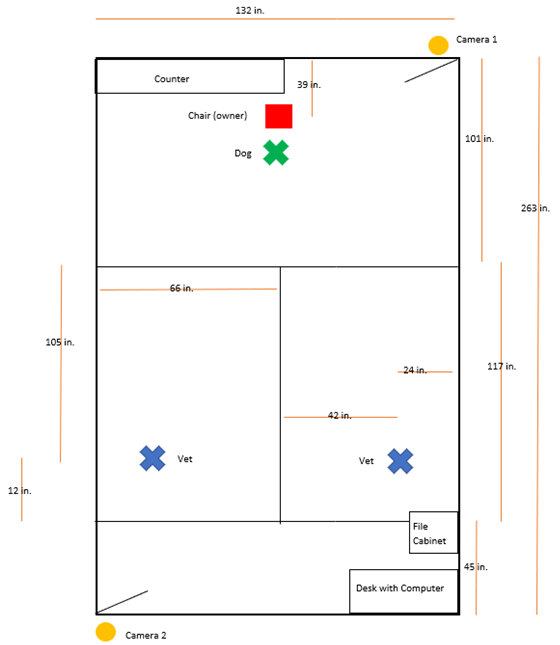
Appendix 1: Layout of the experimental room.
Before each trial, the two female veterinarians were randomly assigned to either “white coat” or “no white coat” condition, and randomly positioned on the right or the left side of the room. The two vets were either wearing a pair of red medical scrubs and a white coat on, or just the red scrubs. The random assignment was done by the computer program Random.org [11]. Attire and position of the veterinarians were randomly assigned and interchanged to account for order effects. The room was split into 5 areas: around the owner; around veterinarian one; around veterinarian two; behind the owner by a door; and behind the veterinarians by the door. These area identifications were used for recording data of where the dog stayed in the room during the trial. Only the veterinarians and the dog owner were allowed in the room with the dog. The exam room was cleaned before and after each trial with an odor attenuating solution to minimize effect of odorants and kept with the same arrangement to account for any confounding variables. The white coats were clean and free of animal odor for each trial; if in the previous trial the coat was contaminated by the dog rubbing or licking the coat, it was changed before the next trial.
A total of thirty-seven (N=37) dogs aging between two and six years of age, of both genders and various breeds participated in the study. The dogs were healthy and vaccinated against rabies. Each dog was identified with a letter or letter combination between A and AK. The dogs were recruited via email to owners, and an online poll was sent to the owner to sign up for a trial time that spanned across two weeks. All the information about the clients and the dogs was treated as confidential and was only identified by the number that the dog was assigned with during the trials.
Upon arrival at the veterinary hospital the dog owner checked in with the front desk. The dog owner and the dog stayed in the reception for an acclimation period where they were greeted by the experimenter who had the client sign the consent form and asked if the dog owner had any concerns about the procedure. Upon signing the consent form, the dog and the owner were invited to the experimental room. The owner was asked to sit on a chair placed in the middle of the room for a period of three minutes, so the dog had the opportunity to acclimate to the room with a long lead held by the owner. After the three minutes both vets (“coat” and “no coat”) entered the room without talking to the client or the dog, and positioned themselves equidistantly away from the dog, holding a food reward in their hands. The vets did not make eye contact with the dog or talk to the dog while in the room. The dog owner released the leash when the vets offered the treat to the dog for 60 seconds. Each dog had one minute to retrieve the treat. If in one minute the dog did not approach any of the vets, the experiment was terminated, and the vets exited the room. The number of times the dog approached the veterinarian/s, the location of the dog in the room, and retrieval or not of the treat was recorded.
Each of the trials were recorded using cameras placed in the back right and front left corners of the room to avoid blind spots (camera depicted by the yellow circles). After the trials commenced, a peer who was blind to the experiment watched the videos of the trials and recorded: trial date, trial number, dog ID, which vet was approached more often (coat or no coat), and how much time was spent in the area correlating to the owner, the vet wearing a coat, and the vet not wearing a coat. The videos were watched by two individuals blind to the protocol. Each observer watched half of the trial videos. After initial data recordings, the observers watched half of each other’s trial videos to account for observer bias. There was a rater’s agreement of at least 98% in all categories, verifying the homogeneity and reliability of the scoring. Data was analyzed using SPSS® statistical software.
Results
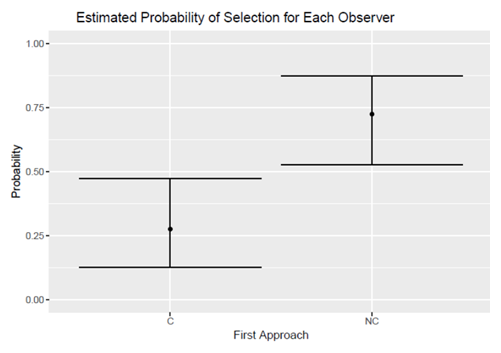
Seven out of the thirty-seven dogs that took part in the trial did not leave their owners side for the entirety of their trial. Data for these dogs was excluded from the analysis. A one-sample test for binomial proportion was used to estimate how many times the dogs approached each of the veterinarians during the trials. The Clopper-Pearson method was used for estimating the probability of the event happening in a success-failure trial.
Dogs were significantly more likely to approach the vet not wearing a white coat (p = 0.025), compared to the one wearing a coat (Figure 1).
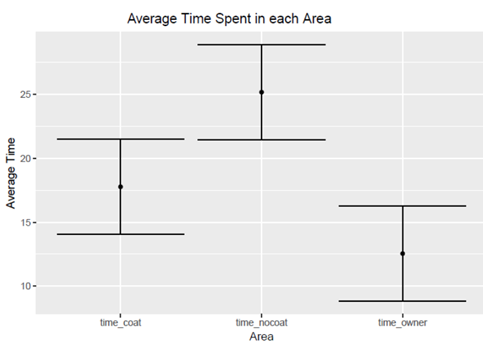
There was also a significant difference between the amount of time in the no coat and coat areas (estimated diff = 7.4 sec, p = 0.015, 95 % CI 1.2 to 13.6). There was a 7.4 second difference between the area around the no coat veterinarian and the area around the coat veterinarian. Dogs spent more time on average in the no coat vet area. There was no significant difference between the amount of time with the owner and the amount of time in the coat vet area (estimated diff = -5.2 sec, p = 0.12, 95 % CI -11.5 to 1.0). There was a -5.2 second difference between the area around the owner and the area around the coat wearing veterinarian (Figure 2). In addition, the residual plots were checked for assumptions of variance of homogeneity and no deviations were detected.
Discussion
We predicted that most dogs would approach the vet not wearing a white coat more often. We also predicted that most dogs would spend more time in the proximities of the vet not wearing a coat than the vet with a lab coat on.
Dogs’ preference for the vet not wearing a white coat can be due to previous experiences during a visit to the vet. It is possible that dogs associate past traumatic experiences with the white coat during regular procedures done at the vet’s office. It is not uncommon for dogs to have experienced discomfort from blood draws, injections, temperature taking, weight checks, or other uncomfortable procedures that commonly take place during a routine veterinary visit. It is possible that a vet wearing a white coat has a stockier appearance than when wearing scrubs or normal fitting coat, offering a more intimidating appeal to the dog. However, some dogs did approach the vet with a coat on and retrieved the treat, not showing a true aversion, suggesting that maybe for some dogs, past vet visits may have been positive and not traumatic at all.
It is unlikely that dogs approaching the vet with no coat first was simply due to Pavlovian classical conditioning because the ability of a stimulus to evoke a response depends on learning, and how learning affects future behaviors, given that all dogs have been exposed to a vet in the past [12]. Previous experience at a vet was not assessed prior to the trial. Still, evaluative conditioning may have occurred, where the prior subjective emotional experience at a vet, even if aversive, may have changed valence in the presence of a reinforcer such as a food reward [13].
Dogs spent more time in the area with the no coat vet than the coat vet either prior to, or after retrieving the reward. In this case, it does not seem that dogs were incentive driven only, where the “liking” and “wanting” (highly dopamine mediated behaviors) of a food reward prevailed [14]. It is possible that dogs showed preference for the area where the no coat vet stood because they felt safe to continue to investigate in an unfamiliar environment (dopamine mediated novelty seeking) driven by curiosity [15], or most likely because some aversion (driven by synaptic inhibition of dopamine neurons) to the white coat was experienced [16]. Dogs also spent more time in the owner area than in the coat vet area, but this difference was not significant. A safe- haven effect of attachment has been demonstrated in dogs before, where if the owner serves as a safe-haven, the dog will be more willing to explore a novel environment, even if in the presence of a possible threatening social stimulus such as a stranger [17].
There are a few limitations that may impact the results of our study. Several of the participants had visited the Washington State University Veterinary Teaching Hospital prior to the trials at a certain point in time, which was not accounted for. It is possible that the previous experiences were very traumatic for some dogs, but maybe positive for others. An aspect that limits our results is that all the canine participants have different backgrounds and different previous experiences. There are unaccountable differences in the types of procedures, how traumatizing these could have been, the number of procedures or veterinary visits that each of the dogs might have, how familiar a vet was to a particular dog, and the prevalence of the veterinarian wearing a white coat around them, which in turn could contribute to how they had been conditioned to the white coat in the past. A larger subset of canine participants from different age, breed and gender should be investigated in a future WCE study, preferably controlling for dogs’ previous experiences at the vet. This finding could also prompt further investigation on whether cats and other small animals respond in a similar manner to white coats and scrub uniforms, or if simply changing the color of the coat changes the behavior of the veterinary patients.
The white coat appears to be a stressor making the visit to the vet more challenging to the canine patient. Veterinarians and staff shall provide a comfortable setting for patients so that they can properly assess and treat them, while decreasing fear of the vet visit.
Conclusion
We observed a true WCE on dogs, characterized by preference for a veterinarian not wearing a white laboratory coat during a brief three-minute modified place preference trial. We entertain the possibility that the coat may not be the aversive stimulus but the white color. If a true WCE does exist, a further trial should compare laboratory coats of a different color.
Acknowledgments
We thank Dr. Raelynn Farnsworth who assisted with the data collection and paper revisions, and Hayley Clark who assisted with selection of papers. The authors state that there are no conflicts of interest.
References
-
Conditioned place preference paradigm (CPP) is a research method commonly used to test motivational and disciplinary stimulus. In this method, the subject of the trial is placed in a controlled environment and is given either a rewarding or punishing stimulus. Later, the subject is given access to the two environments and has the option to choose which environment it prefers or avoids [10]. We used a modified version of the conditional place preference paradigm assuming dogs have been conditioned to the visual of a white coat, given that all subjects in this study have past experiences at a veterinarian’s office.
- The Digital Stethoscope: Harnessing AI in Veterinary Medicine Without Losing Our Healing Touch
- Meningoencephalomyelitis of Unknown Etiology: Short-Term Effect of Two Treatment Protocols on Cerebrospinal Fluid
- Safety and Efficacy of the HomeoPet Cough in Domestic Pets –A Clinical and Correction Analysis Based Upon User Response Survey
- Non Human Animals Responses to Social Loss
- Owner Reported Clinical Outcomes of a Homeopathic Proprietary Preparation for the Treatment of Upper Respiratory and Nasal Disorders in Companion Animals
- Effects and Diagnostic Approach of Ultrasound in Veterinary Practice: A Systematic Review