
Genetic Strategies to Reduce Mastitis
Letter to Editor
The word mastitis is derived from two Greek words i.e. mastos which means “breast” and itis which means “inflammation”. Mastitis can be defined as inflammation of the mammary gland, caused by the invasion and duplication of Escherichia coli (E. coli), Staphylococcus uberis (S. uberis) and Staphylococcus aureus (S. aureus) and a wide variety of other microorganisms through teat or damaged nipple,
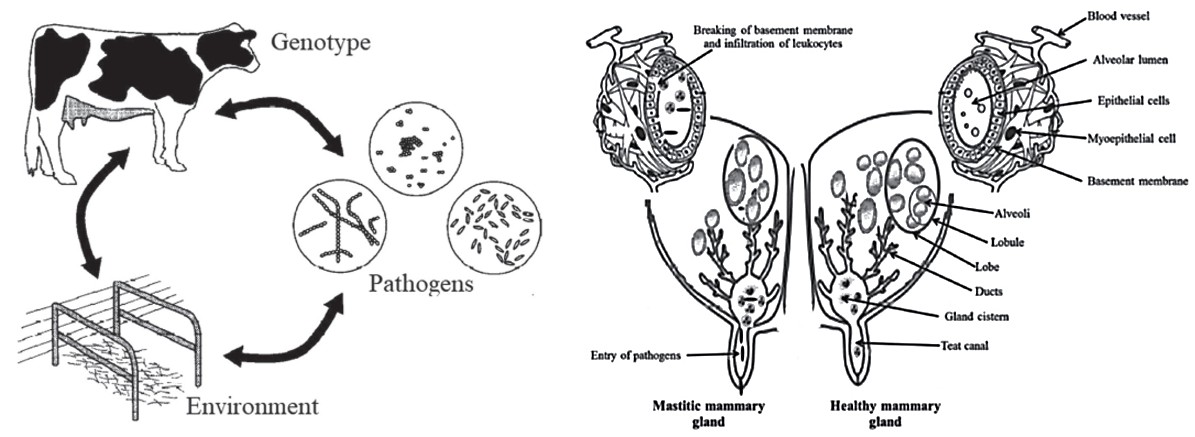
Figure 1a. Figure 1b.
The incidence of mastitis can be reduced either by decreasing the exposure to pathogens or by increasing resistance of cow to intra-mammary infection [2]. Resistance could be defined as the ability to avoid an infection of the udder or quick recovery from any infection. With the advancement Letter to Editor decreasing potential milk production in the affected quarter of mammary gland [1]. Many factors affect the incidence of mastitis, such as the productive stages of the cow, the number of lactations, the management of the herd, the temperature of the environment, the humidity, the weather, the breeds and the characteristics of the lactation (Figure 1a and 1b).
of molecular techniques mapping and tagging of genes, identification of genetic markers, studying candidate genes and detection of quantitative trait loci (QTL) are being used to make genetic improvement in breeding stock (improve production and disease resistance traits) through marker assisted selection. Using these techniques may be useful tools in understanding the genetic determinism of mastitis resistance.
The era of molecular marker development and applications begun in the 1980s. Modern developments in biotechnology have made it possible to unravel bulky genetic polymorphisms at DNA level. Functional mutation is used in marker assisted selection (MAS) which is basically responsible for phenotypic variations [4]. Generally, two main approaches are used to study markers (genes associated with mastitis resistance). One is to detect and localize the QTL while the other is candidate gene approach which looks for single nucleotide polymorphisms (SNPs) in the genes which are related to mastitis. The SNPs within the candidate genes are tested for better understanding their effects and association with quantitative traits. Another method to locate genomic variants or markers is genome wide association studies (GWAS). This method utilizes the information on genetic markers like SNPs to study their association with a trait of interest assuming that the genetic marker is in linkage disequilibrium with or close to a causative mutation [5]. GWAS have been used to identify marker or SNP and their association with mastitis related traits and many QTLs in cattle.
Mastitis resistance is controlled by several loci, each of which is responsible for small amount of overall variation. Variety of SNPs exist across the genome of different species which are used in selection program over other genetic markers due to their relatively less frequent mutation rate, easy and cost effective genotyping [6]. These advancements in biotechnology result in a large number of alternative methods of genetic markers for studying the required traits and using them in MAS, including microsatellites, amplified fragment length polymorphisms (AFLPs) restriction fragment length polymorphisms (RFLPs) to detect SNPs and for identification of the important genes for genetic improvement. Various techniques are being used as control measures for bovine mastitis including candidate gene approach which focuses on improving the host genetics through MAS [7, 8, 9]. However, utilization of MAS in dairy cattle produces additional genetic and economic gains and can utilize the candidate genes associated with health and other production traits. In the present study identification of SNPs in inflammation related candidate gene, mRNA expression and DNA methylation level and their association with mastitis traits have been evaluated.
Two main approaches are used to find loci of interest controlling phenotypic traits. One is candidate gene approach and the other is whole genome sequencing based on linkage mapping on DNA markers. A candidate gene can be defined as a gene with biological effects on the physiology of a trait of interest (functional) or as a gene closely linked to a functional gene (positional). This approach is considered as a very powerful method and is used to discover SNP even with a minor effect. Sometimes candidate gene provides information as a true causative gene. Studies using candidate gene approach for conducting genetic association focuses on associations of genetic variation within known genes of interest with phenotypes or disease states. This method is commonly used in association study due to its simplicity for obtaining samples and genotype data [10]. As described earlier, mastitis resistance is a complex function involving various biological pathways, molecules and cells. During last decade the genes associated with the immune response have been investigated for the presence of SNPs and associations with mastitis related traits. Therefore, many functional candidate genes could play an important role in the determinism of the function.
References
-
Rasheed A, Usman T, Niaz K (2020) A Review on Bovine Mastitis with Special Focus on as a Potential Candidate Gene for Mastitis Resistance–A Review. Annals of Animal Science 20(3): 735-755.
-
Cheng WN, Han SG (2020) Bovine mastitis: risk factors, therapeutic strategies, and alternative treatments-A review. Asian-Australas J Anim Sci 33(11): 1699-1713.
-
Rasheed A, Ali N, Niaz S, Zeb S, Khattak I, et al. (2020) Single Nucleotide Polymorphisms in the Promoter of CD4 Gene Are Associated with Production and Mastitis Traits in Dairy Cattle. Pak Vet J 40(4): 394-396.
-
Amiteye S (2021) Basic concepts and methodologies of DNA marker systems in plant molecular breeding. Heliyon 7(10): e08093.
-
Joiret M, Mahachie John JM, Gusareva ES, Kristel Van Steen, et al. (2019) Confounding of linkage disequilibrium patterns in large scale DNA based gene-gene interaction studies. BioData Mining 12**:** 11.
-
Lovina I Udoh, Willie Peggy Obaseojei, Chiebuka Uzoebo (2021) Single nucleotide polymorphisms: a modern tool to screen plants for desirable traits. In Plant Breeding- Current and Future Views. IntechOpen.
-
Thompson-Crispi K, Atalla H, Miglior F, Mallard BA (2014). Bovine mastitis: frontiers in immunogenetics. Frontiers in immunology 5: 493.
-
Chakraborty S, Dhama K, Tiwari R, Iqbal Yatoo M, Khurana SK, et al. (2019). Technological interventions and advances in the diagnosis of intramammary infections in animals with emphasis on bovine population-a review. The veterinary quarterly 39(1): 76–94.
-
Cardoso CV, Barbosa EV, Liberal MHT, das Chagas EF (2019). Transgenic technology: the strategy for the control and prevention of bovine staphylococcal mastitis?. Biotechnology Research and Innovation 3(2): 291-297.
-
Daly AK, Day CP (2001) Candidate gene case-control association studies: advantages and potential pitfalls. British journal of clinical pharmacology 52(5): 489-499.
- The Digital Stethoscope: Harnessing AI in Veterinary Medicine Without Losing Our Healing Touch
- Meningoencephalomyelitis of Unknown Etiology: Short-Term Effect of Two Treatment Protocols on Cerebrospinal Fluid
- Safety and Efficacy of the HomeoPet Cough in Domestic Pets –A Clinical and Correction Analysis Based Upon User Response Survey
- Non Human Animals Responses to Social Loss
- Owner Reported Clinical Outcomes of a Homeopathic Proprietary Preparation for the Treatment of Upper Respiratory and Nasal Disorders in Companion Animals
- Effects and Diagnostic Approach of Ultrasound in Veterinary Practice: A Systematic Review