
Gradual Growth of Several Claw Traits and Claw Lesions in Dairy Cows after Hoof Trimming
Several claw measurements, horn growth and wear were recorded monthly in a research farm to investigate the effect of solid concrete floor and gradual growth of these traits over 3 month after trimming. Two methods of hoof trimming were used: Standard Dutch (STD) and hollow (HOL). The experimental cows (19 primiparous and 19 multiparous) were selected (8 primiparous and 11 multiparous cows for STD and 9 primiparous and 10 multiparous cows for HOL). Information on claw traits was recorded on right lateral hind claw between November 2021 and April 2022. In addition, lesions development of interdigital dermatitis and heel erosion (IDHE) and digital dermatitis (DD) was studied in both rear feet. No differences were detected in claw traits among the trimming methods. A gradual growth of all claw traits investigated, was detected in each month (1, 2 and 3) after trimming. Lesions of IDHE developed gradually over time in both trimming methods. Development of different stages of DD was investigated 3 months after trimming methods. Classical ulcerative lesions (stage M2). Persisted in each month after trimming and did not cure effectively after caw trimming and frequent use of footbaths.
Găvan Constantin* and Riza Mihaela
Agriculture Research and Development Station Șimnic, City Craiova, Romania *Corresponding author: Găvan Constantin, Agriculture Research and Development Station Șimnic – Craiova, Șoseau Bălcești, number 54, Dolj county, Romania, Tel: +400251417534; Email: scda_simnic@yahoo.com
Introduction
In general, claw problems have become more serious since the introduction of loose housing systems. Although improvements in housing systems and nutrition have been made, incidence of claw lesions remain at a high level [1, 2]. Prevalence of claw problems varies considerably among farms or regions. In extended studies, the number of dairy cows having claw lesions was estimated to be 70-85% [3, 1, 4]. Recently, Jury, et al. [5] reported a high herd and cow prevalence of heel horn erosion of 92.9%, and 64.7% respectively in swiss cattle farms.
The bovine claw capsule is in a continuous process of gradual growth and gradual wear and tear. In normal conditions, horn growth and wear occur at approximately equal [6]. In adverse conditions, when cows are housed on concrete floors, claw conformation changes.
Morphologies measurements and histological physical characteristics have been reported as being potential indicators of claw quality [7, 8]. The horn capsule of the claw consists of tubular, inter-tubular and laminar horn cells (keratin), which determine the structural strength, biomechanical behavior, and resistance of claws to external stressors [9] claw morphology is described by claw angle, toe length, claw width, claw diagonal, claw height and heel height. The size and shape of claws are important in absorbing the shock associated with locomotion and weight distribution of the cows [10, 11, 1]. Several claw defects have been described in dairy cattle [1, 12].
The International Committee for Animal Recording (ICAR) in January 2020, published foot and claw disorders that can be used for identification (ICAR.org) [13].
Claw color is under investigation for an association with claw quality [14, 15, 16].
Now, in dairy farms, cows are predominantly housed in free stalls with concrete alleyways. On hard surface horn growth is accelerated [17] and the abrasiveness of concrete induces increased wear and tear [18].
The most important part of claw health management has and still does involve the hoof trimming of cows. Trimming can be an effective method for the treatment of lame cows, and for preventing some forms of claw horn lesions developing their clinical manifestations.
The large deterioration in claw health during the first lactation, the cumulative nature of claw lesions between lactations and high recurrence of lameness, makes its prevention in heifer vital to maximize the longevity of animals [19].
In this study we performed an in depth monitoring of claw traits and development of interdigital dermatitis, heel erosion and digital dermatitis in primiparous and multiparous Holstein Friesian cows housed on solid concrete flooring system. The aim of this study was to investigate the effect of solid concrete floor and changes in several claw shape measurements over time. In addition lesion development of interdigital dermatitis, heel erosion and digital dermatitis was investigated in both rear feet for 3 months after hoof trimming.
Materials and Methods
This study was done in the research dairy from of Agricultural Research and Development Station (ARDS) Simnic – Craiova, Romania. The dairy farm has a herd size of 280 Holstein Friesian animals and dairy cows produced an average 9440 kg of milk per 305 days lactation with year around calving.
All procedures were carried out in compliance with EU and national legislation.
All the cows at the farm are kept in the pens with concrete alleys. The experimental cows (n=38) were selected between November 2021 to April 2022 from 62 cows kept under the same roof. The management conditions were similar.
Water and partially mixed ration were available ad libitum. The ration formulation was according NRC nutrient requirements (NRC 2001).
The lactating cows were milked in a classic DeLaval milking system (with 10 milking units).
The cows entered the experiment at 90-100 days in milk (DIM), when they were about to be trimmed according to standard management procedures.
Criteria for inclusion to the experiment were:
- Clinical healthy cows;
- Not be lame cows (locomotion score 2 or less on the 5-point scale);
- Claws had enough for trimming.
Parties of the cows ranged from 1 to 4. Every 2 weeks a footbath containing a solution of formalin or formalin- cooper sulfate was placed in their path for 2 days.
Trimming methods
Two trimming methods were used in this experiment: Standard Dutch trimming method (STD) and hallow trimming method (HOL) or „concave‟ trimming method [20].
The 2 trimming methods, STD for 8 primiparous cows and 11 multiparous cows and HOL for 9 primiparous cows and 10 multiparous cows are presented in Table 1.
| Standard Dutch method | Hollow trimming method |
|---|---|
| - Make the medial claw 7.5 cm long; | - Make the medial claw 7.5 cm long; |
| - Make the toe 0.5 cm thick; | - Make the toe 0.5 cm thick; |
| - Save height in the bulb area. | - Save height in the bulb area. |
| - Make the lateral claw same length and height as medial claw (if possible). | - Make the lateral claw same lengths as medial claw (if possible), height difference up to 5 mm may remain. |
| Make the soles flat | Make sole models: area A and B can be dug out 3 to 5 mm if the sole is thick enough. |
Table 1: Trimming methods used in the experiment. 1 adapted from Ouweltjes, et al. [20].
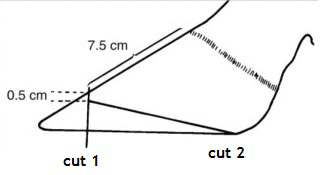
The two experimental groups were matched for parity and date of entering in the experiment. All experimental cows were kept in the same environment for 3 months before and 3 months after trimming.
Claw measurements
Claw measurements (hind claws) were done after elevation of the heaves in trimming chute: toe length (cm) from coronary band to the toe tip (A), dorsal hoof angle (°) measured between dorsal hoof wall and sole lines by a protractor (D), toe height (cm) from coronary band in toe region to the ground (B), heel height (cm) from coronary band in heel region to the ground level (C), claw diagonal (cm, E) and claw.
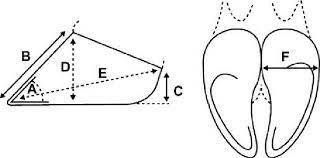
Width (cm) for both medial and lateral hind claws (F) (Figure 1).
A cross was made at the dorsal region of the abaxial wall to measure horn growth and wear. Distance was measured between the cross and coronal boundary and between cross and the lower edge of the claw. Changes in the distance between 2 measures were used to calculate growth and wear rates [1]. All claw trait measurements were made.
All the primiparous cows and multiparous cows were monitored for claw health. Claw health was recorded for each hind foot by scoring the presence of digital dermatitis (DD), interdigital dermatitis (ID), and heel erosion.
Digital dermatitis (DD) was classified in 5 classes (Moto M4+1) [21]. M0 = no signs of D; M1 = early stage, lesions < 2 cm; M2 = acute stage, lesions > 2 cm; M3 = healing stage, lesions covered with firm scab; M4 = chromic stage, lesions of various size, clearly circumscribed dys – and hyperkeratosis or proliferative overgrowths; M4 +1 = chronic M4 stage and new M1 lesions M2 lesions.
Interdigital dermatitis and heel erosion (IDHE) were evaluated together for severity and extend on a scale of 0 to 4 (0 = heel horn intact; 1 = slight defect of horn integrity, pits or small fissures; 2 = V – shaped fissures or circular craters extending small areas of the heel; 3 = V – shaped fissures or circular craters extending entire heel; 4 = profound fissures or circular craters extending to the corium of the heel [1].
Statistical Analysis
The data entered into Microsoft Excel computer program 2007 – STATA version 14 was used to summarize the data and descriptive statistics were used to express the results. The p value p obtained for the difference between the estimated means was adjusted using Tukey’s method. Method A p ≤ 0.05 was considered as significant level.
Results
In the step 1 of the two trimming the medial toe length was assessed at 7.17 – 7.19 cm for primiparous cows and 7.73 – 7.80 cm for multiparous cows. The sole depth at the toe was reduced to 5-7 mm, until the continuity of the white line was restored.
In the step 2 the priority was to correct balance as much as possible without creativity thin sales in lateral toes. It is important to leave adequate sole depth on the lateral hind claw to protect heel from trauma, bruising and subsequent white line disease.
Step 3, in Hollow trimming method, involves modelling of the sole ulcer predisposition site (Table 1), by digging out 3-5 mm and making a concave area. Also digging out between the toes was made as an aid in slurry manure clearance and to reduce sole bruising at the sole ulcer predisposition site. The Hollow trimming method may be beneficial to maximize the time this area remains non-weight bearing. In standard Dutch method the soles were made flat.
Results of measurements in a total of 38 cows are reported in lateral hind claws (Table 2) for both trimming methods. In STD method the means of lateral toe length, claw width, claw diagonal, claw height, heel height, and claw angle were 7.17 ± 0.1 cm, 5.14 ± 0.1 cm, 13.28 ± 0.26 cm, 6.10 ± 0.14 cm, 4.15 ± 0.12 cm and 45.87° respectively, for primiparous cows. For multiparous cows in STD method the same claw traits measurements were, 7.80 ± 0.19 cm, 5.76 ± 0.20 cm, 13.82 ± 0.15 cm, 6.74 ± 0.17 cm and 48.82° ± 0.98° respectively.
In HOL trimming method the means of lateral toe length, toe width, toe diagonal, toe height, heel height and toe angle in primiparous cows were: 7.19 ± 0.10 cm, 5.10 ± 0.11 cm,
13.32 ± 0.26 cm, 6.18 ± 0.15 cm, 4.26 ± 0.10 cm and 47.44° ± 1.81° respectively. For the multiparous the same claw traits measurements were: 7.73 ± 0.18 cm, 5.84 ± 0.12 cm, 13.87 ± 0.39 cm, 6.70 ± 0.32 cm, 4.86 ± 0.19 cm and 49.1° ± 0.87° respectively.
| Claw traits | S - Dutch method | Hollow method | ||
|---|---|---|---|---|
| Primiparous cows | Multiparous cows | Primiparous cows | Multiparous cows | |
| Toe length (cm) | 7.17 ± 0.10 | 7.80 ± 0.19 | 7.19 ± 0.10 | 7.73 ± 0.18 |
| Claw width (cm) | 5.14 ± 0.10 | 5.76 ± 0.20 | 5.10 ± 0.11 | 5.84 ± 0.12 |
| Claw diagonal (cm) | 13.28 ± 0.26 | 13.82 ± 0.15 | 13.32 ± 0.26 | 13.87 ± 0.39 |
| Claw height (cm) | 6.10 ± 0.14 | 6.74 ± 0.17 | 6.18 ± 0.15 | 6.70 ± 0.32 |
| Heel height (cm) | 4.15 ± 0.12 | 4.77 ± 0.17 | 4.26 ± 0.10 | 4.86 ± 0.19 |
| Claw angle (°) | 45.87 ± 1.25 | 48.82 ± 0.98 | 47.44 ± 1.81 | 4.91 ± 0.87 |
Table 2: Mean ± SD of claw traits in lateral hind claws at the day of trimming (day of measurements).
No differences were detected in claw shape among the 2 trimming methods at the day of trimming (day 0 of measurements, Table 2).
Monthly changes in claw right lateral hind traits after trimming of primiparous cows are shown in Table 3.
| Item | STD Method | HOL Method | |||||
|---|---|---|---|---|---|---|---|
| Months after trimming | |||||||
| 1 | 2 | 3 | 1 | 2 | 3 | ||
| Toe length (cm) | 7.50 ± 0.10 | 7.71 ± 0.10 | 7.91 ± 0.10 | 7.60 ± 0.11 | 7.76 ± 0.09 | 7.96 ± 0.09 | |
| Claw width (cm) | 5.25 ± 0.14 | 5.30 ± 0.11 | 5.37 ± 0.10 | 5.11 ± 0.11 | 5.20 ± 0.12 | 5.22 ± 0.14 | |
| Claw diagonal (cm) | 13.37± 0.25 | 13.51± 0.26 | 13.57± 0.27 | 13.35± 0.19 | 13.54± 0.18 | 13.62± 0.18 | |
| Claw height (cm) | 6.25 ± 0.09 | 6.36 ± 0.07 | 6.54 ± 0.05 | 6.26 ± 0.07 | 6.35 ± 0.07 | 6.58 ± 0.08 | |
| Heel height (cm) | 4.50 ± 0.16 | 4.59 ± 0.14 | 4.78 ± 0.14 | 4.66 ± 0.12 | 4.77 ± 0.15 | 5.00 ± 0.10 | |
| Claw angle (°) | 47.1 ± 1.35 | 48.25± 1.38 | 50.12± 1.64 | 48.66± 1.58 | 50 ± 1.58 | 51.77± 1.39 |
Table 3: Monthly changes in claw right lateral hind traits after trimming of primiparous cows.
Monthly changes in claw right lateral hind traits after trimming of multiparous cows are shown in table 4.
| STD Method 11 | HOL Method 10 | |||||
|---|---|---|---|---|---|---|
| Months after trimming | Months after trimming | |||||
| 1 | 2 | 3 | 1 | 2 | 3 | |
| Toe length (cm) | 8 ± 0.18 | 8.2 ± 0.19 | 8.26 ± 0.16 | 7.92 ± 0.17 | 8.18 ± 0.14 | 8.23 ± 0.10 |
| Claw width (cm) | 5.81 ± 0.14 | 5.88 ± 0.18 | 5.94 ± 0.14 | 5.95 ± 0.11 | 5.98 ± 0.09 | 6.05 ± 0.07 |
| Claw diagonal (cm) | 13.87± 0.14 | 13.97± 0.14 | 14.07± 0.14 | 13.97± 0.09 | 14.07± 0.09 | 14.17± 0.09 |
| Claw height (cm) | 6.80 ± 0.15 | 6.94 ± 0.09 | 6.99 ± 0.08 | 6.83 ± 0.34 | 6.99 ± 0.32 | 7.10 ± 0.29 |
| Heel height (cm) | 4.91 ± 0.15 | 5.01 ± 0.15 | 5.11 ± 0.15 | 5 ± 0.15 | 5.05 ± 0.12 | 5.12 ± 0.10 |
| Claw angle (°) | 49.82± 0.98 | 51 ± 1.09 | 51.6 ± 1.02 | 50.10± 0.87 | 51.4 ± 0.70 | 52.8 ± 0.63 |
Table 4: Monthly changes in claw right lateral hind traits after trimming of multiparous cows After trimming all measurements in
Table 4: Monthly changes in claw right lateral hind traits after trimming of multiparous cows After trimming all measurements in claw traits increased. In primiparous cows the highest measurements in the claw traits were recorded in HOL trimming method, after 3 months, except for claw width (table 3). In multiparous cows the highest measurements in the claw traits were recorded in HOL trimming method, after 3 months, except for tow length (Table 4).
The effect of solid concrete floor on claw horn growth, wear and net growth is shown in Table 5 and table 6. Rates of growth and net growth changed over time. The means for horn growth and wear ranged between 3.8 mm/month to 4.1 mm/month and 1.7 to 1.9 mm/month, respectively in primiparous cows (Table 5).
| Item | STD Method | HOL Method | ||||
|---|---|---|---|---|---|---|
| Months after trimming | Months after trimming | |||||
| 0 to 1 | 1 to 2 | 2 to 3 | 0 to 1 | 1 to 2 | 2 to 3 | |
| Horn growth mm/month | 4.1 | 3.9 | 3.8 | 4 | 3.8 | 3.9 |
| Horn wear mm/month | 1.8 | 1.7 | 1.7 | 1.8 | 1.8 | 1.9 |
| Net horn growth mm/month | 2.3 | 2 | 2.1 | 2.2 | 2 | 2 |
Table 5: Horn growth, horn wear and net horn growth recorded in right lateral hind claws of primiparous cows.
| Item | STD Method | HOL Method | ||||
|---|---|---|---|---|---|---|
| Months after trimming | Months after trimming | |||||
| 0 to 1 | 1 to 2 | 2 to 3 | 0 to 1 | 1 to 2 | 2 to 3 | |
| Horn growth mm/month | 4.6 | 4.7 | 4.9 | 4.5 | 4.6 | 4.8 |
| Horn wear mm/month | 2.1 | 2.2 | 2.2 | 2.1 | 2.2 | 2.2 |
| Net horn growth mm/month | 2.5 | 2.5 | 2.7 | 2.4 | 2.4 | 2.6 |
Table 6: Horn growth, horn wear and net horn growth recorded in right lateral hind claws of multiparous cows.
The means for horn growth and horn wear ranged between 4.5 to 4.9 mm/month and 2.1 to 2.22 mm/month respectively in multiparous cows (Table 6). These changes resulted in a net horn growth varying between 2.0 and 2.3 mm/month in primiparous cows and between 2.4 to 2.7 mm/month multiparous cows.
Claw lesions
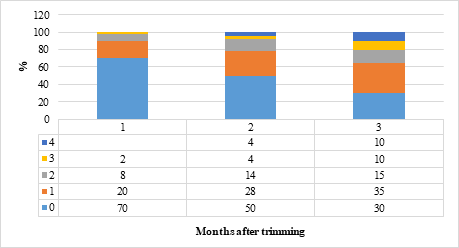
Distribution of the percentage of hind claws within each category of interdigital dermatitis and heel erosion (IDHE) during 3 months after trimming in primiparous cows in both methods is shown in Figure 2 and in multiparous cows in Figure 3.
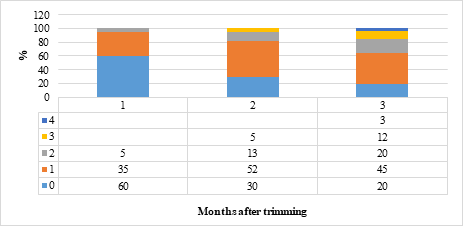
At first inspection (1 month later) IDHE lesions in the claw of primiparous cows were mostly absent (60%) or mild (category 1; 35%). By 2 months after trimming the proportion of claws with no signs of IDHE decreased to 30% and by 3 months after trimming in both methods the proportion of claws with no signs of IDHE decreased to 20%.
At 2 months after trimming methods (STD + HOL) most IDHE lesions were of category 1 (52%) in hind claws of primiparous cows (Figure 2). At 3 months after trimming methods (STD + HOL) most IDHE lesions were of category 1 (45%), category 2 (20%) and category 3 (12%) in claws of primiparous cows (Figure 2).
In multiparous cows at first inspection (1 month later). IDHE lesions of hind claws were absent (70%). At third inspection (3 months after trimming methods, STD + HOL) most IDHE lesions were of category 1 (35%), category 2 (15%), category 3 (10%) and category 4 (10%).
Distribution of the percentage of hind claws within each category of DD during 3 months after trimming (STD + HOL) in primiparous cows is shown in Figure 2 and for multiparous in Figure 3.
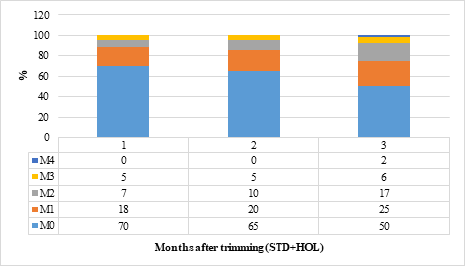
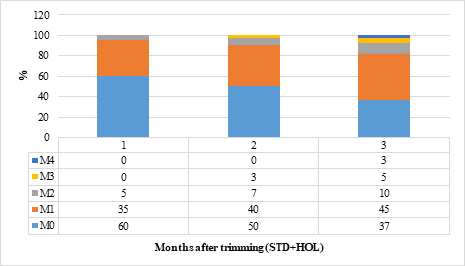
At 1 month after trimming methods, DD lesions in hind claws of primiparous cows were mostly absent (70%) and in multiparous cows (60%). At 2 month after trimming methods (STD + HOL) the proportion of claws with no signs of DD decreased to 65% in primiparous cows to 50% in multiparous cows. At 3 months after trimming methods the proportion of claws with no signs decreased to 50% in primiparous cows and to 37% in multiparous cows. The M1 lesions ranged from 18% to 25% in primiparous cows and from 35% to 45% in multiparous cows. The M2 lesions ranged from 7% to 17% in primiparous cows and from 5% to 10% in multiparous cows. At 3 months trimming methods the M3 lesions were in a proportion of 6% in primiparous cows and 5% in multiparous cows. The M4 lesions of DD after 3 months were in a proportion of 2% in primiparous cows and 3% in multiparous cows.
Discussion
Hind claws were subjected to claw inspection because lesions are predominantly present in hind claw. Measurements of one hind claw are representative for estimating the size of hind claws [22]. Trantre and Morris [23] found no difference in horn growth between the lateral and medial hind claw.
Boelling and Pollott reported conclusive evidence that claw traits recorded on only one claw traits recorded on only one claw of one hind foot gave a representative picture of both claws on both hind feet. Hoof trimming in both trimming methods was done after a period of metabolic stress and negative energy balance [24]. If routine trimmings are performed once per year the incidence of too long claws, acute toe angles, and overgrown capsules, which could lead to an incorrect weight distribution are more frequent than if trimming were performed twice a year [3].
Claw trimming has been shown to increase the milk yield of both primiparous and multiparous dairy cow when comparing the yield before and after trimming [25].
In this study, none of the claw dimensions was influenced by trimming method. Similar results were reported by Ouweltjes et al. [16].
Lesions of IDHE were less sever after 1 month after trimming and developed gradually over time in both trimming methods used for primiparous or multiparous cows. Although deep grooves are cut out, it takes some time before the loss of heel horn tissue is fully covered. Trimming is highly advisable to restore claws from heel horn damage [26].
Digital dermatitis generally been recognized as a widely occurring infectious disease, and much work has been performed to clarify the etiology and risk and risk factors involved (reviewed by Berry et al., 2004 [27]). In this study lesions of DD were investigated 3 months after trimming and examined development of each disease stages. This disease cannot be controlled without repeated antibiotic treatment [28]. The dairy herd in this study received non antibiotic footbath without significant effect.
Conclusions
No differences in claw traits measurements were found between the 2 trimming methods used for primiparous or multiparous cows kept on solid concrete floor.
Lesions of IDHE increased gradually over time.
Classical lesions of DD are long lasting and insensitive to claw trimming and frequent use of footbaths.
The basic principles of hoof trimming have not changed for more 30 years and refinements are needed in the light of changes made to management systems. A team approach with vets, professional hoof trimmers, farmers, nutritionists, all together can improve the health and welfare of dairy cows.
References
-
Andersson L, Lundström K (1981) The influence of breed, age, body weight and season on digital diseases and hoof size in dairy cows. J Vet Med A 28(2): 141-151.
-
Tranter WT, Morris RS (1992) Hoof growth and wear in pasture-fed dairy cattle. NZ Vet J 40(3): 89-96.
-
Boelling D, Pollott GE (1998) Locomotion, lameness hoof and leg traits in cattle. I. Phenotypic influences and relationships. Livest Prod Sci 54(3): 193-203.
-
Manske T, Hultgren J, Bergsten C (2002) The effect of claw trimming on the hoof health of Swedish dairy cattle. Preventive Veterinary Medicine. 54(2): 113-129.
-
Sogstad AM, Østerås O, Fjeldaas T, Refsdal AO (2007) Bovine claw and limb disorders at claw trimming related to milk yield. J Dairy Sci 90(2): 749-759.
-
Ouweltjes W, Holzhauer M, van der Tol PP, van der Werf J (2009) Effects of two trimming methods of dairy cattle on concrete or rubber – covered slatted floors. J Dairy Sci 92(3): 960-971.
-
Toussaint Raven E, Haalstra RT, Peterse DJ (1989) Cattle foot care and claw trimming. Farming press. Ipswich, UK.
-
Berry SL, Walker RL, Read DH, Hird DW, Ertze RA (2004) The current state of knowledge on (papillomatous) digital dermatitis in dairy cattle. Pages 130-137 in Proc. 13th Int. Symp on Lameness in Ruminants, Maribor, Slovenia.
-
Bergsten C (1997) Infectious disease of the digits. Pages 89-100 in Lameness in cattle (3rd Edn.) PR Greenough AD Weaver (Eds.) WB. Saunders, Philadelphia.
-
Somers JG, Schouten WG, Frankena K, Noordhuizen- Stassen EN, Metz JH (2005) Development of claw traits and claw lesions in dairy cows kept different floor system. J Dairy Sci 88(1): 110-120.
-
Döpfer D (1994) Epidemiological investigations about digital dermatitis on two dairy farm. PhD Thesis. Hanocer Germany.
-
Solano L, Barkema HW, Mason S, Pajor EA, LeBlanc SJ, et al. (2016) Prevalence and distribution of foot lesions in dairy cattle in Alberta, Canada. J Dairy Sci 99: 68288- 6841.
-
Capion N, Thamsborg SM, Enevoldsen C (2008) Prevalence of foot lesions in Danish Holstein cows. Vet. Record 163(3): 80-85.
-
Jury A, Syring C, Becker J, Locher I, Strauss G, et al. (2021) Prevalence of claw disorders in swiss cattle farms. Schweiz Arch Tierheilkd. 164(11): 779-790.
-
Vermunt JJ, Greenough PR (1995) Structural characteristics of the bovine claw horn growth and wear, horn hardness and claw conformation. Br Vet J 151(2): 157-180.
-
Van Marle-Köster E, Pretorius SJ, Webb EC (2019) Morphological and physiological characteristics of claw quality in South African Bonsmara cattle. S Afr J Anim Sci 49(5).
-
Hahn MV, McDaniel BT, Wilk JC (1984) Genetic and environmental variation of hoof characteristics of Holstein cattle. J Dairy Sci 67(12): 2986-2998.
-
Politiek RD, Disti O, Fjeldaas T, Heeres J, Nielsen E, et al. (1986) Importance of claw quality in cattle: Review and recommendations to achieve genetic improvement. Report of the EAAP Working Group on “Claw quality in cattle”. Livest Prod Sci 15(2): 133-152.
-
Franck A, G Cocquyt, Simoens P, De Belie N, (2006) Biomechanical properties of bovine claw horn. Biosystems Eng 93(4): 459-467.
-
Van der Tol PPJ, JHM Metz, Noordhuizen-Stassen EN, Back W, CR Braam et al. (2002) The pressure distribution under the bovine claw square standing on a flat substrate. J Dairy Sci 85: 1476-1481.
-
Bonser RHC, Farrent JW, Taylor AM (2003) Assessing the frictional and abrasion-resisting properties of hooves and claws. Bio Eng 86(2): 253-256.
-
Volkman N, Kemper N (2018) Claw condition and claw health in dairy cows: How important is access to pasture? The Veteriary Record 182: 76-78.
-
Hepburn NL, Kinninmouth L, Galbraith H (2007) Pigmentation, impression hardness and the presence of melanosomes in bovine claw tissue. J of Agric Sci 145: 283-290.
-
Scobie DR, Makela AG, van Koten C, DO’Connell (2017) Mechanical properties of black, grey and white hoof material of sheep. Proceeding of the New Zeeland Society of Animal Production. 77: 154-158.
-
ICAR Claw Health Atlas.
-
Bergsten C, Stranberg P (1990) The way to healthy hooves. Update in cattle lameness. in Proc. 6th Int. Symp on Diseases of Ruminant Digit. Liverpool UK. Pp: 259-
-
Murphy PA, Hannan J (1987) Effects of slatted flooring on claw shape in intensively housed fattening beef cattle. Bovine Pract 22: 133-135.
-
Offer JE, D McNulty, DN Logue (2000) Observations of lameness, hoof conformation and development of lesions in dairy cattle over for lactations. Veterinary Record 147: 105-109.
- The Digital Stethoscope: Harnessing AI in Veterinary Medicine Without Losing Our Healing Touch
- Meningoencephalomyelitis of Unknown Etiology: Short-Term Effect of Two Treatment Protocols on Cerebrospinal Fluid
- Safety and Efficacy of the HomeoPet Cough in Domestic Pets –A Clinical and Correction Analysis Based Upon User Response Survey
- Non Human Animals Responses to Social Loss
- Owner Reported Clinical Outcomes of a Homeopathic Proprietary Preparation for the Treatment of Upper Respiratory and Nasal Disorders in Companion Animals
- Effects and Diagnostic Approach of Ultrasound in Veterinary Practice: A Systematic Review