
Herd Prevalence of Mycobacterium Avium Ss. Paratuberculosis in a Comingled Population of Captive Nyala (Tragelaphus Angasii), Impala (Aepyceros Melampus) And Thomson’s Gazelle (Gazella Thomsonii)
Mycobacterium avium subspecies paratuberculosis (MAP) is the causative agent of paratuberculosis, a contagious, chronic, and eventually fatal enteric disease of domestic and non-domestic ruminants. MAP is highly resistant to heat, disinfectants, and environmental agents, staying infective for a long time in the environment which makes biosecurity a challenge when trying to control this disease in domestic, zoo ruminants, and especially wild animals. The highest burden of MAP is in domestic ruminants, followed by zoo ruminant species, and then frees ranging wild ruminants. The overall physiology and pathophysiology of MAP when it occurs in all three ruminant groups is essentially identical, so environmental factors would appear to have dominant roles in explaining the differences in the prevalence among the three groups. Herd prevalence in a group of comingled managed zoo ruminants nyala (Tragelaphus angasii), impala (Aepyceros melampus) and Thomson’s gazelle (Gazella thomsonii) show a clear difference between the low prevalence of MAP in the Thomson’s gazelle compared to both he impala and nyala. When Thomson’s gazelle herd were later fed a high intake of concentrate rations in a similar fashion to the nyala and impala, the prevalence of MAP then started to approach these latter species. Feeding niches and nutrition, especially high concentrate, low fiber feeding, leads to a higher prevalence of MAP. Hypocalcemia or increased calcium demand parallels this trend in MAP prevalence amongst these three comingled species. The observation is that the more intensively managed any ruminant becomes, especially in terms of feeding, the higher the apparent prevalence of MAP. In this regards MAP infection can be more appropriately thought of as an anthropogenic condition. This perspective may allow for exploring other control measures focused on feeding practices and more specifically on calcium metabolism.
Introduction
Mycobacterium avium ss. paratuberculosis in zoological specimens has been reviewed Roller M, et al. [1] as well as in wildlife and farmed deer [2]. Various aspects of diagnostic methodologies to stage the infection, including early life stage infection [3], and biosecurity are discussed but nutrition is rarely if ever mentioned. In zoological collections with ruminants, managing MAP is essential as clinical cases and presence of the infectious agent has been documented in numerous facilities [1]. While the infectious route is generally well accepted as fecal oral early in the ruminant’s life [3], there has been little attention to the apparent differences in susceptibility of certain species to MAP. This report examines a comingled population of captive wild ruminant species with various prevalence rates to MAP and reconciles these differences in the MAP pathogen and disease load by examining the environment they all comingled in.
Materials & Methods
Retrospective analysis of MAP on a 15 acre (6.07 hectares) mixed species display at Busch Gardens Tampa Bay, Florida (BGT) was conducted from 1992 through 2002. Nyala (Tragelaphus anagasii), impala (Aepyceros melampus), and Thomson’s gazelle (Gazella thomsonii) all commingled on this display for the 10 years until the herds were removed for renovations of the display as a medical management scheme to help control MAP within the entire facility. Management control also consisted of finding all MAP positive animals and removing them as well as a pressure-steam treatment of the pastures housing these ruminants. All individuals of each three species were eventually humanely euthanized as the herds were de-populated and complete necropsies performed. Animals were defined as having MAP if they had a fecal culture that grew MAP, a positive fecal polymerase chain reaction (PCR) test, or either culture or PCR positive on any tissue taken at necropsy.
Results
Johne’s status of the respective herds is shown in Table 1. Nyala and impala had essentially identical herd prevalence over the 10-year study period at 42.19 and 42.22 % respectively. Thompson gazelle herd prevalence was relatively low when compared to the other two species at 5.84% over the same period.
| Herd | Johne's Positive | Herd Prevalence | |
|---|---|---|---|
| Nyala | 64 | 27 | 42.19 |
| Impala | 90 | 38 | 42.22 |
| Thompson gazelle | 137 | 8 | 5.84 |
Table 2: Herd sizes (number of individuals) with numbers of Johne’s positive individuals as defined as well as prevalence in comi
Table 2 shows the calculated risk ratio calculated in 2 X 2 squares of the species with the lowest prevalence, the Thomson gazelle, to the species with the highest prevalence, the nyala and impala. Impala were approximately 12 times more likely to have MAP detected over the 10-year study period than Thompson gazelles. Nyala were approximately 25 times more likely to have MAP over the same period. While not shown, nyala are approximately twice as likely as the impala to have MAP during this study period and this is implied with the comparison of each to the Thomson gazelle.
| J Pos | J Neg | Total | |
|---|---|---|---|
| Impala | 38 | 52 | 90 |
| T. gazelle | 8 | 129 | 137 |
| Odds ratio | 11.78 | ||
| Nyala | 38 | 25 | 63 |
| T. gazelle | 8 | 129 | 137 |
| Odds ratio | 24.51 |
Table 1: Risk ratio of impala and nyala to the Thomson gazelle (T. gazelle) in 2 X 2 squares. The impala were approximately 12 ti
Discussion
Over the study period there is a clear difference in the prevalence of MAP amongst these three species. Zoo ruminants face the same challenges as domestic ruminants in terms of infectious disease risk and that is namely higher animal densities and relatively higher concentration of the infectious agent (Roller et al 2020). An added and perhaps more critical similarity that is often not considered is that both groups of ruminants are typically fed in a similar fashion: high-concentrate and low fiber diets. When the ratio of concentrate feeds compared to fiber/forage is high, there is considerably less chewing from ruminants. This leads to less opportunity for salivary recycling of phosphorus which elevates serum levels of phosphorus. This elevated serum level of phosphorus then directly results in hypocalcemia by precipitating calcium, decreasing vitamin D production, and interfering with PTH-mediated bone resorption. Hypocalcemia is noted in captive giraffes as early as 1975 Flach EJ [4] and inverted serum calcium to phosphorus ratios were noted in the collection at BGT in this same period [5]. Hypoglycemia as well as hypocalcemia are noted as likely causes of “Peracute Mortality Syndrome” in captive giraffe [6]. Zoo ruminants in general are documented to have clinically significant hypocalcemia and other mineral derangements [7]. In this report a more direct association is made with the browsing species of nyala and intermediate foraging impala developing MAP while the grazing species Thomson gazelle had a low prevalence of the disease. While the difference between browsing and grazing ruminants in terms of calcium handing may have a role in this scenario, the simple fact that the larger species kept the smaller ones from the concentrate feed may be more significant. (Figure
1). Thomson’s gazelles in this habitat often would live to 15 to 18 years of age and were euthanized due to degenerative conditions such as osteoarthritis and neoplasia (Ball 2002 clinical data).
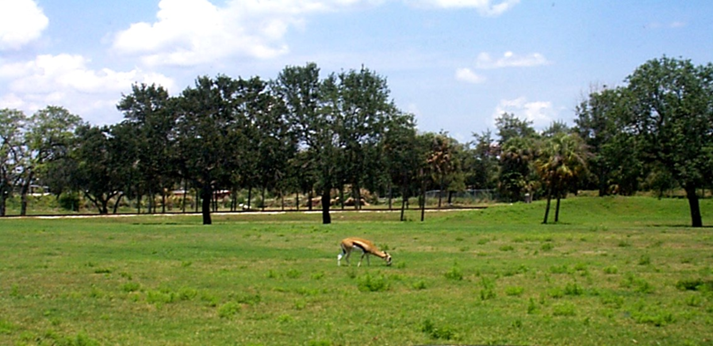
Once the competition was removed during the MAP management and the Thomson gazelle were isolated with little option except the concentrate, they were found to have both developed hypocalcemia and the prevalence of MAP increased dramatically to approximately 25% (Figure 2).

Figure 2: Dry lot habitat for the Thomson’s gazelle after being moved from the 10-acre habitat they shared with the nyala and impala. The lack of grass necessitated hay feeding and a reliance on concentrated feeds. When this herd was eventually depopulated, they were found to be hypocalcemia and had an increased prevalence of MAP. Photo credit: Ray Ball.
This strong association would suggest a causative role for calcium in the manifestation of MAP in at least this species and we believe in all ruminants. Calcium demand in all ruminants would be expected to be highest during the growth of calves and in parturition and lactation [8]. These physiologically demanding periods are also when MAP is noted to be most prevalent. Hypocalcemia is known to alter the immune response in ruminants because of decreased intracellular calcium stores in peripheral blood mononuclear cells (PBMC) [9]. This hypocalcemia has specifically been documented to be associated with the periparturient period, but any potential cause of hypocalcemia should be expected to have the same effect on PBMC with resultant immune suppression.
The three zoo ruminant species in this review commingled on the same pasture and from an infectious disease perspective, should have had the same exposure to MAP. The vast differences in the observed prevalence show that other factors are essential for a ruminant to develop MAP aside from simple exposure to the pathogen. Biosecurity measures in ruminants in general have focused on eliminating exposure to MAP in calves and have included hand rearing and using colostrum from MAP free herds or commercial colostrum replacers. These measures as well as the environmental treatment mentioned above have resulted in a reduction in the prevalence of MAP but an increase in the prevalence of other non-tuberculous mycobacteria (NTB) had increased. Such organisms as Mycobacterium gordonae, Mycobacterium fortuitum, Mycobacterium genavense, and Mycobacterium kansasii had all been implicated in clinical disease of zoo ruminants after this intensive MAP biosecurity measures had depopulated these three herds. All affected ruminants were hypocalcemia (Ball unpublished clinical data 2002). Correcting the concentrate to forage ratio and resultant increase in feeding times and chewing may also be beneficial in managing another infectious disease of concern in captive ruminants, Hemonchus contortus [10].
Conclusion
Environmental management is essential in animal health and pathogen load is an essential part of this environmental management. Nutrition is another environmental aspect of animal health but has been overlooked in the management of MAP and perhaps other infectious agents. Hypocalcemia or an increase in calcium drive appears to make ruminants susceptible to MAP infection. This condition is entirely due to the feeding strategies in captive ruminants, both domestic and zoo ruminants. As such it truly is an anthropogenic disease but is therefore potentially correctable. Efforts to manage or even eliminate MAP may be better served by improving nutritional management over biosecurity.
References
-
Roller M, Hansen S, Witzens TK, Oelemann WMR, Czerny CP, et al. (2020) Mycobacterium avium Subspecies paratuberculosis Infection in Zoo Animals: A Review of Susceptibility and Disease Process. Front Vet (7): 1-19.
-
Carta T, Alvarez J, Lastra JMP, Gortazar C (2013) Wildlife and Para tuberculosis: A review. Res Vet Sci 94(2): 191-
-
Burgess TL, wite CL, Rideout BA (2018) Early-life exposures and Johne’s disease risk in zoo ruminants. J Vet Diagn Invest 30(1): 78-85.
-
Flach EJ (1997) chronic loss of condition with persistent neutrophilia in a reticulated giraffe (_Giraffa_ _camelopardalis_). _Proceedings of the Spring Meeting of the_ _British Veterinary Zoological Society 33-36._
-
Ball RL, Miot J, Dumonceux G, Burton M (2000) Hematology, Serum Chemistry, Blood Coagulation Profiles, and Serology of Physically Restrained Captive Reticulated Giraffe (Giraffa camelopardalis). American Association of Zoo Veterinarians Conference 2000.
-
Ball RL, Kearney C, Burton M, Dumonceux G, Olsen JH (2002) Morbidity and Mortality Related to Hypoglycemia and Chronic Energy Malnutrition in Captive Giraffe. American Association of Zoo Veterinarians Conference 2002.
-
Miller M, Weber M, Valdes EV, Neiffer D, Fontenot D, Fleming G, et al. (2010) Changes in serum calcium, phosphorus, and magnesium levels in captive ruminants affected by diet manipulation. J Zoo Wildl Med 41(3): 404-408.
-
Chiodini RJ, Kruiningen HJ, Merkal RS (1984) Ruminant paratuberculosis (Johne’s disease): the current status and future prospects. Cornell Vet 74(3): 218-262.
-
Kimura K, Reinhardt TA, Goff JP (2006) Parturition and hypocalcemia blunts calcium signals in immune cells of dairy cattle. J Dairy Sci 89(7): 2588-2595.
-
Lukacs (2016) Comparing Fecal Egg Counts to Time Spent Eating in a Group of Giraffes (Giraffa camelopardalis) in a Zoological Park: A Retrospective Study”. Joint AAZV, EAZWV, IZW Conference.
- The Digital Stethoscope: Harnessing AI in Veterinary Medicine Without Losing Our Healing Touch
- Meningoencephalomyelitis of Unknown Etiology: Short-Term Effect of Two Treatment Protocols on Cerebrospinal Fluid
- Safety and Efficacy of the HomeoPet Cough in Domestic Pets –A Clinical and Correction Analysis Based Upon User Response Survey
- Non Human Animals Responses to Social Loss
- Owner Reported Clinical Outcomes of a Homeopathic Proprietary Preparation for the Treatment of Upper Respiratory and Nasal Disorders in Companion Animals
- Effects and Diagnostic Approach of Ultrasound in Veterinary Practice: A Systematic Review