
Varicose Ulcer in Canine Pelvic Limb: Homeopathic Attitude
Although frequent in humans and their historical references are older than those of arterial diseases, in veterinary medicine varicose veins are rarely diagnosed. Descriptively, this article presents a case report of a senile female dog (thirteen years old), with knotty tortuosity in the medial part of the pelvic limbs, licking dermatitis, pruritus and respiratory difficulty. After administration of Phosphorus 200 cH, orally in a single dose, the pruritus, licking and erythema ceased. There was improvement in the respiratory condition. The patient exonerated, evolving to varicose ulcer after medication.
Introduction
The geriatrics is the area of knowledge that aims at assisting senior patients [1]. The fields of action and knowledge are extremely vast and gain greater notoriety as the life expectancy of animals increases [2], as well as the increased concern of responsible to offer a better quality of life and welfare to their animals, especially in the final stages of life [1].
Varicose veins are characterized by pelvic varicose veins, represented as a dilation and tortuosity of the pelvic venous plexus associated with reduced venous return secondary to incompetent valves inside the veins [3]. These alterations impair the contractility and relaxation of the veins, gaining the increasing fact that venous hypertension overloads the microcirculation [4, 5, 6]. The relationship of structural abnormality in the wall of the veins, corroborate with the mechanisms of chronic venous insufficiency [6]. Although poorly understood, secondary lesions are generated in endothelial cells that cause leukocyte infiltration and inflammation, determining chronic venous distension and reflux [4, 5]. A combination of environmental risk factors, anatomical, and genetic risk factors contribute to pelvic congestion syndrome [7]. These include previous pregnancy [6], pelvic surgeries, hormone therapy (estrogen), obesity, and phlebitis [7].
The associated with the existence of varicose veins in the lower limbs are pain (generalized or circumscribed), lipodermatosclerosis or ulceration, tiredness, edema of the lower limbs, fatigue and pruritus [6, 8]. Can be diagnosed by pelvic ultrasound with Doppler [2].
Patients who need Phosphorus help are those with a fear of storms, thunder, darkness and loneliness [9]. Is very compassionate, he likes to give affection. Tendency to hemorrhage, wounds bleed profusely. There are petechiae, ecchymoses. Vesicles or blisters and blood may form on the skin. Old scars open again [10]. Drug of choice in pyaemia and necrosis of the lungs. Periostitis on the tibia. Acts on paralysis after stroke [9].
Among the systems, there are a myriad of conditions, diagnostic and therapeutic approaches for the geriatric patient. Homeopathy, unlike other therapies, aims at healing, and exoneration is its methodological potential. This article aproche this tool through a descriptive case report.
Case Report
A canine of the Lhasa Apso breed, female, entire, thirteen years, ten kilograms (tendency to obesity), presented recurrent dermatitis with knotty tortuosity in the medial part of the pelvic limbs and pustules in the ventral abdomen, joint erythema of the limbs, acral lick dermatites, pruritus and fatigue for one year. The dog had previously been treated with allopathy, but it had no effect. Normophagia (hypoallergenic therapeutic dog breed), normodipsia, normochesia, and normal colored urine. On clinical examination, there was increased respiratory amplitude, panting, breathing with open mouth bove forty-eight breaths per minute, heart rate hundred beats per minute (muffled heart sounds), rectal temperature 37ºC. Normal colored mucous, moderate periodontal disease (bacterial plaque), adequate hydration, abdominal enlargement, non-reactive lymph nodes. Mental symptoms: compassionate, anxiety of conscience and fear of fireworks. Given this situation, homeopathic treatment was Phosphorus 200 cH, three globules orally single dose. There was an improvement in the respiratory condition in twenty- four hours after drug administration. However, the wounds on the medial side of the pelvic limb became open wounds, characterizing homeopathic exoneration.
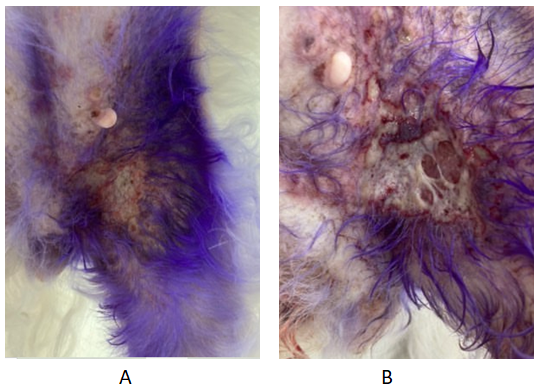
Source: Barbosa, 2023. A: once day. B: second day, after the use Phosphorus 200 cH. Figure 1: Medial region of left pelvic limb and ventral abdomen.
Discussion
In every “homeopathic cure”, the vital principle dynamically altered by the “natural disease” (“disease that exists”) undergoes the action of an artificial disease (“disease that does not exist” – created by the administration of a “medicinal potency”) similar (chosen for the most perfect possible similarity between its symptoms and the “natural one”) and stronger (capable of inducing symptoms in an “unconditional” way) [11]. Subdued, the natural (weaker) dynamic morbid manifestation ceases and disappears [12]. Consequently, this morbid manifestation ceases to exist for the vital principle, which then becomes occupied and governed only by the strongest artificial manifestation [11, 13].
This case report is the first case of varicose veins in the pelvic limbs in a dog. Varicose veins are most frequently described in human medicine. It is usually more common in women and in the older age group with venous insufficiency, including venous ulceration [14]. The patient had characteristics of an affected vascular system, marked mainly by fatigue and panting. Unfortunately, it was not possible to carry out complementary tests to prove differential diagnoses [15], such as heart disease, hyperadrenocorticism and dermatopathies, as the patient died. In hematological exams there was subtle leukocytosis, preserved renal and hepatic function.
By visual inspection and evolution of the condition, we can consider varicose ulcer as a single diagnosis [16]. In varicose veins, extravasation of macromolecules and erythrocytes occurs, which will cause leukocyte activation and migration, initiating an inflammatory reaction with the release of inflammatory factors and increased synthesis of MMP‐2 [17, 18].
A suitable homeopathic medicine always produces, during the first hour of its action, an evident homeopathic aggravation of this category. This preponderance of drug symptoms over the symptoms of the natural disease that simulates a worsening of the original disease [11]; Leg ulcers worsen as psora interna remains unhealed [12, 19].
What else is to be cured in illnesses besides the symptoms? To treat long-term diseases, proportionally more time is needed [12]. Being the age factor an obstacle to healing.
Conclusion
In veterinary medicine, the vascular issue must be considered as a differential. The diagnosis in the dog and cat clinic is what directs the treatment in the veterinary clinic. The antipsoric medication kept the greatest similarity of possible signs in continuity to the established diagnosis of varicose veins. Complementary exams are necessary for accuracy of the picture. So far, the literature does not include such a theme.
References
-
Hoskins JD (2008) Geriatrics & Gerontology of the Dog and Cat 2nd (Edn.), Roca, São Paulo, Brazil, pp: 415.
-
Gerosa RM (2007) Geriatria canina. Inter-Médica, Buenos Aires, Argentina, pp: 688.
-
Martins JA, Balbueno MCS, Coelho CP (2022) Varicosis in a dog diagnosed by ultrasound examination: Case Report. Brazilian Journal of Development 8(3): 19977- 19984.
-
Greiner M, Dadon M, Lemasle P, Cluzel P (2012) How does the pathophysiology influence the treatment of pelvic congestion syndrome and is the result longlasting? Phlebology 27(1): 58-64.
-
Phillips D, Deipolyi AR, Hesketh RL, Midia M, Oklu R, et al. (2014) Pelvic congestion syndrome: etiology of pain, diagnosis, and clinical management**.** J Vasc Interv Radiol 25(5): 725-733.
-
Alves CP, Almeida CC, Balhau AP (2018) Varicose veins of the forelimbs: practical aspects. Portuguese Society of Surgery. Vascular Surgery Chapter.
-
Siqueira FM, Monsignore LM, Rosa-E-Silva JC, Poli- Neto OB, Castro-Afonso LH, et al. (2016) Evaluation of embolization for periuterine varices involving chronic pelvic pain secondary to pelvic congestion syndrome. Clinics Sao Paulo 71(12): 703-708.
-
Eberhardt RT, Raffetto JD (2005) Chronic Venous Insufficiency. Circulation 111(18): 2398-2409.
-
Torro AR (2020) Homeopatia veterinária: Matéria médica. 2a. São Paulo. EdAutora.
-
Vijinovsky B (2003) Homeopathic Materia Medica Treatise 3rd(Edn.), Organon.
-
Hahnemann S (1995) Organon of the art of healing. In: Villela EM, et al. (Eds.), Museu Homeop, Ribeirão Preto, A Brickmann.
-
Pustiglione MO (2001) moderno Organon da arte de curar de Samuel Hahnemann. Typus, São Paulo.
-
Narita FB, Balbueno MCDS, Coelho CDP (2020) Tratamento de dermatite e papilomatose oral em cão com altas diluições: relato de caso. Brazilian Journal of Development 6(12): 100500-100507.
-
Piazza G (2014) Varizes Veins. Circulation 130(7): 582- 587.
-
Ai Q, Chen C, Yu Y, Wu S, Huang Q, et al. (2022) Progressive Obstruction of Inferior Vena Cava by Ameroid Constrictor: The Canine Model of Revealing Hemodynamic and Compensatory Patterns of Tumor Thrombus Formation at the Renal Hilus Level. J Endourol 36(8): 1119-1125.
-
Attard S, Muscatello LV, Mazzullo G, Pisu MC (2022) Penile Varicose Vein in Akita inu, 7-Year-Old Dog: A Clinico-Pathological Study. Vet Sci 9(2): 47.
-
Acierno MJ, Brown S, Coleman AE, Jepson RE, Papich M, et al. (2018) ACVIM consensus statement: Guidelines for the identification, evaluation, and management of systemic hypertension in dogs and cats. Journal of Veterinary Internal Medicine 32(6): 1803-1822.
-
Joseph S, Bagin S, Neal Ellis C, Mody P, Patel D, et al. (2023) Dietary Modulation of Chronic Inflammation of Diabetes: A Narrative Review. J Endocrinol 7(1): 1-10.
-
SADEGHI S (2021) Homeopathic Healing of Patients with Diabetic Foot Ulcers. Med J Clin Trials Case Stud 5(2): 1-2.
- The Digital Stethoscope: Harnessing AI in Veterinary Medicine Without Losing Our Healing Touch
- Meningoencephalomyelitis of Unknown Etiology: Short-Term Effect of Two Treatment Protocols on Cerebrospinal Fluid
- Safety and Efficacy of the HomeoPet Cough in Domestic Pets –A Clinical and Correction Analysis Based Upon User Response Survey
- Non Human Animals Responses to Social Loss
- Owner Reported Clinical Outcomes of a Homeopathic Proprietary Preparation for the Treatment of Upper Respiratory and Nasal Disorders in Companion Animals
- Effects and Diagnostic Approach of Ultrasound in Veterinary Practice: A Systematic Review