
Investigation of the Occurrence of Lungworm Pneumonia in Sheep Based on Histopathological Study in Tehran Province
Lung parasites are one of the main causes of respiratory diseases in sheep in most parts of the world. The survival and development of lung parasites in sheep occurs more in tropical and subtropical regions of the world and this leads to the removal of this organ, which includes many economic losses. In this study, the lungs of 4500 sheep from various farms in an industrial slaughterhouse in Tehran province were examined. After slaughter, common methods of meat inspection were used to identify pathological lesions in carcasses using macroscopic examinations. As a result, macroscopic pneumonia was identified in the lungs of 420 sheep (9.33%). Then, based on specific features such as the presence of gray-white nodules, brown spots, and the presence of adult worms, 65 lungs suspected of lungworm pneumonia were identified and tissue samples were taken.
Introduction
Sheep are important domestic animals in animal production systems, and their production plays a very important role in increasing income and increasing the amount of protein consumed in human life. Sheep production is very profitable due to its short gestation period, rapid maturity, high conversion rate, and rapid growth potential. Due to these unique potentials, sheep can be used to quickly provide the necessary protein for the increasing population of the country; however, comparing the economic income from this animal with its large population in the country, the profitability of this animal is still low. This low profitability indicates diseases, genetic potentials, and non-compliance with livestock standards. Nevertheless, various reasons prevent the full use of sheep. Lung parasites are one of the main causes of respiratory diseases in sheep in most recognized areas. The survival and development of lung parasites in sheep occurs more in tropical and subtropical regions of the world. A very high prevalence of infection with small lungworms has been reported in recent years in sheep from farms in the southeast of South Australia (SA), an area with more than three million sheep. The most recent data suggests that, in southeast SA, there is a very high rate of infection of both adult sheep and lambs, with 20–35 % of consignments infected based on abattoir surveillance Lung infection by worms is called bronchitis. Worms make up about half of the animals on earth. Worms play an important role in nutritional and population interactions. Among small ruminants such as sheep and goats in Iran, lungworms in the Trichostrongylidae and Metastrongylidae families are of particular importance. The lung parasite Dictyocaulus filaria has a lot of value in small ruminants such as sheep from the Trichostrongylidae family. The life cycle of the Dictyocaulus species is direct in such a way that their first-stage larvae become infected larvae in the environment and grazing animals using these larvae become infected. The route of movement of these larvae is first to the respiratory system. Then adult worms lay eggs and turn into first-stage larvae in the feces and are excreted by feces. From the Metastrongylidae family, Protostrongylus rufescens, Muellerius capillaris, and Cystocaulus ocreatus create pulmonary worms. Metastrongylid worms have an indirect life cycle, meaning that the first-stage larvae must be transformed into third-stage larvae (infectious) to an intermediate host such as a snail. Infection with Dictocaulus filaria is more common. In cold seasons such as autumn and early winter, the spread of pulmonary worms is higher because the priority of the larval stage of the parasite is low temperatures. The severity of lungworm infection depends on the immune system of the infected animal and the number of larvae swallowed by the animal. In the necropsy of affected animals, worms are seen as thread-like and mass-like in the sub-surface of the lung airways. Today, to make more use of livestock products, prevention and control of lungworms such as Dictocaulus and Muellerius are very important. The species of importance in ruminants belong to two different families; the Dictyocaulidae and the Metastrongylidae. The Dictyocaulidae include Dictyocaulus viviparus in cattle and buffaloes, and Dictyocaulus filaria in sheep and goats. These worms are 5-10 cm long and live in the trachea and bronchi. The Metastrongylidae are represented by at least three species in small ruminants. Protostrongylus rufescens is a small worm (1.5-3.5 cm) found in the bronchioles, Muellerius capillaris (1.2-2.5 cm) which is located in the alveoli, and Cystocaulus ocreatus (2-5 cm) is found in the terminal bronchioles. An infection of the lower respiratory tract by any of these nematodes of species may result in bronchitis or pneumonia or both.
Methods
During the present research field operation, which was carried out in one of the industrial slaughterhouses in Tehran province during autumn and winter of 2022, the lungs belonging to 4500 sheep that were raised in various livestock farms in this city and sent to the slaughterhouse in this city were examined one by one after slaughter (regardless of age and gender). Common methods for inspecting meat to identify pathological lesions in carcasses were used. Thus, macroscopic pneumonic lesions were identified in the lungs of 420 sheep (9.33%). With more accurate evaluations of macroscopic lesions in the recorded lungs and taking into account specific features based on the presence of nodules, which are usually grayish-white, the presence of brown spots, and the presence of adult worms, 65 suspected cases (15.47%) of pulmonary worms were identified and collected for further examination. Small tissue samples (approximately 0.5x1x1 cm in size) were taken from the examined lungs for parasitological and histopathological examinations. The samples were fixed in 10% formalin buffer, embedded in paraffin blocks, sectioned to a thickness of 4 microns, and then stained using the common hematoxylin-eosin method.
Result
Pulmonary worms were diagnosed in 65 cases (15.47%) of the examined lungs, which macroscopically appeared as white, gray, or light green nodules measuring 1-10 mm and slightly protruding with a variable consistency (soft to firm) in 32 cases. These nodules were observed in the lobes of the diaphragmatic (22 cases in the posterior surface) and other lung lobes in the remaining samples. In the main bronchi of the diaphragmatic lobes, ten of these lungs had white, thread-like worms measuring 5-10 cm, and in five cases, worm nodules were also observed.
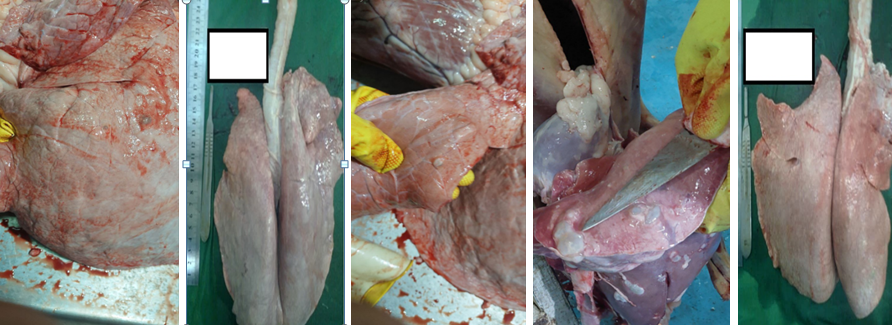
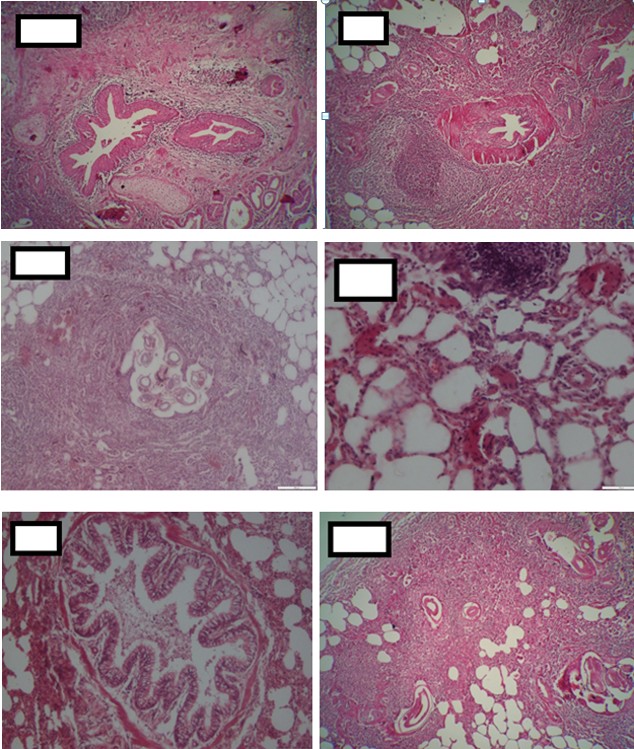
Microscopically, various forms of pulmonary worm lesions were observed in these lungs: In 32 lungs, embryonated eggs and larval worms were observed in the alveoli and bronchioles or sections of the worms in the bronchioles and bronchi. Also, marked hyperplasia of the mucosal muscle of the respiratory tract around the worm sections and metaplastic goblet cells in the bronchioles and hyperplasia of these cells in the walls of the bronchioles were observed. Thickening of the walls of infected alveoli and hyperplasia of lymphoid tissue around the respiratory tract along with the formation of granulation centers (in 8 samples) were other lesions observed in this group. In six of these lungs, cysts containing a considerable number of parasitic bodies were also observed. The walls of these cysts were relatively delicate and made of connective tissue. Eosinophilic granulomatous amass reaction around the necrosis center was another visible lesion in five samples of the examined lungs, observed in microscopic sections. Samples were sent to the parasitology laboratory to diagnose and identify the type of parasites in this study.
Conclusion
Sheep are an important domestic animal in livestock production systems, and their production plays a vital role in the income and protein intake of small-scale livestock farmers. Sheep breeding in Iran faces various problems, and the most important of these is worm infestations. Worm infestations are a significant factor in reducing fertility, conversion rate, slow growth, anemia, and effective and profitable sheep production. By wasting livestock production, it causes significant economic losses to small- scale rural livestock farmers. Lung worms are parasites that can infect the lower respiratory tract and usually lead to the formation of parasitic bronchitis or pulmonary worms. Therefore, controlling these parasites is essential to increase the potential for sheep production. To control parasitic diseases appropriately, strict rules must be established to control them that are implementable for all regions. More than half of sheep mortality and complications on farms are due to pneumonia and internal parasites. Animal infestation with lung worms has a very extensive distribution depending on weather conditions. Larvae need moisture and a temperature of 27 degrees Celsius to grow. They reach the infectious stage within six or seven days. The disease is transmitted by coughing, and the source of infection is meadows and contaminated water. Most cases of pulmonary worms occur in the cold season, especially in autumn and early winter, because the larval stages of the worms tolerate low temperatures and prefer them. In warmer weather, when conditions are often unsuitable for larval survival, the carrier that exists for animals is a more critical source. Contamination of pastures and disease prevalence in lambs is likely to occur after a long rainy period during lactation. The present study was conducted to evaluate the prevalence of pulmonary worms in slaughtered sheep in Tehran province and based on pathological findings. In the study, 37 of the examined lungs were infested with parasites, which had white, gray, or light green nodules.
Nodules were found in the diaphragmatic lobes in 29 cases and in other lung lobes in the remaining cases. According to the study conducted by Mubashir Ali, et al, clinical signs observed in infected sheep include severe cough, loss of body condition, and daily losses, and nodules were observed on the surface of the lungs and discoloration was observed during autopsy, which is consistent with the results of the present study [1]. Reported that the prevalence of contagious bronchitis (pulmonary worms) usually occurs during the fall and early winter, which seems to be correct based on the fact that the study was also conducted in the fall. Engdaw T reported that the prevalence of lung worm infections is low in spring and summer and increases rapidly in fall and winter, which is consistent with the present study [2]. According to a study by Radostits OM [3] although sheep of all age groups are infected with these parasites, young sheep are more susceptible. It cannot be definitely stated that this disease is more prevalent in young sheep, considering that the age of the sheep in the present study was determined based on dental formula. Bekele, et al. [4] reported that severe infection with Dictyocaulus filaria leads to cough, weight loss, respiratory system damage, or even death, which is entirely consistent with the research conducted [5].
According to the study conducted, pulmonary worms exist in sheep [6, 7]. Although macroscopic and pathological methods are not definitive diagnostic methods for identifying pulmonary worms, molecular methods are more reliable for diagnosis [8]. In order to increase the efficiency and profitability of sheep breeding, the use of criteria for limiting and controlling the spread of parasites is recommended [9]. There are effective parasite control methods and drug treatments available that can prevent many of these lesions and damages [10, 11].
References
-
Rather Ali M (2015) Prevalence and pathology of parasitic infestations in slaughtered sheep in Kashmir valley. Journal of Parasitic Diseases, 39 (1): 114-118.
-
Engdaw T (2015) Prevalence and associated risk factors of lung worm infection in small ruminants slaughtered at Adama municipal abattoir, Oromia region, Ethiopia. Global Veterinaria 14 (6): 853-859.
-
Radostits OM, Gay CC, Hinchcliff KW, Constable PD (2010) Veterinary medicine: A textbook of the diseases of cattle, horses, sheep, pigs and goats. Cat Vet J 51(5): 541.
-
Bekele T, Ashenafi H, Getachew T (1992) Efficacy of ivermectin against Dictyocaulus filaria in sheep. Veterinary Parasitology 41 (1): 107-113.
-
Uro F (2019) Prevalence of lungworm infection and associated risk factors in sheep in Wolaita zone, Ethiopia. Journal of Parasitology Research, pp: 1-7.
-
Jenny EH, Campbell AJD, Larsen JWA (2021) Severity and prevalence of small lungworm infection on three South Australian farms and associations with sheep carcass characteristics. Vet Parasitol 296: 109503.
-
Karikalan M (2020) Pneumonia due to protostrongylid lung worms in wild himalayan bluesheep (Pseudoisnayaur), pp: 181-183.
-
Arke AA, Yitayih TT, Moges TM (2020) Comparative Study on Lungworm Infection in Clinically Diagnosed Respiratory Signs and Apparently Healthy Sheep and Cattle in Tiyo District, Central Ethiopia. Nature and Science 18(8): 10-18.
-
Mohammad H, Chalechale A, Malmir E (2019) pulmonary lesions in slaughtered sheep in Western Iran: gross and histopathological findings. Vet Ital 55(1): 47-56.
-
Mark T (2019) Respiratory diseases in sheep. Vet Pract 7(4): 1-2.
-
Getu (2022) Prevalence of lungworm infection and associated risk factors among sheep with respiratory signs and evaluation of public intervention for control and prevention in north shewa zone, oromia, ethiopia. Diss. Haramaya University.
- The Digital Stethoscope: Harnessing AI in Veterinary Medicine Without Losing Our Healing Touch
- Meningoencephalomyelitis of Unknown Etiology: Short-Term Effect of Two Treatment Protocols on Cerebrospinal Fluid
- Safety and Efficacy of the HomeoPet Cough in Domestic Pets –A Clinical and Correction Analysis Based Upon User Response Survey
- Non Human Animals Responses to Social Loss
- Owner Reported Clinical Outcomes of a Homeopathic Proprietary Preparation for the Treatment of Upper Respiratory and Nasal Disorders in Companion Animals
- Effects and Diagnostic Approach of Ultrasound in Veterinary Practice: A Systematic Review