
Assessment of Slaughter Slabs Waste Management on Meat, Environment and Public Health in Khartoum State
Stratified random sampling was adopted for this study to detect and interprets the impacts of three slaughter slabs’ waste on the public and environmental health. While hazard analysis critical control points (HACCP) prerequisite programs (PRPs) in the investigated slaughter slabs were assessed by administering structured checklist. Verification for these PRPs by microbiological quality of meat was determined using both Aerobic Plate Count (APC) and Total Coliform Count (TCC). In addition, the assessment of the awareness of neighborhood residence pertaining public health and environmental hazards implications of the slaughter slabs waste was done by administering two semi-structured questionnaires; the first of which targeted 50 respondents of neighborhood residence and the other targeted 10 hospitals located at the vicinity of the slaughter slabs and contained questions pertaining to medical staff perceptions and medical records of cases diagnosed as public health diseases. The result revealed that the three slaughter slabs failed to attain compliance with FAO requirements. This was reflected in the higher microbial content of meat samples with mean total bacteria count (TBC) 16. 7× 10 5; 16. 6 × 10⁵ and 13.9 × 10⁵ in slaughter slabs A, B and C, respectively. A highly statistically significant difference was found in the TBC between the three slaughter slabs with P < 0.05. These values were higher than the standard permissible limit (1× 10⁵). Moreover, the mean total coliform count using (MPN) in the three slabs were 263, 418 and 361 in slaughter slab A, B and C, respectively with a higher significant difference in the TCC compared to the standard permissible limit (1×10²) of MPN. The results also showed that 90% of the respondents agreed that there were public and environmental hazards of slaughter slab waste to residential neighborhoods. The findings also disclosed that 100% of the investigated physicians in charge of hospitals in the vicinity of slaughter slabs confirmed that there was association between slaughter slab waste and infectious diseases, gastro-intestinal infections as well as spread of respiratory infection. It could be concluded that slaughter slabs’ waste had negatively impacted both public and environmental health of the residential neighborhoods.
Introduction
A slaughter slab is defined as: “A facility where animals are slaughtered for human consumption. It typically consists of a gantry hoist, concrete slab, metal roof, floor rings to hold animals, skinning cradles for cattle and small stock, rails for handling the carcasses, and an adequate and convenient water supply” [1].
Slaughterhouse waste is defined by Bradley PJ, et al. [2] as waste or waste water from a slaughterhouse that may include contaminants such animal faces, blood, fat, animal trimmings, launch content, and urine. The main environmental concerns of slaughterhouse wastewater are the amount of liquid and suspended solid waste and the generation of odours [3]. From one hand, odours from slaughterhouses attract disease vectors such as flies, cockroaches, and rodents. This exposes the neighbors to diseases such as typhoid, cholera, and malaria [4]. On the other hand, wastewater can contaminate both surface and groundwater [5].
Additionally, air pollutants and toxic gases produced by the decomposition and accumulation of animal waste can increase the greenhouse effect, human lung disease, cardiovascular problems, and early death [6]. Therefore, if specific safety measures are not followed, slaughterhouse waste may have negative effects on both humans and the environment [7].
According to WHO [8] and Mustafa E, et al. [9], research institutes in Sudan carried out studies on microbial contamination in meat processing plants, and the results showed high levels of microbiological contamination because hazard analysis critical control points (HACCP) prerequisite programs (PRPs) containing good manufacturing practices (GMPS) and good hygienic practices (GHPS) were not implemented. Consequently, to lessen the harm that slaughter slab waste causes to the environment and national economies, it needs to be properly managed and controlled [10]. Additionally, slaughter slabs must conform to standard procedures and appropriate cleaning techniques to meet public health criteria [11].
The objectives of this study were to evaluate HACCP prerequisite programs (PRPs) in the slaughter slabs, determine the microbiological quality of meat in the examined slaughter slabs and assess the awareness of neighborhood residence regarding public and environmental health implications of the slaughter slabs waste.
Materials and Methods
Study Area
The study was conducted in three slaughter slabs in Khartoum State, of which two were in Omdurman and one in Khartoum north. Slaughter slabs were randomly selected based on the number of slabs, the size of production and the social characteristics of the population in the two areas. Khartoum State is located in the central part of the country, just south of the confluence of the White Nile and the Blue Nile rivers. The state covers an area of 22,142 km2 and has a population of about 8 million people. The state lies between longitudes 31.5 to 34°E and latitudes 15 to 16°N (Khartoum State - Wikipedia).
Khartoum State has an arid and dry desert climate. The temperature in summer ranges from 25 to 40 °C from April to June, and from 20 to 35 °C in the months of July to October. In winter, the temperature declines gradually from 25 °C to 15 °C between November and March. The wettest month is July, with an average precipitation of 30 mm. (Simulated historical climate & weather data for Khartoum - meteoblue).
There are 4 traditional red meat slaughter slabs (local name: Masatib) in Khartoum State. They are designed to produce 105 and 325 heads of cattle and sheep per day, respectively. But the actual daily throughputs are 128 and 400 heads of cattle and sheep per day (6 hrs), respectively (more than the designed capacity). These facilities completely lack lairages, waste management system, hot water for sterilization purposes, chilling facilities and permanent electricity and water supply [12].
Study Design
Stratified random sampling was adopted for this study to detect and interprets impacts of three slaughter slabs’ waste on public and environmental health in Khartoum State. The study was carried out from August to September, 2022.
Data Collection Tools and Technique in Slaughter Slabs
a) Evaluation of HACCP prerequisite programs (PRPs) in the slaughter slabs Standardized and structured checklist was adopted to evaluate good manufacturing practices (GMPs) and Good hygienic practices (GHPs) in the examined slaughter slabs as part of the HACCP prerequisite programs (PRPs) with focus on methods of slab waste disposal.
The following Scoring System was used in the evaluation of PRPs with a conformance level of 80%:
1) Full conformance: 10 points 2) Minor deficiency: 7 points 3) Major deficiency: 3 points 4) Non-conformance: 0 point b) Determination of microbiological quality of meat in the examined slaughter slabs To determine the microbiological quality of meat produced in the investigated slaughter slabs, both Aerobic Plate Count (APC) and Total Coliform Count (TCC) of meat samples were investigated.
Bacteriological Sample Size
A total of 90 swab samples of meat, 30 from each slaughter slab were collected.
Sample Size Determination for Bacteriological Examination
The sample size was estimated using Yamane’s formula presented as equation: n= N/ 1+N (e) 2 Where: n: deterministic samples N: Total population 1:1 is constant e = error limit or margin of error; it is usually accepted at 5% or 0.05
Sampling Procedure, Techniques, and Transportation
The samples were taken from flank sites using the sterile dry swabs method [13, 14] and transported in an ice box (4°C) to laboratory of the college of Applied and Industrial Sciences University of Bahri for microbiological analysis.
Procedure for Evaluation of Bacterial Load
APC will be done by using spread plate method. A spreader will be used to spread the bacteria on to the plate (the suitable colony rang is 25-250) [15].
Most Probable Number (MPN) was used to calculate the total coliform count (TCC). The sample was diluted in several stages, filled into tubes together with a nutrient solution and incubated at an appropriate temperature [16].
c) Assessment of awareness of neighborhood residence regarding public and environmental health implications of the slaughter slabs waste To assess the awareness of neighborhood residence about the public health and environmental hazards implications of the slaughter slabs waste, two questionnaires were administered.
i. A semi-structured interview-administered questionnaire was used for data collection. The World Health Organization questionnaire was used [17]. Fifty respondents of neighborhood residence consisted of men and women between ages of 20 and 60 years old were randomly selected. Close ended questionnaire was used for collection data [18]. The instrument was constructed in four points Likert Scale format with the following scales: 1) Strongly Agree (SA): 4 points 2) Agree (A): 3 points 3) Disagree (D): 2 points 4) Strongly Disagree (SD): 1 point ii. Another semi-structured questionnaire was used to collect data from 10 hospitals located at the vicinity of the slaughter slabs. This contained questions pertaining to medical staff perceptions in addition to medical records of cases diagnosed as public health diseases.
Ethics Approval and Consent to Participate
A verbal consent was obtained from each participant prior to study conduction. In addition, permissions from the medical directors of the hospitals and primary care facilities in the studied areas were obtained before data collection. Confidentiality was kept throughout the study steps.
Statistical Analysis
The collected was data analyzed using statistical packaging for the social sciences (SPSS) Version 23.0 for windows. One sample t. Test, ANOVA test and chi _square test.
Results
Evaluation of HACCP Prerequisite Programs (Prps) In The Slaughter Slabs
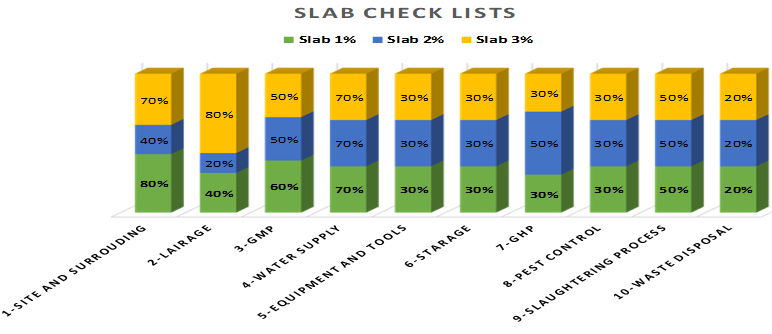
The study showed that the three slaughter slabs failed to attain compliance when evaluated for PRPs (GMPs and GHPs) and scored lower than 80% (Figure 1).
The result showed that only slaughter slab [1] complied with site and surrounding specification (80%), while the others did not. Also, slaughter slab [3] complied with lairage specification (80%), while others did not. The results also revealed that all slaughter slabs did not comply with the specifications of GMPs, water supply, equipment and tools, storage conditions, GHPs, pest control, slaughtering processes, and appropriate waste disposal methods (Figure 1).
Determination of microbiological quality of meat in the investigated slaughter slabs
76667× 105; 16. 66000 × 105 and 13.90333 × 10⁵ in slaughter slabs A, B and C, respectively. There was a highly statistically significant difference in the TBC between the three slaughter slabs with P < 0.05 (Table 1).
The mean total bacteria count (TBC) was found 16.
| N | Mean | Std. Deviation | Std. Deviation | Std. Error | Minimum | Maximum | Sig. | |
|---|---|---|---|---|---|---|---|---|
| TBC | Slab A | 30 | 16.76667x10⁵ | 30.47083 | 5.56319 | 92.5 | 200 | |
| TBC | Slab B | 30 | 16.66000x10⁵ | 27.91872 | 5.09724 | 92.5 | 200 | 0.001 |
| TBC | Slab C | 30 | 139.0333x10⁵ | 34.43057 | 6.28613 | 72 | 200 | |
| TBC | Total | 90 | 157.7667x10⁵ | 33.47271 | 3.52833 | 72 | 200 |
Table 1: The mean total bacteria count in the investigated slaughter slabs.
The mean TBC in the three slaughter slabs was higher than the standard permissible limit of total bacteria count (1× 10⁵) and statistically this difference was highly significant, with P < 0.05 (Table 2).
| Variable | Df | Sig. (2-tailed) | Mean Difference |
|---|---|---|---|
| TBC Slab A | 29 | 0 | 67.667 |
| TBC Slab B | 29 | 0 | 66.6 |
| TBC Slab C | 29 | 0 | 39.033 |
Table 2: One Sample T-test (Total Bacteria Count).
The mean total coliform count using (MPN) of the three slabs were 263, 418 and 361 in slaughter slab A, B and C, respectively. There was highly significant difference in the MPN compared to the standard permissible limit (1×10²) of (table 3), while there were no significant differences in the MPN between the three slaughter slabs with P <0.05 (Table 3).
| N | Mean | Std. Deviation | Std. Error | Minimum | Maximum | Sig. | ||
|---|---|---|---|---|---|---|---|---|
| MPN | Slab A | 30 | 262.37 | 394.3385 | 71.99603 | 3 | 1100 | |
| Slab B | 30 | 417.7333 | 463.4324 | 84.61079 | 20 | 1100 | 0.388 | |
| Slab C | 30 | 360.7333 | 459.0936 | 83.81865 | 15 | 1100 | ||
| Total | 90 | 346.9456 | 439.8769 | 46.3671 | 3 | 1100 |
Table 3: The mean total coliform count (MPN) in the investigated slaughter slabs.
The mean total coliform count (MPN) was significantly higher than the standard permissible limit of the coliform count (1×10²) (Table 4).
| Variable | T | Df | Sig. (2-tailed) | Mean Difference |
|---|---|---|---|---|
| MPN: Slab A | 2.255 | 29 | 0.032 | 162.37 |
| MPN: Slab B | 3.755 | 29 | 0.001 | 317.733 |
| MPN: Slab C | 3.111 | 29 | 0.004 | 260.733 |
Table 4: One Sample T-test (Most Probable Number).
Assessment of Awareness of Neighborhood Residence Regarding Public and Environmental Health Implications of the Slaughter Slabs Waste
This study endeavored to assess the awareness of neighborhood residence about the public health hazards.
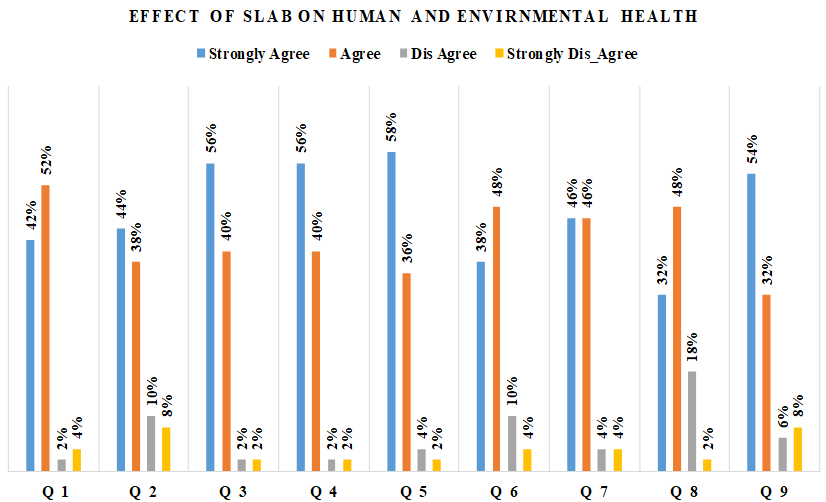
Implications of the slaughter slabs’ waste. In answering the questionnaire 9 questions, Figures 2 &3 show that 90% of the respondents agreed (strongly agree 48% and agree 42%) that there were public and environmental health hazards of slaughter slabs’ waste to residential neighborhoods.
E FFE CT O F S L A B T O T H E H E ALTH O F H UM A N A N D E NVIR ONM ENT
Figure 3 represents the responses of respondents to possible effects of slab waste on human health and environment.
When using chi-square to denote the differences between the answers for each statement in the questionnaire, it was observed that, there were significant associations between the answers of the respondents in the three slabs areas at P <0.05. The test value for all statements was (32.520 / 3/ 0.000) and this value was greater than the chi-square value (Table 5).
| Questions | Interpretation | Test values | Medium | P-value | |
|---|---|---|---|---|---|
| Q1 | Health of residents who are neighbors to slaughter slab is in danger | Agree | 39.76 | 3 | 0 |
| Q2 | Inappropriate slaughter slab waste disposal harms people and environment | Agree | 20.88 | 3 | 0 |
| Q3 | Residents around slaughter slab are infested by flies and mosquitoes with varying degrees as per distance | Strongly agree | 48.08 | 4 | 0 |
| Q4 | The spread of flies and mosquitoes cause diseases to neighbouring residents | Strongly agree | 44.88 | 4 | 0 |
| Q5 | Wastes produced by slaughter slab are associated with several infectious diseases | Strongly agree | 43.6 | 4 | 0 |
| Q6 | Odour emission from slaughter slab could cause eye, nose, and throat irritation, nausea, cough, bronchitis, shortness of breath, stress, drowsiness, and alteration of mood | Agree | 27.28 | 3 | 0 |
| Q7 | Slaughter slab have health and environmental hazards, as well as benefits | Agree | 35.28 | 3 | 0 |
| Q8 | Slaughter slab operations are associated with infection of residents with typhoid, malaria, and diarrhea | Agree | 23.12 | 3 | 0 |
| Q9 | Residents of slaughter slab are at risk of outbreak of water borne diseases due to unhygienic nature of the activities of these operations | Strongly agree | 30.8 | 4 | 0 |
Table 5: Chi-square value.
Questionnaire Results Pertaining to Medical Staff Perceptions in Addition to Medical Records of Cases Diagnosed as Public Health Diseases.
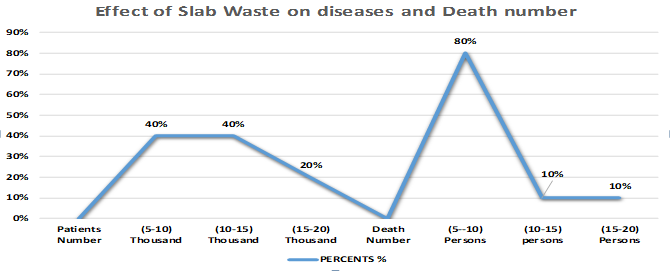
Data also was collected from hospitals located at the vicinity of the slaughter slabs. The figures below contain answers to questions pertaining to medical staff perceptions in addition to medical records of cases diagnosed as public health diseases and deaths.
The percentage of patients and deaths per year in hospitals and primary care facilities in the vicinity of slaughter slabs is shown in (Fig 4): the examined patients between 5-10 thousand/year as well as between (10-15) thousand per year were 40% out of the total number of patients and between 15-20 thousand/year were 20%, out of the total number of patients. The number of human deaths per year: deaths registered in hospitals and health care facilities rate between 5-10 person/year were 80%, out of the total number of deaths, and between 10-15 and 15-20 person/year were 10% annually, out of the total number of deaths (Figure 4).
SLAB SMELL AND DISEASES
Eyes, Nose and throat irritation
$$ \square $$ $$ \square $$
40% Nausea, Stress and Breath shortness
60% Figure 5: Relation between smell from slaughter slab and eye, nose, nausea, stress, and breath shortness according to physicians’ responses.
Slaughter slab odour was found to cause eye, nose, throat irritation, nausea, and cough (resp. diseases). According to physicians’ responses (60%) there was relation between smell from abattoir and nausea, stress, and breath shortness as well as between eyes, nose, and throat irritation (40%) (Figure 5). Slaughter slab waste was found to be associated with several infectious diseases. All (100%) of the investigated physicians in charge of hospitals and primary care facilities in the vicinity of slaughter slabs confirmed that there were association between slaughter slab waste and spread of flies and infectious diseases like malaria, typhoid and gastro-intestinal infections as well as spread of respiratory infection (Figure 6).
Also, all the respondents agreed that there was a relationship between slaughter slabs waste and public health (Figure 6).
Figure 6 shows that all (100%) respondents agreed that there were relationships between slaughter slab waste and public health, infectious diseases, spread of malaria, typhoid and diarrhea, and the spread of gastrointestinal and respiratory diseases.

Discussion
This study showed that the three slaughter slabs failed to attain compliance with standards set by FAO [1] when assessed for GMPs and GHPs. They also failed to attain compliance in other investigated parameters and scored lower than 80%.
The non-compliance of GMPs specifications of the slaughter slabs in the present study might be due to poor infrastructure and poor environmental practices. This result is consistent with Adebowale O, et al. [19] who disclosed that investigated abattoirs in their study area were typically characterized by inadequate waste management facilities, unhygienic operations, and environmental pollution of air and water. The result is also supported by Douglas KE, et al. [20] who investigated health implications of sanitation in a public abattoir in Port Harcourt, Nigeria and Oloruntoba EO, et al. [21] in Ibadan, Southwest Nigeria and found that the abattoir lacked sanitary infrastructure and processes such as waste disposal, and pest control.
The result also aligns with Singh AL, et al. [22] who revealed that all the slaughterhouses suffer from very low hygienic standards posing both environmental and human health hazards due to discrete disposal of waste.
Nonconformance of potable water supply found in this study is consistent with the evaluation of abattoirs conducted in Ibadan, Southwest Nigeria, by Oloruntoba EO, et al. [21], who discovered that only one (8.3%) of the abattoirs had sufficient access to a potable water supply. This is a significant factor that affects sanitation procedures [23].
This study also demonstrated low conformance to pest control program in the investigated slaughter slabs. This may pose a risk to public health by polluting air, soil, and water and attracts flies and other disease-vectors [24].
Contrary to that stated by Bakum C [23], the finding of the current study revealed that all slaughter slabs had very low efficient waste management methods. This finding agrees with Obigiegwu C, et al. [25], who noted that abattoirs in underdeveloped nations frequently struggle to handle, dispose of, and process waste in a way that is acceptable to the environment. It also aligns with Elniema MA, et al. [9] who reported that there were no environmentally friendly abattoir waste disposal methods in slaughter slabs in Sudan. Furthermore, this result is consistent with that of Oloruntoba EO, et al., Oruonye ED, Nwachukwu CG and Olowoporoku OA [21, 26, 27, 28] in Nigeria who stated that many of the examined abattoirs had inadequate solid waste management procedures.
In the present study meat swab samples acted as a verification tool for the assessment of GMPs and GHPs in the investigated slaughter slabs. The mean TBC and MPN in the three slaughter slabs were higher than the standard permissible limit of total bacterial count and statistically this difference was highly significant, with P < 0.05.
The higher bacterial counts in meat samples in the present study may be potentially linked to noncompliance of PRPs. Similarly, Elniema MA, et al., Abdalla MA, et al., Ali AA, Salman AMA, et al., Shuaib YA, et al. and Elhassan IM, et al. [9, 29, 30, 31, 32, 33] concluded that slaughterhouses and other meat operations in Khartoum State, Sudan revealed higher levels of microbial contamination than the acceptable value set by the international standards.
In the present study, physical observation and information from the questionnaire revealed that slaughter slabs activities in the study area showed respondents’ great awareness of the dangers of slaughter slab waste on public health.
These findings agree with the findings of who disclosed negative effect of abattoir operations on the health of people in Ogbomoso, Osun State, Nigeria [5, 34]. The findings equally corroborate the earlier findings of who submitted that abattoir operations carried out in different areas under investigation had negative effects on public health and safety [29, 35, 36].
Contrary to this finding, Adonu RE, et al. [35] stated that more concerns are being expressed over the dangers to the health of residents who are neighbours to abattoirs, especially in developing countries where level of awareness is low.
This study disclosed that most (86%) of the of the investigated respondents said that residents neighbouring slaughter slabs are at risk of outbreak of water borne diseases due to unhygienic nature of the activities of these operations.
This finding is consistent with who reported that host communities and workers living within and around the Gwagwalada abattoir in Gwagwalada Area Council of the FCT, Abuja, Nigeria are at risk of outbreak of water borne diseases [18].
In the current study all (100%) of the investigated physicians in charge of hospitals and primary care facilities in the vicinity of slaughter slabs confirmed that there were association between slaughter slab waste and spread of flies and infectious diseases. Similar to this finding, medical expert reported association of some diseases with abattoir activities which include: pneumonia, diarrhoea, typhoid fever, asthma, respiratory and chest diseases [5, 37, 38].
These results are also agreed with who reported that some microorganisms such as P. aeruginosa, Salmonella typhimurium, Vibrio cholerae, G. intestinalis, Legionella spp., E. coli, Shigella sonnei may be released in the environment from animal establishments and enter the food chain via public water supply systems [39, 40].
This study showed that all (100%) respondents agreed that there were relationships between slaughter slab waste and public health, and infectious diseases. These results are supported by the findings of who reported that abattoir solid waste and waste water in neighborhood when it decomposes, it favours breeding of flies, attracts rodents and vermin and the resultant diseases are typhoid and paratyphoid, fever, diarrhoea/dysentery, cholera, hookworm, other intestinal infections etc [22, 41]. Singh AL, et al. [22] also reported that residents living in the vicinity of the slaughterhouses i.e. 0 to 3 km had reported headache, general body ache and weakness, excessive coughing, shortness of breath and other respiratory symptoms, fever, typhoid fever, jaundice, cholera, diarrhoea/ dysentery, and malaria.
The finding also aligned with that of who investigated the negative impact of abattoir activities and management in residential neighborhoods in Kuala Terengganu, Malaysia and reported that the prevalence of typhoid fever, diarrhoea and coughing were 14.4%, 12.5 and 10.7%, respectively were associated with abattoir activities [42].
Moreover, similar findings were reported by Wing S, et al. [37] who assessed the effects of slaughterhouse activities on the health of surrounding residents in Osogbo Nigeria and found that the proportion of residents that treated for malaria and diarrhoea continually in the study areas was 69.4 % and 70.4 %, respectively. Similar results also were obtained by Bell YO, et al. [5] in Ogbomoso, Nigeria.
Aligning with results of this study, serious health risks such as campylobacteriosis, diarrhea, encephalitis, typhoid, giardiasis, hepatitis A, poliomyelitis, salmonellosis, and gastroenteritis associated with the microbial contaminants in untreated waste water are reported by Indiana State Department of Health and Okoh AI, et al. [43, 44].
Conclusion
It could be concluded that slaughter slabs’ waste in the investigated area had negatively impacted both public and environmental health of the residential neighborhoods.
Acknowledgement
The author would like to thank the staff members of the College of Veterinary Medicine and College of Science, University of Bahri and the medical staff of hospitals and primary care units in the investigated area and other respondents who participated in the study for their cooperation and support.
References
-
Food and Agriculture Organization of the United Nations (FAO) (1988).FAO/SIDA Cooperative Programme. Rural Structures in East and South-East Africa. Farm structures in tropical climates. Viale delle Terme di Caracalla 00153 Rome, Italy.
-
Bradley PJ, Migaki G, Taylor KE (2009) Meat Hygiene: 3rd (Edn.), London, UK.
-
Gauri SM (2006) Treatment of waste water from abattoir before land application: a review. Bioresource Technology 97(9): 1119-1135.
-
Daramola OP (2012) Clapping With One Hand: The Case of Urban Environmental Sanitation Practices in Nigeria. Journal of Applied Technology in Environmental Sanitation 2(4): 223-228.
-
Bell YO, Oyedemi DTA (2009) The impact of abattoir activities and management in residential neighbourhoods: A case study of Ogbomoso, Nigeria. J Soc Sci 19(2): 121-127.
-
Ogbonna DN, Ekweozor IKE, Igwe FU (2002) Waste management: A tool for environmental protection in Nigeria. JSTOR 31(1): 55-57.
-
Osibanjo O, Adie GU (2007) Impact of effluent from Bodija abattoir on the physicochemical parameters of Oshunkaye stream in Ibadan city, Nigeria, AJOL 6(15): 1806- 1811.
-
WHO (2000) Food safety: Resolution of the Executive Board of the WHO. 105th session.
-
Elniema MA, Adil SMA, Hamad IM (2016) Review on Food Safety System with Reference to Meat Operations in Khartoum State, Sudan. RAJAR 2(7): 2394-6709.
-
Odjadjare EE, Ebowemen MJ (2020) Antibiogram of Pseudomonas isolates and potential public health impact of an abattoir effluent in Benin City, Nigeria. AJOL 21(3): 240-249.
-
Nwanta JA, Onunkwo JI, Ezenduka VE, Phil PO, Egege SC (2008) Abattoir operations and waste management in Nigeria: A review of challenges and prospects. SJVS 7(2): 61-67.
-
Ministry of Agriculture, Animal Wealth and Irrigation (MAAI) (2015) The Annual Report. Ministry of Agriculture, Animal Wealth and Irrigation, Khartoum State. In: Elniema A, et al. Review on Food Safety System with Reference to Meat Operations in Khartoum State, Sudan. RAJAR 2(7): 2394-6709.
-
Petersen JA (2016) Laboratory Exercises in Microbiology: Discovering the Unseen World Through Hands- On Investigation. CUNY Academic Works.
-
Public Health England (2015) Sample Processing and result entry in StarLims Standard Method FNES6 (Q 12), Version 4.
-
(2001) Food and Drug Administration Science & Research (Food).
-
Bartram J, Pedley S (1996) A Practical Guide to the Design and Implementation of Freshwater Quality Studies and Monitoring Programmes.
-
World Health Organization (2006) Five keys to safer food manual. Zoonoses and foodborne diseases.
-
Ekpo CG (2019) Environmental Problems Associated with Abattoir Operations in Gwagwalada Area Council, Federal Capital Territory, Abuja. ASSRJ 6(3): 215-226.
-
Adebowale O, Akinkuotu O, Kehinde O (2012) Public health implication of unwholesome practices at a municipal abattoir in south-western Nigeria. Journal of Natural Science Engineering and Technology 11(1): 136-
-
Douglas KE, Ovua A, Orji C, Sapira B (2013) Health implications of sanitation in a public abattoir in Port Harcourt, Nigeria. AJOL 13(2): 91-95.
-
Oloruntoba EO, Adebayo AM, Omokhodion FO (2014) Sanitary conditions of abattoirs in Ibadan, Southwest Nigeria. Afr J Med Med Sci 43(3): 231-237.
-
Singh AL, Jamal S, Baba S, Islam MM (2014) Environmental and Health Impacts from Slaughter Houses Located on the City Outskirts: A Case Study. Journal of Environmental Protection 5(6): 566-575.
-
Bakum C (2017) Waste Management. International Encyclopedia of the Social & Behavioral Sciences. In: Wright JD, (Ed.), 2nd (Edn.), Elsevier Waste Management: Definition, Goals & Future Trends, pp: 697-702.
-
Singh VP, Neelam S (2011) a survey report on impact of abattoir Activities Management on environments. Indian Journal of veterinarians 6: 973-978.
-
Obigiegwu C, Chineke H, Ubajaka C, Adogu P (2019) Public health challenges in Somachi main abattoir Owerri, Nigeria: A review and field activity report. EJMED 1(2):1-7.
-
Oruonye ED (2015) Challenges of abattoir waste management in Jalingo Metropolis, Nigeria. IJRG 1(2): 22-31.
-
Nwachukwu CG (2015) Environmental sanitation situation in abattoirs in Onitsha metropolis. Knowledge Review 32(1): 37-44.
-
Olowoporoku OA (2016) Assessing environmental sanitation practices in slaughterhouses in Osogbo, Nigeria: Taking the good with the bad. Journal of Environmental Science 1: 44-54.
-
Abdalla MA, Suliman SE, Bakhiet AO (2010) Methods for Reduction of Contamination of Indigenous Cattle Carcasses during Slaughtering. Assuit Vet Med J 56(158): 86-93.
-
Ali AA (2007) Prevalence of bacterial contamination of public health concern on bovine carcasses at Khartoum state-Sudan. M.Sc. Thesis Sudan University of Science and Technology, Sudan.
-
Salman AMA, Elniema AM, Iman MH (2014) Some Quality Aspects of Fresh and Refrigerated Beef Cuts in Alkadaro Slaughterhouse, Khartoum- Sudan. RAJAR 2(7): 491-504.
-
Shuaib YA, Mohamed AK, Noor MSE, Suliman SE, Abdalla MA (2015) Evaluation of the Safety Status of Beef for Domestic Consumption during Processing at Three Slaughterhouses in Omdurman, the Sudan. IOSR-JAVS 8(4): 22-27.
-
Elhassan IM, Abdelgadir AE, Ibrahim AE (2011) Microbiological assessment of mutton intended for export from Elkadaro export slaughter house, Sudan. AJMR 5(8): 893-897.
-
Weobong CA, Adinyira EY (2011) Operational impacts of the Tamale abattoir on the environment. Journal of Public Health and Epidemiology 3(9): 386-393.
-
Adonu RE, Dzokoto L, Salifu SI (2017) Sanitary and hygiene conditions of slaughterhouses and its effect on the health of residents: A case study of Amasaman slaughterhouse in the Ga west municipality, Ghana. Food Science and Quality Management 65: 11-15.
-
Daramola OP, Olowoporoku AO (2017) living with a fatal choice: Effects of slaughterhouse activities on residents’ health in Osogbo, Nigeria. International Journal of Environmental Problems 3(1): 26-35.
-
Wing S, Wolf S (2000) Intensive livestock operations, Health and Quality of life among Eastern North Carolina Residents. Environmental Health Perspectives 108(3): 233-238.
-
Alayu E, Yirgu Z (2018) Advanced technologies for the treatment of wastewaters from agro- processing industries and cogeneration of by-products: a case of slaughterhouse, dairy and beverage industries. International Journal of Environmental Science 15(7): 1581-1596.
-
Craun MF, Craun GF, Calderon RL, Beach MJ (2006) Waterborne outbreaks reported in the United States. J Water Health 4(2): 19-30.
-
Craun GF, Brunkard JM, Yoder JS, Roberts VA, Carpenter J, et al. (2010) Causes of outbreaks associated with drinking water in the United States from 1971 to 2006. Clin Microbiol Rev 23(3): 507-528.
-
Salahuddin M (2011) Household Level Waste Management in Aligarh City. B.R. Publishers, New Delhi, India.
-
Abdullahi A, Norizhar K, Azmi H, Ibrahim S (2015) Negative Impact of Abattoir Activities and Management in Residential Neighbourhoods in Kuala Terengganu, Malaysia. IJPHS 4(2): 121-130.
-
Indiana State Department of Health (2009) Diseases Involving Sewage.
-
Okoh AI, Sibanda T, Gusha SS (2010) inadequately treated wastewater as a source of human enteric viruses in the environment. IJERPH 7(6): 2620-2637.
- The Digital Stethoscope: Harnessing AI in Veterinary Medicine Without Losing Our Healing Touch
- Meningoencephalomyelitis of Unknown Etiology: Short-Term Effect of Two Treatment Protocols on Cerebrospinal Fluid
- Safety and Efficacy of the HomeoPet Cough in Domestic Pets –A Clinical and Correction Analysis Based Upon User Response Survey
- Non Human Animals Responses to Social Loss
- Owner Reported Clinical Outcomes of a Homeopathic Proprietary Preparation for the Treatment of Upper Respiratory and Nasal Disorders in Companion Animals
- Effects and Diagnostic Approach of Ultrasound in Veterinary Practice: A Systematic Review