
A Report on Emerging Evidence and Implications of COVID-19 Related Tinnitus: Preliminary Survey Results
This research explores the COVID-19 vaccination connection to tinnitus, considering its onset and exacerbation post vaccination. A survey of 417 respondents (mean age 63.2 years), mainly European American/White, studied COVID-19, vaccines, and tinnitus. Preliminary results showed those aged 46 to 65 had higher tinnitus rates. Pfizer-BioNTech was common (initial first dose 54%), and 86.7% hadn't had COVID-19 infection prior to vaccination. Before vaccination, 45.8% reported no tinnitus, while 32.4% had persistent tinnitus symptoms. Tinnitus symptoms worsened post-vaccination for most, with varying durations. The onset of new tinnitus post vaccination occurred particularly after the second dose. Psychological distress is linked to tinnitus development, affecting the quality of life. A participant's struggle underscores the need for support. The conclusion emphasizes vigilance, intervention, and collaboration to address tinnitus and its impact. Ongoing research is essential for understanding COVID-19-related tinnitus
Introduction
Research is underway to uncover the mechanisms responsible for COVID-19-related tinnitus, which can manifest as either new-onset symptoms or the worsening of preexisting tinnitus. Potential factors contributing to tinnitus in COVID-19 patients include direct impact on the auditory system, inflammation within the inner ear, immune responses triggered by the virus, systemic illness effects, and medications used in COVID-19 treatment.
Survey Study
A survey study assessed the prevalence and impact of COVID-19 and vaccines on tinnitus. The survey was designed to address (i) if the COVID-19 virus had any impact on preexisting tinnitus, (ii) if the COVID-19 vaccination had any impact on preexisting or lead to the on-set of tinnitus, and (iii) whether the pandemic-induced circumstances affect existing tinnitus or hyperacusis. The questionnaire was designed to capture demographics, occurrence, characteristics, and the change of tinnitus before and after COVID-19 vaccination.
The study encompassed 421 participants with an average age of 55.6 years (14.2 SD). The majority of respondents identified as European American/White. Regarding gender distribution, 51.4% were female, 47.8% were male, 0.3% identified as other, and 0.5% did not disclose their gender. Notably, individuals aged 40 years and above displayed a higher degree of impact, particularly within the age bracket of 46 to 70 years, who exhibited a more pronounced occurrence and alteration in tinnitus perception.
Covid-19 Infection/Vaccination and Tinnitus
In the early stages of the pandemic, tinnitus emerged as one of the initial indicators of COVID-19 [1].
Subsequent case reports [2, 3, 4] and comprehensive studies further indicated its frequent occurrence among affected patients [5, 6]. Studies like Erinc, et al. [7] reported the relationship between tinnitus and hyperacusis in patients affected by COVID-19 infection. The authors reported a notable increase in tinnitus reporting in individuals affected by COVID-19 and hyperacusis has worsened in individuals who did not get in contact with COVID vaccine.
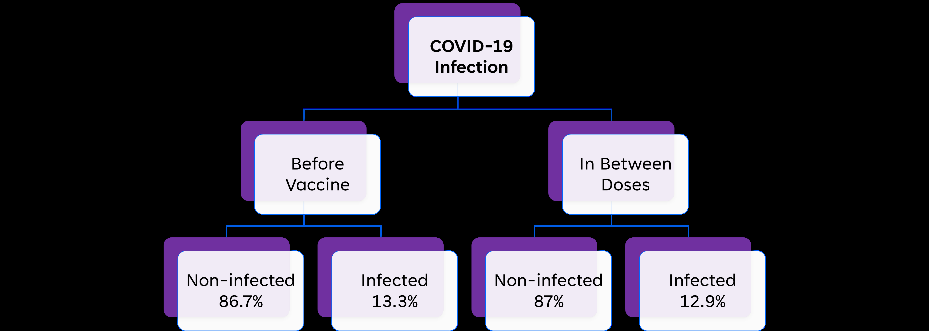
In the current study, 86.7% of the participants had not Contacted COVID-19 prior to receiving any dosage, and 87% remained uninfected throughout the intervals between doses refer to Figure 1. Among this group, 5% of those infected required hospitalization. Analysis of responses indicated that 53.5% received a total of two doses along with a booster, with Pfizer-BioNTech being the primary initial vaccine chosen by 54% of individuals, followed by Moderna refer to Table 1.
| First Dose | Second Dose | Frist Booster | Second Booster | |
|---|---|---|---|---|
| Pfizer-BioNTech | 211 | 211 | 152 | 89 |
| Moderna | 150 | 150 | 114 | 78 |
| Johnson & Johnson | 12 | 12 | 4 | 2 |
| Total Responded Count | 373 | 373 | 270 | 169 |
Table 1: COVID-19 Vaccination Manufacturers and Count of Responded for Each Dose.
Before COVID-19 vaccination (BCV), 45.8% of respondents did not experience tinnitus symptoms, while 54% had preexisting tinnitus. The described tinnitus manifestations included roaring, ringing, hissing, buzzing, and sounds resembling crickets. Among these, 64.1% of individuals reported ringing as the most common symptom. Regarding ear distribution, 13.8% experienced tinnitus in the right ear, 14.2% in the left ear, 61.5% in both ears, 6.4% at the center of the head, and 4.1% described the location as other.
Following COVID-19 Vaccination (ACV), tinnitus was reported by 91.8% of participants, while 8.2% indicated the absence of tinnitus. Changes in tinnitus, marked by adverse symptoms, were more prevalent after the first dose (35.6%) and second dose (37.3%) refer to (Table 2). Among the 346 individuals who experienced altered tinnitus or new instances of tinnitus post-ACV, the reported symptoms included ringing, roaring, high-pitched electric whirling, hissing, buzzing, sensation of air in the ears, and whistling, occurring in both ears. Predominantly, this tinnitus was described as high-pitched in nature (30.27%), with 278 cases (80.35%) describing it as continuous and 37 cases (10.69%) as intermittent or fluctuating.
| Dose Number | Reported change in the Tinnitus Count (%) |
|---|---|
| 1st Dose | 84(35.6%) |
| 2nd Dose | 88(37.3%) |
| 1st Booster | 66 (28%) |
| 2nd Booster | 31(13.2%) |
| 3rd booster | 3 (1.27%) |
| Total Responded Count | 236 (100%) |
| Change in tinnitus perception and new onset of tinnitus after vaccination (Time) | Count (%) |
| Up to 4 hours | 41 (15.24%) |
| After 24 hours | 44 (16.36%) |
| After a few days | 70 (26.02%) |
| After a few weeks | 37 (13.75%) |
| After a month | 12 (4.46%) |
| Between 1-3 months | 29 (10.78%) |
| Between 3-6 months | 17 (6.32%) |
| 6+ months | 19 (7.06%) |
| Total Responded Count | 269 |
Table 2: Alterations in Tinnitus Perception - the Change Observed Relative to COVID-19 Vaccination Dose Number and Booster Number
Participants reported that their tinnitus symptoms worsened within a few days after vaccination, with the duration of exacerbation varying from a few hours to a few months. Out of the total responded count (269), 70 (26 %) individuals reported to have noticed the change after a few days. Detailed data shown in (Table 3).
In individuals with preexisting tinnitus (108), the changes in tinnitus perception were reported a few days post-vaccination by 25.6% of respondents. For individuals with a new onset of tinnitus, 161 respondents experienced symptoms post vaccination, with 40.2% reporting onset following the second dose. The onset of tinnitus symptoms varied among respondents, but a majority reported onset occurring after a few days following vaccination.
When comparing tinnitus occurrence frequency for BCV and ACV “Have you had noise (such as ringing or buzzing) in your head or in one or both ears that lasts for more than five minutes?” the total counted responses were greater for ACV (74.8 %) for Yes, most or all of the time (90%- 100%) compared to BCV (32.6%). For ACV, only 34 (8.3%) out of 408 responded individuals reported no, never compared to BCV (45.9%) Refer to Table 4.
| Have you had noise (such as ringing or buzzing) in your head or in one or both ears that lasts for more than five minutes | BCV | ACV |
|---|---|---|
| Yes, most or all of the time (90%- 100%) | 135 (32.6%) | 305 (74.8%) |
| Yes, a lot of the time (50% to 90%) | 33 (8%) | 38 (9.3%) |
| Yes, some of the time (30% to 50%) | 56 (13.5%) | 31 (7.6%) |
| No, never | 190 (45.9) | 34 (8.3%) |
| Total Responded Count | 414 | 408 |
Table 3: Tinnitus Occurrence Frequency Ratings for Before COVID Vaccination (BCV) and After COVID Vaccination (ACV).
Psychological Well-Being During Pandemic and Tinnitus
Stress and anxiety during the pandemic have been linked to some individuals’ tinnitus development [8, 9].
Several studies have reported a rise in anxiety, depression, and other psychopathologies during the COVID-19 pandemic [10, 11, 12, 13]. Individuals who experience tinnitus have a devastating impact on their lives. The majority of the participants in the survey reported to have adverse effects on the quality of life due to the sudden onset of tinnitus post vaccination. These effects descriptions ranged from mild to severe anxiety, sleeplessness or difficulty sleeping, difficulty focusing on work, fear of tinnitus getting worse, and suicidal thoughts.
One of the participants described their condition as follows: After receiving the three booster shots from Pfizer in October 2022, I developed tinnitus after 20 days. To date, I have received a total of five shots. Seeking relief, I consulted with two ENT doctors, both of whom provided the same diagnosis - that there is currently no known cure for tinnitus, and they couldn’t offer any specific treatment. Their advice was to learn to cope with the condition. Regrettably, following this counsel from the specialists, I struggled with insomnia and anxiety attacks for about two and a half weeks, pushing me to the brink of desperation. The severity of the situation led me to seek a semester of medical leave from the university where I work, hoping to find assistance in my home country.
Such experiences emphasize the importance of timely intervention and support for tinnitus patients.
Based on the self-reported results from this survey study future research might need to focus on questions related to tinnitus reported by 91.8% of participants after COVID-19 vaccination such as, how does this prevalence compare to the rates observed in other m-RNA vaccinations? What could be potential mechanisms linking the COVID-19 vaccination to changes in tinnitus, and how might these findings contribute to our understanding of the vaccine’s effects and physiological manifestations? In light of the findings, what considerations should be considered when assessing and addressing tinnitus-related concerns in individuals receiving COVID-19 vaccinations?
Conclusion
While ongoing research aims to uncover the precise mechanisms linking COVID-19 to tinnitus. Healthcare professionals should be vigilant in recognizing and documenting cases of tinnitus in COVID-19 patients. Timely intervention, collaboration with audiology specialists, and supportive care are crucial in alleviating the impact of tinnitus on patients’ well-being. As the investigation continues, healthcare providers should remain attentive to the emerging evidence surrounding COVID-19-related tinnitus.
Ethical Clearance: Approved IRB from San Jose State University IRB board.
References
-
Liang Y, Xu J, Chu M, Mai J, Lai N, et al. (2020) Neurosensory dysfunction: a diagnostic marker of early COVID-19. International Journal of Infectious Diseases 98: 347-352.
-
Chirakkal P, Al Hail AN, Zada N, Vijayakumar DS (2021) COVID-19 and Tinnitus. Ear Nose Throat Journal 100(2suppl): 160S-162S.
-
Daher GS, Nassiri AM, Vanichkachorn G, Carlson ML, Neff BA, et al. (2022) New onset tinnitus in the absence of hearing changes following COVID-19 infection. American Journal of Otolaryngology 43(1): 103208.
-
Lamounier P, Gonçalves VF, Ramos HVL, Gobbo DA, Teixeira RP, et al. (2020) A 67-year-old woman with sudden hearing loss associated with SARS-CoV-2 infection. The American journal of case reports 21: e927519.
-
Kalcioglu MT, Cag Y, Kilic O, Tuysuz O (2020) Can COVID-19 cause sudden sensorineural hearing loss? International Journal of Infectious Diseases 101: 205.
-
Munro KJ, Uus K, Almufarrij I, Chaudhuri N, Yioe V (2020) Persistent self-reported changes in hearing and tinnitus in post-hospitalisation COVID-19 cases. Int J Audiol 59(12): 889-890.
-
Erinc M, Mutlu A, Celik S, Kalcioglu MT, Szczepek AJ (2022) Long-Term Effects of COVID-19 and the Pandemic on Tinnitus Patients. Frontiers in Neurology 13: 921173.
-
Bhatt IS, Wilson N, Dias R, Torkamani A (2022) A genome- wide association study of tinnitus reveals shared genetic links to neuropsychiatric disorders. Scientific Reports 12(1): 22511.
-
Szczepek AJ, Mazurek B (2021) Neurobiology of stress- induced tinnitus. Curr Top Behav Neurosci 51: 327-347.
-
d’Ettorre G, Ceccarelli G, Santinelli L, Vassalini P, Innocenti GP, et al. (2021) Post-traumatic stress symptoms in healthcare workers dealing with the COVID-19 pandemic: a systematic review. International Journal of Environmental Research and Public Health 18(2): 601.
-
Kar N, Kar B, Kar S (2021) Stress and coping during COVID-19 pandemic: Result of an online survey. Psychiatry research 295: 113598.
-
Kauhanen L, Wan Mohd Yunus WMA, Lempinen L, Peltonen K, Gyllenberg D, et al. (2023) A systematic review of the mental health changes of children and young people before and during the COVID-19 pandemic. European Child and Adolescent Psychiatry 32(6): 995- 1013.
-
Khademia F, Delavari S, Koohjani Z, Khademian Z (2021) An investigation of depression, anxiety, and stress and its relating factors during COVID-19 pandemic in Iran. BMC public health 21(1): 1-7.
- 4th Branchial Cleft Sinus Anomaly Presenting as Recurrent Thyroid Abscess in A Child: A Case Report
- Parotid Duct Injury Repaired Using an Angiocatheter Stent: A Case Report
- Organization and Functionality of the Referral and Counter-Referral System for ENT Disorders in District Hospitals of N’Djamena, Chad: A Cross-Sectional Analytical Study
- Facial Metastases from a Gastrointestinal Stromal Tumor: A Case Report
- Panorama of Ent Cancers and Literature Review: Epidemiological Profile and Therapeutic Management
- Could Antimicrobial Resistance Prove to Be Both a Threat and an Opportunity for us?