
Challenges in Teaching and Research in the Energy Sector
There is a set a multifaceted challenges facing the global energy scenario in both developed and the developing world. While the developed countries are trying to transition away from the conventional energy resources, the developing countries are unable to fully harness the available energy resources. The issues range from environmental considerations, supply and demand mismatch, dwindling reserves, financial and technological inadequacy, logistics of energy production, transmission and consumption, and the social issues. To address these issues facing the globe, it is essential for the academic world to come up with new ways of teaching and research. A response proportionate to the problems demands innovative research to achieve sustainable development of energy resources, while at the same time taking care of social well-being and environmental quality. There is a perceptible lack of clarity in addressing these issues in the current agenda of teaching and research in the energy sector. They are mostly confined to their respective silos, fossil fuels or alternative sources of energy, while a broad-based agenda is needed with active involvement of the government, to focus on the big challenges. It is proposed that there are three important aspects which influence the teaching and research agenda, and focusing on these will provide the solutions to the energy issues facing the globe. First, collaboration between academicians and policymakers is required in order to prioritize the issues in energy supply and demand, logistics, social well-being, and global climate. Secondly, there is a need for increased focus on the identification and characterization of climatological and social impact of alternative sources of energy. Thirdly, industries and government should increase spending on human capital development to improve training and R&D activities on energy sustainability.
Introduction
The human society and its well-being rely on the sustenance and processes associated with economic, environmental, and socio-political systems [1]. The humankind structures its lives through the adoption and incorporation of responses and solutions that reflect its preferences and access to resources. Many uncertainties have hampered the efforts to achieve energy sustainability across the globe. Fundamentally, the academic culture has not evolved sufficiently to mount adequate responses at the scale of the energy issues facing the world. The inadequacy of the adaptive capacity is evidence in research institutes charged with addressing the grand challenges. A response proportionate to the problems requires advanced research on sustainable development that would balance global wealth with enhanced social well-being and environmental quality [2].
Review
The history of energy use illustrates the competition in usage of different sources of energy and dictates the exploitation of resources. Currently, crude oil, coal, and natural gas continue playing a crucial role in the global energy mix. Although engineers and scientists have developed clean energy technologies such as clean coal, it remains contentious on whether such technologies will offset the increasing carbon footprint. The growth in the global energy demand, the economic investment requisite for the implementation of the technologies, and the race to minimize the damage emanating from the continued use of fossil fuels has exacerbated the challenge [3]. A multiplicity of factors has exacerbated the current energy issues across the world. Fossil fuels have been a major source of energy across the globe. However, the consumption of fossil fuels has been associated with many issues. For instance, fossil fuel consumption in the US totalled approximately eighty quadrillion Btu (British Thermal Units) as of 2011. Renewable energy and nuclear energy contributed only 9.1% and 8.3% respectively. Non-renewable sources of energy such as fossil fuels have created environmental concerns, especially greenhouse gas emissions. The net increase in the consumption of fossil fuels has led to the deposition of billion tones of atmospheric CO2 [3].
A recent phenomenon has been explosive growth of the Internet and the digital economy that has spurred the growth of data centers consuming electricity 24 hours a day. The average iPhone consumes more energy annually than a medium-sized refrigerator [4]. Our computers and smart phones might seem clean, but the digital economy uses a tenth of the world's electricity — and that share will only increase, with serious consequences for the economy and the environment. According to a recent report of the Greenpeace, electricity demand of data centers is expected to rise by 81% by the year 2020 [5]. The aggregate electricity demand of the cloud was 684 billion kWh in 2011 and is forecasted to increase by 63% in 2020 [6]. It also suggests that global carbon footprint of data centers and telecommunications networks would increase carbon emissions on average between 5% - 7% each year up to 2020. But if energy efficiency could be achieved leading to energy saving gains, the positive effect of energy efficiency might outweigh the negative effect of increased electricity consumption. Effective coordination between energy efficiency from ICT (information- communications-technologies, otherwise known as the digital economy) policy, and existing emissions reduction policies have the potential to reduce environmental hazards arising from electricity consumption for the digital economy [7]. According to Hassan, Boostanimehr, & Bhargava, facility-level consumption, especially in data centers, raises the greatest concern regarding energy consumption and efficiency [8]. Hence, energy saving in datacentres remains a crucial concern in research and academics. Nevertheless, Crow (2010) observes that the ability of the research institutes to develop adaptive responses to the grand challenges remains contentious.
Path of Action
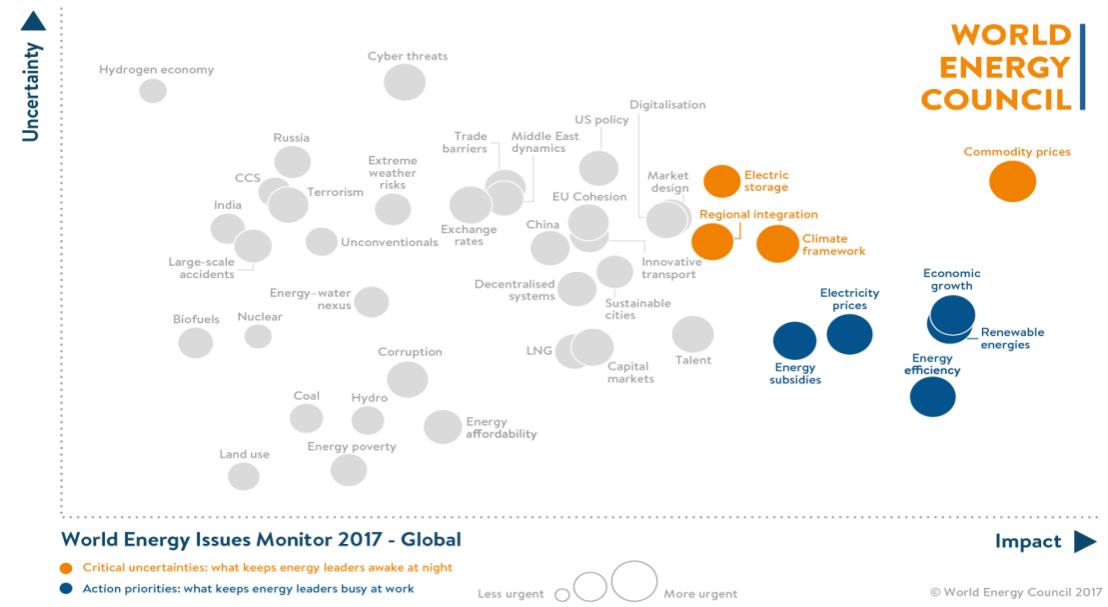
The global energy sector faces critical uncertainties and lacks a clear path of action. The World Energy Council provides an overview of the issues that global energy governance should monitor to provide solutions as illustrated in Figure 1 [9]. Global environmental politics have tried to address the uncertainties although the research agenda for the provision of viable solutions across the globe remains limited [10]. Falkner suggests the need for the research agenda to focus on ecological limits and environmental impacts, the notion of global environmental governance, and the notion of energy sustainability. Moreover, the grand challenge pertinent to research and training relates to the development of future alternatives, anticipation of problems, and the consequences of the alternatives developed through R&D activities [11]. Essentially, the global sources of energy will have to evolve from those reliant on sunlight stored in chemical bonds of fossil fuels and focus on renewable sources of energy. Some of the research areas that require additional focus include direct conversion of sunlight to energy through engineered technologies and extraction of energy from biota through photosynthetic process. While the energy pathways are related to the deployment of technology, the development of the technologies and the associated processes require a scientific foundation based on appropriate training [11]. Many scholars in the energy sector support the notion that global energy governance faces the challenge of fragmentation of policy, research, and training [12]. According to Kottari, the global energy system requires an integration of the traditional security concerns with the quest of environmental sustainability through a clear research agenda [13].
Teaching and Research Agenda
The human race faces an enormous challenge pertinent to the production, transmission, conversion, consumption, effects, and sustainability of energy. As illustrated above, the challenges are associated with the research agenda. The following overarching recommendations could help in charting a way forward in research and teaching to address the global energy issues. First, researchers and policymakers should collaborate to prioritize the research agenda for meeting the goals of energy supply, social well- being, and climate change. The research agenda should focus on meeting three demands – securing energy supply, reducing energy poverty, and protecting the global climate. The key policy concern in this case would be the promotion of understanding of the interrelationship of the three global goals. Achieving long- term energy sustainability should remain a core research area from the global environmental politics perspective. De-carbonizing energy should become the overriding concern in future technological and scientific research agenda. Secondly, there is a need to identify and characterize earth system drivers, vulnerabilities, and feedback. While the current research has tried to focus on renewable energy sources, there has been minimal research that has focused on the vulnerability and resilience of the new technologies to changing climatic conditions [11]. Therefore, researchers should focus on aspects like these, such as understanding ways to identify, quantify, and model methodologies of present carbon sinks to increase the effectiveness in the removal of atmospheric CO2. Third, governments should take additional measures in funding training and research on energy sustainability. Currently, only a few institutes offer undergraduate and graduate programs related to sustainability. Integration of sustainability courses across institutions of higher learning and provision of funds for increased R&D activities could help in the development of adaptive solutions to the global energy issues. The National Science Board of the US points at the importance of human capital development in addressing energy sustainability and marinating a healthy energy economy [14].
Conclusion
The concerns about climate changes have led to concerns about capability of research institutes and R&D centers to deliver commensurate solutions to the problem. Continued reliance on fossil fuels and increased dependence on datacenters have created concerns about the increasing quantum of electricity use and the need to focus on energy efficiency. While environmental concerns pervade the global energy system, the delivery of innovative and adaptive strategies to mitigate the problems has remained challenging. Although many mechanisms have emerged, their long-term impacts have not received adequate research attention. This paper has highlighted some of the critical areas that should be addressed pertinent to research and training. Fundamentally, human capital development remains the key to addressing the global energy issues through an improved and clear research agenda.
References
-
Holdren JP (2008) Science and technology for sustainable well-being. Science 319(5862): 424-434.
-
Crow MM (2010) Organizing teaching and research to address the grand challenges of sustainable development. Bioscience 60(7): 488-489.
-
Coyle ED, Simmons RA (2014) Understanding the global energy crisis. Purdue University Press, USA.
-
Mills MP (2013) The Cloud Begins With Coal: Big Data, Big Networks, Big Infrastructure, and Big Power, Digital Power Group.
-
GeSI Smarter (2020) The Role of ICT in Driving a Sustainable Future. Retrieved. Global e-Sustainability Initiative aisbl and The Boston Consulting Group.
-
Greenpeace International (2014) Clicking Clean: How Companies are creating the Green Internet. Greenpeace Inc, USA.
-
Salahuddin M, Alam K (2016) Information and communication technology, electricity consumption and economic growth in OECD countries: A panel data analysis. Electrical Power and Energy Systems 76: 185-193.
-
Hasan Z, Boostanimehr H, Bhargava VK (2011) Green cellular networks: A survey, some research issues and challenges. IEEE Communications surveys & tutorials 13(4): 524-540.
-
World Energy Council (2017) World energy issues monitor, 2017. WEC, England.
-
Falkner R (2014) Global environmental politics and energy: mapping the research agenda. Energy Research & Social Science 1: 188-197.
-
Arkin A, Baliga N, Braam J, Church G, Collins J, et al. (2010) Grand challenges for biological and environmental research: A long-term vision, University of Missouri, USA.
-
Florini A, Sovacool BK (2009) Who governs energy? The challenges facing global energy governance. Energy Policy 37(12): 5239-5248.
-
Kottari M (2016) A new era for global energy governance? The environmental imperatives and the EU perspective. Politikon 29: 124-139.
-
National Science Board (2009) Building a sustainable energy future. NSBI (9): 1-74.
- Nigeria’s Vulnerability in the Face of Global Energy Policy
- A Simulation Study of Investigation of Optimum Oil Production Performance by Applying Various Gas Injection Methods in Oil Reservoir
- Characterization of Permo-Triassic Reservoirs through Thermal Maturity Assessment of Westphalian Source Rocks in the Cheshire Basin
- Influence of Microwax on the Rheological and Thermal Behaviour of a Wax Crude Oil
- Real-Time Monitoring and Performance Optimization of Steam Injection in Heavy Oil Reservoirs Using Fiber Optic Sensing and Integrated Predictive Simulation Models
- Rapid On-Site Determination of the Total Petroleum Hydrocarbon Content of Soils by Handheld Fourier Transform Near-Infrared Spectroscopy: Development of a Global, Site- and Scanner- Independent Calibration Model