
Reorientation of Hydrocarbons Chains in Gasoline Fuels under Exposure to Static Magnetic Field: A Starting Point for Increasing Energy Efficiency of Motor Vehicles
We report the result that the reorientation of hydrocarbons chain in gasoline fuel is induced by an applied static magnetic field. Indeed, 1 h 30 min exposure of samples of gasoline fuel to a 150 mT static magnetic field provided the result that CH2 bending vibration around 1465 cm-1, CH3 symmetrical band at 1378 cm-1 and C–C stretching at 1610 cm-1 decreased significantly, whereas CH2 twisting band around 1230 cm-1 increased significantly after exposure. These findings demonstrated that a reorientation of hydrocarbons chains occurs under an applied magnetic field. This relevant result can be used to increase the energy efficiency of motor vehicles.
Calabrò E1,5,* and Magazù S1,2,3,4
Sciences of Messina University, Italy
Sadron, Université d’Orléans, 1b rue de la Férollerie, France
and Earth Sciences of Messina University, Italy; Tel: +390906765019; Email: e.calabro@yahoo.com can be used to increase the energy efficiency of motor vehicles.
Introduction
In this review paper the response of gasoline fuel under exposure to a static magnetic field (SMF) studied by Fourier Transform Infrared (FTIR) spectroscopy analysis was reported in order to demonstrate that changes of vibration bands can induce an increase of the combustion of air-fuel mixture. Gasoline fuel is obtained from petroleum crude oil and is composed by a mixture of hydrocarbons, mostly alkanes, i.e. on the form Cn H2n+2. The primary constituent of fuel gasoline is n-butane (C4H10), n-pentane (C5H12), n-hexane (C6H14), n-heptane (C7H16) and above all n-octane (C8H18). The properties of gasoline are dependent on the species contained in the blend [1, 2]. We know that hydrocarbons in motors gasoline fuel burn mixing with air by means of the combustion represented by the reaction with oxygen, whose the most representative is the chemical reaction with octane, which produces heat and pressure within the cylinder during the four-stroke combustion cycle [3, 4]. A relevant problem in motor vehicles is how maximize the energy efficiency of this combustion cycle. To this aim, the engineers should choose the correct air/fuel ratio. The power output of motor vehicles strictly depends on the amount of fuel that can be combusted in the cylinders. Nevertheless, only about 20% of the total energy obtained by the combustion process can be used, because the remaining 80% is lost to friction and wasted as heat. Scientists, government agencies and vehicle manufacturers have largely searched methods to increase the efficiency of motor vehicles. Indeed, the potential to improve fuel efficiency by gasoline’s combustion in engines is enormous [5, 6]. Such research has been encouraged by government agencies also to reduce the emissions limiting the output and reactivity of pollutants, in particular the emission of CO2 [7]. Recent studies showed that natural magnets located in a point around the tube where gasoline flows towards carburetor can increase gasoline’s combustion efficiency and the output energy due to the enhancing of reaction with the oxygen during the combustion process [8, 9, 10, 11]. This result was not confirmed by experiments coordinated by the Environmental Protection Agency (EPA) in USA, whose result showed that no significant difference are detected between the use of magnetic field devices inserted in the fuel plant of motor vehicles and the traditional fuel plant in analogue vehicles [12]. Nevertheless, we think that applying a SMF to the entire gasoline tank in motor vehicles would produce different effects from the traditional case as the whole amount of fuel gasoline would be subject to the SMF, contrary to previous studies in which only a small area of the tube where gasoline flows was subjected to a magnetic field. In order to demonstrate this assumption, the response of gasoline vibrations to SMF was studied by means of FTIR spectroscopy. This technique has been successfully used in previous studies to highlight the characteristics of petroleum compounds [13, 14, 15].
Materials and Methods
Gasoline Samples and Experimental Set-Up
Different gasoline samples were collected from various commercial processing plants and subjected to the following assay. The octane number of gasoline was 95. Each sample consisted of 15 ml of gasoline placed in small glass containers. Either exposed and control samples were located in the same room at the temperature at 20°C. Exposed samples were placed between two Helmholtz coils, at the center of the coils distance, that were driven by a DC generator producing a uniform magnetic field intensity at 150 mT, following the theory of Helmholtz coils, as accurately described in [16, 17].
Infrared Spectroscopy
FTIR spectroscopy was applied to gasoline samples by using a spectrometer Vertex 80v of Bruker Optics. Gasoline samples of 200 μl were placed between a pair of CaF2 windows and for each spectrum 64 interferograms were collected with a spectral resolution of 4 cm-1. Interactive baseline correction, smoothing correction, vector area normalization were used for exposed and control samples as accurately described in [18, 19, 20] Finally, statistical analysis was applied to 18 different samples of gasoline fuel using Student’s t-test for comparisons between exposed and unexposed samples, with p-values less than 0.05 considered significant.
Results and Discussion
Representative transmittance spectra of exposed and unexposed samples after 15 min exposure in the region 3000-1200 cm-1 were reported in Figure 1, in which exposed and unexposed samples spectra are represented by red and blue color, respectively.
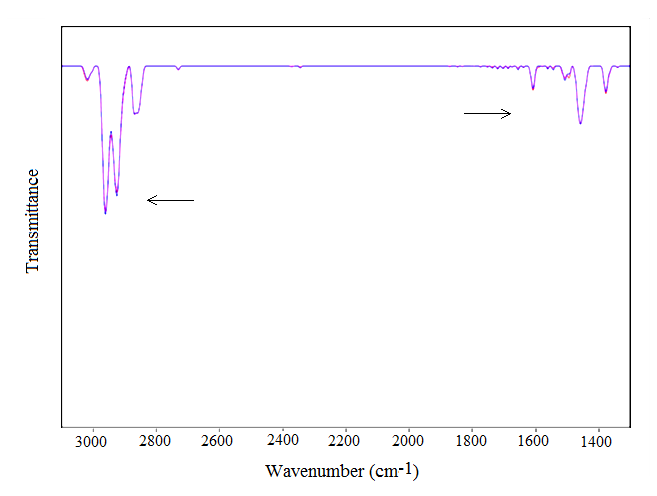
1 and 2922 cm-1, respectively; also, the symmetric
stretching of methyl sCH3 and methylene sCH2 are represented by the vibrations at 2885 and 2840 cm-1, respectively [21, 22]. No appreciable changes in these vibrations were observed under exposure to SMF at 150 mT up to 1 h 30 min. This result was confirmed applying Fourier Self-deconvolution (FSD) analysis [23]. Furthermore, the band around 1465 cm-1 observed in the spectra, assigned at CH2 scissoring vibration did not change significantly after 15 min exposure (Figure 2A), but decreased significantly (p < 0.05) after 1 h 30 min of exposure (Figure 2B), showing that exposure to SMF can change CH2 bending vibration in gasoline fuel [24, 25, 26].
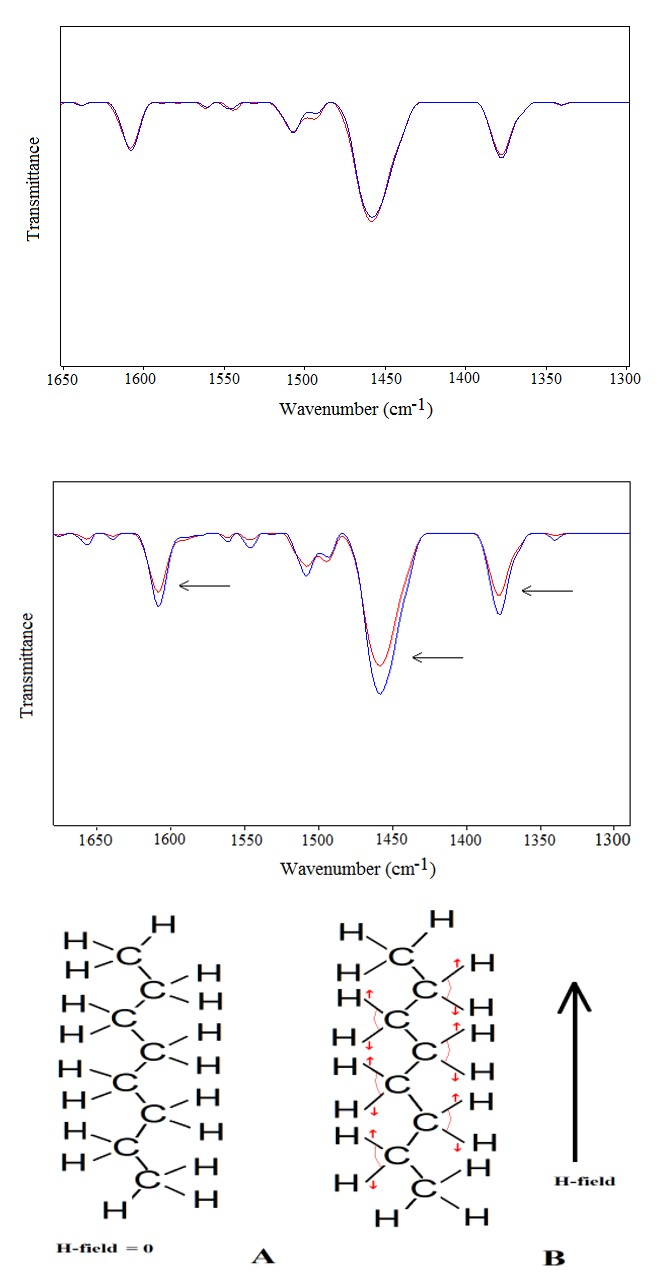
Figure 2A: Representative FTIR spectra from 1650 to 1300 cm-1 of gasoline fuel after 15 min of exposure to a static magnetic field at the intensity of 150 mT. The spectra of exposed samples are represented in red color.
Figure 2B: Representative FTIR spectra from 1650 to 1300 cm-1 of gasoline fuel after 1 h 30 min of exposure to a static magnetic field at the intensity of 150 mT. CH2 bending vibrations at 1610, 1465 and 1378 cm-1 (pointed out by arrows) decreased in intensity after exposure. The spectra of exposed samples are represented in red color. In addition, the peak at 1378 cm-1 can be attributed to CH3 symmetrical deformation band and the bands observed at 1655, 1610 and 1522 cm–1 can be attributed to C–C stretching vibrations [29]. The C–C aromatic ring stretch is represented by the vibration at 1495 cm-1. Also, the strong vibrations at 1610 and 1378 cm-1 decreased in intensity significantly (p < 0.05) after exposure up to 1 h 30 min (Figure 2B). The classical theory of diamagnetism is able to explain the change in intensity of the main vibration bands of gasoline fuel, observed after exposure to SMF. Indeed, aliphatic hydrocarbons that compose gasoline fuel are diamagnetic substances with diamagnetic susceptibility whose intensity increases with increasing of the number n of carbon atoms in the chain CnH2n+2 [30]. Diamagnetism consists of a magnetic field created in diamagnetic materials which opposes to the external applied magnetic field. Thus, a SMF applied to gasoline fuel should induce a magnetic field in the fuel which opposes to the applied field. As a result, the application of a SMF on gasoline samples should induce the alignment of gasoline chains with their axes parallel to the field, opposing to it. This phenomenon was already observed in macromolecules like polymers, that align along the direction of an applied SMF which can induce the reorientation of the polyethylene chains towards the direction of the field [31, 32, 33]. In this scenario, the decrease in intensity of bending vibrations observed after exposure to SMF can be explained as follows. The CH2 chains of octane molecule are at equilibrium with a nonzero dipole moment. Under the exposure to SMF, these chains begin their motion aligning with the applied field and opposing to it, causing that the angle bends become larger than in the absence of a magnetic field (Figure 3A & Figure 3B). As a result, the dipole moment is reduced so that corresponding bending vibrations of CH2 and CH3 decrease in intensity because the reorientation of hydrocarbons chains.
Figure 3A: Scheme of the octane chemical structure in gasoline fuel before exposure to a SMF. Figure 3B: Scheme of the octane chemical structure in gasoline fuel representing its rearrangement in plane after exposure to a SMF.
Also, the increase in intensity of the vibration at 1230 cm-1 which was observed by Calabrò and Magazù, can find its explanation. In fact, this band can be attributed to out of plane twisting of CH2 group. The deviation of direction of C–H linkages from CH2 plane should induce an increase of dipole moment which opposes to the external field. The enlargement of the angles in plane and out of plane between the C–H linkages of CH2 group should induce an increasing of combustion process. Indeed, the application of a SMF should induce opposite spinning electrons to have parallel spins, generating a magnetic field opposing to the external field [34]. As a result, parallel spinning electrons could react with oxygen atoms more rapidly than molecules with paired electrons spinning opposite directions, so that the combustion process increases with increasing of the applied SMF. Also previous study are in agreement with our result. Indeed, it was observed that hydrocarbons viscosity decreases with increasing of the applied SMF, so that better atomization of the fuel should verify [35]. In view of these findings, it can be hypothesized to plan a gasoline tank embedded in the magnetic field produced by a permanent electromagnet, driven by the same electric plant which is in the motor vehicle, so that the magnetic field originated by the magnet can increase during the motion of the vehicle [36, 37, 38, 39].
Conclusions
Hydrocarbons in gasoline fuel under exposure to a SMF at the intensity of 150 mT were studied using FTIR spectroscopy. First, no appreciable change of symmetric and asymmetric stretching of CH3 and CH2 vibration bands was observed after exposure to SMF. In contrast, bending vibration bands decreased significantly after 1 h 30 min of exposure such as vibration band at 1465 cm-1 assigned at CH2 scissoring vibration. This result can be explained by the theory of diamagnetism, assuming that hydrocarbons chains reoriented towards the direction of the applied SMF, opposing to it. Also the methyl symmetrical deformation band at 1378 cm-1 and C–C stretching vibrations at 1610 cm-1 decreased in intensity after exposure to SMF, confirming this scenario. These findings showed that an enlargement of the angles in plane and out of plane between the C–H linkages of CH2 group occurred after exposure to SMF, favoring the combustion with oxygen. As a result, the energy efficiency of motor vehicles could increase hypothesizing to plan a gasoline tank embedded in the magnetic field produced by a permanent electromagnet, driven by the same electric plant which is in the motor vehicle.
References
-
Gary JH, Handwerk GE (2001) Petroleum Refining Technology and Economics. 4th (Edn.) Marcel Dekker, New York.
-
Speight J (2008) Synthetic Fuels Handbook: Properties, Process, and Performance. 1st (Edn.), McGraw-Hill, New York.
-
Ferguson CR, Kirkpatrick AT (2001) Internal Combustion Engines: Applied Thermosciences. 3rd (Edn.) Toronto: Wiley and Sons.
-
Taylor CF (1985) The Internal Combustion Engine in Theory and Practice: 2nd (Edn.), Combustion, Fuels, Materials, Design. Cambridge: The MIT Press.
-
Baglione M, Duty M, Pannone G (2007) Vehicle System Energy Analysis Methodology and Tool for Determining Vehicle Subsystem Energy Supply and Demand. SAE World Congress, Detroit, Michigan.
-
Bandivadekar A, Bodek K, Cheah L, Evans C, Groode T, et al. (2008) On The Road in 2035: Reducing Transportation's Petroleum Consumption and GHG Emissions. MIT Lab. for Energy and Env Cambridge: Report No. LFEE 2008-05 RP.
-
Arai M (1993) Continuous Analysis of Vehicle Exhaust Gas by Fourier-Transform Infrared Spectroscopy. Analytical Sciences 9: 77-82.
-
Farrag A El Fatih, Gad M Saber (2010) Effect of Fuel Magnetism on Engine Performance and Emissions. Australian Journal of Basic and Applied Sciences 4(12): 6354-6358.
-
Okoronkwo CA, Nwachkwu CC, Ngozi-Olehi LC, Igbokwe JO (2010) The effect of electromagnetic flux density on the ionization and the combustion of fuel (An economy design project). Am J Sci Ind Res 1(3): 527-531.
-
Faris AS, Al-Naseri SK, Jamal N, Isse R, Abed M, et al. (2012) Effects of Magnetic Field on Fuel Consumption and Exhaust Emissions in Two-Stroke Engine. Energy Procedia 18: 327-338.
-
Attar A, Tipole, P, Bhojwani, V (2013) Experimental Investigation of Effect of Magnetic Field on Hydrocarbon Refrigerant in Vapor Compression Cycle. IJERT 2(8): 2106-2112.
-
Environmental Protection Agency (EPA) (1980) Emission Control Technology Division – Office of Mobile Source Air Pollution Control, USA.
-
Zhang X, Qi X, Zou M, Wu J (2012) Rapid detection of gasoline by a portable Raman spectrometer and chemometrics. Journal of Raman Spectroscopy 43(10): 1487-1491.
-
Moigradean D, Poiana MA, Gogoasa I (2012) Quality characteristics and oxidative stability of coconut oil during storage. Journal of Agroalimentary Processes and Technologies 18(4): 272-276.
-
Shakirullah M, Ahmad I, Ishaq M, Ahmad W (2009) Study on the Role of Metal Oxides in Desulphurization of Some Petroleum Fractions. Journal of the Chinese Chemical Society 56(1): 107-114.
-
Magazù S, Calabrò E, Campo S, Interdonato S (2012) New Insights into Bioprotective Effectiveness of Disaccharides: a FTIR Study of Human Haemoglobin Aqueous Solutions exposed to Static Magnetic Fields. Journal of Biological Physics 38(1): 61-74.
-
Calabrò E, Condello S, Currò M, Ferlazzo N, Caccamo D, et al. (2013) Effects of Low Intensity Static Magnetic Field on FTIR spectra and ROS production in SH-SY5Yneuronal-like cells. Bioelectromagnetics 34(8): 618-629.
-
Condello S, Calabrò E, Caccamo D, Currò M, Ferlazzo N, et al. (2012) Protective effects of agmatine in rotenone-induced damage of human SH-SY5Y neuroblastoma cells: Fourier transform infrared spectroscopy analysis in a model of Parkinson’s disease. Amino Acids 42(2-3): 775-781.
-
Magazù S, Calabrò E, Campo S (2010) FTIR Spectroscopy Studies on the Bioprotective Effectiveness of Trehalose on Human Hemoglobin Aqueous Solutions under 50 Hz Electromagnetic Field Exposure. J Phys Chem B 114(37): 12144-12149.
-
Calabrò E, Magazù S (2015) Fourier –Self – Deconvolution Analysis of β-sheet Contents in the Amide I Region of Haemoglobin Aqueous Solutions under Exposure to 900 MHz Microwaves and bioprotective effectiveness of sugars and salt solutions. Spectroscopy Letters: An International Journal for Rapid Communication 48(10): 741-747.
-
Kauppinen JK, Moffatt DJ, Mantsch, HH, Cameron DG (1981) Fourier self- deconvolution – a method for resolving intrinsically overlapped bands. Appl Spectrosc 35(3): 271-276.
-
Byler DM, Susi H (1986) Examination of the Secondary Structure of Proteins by Deconvolved FTIR Spectra. Biopolymers 25(3): 469-487.
-
Calabrò E, Magazù S (2015) FTIR Spectroscopy Analysis of Molecular Vibrations in Gasoline Fuel under 200 mT Static Magnetic Field Highlighted Structural Changes of Hydrocarbons Chains, Petroleum Science and Technology 33(19): 1676- 1684.
-
Parker FS (1971) Applications of infrared spectroscopy in biochemistry, biology, and medicine. Springer US, New York: Plenum Press, pp: 602.
-
Rigas B, Morgello S, Goldman IS, Wong PTT (1990) Human colorectal cancers display abnormal Fourier- transform IR spectra. Proc Natl Acad Sci USA 87(20): 8140-8144.
-
Stuart BH, Ando DJ (1997) Biological applications of infrared spectroscopy. Chichester: John Wiley and Sons, Analytical Chemistry by Open Learning, pp: 212.
-
Usami T, Takayama S (1984) Identification of Branches in Low-Density Polyethylenes by Fourier Transform Infrared Spectroscopy. Polymer Journal 16(10): 731-738.
-
Nielson JR, Holland RFJ (1960) The _b_1_u_ methylene wagging and twisting fundamentals in crystalline polyethylene. J Mol Spectr 4: 488-498.
-
Quillard S, Berrada K, Louarn G, Lefrant S, Lapkowski M, et al. (1995) In situ Raman spectroscopic studies of the electrochemical behavior of polyaniline, New J Chem 19: 365374.
-
Mulay LN, Boudreaux EA (1976) Theory and Applications of Molecular Diamagnetism, Wiley- Interscience publication.
-
Calabrò E, Magazù S (2013) Demicellization of Polyethylene Oxide in Water Solution under Static Magnetic Field Exposure Studied by FTIR Spectroscopy. Adv in Phys Chem pp: 8.
-
Anwer A, Windle AH (1993) Magnetic orientation and microstructure of main-chain thermotropic copolyesters. Polymer 34 (16): 3347-3357.
-
Christianen PCM, Shklyarevskiy IO, Boamfa MI, Maan JC (2004) Alignment of molecular materials in high magnetic fields. Physica B 346: 255-261.
-
Calabrò E (2015) Motor Gasoline’s Hydrocarbons Vibration Bands in the Mid-Infrared Region under Exposure to a Static Magnetic Field. Spectroscopy Letters: An International Journal for Rapid Communication 48(8): 593-599.
-
Attar AR, Tipole P, Bhojwani V, Deshmukh S (2013) Effect of Magnetic Field Strength on Hydrocarbon Fuel Viscosity and Engine Performance. Int J of Mech Eng& Comp Appl 1(7): 94-98.
-
Al-Ghouti MA, Al-Degs YS, Amer M (2008) Determination of motor gasoline adulteration using FTIR spectroscopy and multivariate calibration. Talanta 76(5): 1105-1112.
-
Berrada, Quillard, Louarn, Lefrant (1995) Synth Met 69: 201.
-
Dharaskar SA, Wasewar KL, Varma MN, et al. (2013) Synthesis, characterization and application of 1-butyl- 3-methylimidazolium tetrafluoroborate for extractive desulfurization of liquid fuel, Arabian Journal of Chemistry.
-
Trew VCG (1953) The diamagnetic susceptibility of some alkyl benzenes and higher aliphatic hydrocarbons. Transactions of the Faraday Society 49: 604-611.
- Nigeria’s Vulnerability in the Face of Global Energy Policy
- A Simulation Study of Investigation of Optimum Oil Production Performance by Applying Various Gas Injection Methods in Oil Reservoir
- Characterization of Permo-Triassic Reservoirs through Thermal Maturity Assessment of Westphalian Source Rocks in the Cheshire Basin
- Influence of Microwax on the Rheological and Thermal Behaviour of a Wax Crude Oil
- Real-Time Monitoring and Performance Optimization of Steam Injection in Heavy Oil Reservoirs Using Fiber Optic Sensing and Integrated Predictive Simulation Models
- Rapid On-Site Determination of the Total Petroleum Hydrocarbon Content of Soils by Handheld Fourier Transform Near-Infrared Spectroscopy: Development of a Global, Site- and Scanner- Independent Calibration Model