
Investigating the Effect of Different Nanofluids Types on Crude Oil Viscosity
In the last few years, some literature deals with oil viscosity reduction using nanoparticles. These nanoparticles will act as a catalyst during steam injection. In this research, seven different nanoparticles types investigated to study their effect on crude oil viscosity reduction. These nanoparticles comprise Potassium Aluminum Sulphate, Nickel oxide, Zeolite, Silica, Ferric oxide, Tungsten trioxide, and montmorillonite, with a particle size of 5 nm. Each nano solution was prepared in four different concentrations (0.005, 0.01, 0.1 and 1 wt. %). Flooding displacements carried out through the sandpack model using nanofluids and Egyptian crude oil of 30.7 API that was extracted from the Western Desert. After conventional brine flooding, the crude oil viscosity was measured to be 6.429 cp. While viscosity of the same crude oil was found to be 2.844 cp, 2.05 cp, 2.02 cp, 1.897 cp, 0.989 cp, 0.9612 cp and, 0.949 cp after flooding with Nickel oxide, montmorillonite, Fe2O3, Potassium aluminum sulfate, zeolite, tungsten trioxide, and nanosilica respectively.
Introduction
In the past few years, some changes were noticed in the way in which crude oil is extracted all over the global market. As in Latin America, the production of crude oil was increased by approximately 4.4 MM bbl/day. About 1 MM bbl/day out of this production growth, was produced by the upgrading of crude oil properties from Venzuela [1]. Alomair, et al. [2] stated that there is a noticeable effect of nanoparticles floodings like SiO2, NiO2, and tungsten trioxide, on the alteration of crude oil interfacial tension and viscosity [3]. Nanoscale of any particle type has shown their ability in the change of its chemical and physical properties due to the difference between the particles at their naturally occurring size, and those at the nanoscale size. In other words, nanoparticles of a certain material can have a totally different behavior than the material in its natural size [1]. The use of nanotechnology was commonly needed in the downstream industry [4] since nanoparticles can reduce oil viscosity, minimize interfacial tension and alter rock wettability [5, 6]. For the optimum nanofluid displacement, the nanoparticles concentration should exceed the critical micelle concentration (CMC), in order to decrease the interfacial tension and increase the oil recovery factor [7, 8]. Crude oil viscosity greatly effects on reservoir primary production. Therefore, decreasing the crude oil viscosity, increase the oil mobility and consequently improves oil recovery factor. The main reason for increasing the viscosity of crude oil is the reactions between the clusters. These micelle-like clusters are the product of the asphaltenes molecules agglomeration inside the crude oil. Crude oil viscosity reduction can occur when the clusters reactions stop by breaking the agglomeration between asphaltenes molecules. One of the recommended solutions is reducing the crude oil viscosity by adding kerosene to the oil. By the way, it was widely assumed that kerosene does not break the asphaltenes molecules agglomeration. However, kerosene has shown its role as an effective diluents [9]. Nanoparticles have the ability to break down the agglomeration between the asphaltenes molecules and reduce the crude oil viscosity [10]. A series of chemical reactions have shown a noticeable performance for decreasing the crude oil viscosity. Clark et al. [11] stated that the addition of nanometals to the process of thermal hydrocarbon recovery can guarantee a more reduction in the oil viscosity when it is compared with steam injection only. However, there is not a possible way to combine these nanoparticles with the steam injection till now. Accordingly, this research assumes that the best applicable method to investigate the effect of nanoparticles on the crude oil viscosity is to measure the oil viscosity after being exposed to nanofluid displacement [12]. Wettability alteration or the change of the formation surface from oil wet to water wet has a great enhancement to the oil recovery. Due to the changing of the relative permeability, fluid distribution and flow behavior [13]. Some nanoparticles have approved their ability on changing the surface from hydrophobic to hydrophilic. In other words, some of the nanoparticles can change the surface properties from repelling water, to attract water and repelling oil instead [6]. Accordingly, the electrostatic repulsion between oil and formation is noticed to be much higher during the existence of some nanoparticles. Which in turn increase oil recovery [13]. In this research, we investigate the effect of nanoparticles flooding on the oil recovery factor. The used nanoparticles including; Zeolite, tungsten trioxide, montmorillonite, Fe2O3, Silica oxide, NiO and Potash Aluminum Sulfate. Each nanofluid prepared in four El-hoshoudy AN, et al. Investigating the Effect of Different Nanofluids Types on Crude Oil Viscosity. Pet Petro Chem Eng J 2018, 2(4): 000177.
different concentration (0.005, 0.01, 0.1 & 1 wt%). Conventional water flooding case was considered as the base run, four different concentrations for seven different types of nanoparticles including 28 different displacing studies were compared to the conventional waterflooding case. The point of comparison was the effect of each case on oil recovery. Properties of flooded oil were also measured to investigate the nanoparticles effect on oil viscosity reduction and recovery factor.
Experimental
Preparation of Brine
Sodium chloride (NaCl) was used for preparing brine with a concentration of 35,000 ppm. This brine was then used for initiating sand pack where the sand pack was firstly saturated with brine and then crude oil displaced the brine to imitate reservoir-like conditions. Moreover, brine was used for preparing the displacing nanofluid solution through sonication process for 2-3 hours.
Equipment and Characterization
The density of the fluids measured by Pycnometer. While Chandler rolling ball viscometer used to measure the viscosity of the fluid. Finally, Tensiometer was used to measure the interfacial tension. The density of crude oil was measured to be 0.8 g/cc and (API= 30.7). The interfacial tension between crude oil and brine was measured to be 47.9 dyne/cm. While the viscosity was measured to be 6 cp for the crude oil. However, the viscosity of water was measured by the rolling ball viscometer to be 1.584 for water.
Sand Pack Model and Flooding Tests
Flooding tests generated through the one-dimensional sandpack model as depicted in Figure 1. The model dimensions summarized in Table 1. The technique carried out according to the following steps; Model Packing and Fluid Saturation: Firstly the model filled with the sand and packed well, then flooded with brine till saturation and aged for 3 days. After that, oil displaces the brine until the water cut becomes less than 1%. Accordingly, the amount of displaced brine is the same amount of the initial oil in place for this case [14, 15, 16, 17]. The calculations of porosity, permeability, initial oil, and water saturation, as well as residual oil saturation, are reported elsewhere [18].
Copyright© El-hoshoudy AN, et al.
Waterflooding: The base run case involves brine injection to displace the oil and this simulates the conventional water flooding scenario. The amount of oil displaced by brine was measured to determine the oil recovery factor. Then, viscosity and interfacial tension of the displaced oil was measured.
![Figure 1: The model dimensions summarized in Table 1. The technique carried out according to the following steps; **Model Packing and Fluid Saturation:** Firstly the model filled with the sand and packed well, then flooded with brine till saturation and aged for 3 days. After that, oil displaces the brine until the water cut becomes less than 1%. Accordingly, the amount of displaced brine is the same amount of the initial oil in place for this case [14- 17]. The calculations of porosity, permeability, initial oil, and water saturation, as well as residual oil saturation, are reported elsewhere [18].](/fulltextimages/3057/fig_1.jpeg)
| Properties | Value |
|---|---|
| Internal diameter, cm | 6 |
| Length, cm | 15 |
| Bulk volume, cc | 424 |
| Pore volume, cc | 119 |
| Average Porosity, % | 28 |
| Average absolute permeability, MD | 632 |
Table 1: Dimensions and properties of the sandpack model.
El-hoshoudy AN, et al. Investigating the Effect of Different Nanofluids Types on Crude Oil Viscosity. Pet Petro Chem Eng J 2018, 2(4): 000177.
Results and Discussion
Results of Crude Oil Viscosity
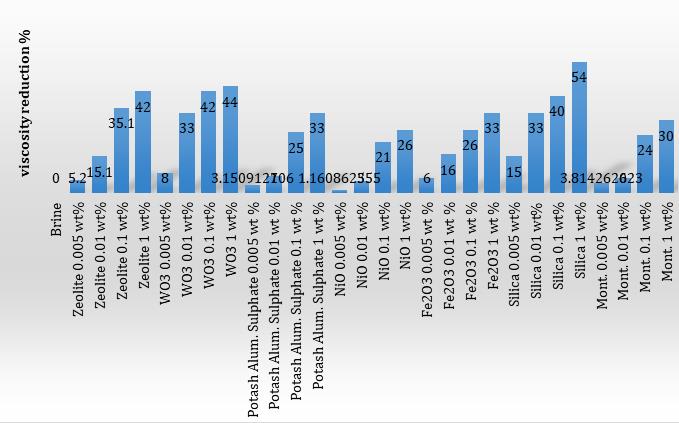
The first method of studying the effect of nanoparticles on reduction of the crude oil viscosity, is to measure the oil viscosity for each case after exposing to nanofluid displacement as shown in Figure 2, which indicate that by increasing the concentration of nanoparticles inside the nanofluid up to 1 wt %, this lead to further reduction in the crude oil viscosity. This behavior may resort to; 1) adsorptive capacity of the nanoparticles toward asphaltenes, so the interaction of asphaltene–nanoparticle becomes greater than that of asphaltene–asphaltenes in crude oil which in turn reduce viscosity [19]; 2) by scattering the nanoparticles in the oil phase they occupy more space and foster greater contact with the presented asphaltenes, so decrease electrostatic associations between asphaltenes which in turn reduce oil viscosity [20]; 3) nanoparticles possess higher selectivity toward n- C7 asphaltenes, so generate a high reduction in the size of the asphaltenes aggregates present in the liquid medium [21].
Copyright© El-hoshoudy AN, et al.
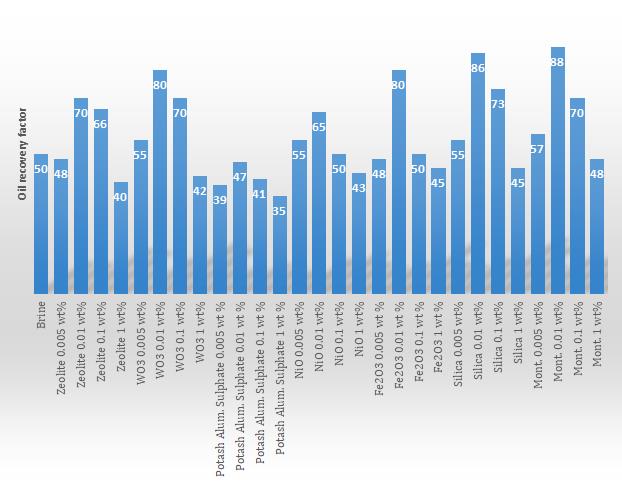
Zeolite, tungsten trioxide, montmorillonite nanoparticles have all shown great performance in reducing the crude oil viscosity. While the best nanoparticle that gave the highest viscosity reduction for the flooded crude oil is nano-silica. Moreover, the change in oil recovery factor.
montmorillonite and silica both gave the highest improvement to the oil recovery factor.
El-hoshoudy AN, et al. Investigating the Effect of Different Nanofluids Types on Crude Oil Viscosity. Pet Petro Chem Eng J 2018, 2(4): 000177.
Copyright© El-hoshoudy AN, et al.
Economical Profile
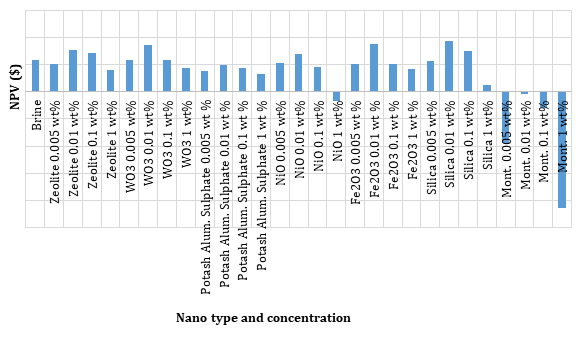
To find whether the need for this recovery mechanism is applicable or not. The net present value for the total project has to be estimated. First, the initial oil in place for a field is assumed to be 100 MM STB and the field will produce from 4 production wells with the same decline rate. Also, the number of years for production is assumed to be 10 years. Moreover, drilling and production operational cost is assumed to be 25 million dollars considering the cost of flooding operations. More and more, a discount factor of 10% is also assumed. All the previous assumptions were applied to all cases. However, the only variable now is the cost and concentration of nanoparticles that differ for each type. Therefore, by considering the PV injected to reach the optimum oil recovery using this mechanism, now the cumulative net present value for the total project can be calculated as shown in Figure 4.
Conclusion
Nanoparticles can reduce crude oil viscosity due to their ability to break down the agglomeration of asphaltenes molecules inside the oil. Zeolite, tungsten trioxide and silica have shown a crude oil reduction percentage of more than 80% with a nanofluid concentration of 1 wt%. Nano silica flooding has the best result in reducing viscosity. Nano silica with concentration 0.005 wt % leads to 15% viscosity reduction, 0.01 wt % leads to 33% viscosity reduction, 0.1% leads to 41% viscosity reduction and finally 1 wt% leads to 54% viscosity reduction. Therefore, it is assumed that increasing nanoparticles concentration from 0.005 wt % to 0.01 or 0.1 wt % lead to a reduction in oil viscosity for all nanoparticles. Continual increasing of nanoparticles concentration by 1 wt % will decrease oil viscosity but slightly improvement will occur for this El-hoshoudy AN, et al. Investigating the Effect of Different Nanofluids Types on Crude Oil Viscosity. Pet Petro Chem Eng J 2018, 2(4): 000177.
concentration. However, this does not guarantee to increase the oil recovery as the relatively high nanoparticles concentration will plug the pore spaces leading decreased oil recovery. Also, this research stated that the use of nano silica flooding has an oil recovery more than 80% and it also has the best net profit present value.
References
-
Badger MW, Schobert HH (1998) Viscosity Reduction in Extra Heavy Crude Oils. Carbon 1: 76.
-
Alomair OA, Matar KM, Alsaeed YH (2014) Nanofluids application for heavy oil recovery. SPE Asia Pacific Oil & Gas Conference and Exhibition. Society of Petroleum Engineer, pp: 18. Copyright© El-hoshoudy AN, et al.
-
Temperley H, Trevena D, Raveché HJ (1980) Liquids and their Properties: A Molecular and Macroscopic Treatise with Applications. Physics Today 33(2): 53.
-
Qu X, Alvarez PJ, Li Q (2013) Applications of nanotechnology in water and wastewater treatment. Water research 47(12): 3931-3946.
-
Hendraningrat L, Li S, Torsæter O (2013) A coreflood investigation of nanofluid enhanced oil recovery. Journal of Petroleum Science and Engineering 111: 128-138.
-
El Hoshoudy A, Desouky S, Al-sabagh A, El-kady M, Betiha M, et al. (2015) Synthesis and Characterization of Polyacrylamide Crosslinked Copolymer for Enhanced Oil Recovery and Rock Wettability Alteration. International Journal of Oil, Gas and Coal Engineering 3(4): 47-59.
-
El-Hoshoudy A, Desouky S, Elkady M, Alsabagh A, Betiha M, et al. (2015) Investigation of optimum polymerization conditions for synthesis of cross- linked polyacrylamide-amphoteric surfmer nanocomposites for polymer flooding in sandstone reservoirs. International Journal of Polymer Science 2015: 14.
-
Zargartalebi M, Kharrat R, Barati N (2015) Enhancement of surfactant flooding performance by the use of silica nanoparticles. Fuel 143: 21-27.
-
Li W, Zhu J-H, Qi J-H (2007) Application of nano- nickel catalyst in the viscosity reduction of Liaohe extra-heavy oil by aqua-thermolysis. Journal of Fuel Chemistry and Technology 35(2): 176-180.
-
Hamedi Shokrlu Y, Babadagli T (2010) Effects of nano-sized metals on viscosity reduction of heavy oil/bitumen during thermal applications. Canadian Unconventional Resources and International Petroleum Conference. Society of Petroleum Engineers, pp: 10.
-
Leifer I, Lehr WJ, Simecek-Beatty D, Bradley E, Clark R, et al. (2012) State of the art satellite and airborne marine oil spill remote sensing: Application to the BP Deepwater Horizon oil spill. Remote Sensing of Environment 124: 185-209.
-
Shah RD (2009) Application of nanoparticle saturated injectant gases for EOR of heavy oils. SPE annual El-hoshoudy AN, et al. Investigating the Effect of Different Nanofluids Types on Crude Oil Viscosity. Pet Petro Chem Eng J 2018, 2(4): 000177. technical conference and exhibition. Society of Petroleum Engineers, pp: 12.
-
Morrow NR, Mason G (2001) Recovery of oil by spontaneous imbibition. Current Opinion in Colloid & Interface Science 6(4): 321-337.
-
El-hoshoudy A, Desouky S, Elkady M, Alsabagh A, Betiha M, et al. (2017) Hydrophobically associated polymers for wettability alteration and enhanced oil recovery–Article review. Egyptian Journal of Petroleum 26(3): 757-762.
-
El-hoshoudy AN, Desouky SM (2018) Synthesis and evaluation of acryloylated starch-g-poly (Acrylamide/ Vinylmethacrylate/1-Vinyl-2-pyrrolidone) crosslinked terpolymer functionalized by dimethylphenylvinylsilane derivative as a novel polymer-flooding agent. International Journal of Biological Macromolecules 116: 434-442.
-
El-hoshoudy AN, Desouky SM, Attia AM (2018) Synthesis of starch functionalized sulfonic acid co- imidazolium/silica composite for improving oil recovery through chemical flooding technologies. Int J Biol Macromol 118(Pt B): 1614-1626.
-
El-hoshoudy AN, Desouky SM, Attia AM (2018) Synthesis and Evaluation of Xanthan-G-Poly (Acrylamide) CoPolymer for Enhanced Oil Recovery Applications. Petroleum & Petrochemical Engineering Journal 2(3): 1-8.
-
El-hoshoudy AN, Desouky SM (2016) Hydrophobic Polymers for Enhanced Oil Recovery: Preparation, Characterization, Rheological Properties. Lambert Academic Publishing;.
-
Aristizábal-Fontal JE, Cortés FB, Franco CA (2018) Viscosity reduction of extra heavy crude oil by magnetite nanoparticle-based ferrofluids. Adsorption Science & Technology 36(1-2): 23-45.
-
Taborda Acevedo EA (2017) Viscosity reduction of heavy crude oil through the addition of nanofluids on the non-thermal process. Universidad Nacional de Colombia-Sede Medellín, pp: 15-161.
-
Taborda EA, Franco CA, Lopera SH, Alvarado V, Cortés FB (2016) Effect of nanoparticles/nanofluids on the rheology of heavy crude oil and its mobility on porous media at reservoir conditions. Fuel 184: 222-232. Copyright© El-hoshoudy AN, et al.
- Nigeria’s Vulnerability in the Face of Global Energy Policy
- A Simulation Study of Investigation of Optimum Oil Production Performance by Applying Various Gas Injection Methods in Oil Reservoir
- Characterization of Permo-Triassic Reservoirs through Thermal Maturity Assessment of Westphalian Source Rocks in the Cheshire Basin
- Influence of Microwax on the Rheological and Thermal Behaviour of a Wax Crude Oil
- Real-Time Monitoring and Performance Optimization of Steam Injection in Heavy Oil Reservoirs Using Fiber Optic Sensing and Integrated Predictive Simulation Models
- Rapid On-Site Determination of the Total Petroleum Hydrocarbon Content of Soils by Handheld Fourier Transform Near-Infrared Spectroscopy: Development of a Global, Site- and Scanner- Independent Calibration Model