
Sizing Surface Production Flow line Insulation Thickness for a Desired Output Temperature
Oil and gas is transported from the wellheads to the gathering stations through pipelines called surface production flowlines. Flow-lines are located at the oil and gas well site and tied to specific wells. Flow-line may be a metallic pipe or a hose. Flow lines may be in a land or subsea well field and may be buried or at grade on the surface of land or seafloor. Most flow lines are very short in length but others may be run for kilometres in larger well fields. Usually, external environment of a surface production flow-line is at lower temperature compared to the flowing fluid temperature in the production flow-line. The interaction of the internal and external temperatures of the oil and gas surface production flowline is a major cause of temperature drop in flow-line. Undesirable and excessive temperature drops must be prevented in oil and gas production flow-line by suitable and economical sizing of flow-line insulation materials. One of the industry requirements of the oil and gas production flow-line is to ensure the flow-line meets a discharge or an output temperature. This paper focuses on choosing and sizing of an insulation material to meet an output temperature of an oil and gas surface production flow-line. Two well stream flows were developed based on stream compositions from the two oil and gas wells. It is desirable that the discharge or output temperature of the discharge fluid at the discharge end of the flow-line does not fall below 20 degree Celsius. The thermal insulation thickness for the 1 km long production flow-line was designed using Urethane Foam insulation material. The chemical processes were modelled in Aspen Hysys and a case study was developed between flow-line output temperature and the flow-line insulation thickness to correlate the two variables.
Introduction
Transportation of petroleum products through pipeline presents considerable risks including wax formation and deposition as a result of heat loss of fluids, which is harmful to the flow due to the reduced inner diameter or totally blocked pipelines in extreme cases [1]. To ensure efficient and economical hydrocarbons transport from wellhead to processing facilities, flow assurance is important in planning and designing of flow transport system [2]. Flow assurance thermal management techniques include insulation, pipe burial, electrical heating, and hot fluid circulation [2].
Apart from conveyance of oil and gas from the wellheads to the gathering stations, surface production flow-lines are also expected to limit heat losses to the external environments. In deepwater oil exploration, wells are located far from platforms, and crude oil often has to be transported over long distances in subsea pipelines [3]. The oil is cooled on its way to the destination due to heat transfer, through the pipelines walls, with the surrounding sea water [3]. Temperature- related transportation problems can take place especially if the production flow-line is not properly and sufficiently insulated against heat losses to the external environment [4]. This may lead to the precipitation of asphaltenes and/or paraffin wax and the formation of hydrates [4].
Thus, during engineering design of subsea production flow-line, it becomes mandatory to have proper insulation type and insulation thickness selection done at the early stages of project, so as to assure the proper flow of the fluids in the flow-line, at desired operating conditions [5]. Thermal insulation design is a key task in oil and gas surface production flow-line. Thermal insulation is one of the most effective energy-conservation measures in hot pipes [6]. Insulation materials are very basic and important requirement in any industry dealing with various heat transfer unit operations [7]. The basic aim of insulation is to retard the rate of heat flow in order to prevent/minimize the change of temperature of the system or the space [7].
The thickness of applied insulation material in any case of oil and gas surface production flow-line usually has a case relationship with the output temperature of the surface flow-line. In optimization of thickness of insulation over a cylindrical pipe and definition of optimum range of thickness for maximum and minimum heat transfer through the insulation at different heat inputs was carried out [8]. It is therefore necessary to build this case to serve as a guide in selecting the suitable thickness of the applied corrosion material.
Study Cases
- Stream Composition
- The Table 1 below shows the stream compositions from the two production wells.
- Mol %
- Stream Composition
- Stream Composition
- 1 From Well 1
- 2 From Well 2
- Methane
- 0.8231
- 0.95
- Ethane
- 0.0589
- 0.03
- Propane
- 0.0311
- 0 i-Butane
- 0.0018
- 0 n-Butane
- 0.0021
- 0 i-Pentane
- 0.0009
- 0 n-Pentane
- 0.0011
- 0 n-Hexane
- 0.0003
- 0 n-Heptane
- 0.0005
- 0 n-Octane
- 0.0001
- 0 n-Nonane
- 0.0001
- 0 n-Decane
- 0.0003
- 0
- H2O
- 0.0156
- 0
- H2S
- 0.0003
- 0.0042
- N2
- 0.0025
- 0.0058
- O2
- 0.0014
- 0
- CO2
- 0.0599
- 0.01
Table 1: Stream Flow Compositions.
Other Input Design Parameters
The Table 2 shows other design parameters for simulation development in Aspen Hysys.
Copyright© Olanrewaju AO.
Olanrewaju AO. Sizing Surface Production Flow line Insulation Thickness for a Desired Output Temperature. Pet Petro Chem Eng J 2018, 2(4): 000178.
| Parameters | Values | ||||
|---|---|---|---|---|---|
| Length of the flow-line | 1000 m | ||||
| Elevation change of the flow-line | + 5 m | ||||
| Insulation material | Urethane Foam | ||||
| Ambient temperature of the flow-line | 10 degree Celsius | ||||
| Pipe schedule | 40 | ||||
| Pipe nominal size | 50 mm | ||||
| Type of flow-line | Buried in soil | ||||
| Buried depth | 1200 mm | ||||
| Well 1: Stream Flow Parameters | Mass flow rate (5000kg/h), Pressure (2000kPa), Temperature (50 degree centigrade) | ||||
| Well 2: Stream Flow Parameters | Mass flow rate (4167 kg/h), Pressure (2000kPa), Temperature (50 degree centigrade) |
Table 2: Other Input Design Parameters.
Study Methodology
Aspen-HYSYS software is process simulation software and available at the Petroleum and Natural Gas Institute, Faculty of Earth Science and Engineering, University of Miskolc. This software package is the used around the world to design plants and to rate their performance. HYSYS was used to conduct the development and simulation of the stream compositions and stream flows from the two production wells and the 1 km production flow-line. Table 2 shows other design parameters from the two wells. A case study was set-up to investigate the correlation between the thermal insulation thickness of the Urethane Foam and the output temperature from the 1 km long flow-line. It is required that the output temperature must not drop below 20 degree Celsius.
Results
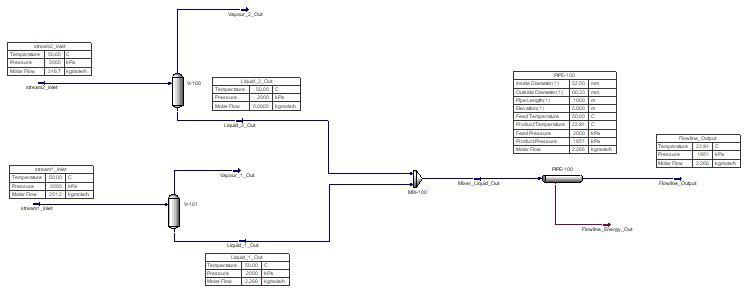
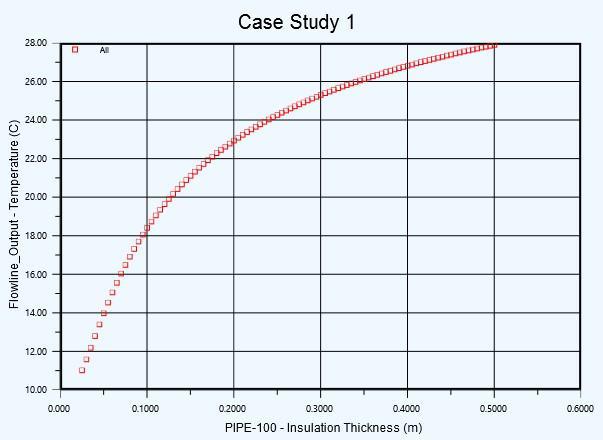
The Figure 1 below shows the process simulation of the two production wells and Table 3 shows the 96 studied cases between the thermal insulation thickness of the Urethane Foam and the output temperature that were investigated. Figure 2 shows the graphical plot of the 96 studied case results between the thermal insulation thickness of the Urethane Foam and the output temperature.
Copyright© Olanrewaju AO.
Olanrewaju AO. Sizing Surface Production Flow line Insulation Thickness for a Desired Output Temperature. Pet Petro Chem Eng J 2018, 2(4): 000178.
| State | PIPE-100 - Insulation | Flowline Output - | ||||
|---|---|---|---|---|---|---|
| Thickness m | Temperature C | |||||
| Case 1 | 0.025 | 11.027846 | ||||
| Case 2 | 0.03 | 11.594391 | ||||
| Case 3 | 0.035 | 12.196932 | ||||
| Case 4 | 0.04 | 12.80614 | ||||
| Case 5 | 0.045 | 13.404548 | ||||
| Case 6 | 0.05 | 13.983906 | ||||
| Case 7 | 0.055 | 14.53881 | ||||
| Case 8 | 0.06 | 15.067254 | ||||
| Case 9 | 0.065 | 15.568872 | ||||
| Case 10 | 0.07 | 16.043944 | ||||
| Case 11 | 0.075 | 16.493936 | ||||
| Case 12 | 0.08 | 16.920193 | ||||
| Case 13 | 0.085 | 17.324165 | ||||
| Case 14 | 0.09 | 17.707318 | ||||
| Case 15 | 0.095 | 18.071077 | ||||
| Case 16 | 0.1 | 18.416798 | ||||
| Case 17 | 0.105 | 18.74575 | ||||
| Case 18 | 0.11 | 19.059116 | ||||
| Case 19 | 0.115 | 19.357989 | ||||
| Case 20 | 0.12 | 19.643374 | ||||
| Case 21 | 0.125 | 19.916197 | ||||
| Case 22 | 0.13 | 20.177307 | ||||
| Case 23 | 0.135 | 20.427482 | ||||
| Case 24 | 0.14 | 20.667436 | ||||
| Case 25 | 0.145 | 20.897825 | ||||
| Case 26 | 0.15 | 21.11925 | ||||
| Case 27 | 0.155 | 21.332265 | ||||
| Case 28 | 0.16 | 21.53738 | ||||
| Case 29 | 0.165 | 21.735063 | ||||
| Case 30 | 0.17 | 21.925747 | ||||
| Case 31 | 0.175 | 22.109832 | ||||
| Case 32 | 0.18 | 22.287686 | ||||
| Case 33 | 0.185 | 22.459652 | ||||
| Case 34 | 0.19 | 22.626047 | ||||
| Case 35 | 0.195 | 22.787164 | ||||
| Case 36 | 0.2 | 22.943278 | ||||
| Case 37 | 0.205 | 23.094643 | ||||
| Case 38 | 0.21 | 23.241495 | ||||
| Case 39 | 0.215 | 23.38335 | ||||
| Case 40 | 0.22 | 23.521847 | ||||
| Case 41 | 0.225 | 23.656451 | ||||
| Case 42 | 0.23 | 23.787343 | ||||
| Case 43 | 0.235 | 23.914692 | ||||
| Case 44 | 0.24 | 24.038657 | ||||
| Case 45 | 0.245 | 24.159387 | ||||
| Case 46 | 0.25 | 24.277023 | ||||
| Case 47 | 0.255 | 24.391696 | ||||
| Case 48 | 0.26 | 24.503532 |
Copyright© Olanrewaju AO.
Olanrewaju AO. Sizing Surface Production Flow line Insulation Thickness for a Desired Output Temperature. Pet Petro Chem Eng J 2018, 2(4): 000178.
| Case 49 | 0.265 | 24.612646 |
|---|---|---|
| Case 50 | 0.27 | 24.71915 |
| Case 51 | 0.275 | 24.823147 |
| Case 52 | 0.28 | 24.924737 |
| Case 53 | 0.285 | 25.024013 |
| Case 54 | 0.29 | 25.121062 |
| Case 55 | 0.295 | 25.215969 |
| Case 56 | 0.3 | 25.308813 |
| Case 57 | 0.305 | 25.399669 |
| Case 58 | 0.31 | 25.488609 |
| Case 59 | 0.315 | 25.575701 |
| Case 60 | 0.32 | 25.661009 |
| Case 61 | 0.325 | 25.744595 |
| Case 62 | 0.33 | 25.826518 |
| Case 63 | 0.335 | 25.906833 |
| Case 64 | 0.34 | 25.985594 |
| Case 65 | 0.345 | 26.062851 |
| Case 66 | 0.35 | 26.138654 |
| Case 67 | 0.355 | 26.213047 |
| Case 68 | 0.36 | 26.286076 |
| Case 69 | 0.365 | 26.357783 |
| Case 70 | 0.37 | 26.428209 |
| Case 71 | 0.375 | 26.497392 |
| Case 72 | 0.38 | 26.565369 |
| Case 73 | 0.385 | 26.632176 |
| Case 74 | 0.39 | 26.697848 |
| Case 75 | 0.395 | 26.762417 |
| Case 76 | 0.4 | 26.825914 |
| Case 77 | 0.405 | 26.88837 |
| Case 78 | 0.41 | 26.949813 |
| Case 79 | 0.415 | 27.010273 |
| Case 80 | 0.42 | 27.069775 |
| Case 81 | 0.425 | 27.128345 |
| Case 82 | 0.43 | 27.186008 |
| Case 83 | 0.435 | 27.24279 |
| Case 84 | 0.44 | 27.298711 |
| Case 85 | 0.445 | 27.353795 |
| Case 86 | 0.45 | 27.408062 |
| Case 87 | 0.455 | 27.461533 |
| Case 88 | 0.46 | 27.514229 |
| Case 89 | 0.465 | 27.566167 |
| Case 90 | 0.47 | 27.617367 |
| Case 91 | 0.475 | 27.667848 |
| Case 92 | 0.48 | 27.717626 |
| Case 93 | 0.485 | 27.766717 |
| Case 94 | 0.49 | 27.815139 |
| Case 95 | 0.495 | 27.862907 |
| Case 96 | 0.5 | 27.910036 |
Table 4: Cases Set-up to Investigate the Correlation between the Insulation Thickness and Output Temperature.
Copyright© Olanrewaju AO.
Olanrewaju AO. Sizing Surface Production Flow line Insulation Thickness for a Desired Output Temperature. Pet Petro Chem Eng J 2018, 2(4): 000178.
References
-
Son Tung Pham, Minh Huy Truong, Ba Tuan Pham (2017) Flow Assurance in Subsea Pipeline Design for Transportation of Petroleum Products. Open Journal of Civil Engineering 7(2): 311-323.
-
Ogboo Chikere Aja, Ramasamy M (2016) Thermal Management of Flow Assurance Challenges in Offshore Fields- A Review. ARPN Journal of Engineering and Applied Sciences. 11(10): 1-8.
-
Phil H (2007) Oil and gas pipelines: Yesterday and today. International Petroleum Technology Institute, ASME, New York.
-
Boyun Guo, William C, Ghalambor Ali Ghalambor (2007) Petroleum Production Engineering: A Computer-Assisted Approach. 1st (Edn.), Elsevier Science & Technology Books, pp: 312.
-
Okologume Wilfred, Dulu Appah (2015) Analyzing Thermal Insulation for Effective Hydrate Prevention in Conceptual Subsea Pipeline Design. International Journal of Current Engineering and Technology, pp: 2492-2499.
-
Bassam AZ (2016) The Economic Thickness of Insulation for Steam Process Distribution Pipelines. Journal of Energy Technologies and Policy 6(2): 1-11.
-
Gajanan Deshmukh, Preeti Birwal, Rupesh Datir, Saurabh Patel (2017) Thermal Insulation Materials: A Tool for Energy Conservation. Journal of Food Processing & Technology 8(4): 1-4.
-
Puspendra Upadhyay, Sunil Yadav, Kiran D Devade (2017) Optimum Insulation Thickness: Radial Heat Conduction through Insulated Pipe. International Journal on Theoretical and Applied Research in Mechanical Engineering (IJTARME) 6(1-2): 163-165. Copyright© Olanrewaju AO. Olanrewaju AO. Sizing Surface Production Flow line Insulation Thickness for a Desired Output Temperature. Pet Petro Chem Eng J 2018, 2(4): 000178.
- Nigeria’s Vulnerability in the Face of Global Energy Policy
- A Simulation Study of Investigation of Optimum Oil Production Performance by Applying Various Gas Injection Methods in Oil Reservoir
- Characterization of Permo-Triassic Reservoirs through Thermal Maturity Assessment of Westphalian Source Rocks in the Cheshire Basin
- Influence of Microwax on the Rheological and Thermal Behaviour of a Wax Crude Oil
- Real-Time Monitoring and Performance Optimization of Steam Injection in Heavy Oil Reservoirs Using Fiber Optic Sensing and Integrated Predictive Simulation Models
- Rapid On-Site Determination of the Total Petroleum Hydrocarbon Content of Soils by Handheld Fourier Transform Near-Infrared Spectroscopy: Development of a Global, Site- and Scanner- Independent Calibration Model