
Discovery of the Rare Gas Helium Vindhyan Rocks, Southern Ganga Basin, Bundelkhand Region, Dist. Sagar, M.P. India
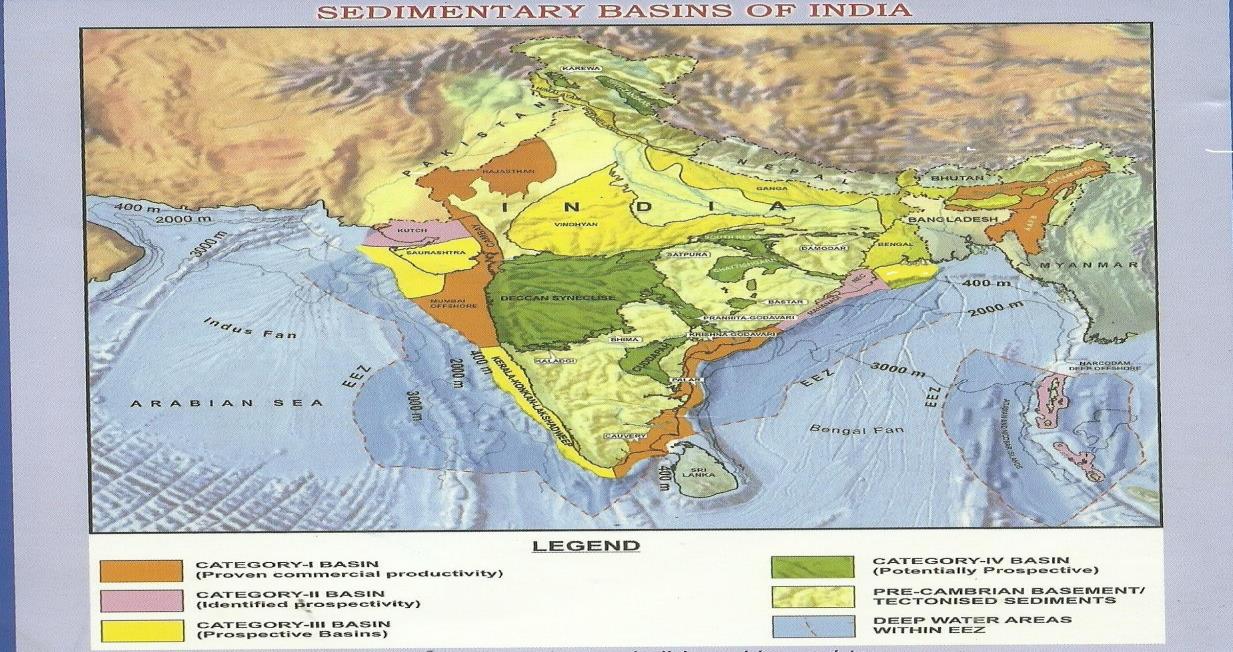
The studies on the helium in hydrocarbon rich petroliferous tube wells in Saugor Division, southern Ganga Basin region has been carried out in great detail in 50 Tube wells, along with the stable isotopic analysis were carried out for the gas sample were collected from the 50 tube wells in Sagar and Damoh District of M.P. The discovery of the rare gas helium in hydrocarbon rich zone in the tube wells in agricultural fields in Sagar District and in Damoh District of M.P. is a unique finding in rocks of the Vindhyan Super Group, in the history of Earth Science in India. The depth of tube wells are varying in 300 feet to 750 feet. On the basis of geochemical analysis, it is remarkable to note that average values of helium contents varies from 0.34 % to 0.732 % along with the 72% to 99% of methane and ethane, and minor amount of oxygen, nitrogen and CO2 gases in the hydrocarbon rich zone are recorded during the geochemical and stable isotope analysis. It has been found in the stable isotope δ C13 value the values for the methane is - 43.6 per mil w. r. t. to - 54.9 per mil w.r.t. PDB and for the Ethane gas is --24.9 to --26.4 per mil w. r. t. PDB in the gas samples collected in the saturated sodium chloride solution in the glass bottles at various sites in Sagar & Damoh District. The occurrence of rare helium gas in the Hydrocarbon rich zone is reported first time in Jan, 2007 from the tube wells of Sagar Distt, which were geochemically and stable isotopically analyzed in the labs of KDMIPE Dehradun & NGRI Hyderabad. The gaseous hydrocarbon analysis show the presence of moderate to low concentration of methane ( C1) 1 to 104 ppb, Ethane( C2)-1 to 14 ppb, Propane( C3) 1 to 10 ppb, i- Butane ( i C4) 1 to 9 ppb and n Butane ( n C4) 1 to 8 ppb in the soil samples collected from different locations. The result of stable isotopic analysis of Ethane gas in these samples δ C13 value are ranging from -24.9 per mill w.r.t. PDB and -26.9 per mill w.r.t. PDB are indicative that this gas is of thermogenic origin, which must have been formed at very high temperature & pressure condition in the deeper horizon of the Great Vindhyan sedimentary basin of an early Proterozoic (> 600 m.y.) period.
Introduction
The present studies on the hydrocarbon gas anomalies in the seepages and leakages of natural petroleum rare gas Helium gases in the agricultural field of Sagar and Damoh district has been done in the hydrocarbon rich zone. These hydrocarbon gases and helium gas were escape from the reservoir and migrated to the surface, the secondary porosity in the rocks, sediment and soil or diffuse into the atmosphere or added in the ground water. These leakages of natural gas is an indication of petroleum gas in the form of oil and gas seeps from precursor underground.
The attempt has been made through the cheaper and faster method of geochemical prospecting, which provides the direct evidence for the presence of petroleum accumulation underground. The samples of soil, water and gas were collected from the tube wells of agricultural field are located in the agricultural field of various villages in the Meerkheri, Rahatgarh (tahsil) Pipariya –Bhutoli villages in Garhakota tehsils of Sagar and Mahalwara village in Sukha block of patharia tahsil of Damoh distt. in the southern fringes of Bundelkhand region in M.P. The first time leakage of petroleum gas was reported in 1980 from the Meerkheri village located on the Sagar to Vidisha road, at about 15 km from the Rahatgarh town. In 1993, in another tube well at Rahatgarh the leakages were reported by the author.
hydrocarbon reservoir. Shandilya [2] has reported the occurrence of the petroleum gas in the Sagar District and suggested that theses petroleum gas is of thermogenic in origin.
Shandilya [3, 4, 5, 6] made Discovery of Natural Gas leakages from Bore wells in the rocks of the Vindhyan Super group in Sagar and Damoh Distt. M.P. and forecasted the reserve of Natural Gas Reserves in Sagar District. Shandilya [7, 8, 9] published an article on GAS IN Copyright© Shandilya AK, et al.
Shandilya AK, et al. Discovery of the Rare Gas Helium Vindhyan Rocks, Southern Ganga Basin, Bundelkhand Region, Dist. Sagar, M.P. India. Pet Petro Chem Eng J 2019, 3(3): 000200.
THE BACKYARD. In the BUSINESS INDIA MAGZINE suggesting that this gas is of thermogenic origin. Shandilya [7, 8, 9] has suggested the possibility of Petroleum Gas reserve in Southern Bundelkhand Region. M.P. Shandilya & Gajbhiye [10] made the Discovery of Rare Helium Gas in Sagar District, M.P. Prasanna, et al. [11] were done the detail investigation of light gaseous hydrocarbon anomalies in the surface soil around Sagar using the geochemical exploration methods for hydrocarbon leakages has been focused on the detection of absorbed petroleum gases by gas chromatographic method, in Vindhyan basin using composition and ratio of the light hydrocarbons methane, ethane, propane, butane.
Geology
The present natural gas leakages has been discovered in the dried tube wells, located on the rocks of Sandstone, shale and limestone rocks of the Rewa and Bhander Group of the Vindhyan Super Group as the basement rocks. These petroliferous rocks are overlain by the Lameta bed (late Cretaceous) in the western part of the Pipariya and Bhutoli area in Garhakota tahsil. On the western part of present area is overlain by the rocks of Upper Cretaceous Deccan Trap Basaltic flows, which are intercalated with intertrappean limestone. The area were the leakages of petroleum gas has been discovered located on the alluvial soil cover. The Deccan Trap Basaltic rocks are exposed west of the Chinnoua village in Garhakota Tahsil. The dips of the sandstone and shales rocks are 10 - 15 degree toward SE direction. The topography is more or less flat with some low lying areas near the stream. The geological formation of Sagar area consists of 09 flows of Deccan Trap.
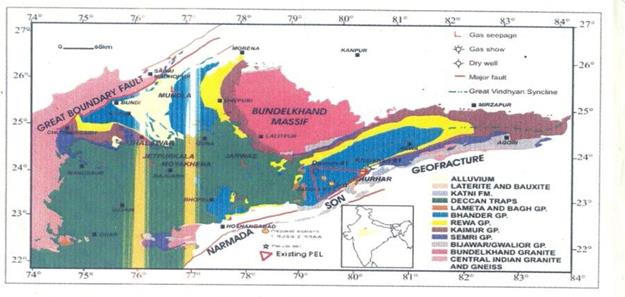
Group. The Deccan Trap basalt rocks are mostly covered by the black soil. The Deccan volcanism during late Cretaceous must have generated the proper thermal conditions and acted as a catalyst in triggering Mesozoic hydrocarbon generation processes in the Vindhyan sedimentary basin in Central India.
Copyright© Shandilya AK, et al.
Shandilya AK, et al. Discovery of the Rare Gas Helium Vindhyan Rocks, Southern Ganga Basin, Bundelkhand Region, Dist. Sagar, M.P. India. Pet Petro Chem Eng J 2019, 3(3): 000200.
| Lower Cretaceous | Lameta Formation | |||||
|---|---|---|---|---|---|---|
| Late Proterozoic Vindhyan Super Group | Bhander (Containing the Petroleum gas & Helium gas) | |||||
| Rewa | ||||||
| Kaimur | ||||||
| Semri | ||||||
| Middle Proterozoic Bijawar Super Group | Phosphastic Dol- The Stratigraphic Succession in Sagar | |||||
| Age | Formation | |||||
| Recent Sub Recent/Quaternaries | Alluvium soil Black soil | |||||
| Upper Cretaceous | Deccan Trap Basalt ( with Intertrapean limestone ) | |||||
| omite | ||||||
| Dolomite | ||||||
| Ferrugenous Shale | ||||||
| Ferrugenous Sandstone | ||||||
| Iron Formation / BHQ | ||||||
| Quartzite | ||||||
| Conglomerate bed. | ||||||
| Early Proterozoic Bundelkhand Granite Complex | Quartz reef intrussion | |||||
| Pegmatitic intrussion | ||||||
| Ultramafic intrusive | ||||||
| Granite Intrussive rocks | ||||||
| Granite Gneiss | ||||||
| Biotite Schist | ||||||
| Archean Mehroni Super Group | Intrussive body | |||||
| Dolomitic Marble | ||||||
| Slate | ||||||
| Ferrugenous Formation | ||||||
| Quartzite | ||||||
| Schist |
Table 1: Description of Lower Cretaceous and Lameta Formation [12].
Observation
On the request of authors, the Director Exploration, KDM IPE, ONGC Dehradun and Director, NGRI Hyderabad has sent a team of scientists for the detailed investigation had visited the Piparia-Bhutoli and Rahatgarh and Meerkheri area and collected the samples of soil, water and gas. The samples were collected from the following localities-
Bhu-1
These tube wells fall under the panchayat and P.O. chanauaa tahsil Garhakota dist. Sagar, M.P.(part of survey of India top sheet no. 55M/1) It is accessible by a 3 km Village road from town Garhakota around 45 km East of Sagar on way to Damoh. The leakage of petroleum gas is reported from 08 tube wells in the month of march 2007. 1. These bore/tube wells varying in the depth from 260 to
400 ft , with top 60 ft is of 8" diam with plastic casing, and rest of well is of 6" diam. depth 340 feet) of Shri
2. Pip-1 The tube wells (depth 400 feet) of Sri Asharam
Patel S/o Sri Ghappu Patel (lat: 23048'20" N, long: 79o50'20.7" E, elevation 450m).
Rah-1
This village is located 40km west of Sagar on way to Bhopal Road. In the bore well of Shri Leeladhar Tiwari (Tiwari Dhawa: lat: 23o57'15.7" N, Long: 79o25'03"E, Elevation 484m), the tube well is situated on the deccan trap - Vindhyan contact. The leakage of petroleum gas is reported since 1993.
Mee-1
This tube well (lat: 23o45'56"N, Long:78o18'9.6"E, Elevation 440m) from where gas seepage was occurring belongs to Shri Dhan Singh. The area falls in the toposheet Copyright© Shandilya AK, et al.
Shandilya AK, et al. Discovery of the Rare Gas Helium Vindhyan Rocks, Southern Ganga Basin, Bundelkhand Region, Dist. Sagar, M.P. India. Pet Petro Chem Eng J 2019, 3(3): 000200.
of India No. 55 I/5. This tube well is the eastern extremity of village meerkhedi, 13 km of Rahatgarh on way to Vidisha. This tube well pouring the petroleum gas since 1984 having enormous bubbling in the water. The tube well is located on the contact of deccan tram basalt and vindhyan sand stone (Inlier).The quantity of petroleun gas bubbling ins increase day by day.
Mah-1
The leakages of the petroleum gas has been reported in 2009 from this village in Patharia Tahsil of Damoh district. The 378 feet deep tube well is pouring the water along with the natural petroleum gas and the water which is coming out of the tube well is burning upto 2-3 feet long flame. In the bore well of Sri Halle singh Lodhi at Mahalwara about 11 km north of Patharia railway Station in Damoh Distt. Is also containing the leakages of petroleum gas in the 378 deep tube well, which was digged in Nov. 2008. The tube well water getting fire, when light up the matchstick about 1.00 m high flame burning in water. The petroleum gas is also coming out of the tube well when no pumping is done, the leakage of the gas can be easily seen in it.
Bat-1
It is located about 25 Km from Damoh. In the tube wells the water gives the smell of kerosene / diesel in the month of Nov.-Dec. 2008 onward. The tube wells are varying ibn depth from 350 to 400 feet in the Vindhyan Limestone rocks.
Pat-1
In this village the tube well is situated in the inliers of the Vindhyan Rocks among the Deccan Trap cover, the tube well was digged in 2000, and depth id about 380 feet. It is also pouring the natural petroleum gas as it was reported in Nov. 2011.
SUK-1
In the agricultural field near the Limestone quarry of Narsinghgarh Cement (Heidel berg Cement Plant) there is a leakages of petroleum gas along with water. Reported in Dec.2009
Man1
A tube well situated in the Deccan trap rocks in Mandi Bamora, depth is 390feet, digged in May2012 a; so pouring the natural gas along with water . The flame of 8- 10 feet was observed at the well site in the Public Health Centre at Mandi Bamora. The thickness of the Deccan trap in very low at the site, resting over the rocks of Vindhyan Super Group, in the northern most extend of the Deccan cover.
Kon-1
At this village the tube wells are also pouring the gas during the month of Nov. and Dec. and the water is giving the smell of the kerosene in it. It is situated on the rocks of the Vindhyan Super Group.
Jhi-1
The tube well is situated on the inlier of the Vindhayn rocks. The tube well was digged in Deccan trap rocks, which has overlying the rocks of Vindhyan Super Group. The depth of tube wells are varying from 300- 400 feet.
Ban-1
In this village the leakages of the natural petroleum gas has been reported in March 2012, from a tube wells which is about 360 feet deep. The gas with more speed in coming in the afternoon hour and with bubbling sound from the tube wells.
Gho-1
The Gho-1 falls in the Banda Tahsil of Sagar District. About 25 Km from Banda, on way to Patharia. In this village there are six (06) tube wells pouring natural gas along with the water. Two hand pump are also leak aging this petroleum gas and burning day and night, with the help of the local administration the fire has been controlled on 7th May 2012. The continuous gas leakage has been reported from this village. In the agriculture field of the villagers. The tube wells were digged in different time, but all of them are pouring the natural gas, which is burning 6-8 feet long flame. The experiment of the gas leakages were done in some of the old tube wells, in which the natural gas in coming along with water which buning, one can say that there is water in burning (Paani me Aag ).
Geochemical Analysis
At ONGC Dehradun
The samples were analysed in the geochemical laboratory of KDM IPE Kaulagarh Road, ONGC, Dehradun. The finding of the geochemical analysis of the natural gas, water, and soil are as follows- Copyright© Shandilya AK, et al.
Shandilya AK, et al. Discovery of the Rare Gas Helium Vindhyan Rocks, Southern Ganga Basin, Bundelkhand Region, Dist. Sagar, M.P. India. Pet Petro Chem Eng J 2019, 3(3): 000200.
| S.No. | Bore Well | Chemical Composition % (v/v) | Isotopic Values (δ C13) | |||||||||||||||||
|---|---|---|---|---|---|---|---|---|---|---|---|---|---|---|---|---|---|---|---|---|
| He | O 2 | CO 2 | C1 | C2+ | δ C13 | |||||||||||||||
| 1 | Pipariya Bhatoli | 0.34 | 1.6 | 24.87 | 0.93 | 72.14 | 0.01 | -61.5 | ||||||||||||
| 2 | Rahatgarh | 0.72 | 0.65 | 14.37 | 0.28 | 84 | 0.02 | -54 |
Table 2: Geochemical Composition of Natural Gas and stable Isotope values [2].
In January 2008 in Bhutoli village further land owner bore the well up to 400 ft. deep there is huge quantity of
At NGRI, Hyderabad
The samples of petroleum gas, soil, water were also collected by the scientists Dr. A.M. Dayal, Dr. Ravi Srivastava, and Dr. D.J.Patil of NGRI Hyderabad along with the author on 4-5 May 2008.The detail geochemical and stable Isotopic studies of the natural petroleum gas, soil and water sample has been done in the Laboratories of NGRI.
| Location | Name of Petroleum Gas | Stable Isotopic Value δ C13 |
|---|---|---|
| Piparia - Bhutoli | Methane | -43.6 per mil w.r.t. PDB |
| Ethane | -24.6 per mil w.r.t. PDB | |
| Rahatgarh - Mirkheri | Methane | - 54.9 per mil w.r.t. PDB |
| Ethane | - 26.4 per mil w.r.t. PDB |
Table 3: Stable Isotopic Value of Hydrocarbon Gas in Sagar District M.P. INDIA [3-6].
The gas result indicate the presence of methane, ethane, propane and butane in Sagar District M.P. The carbon isotope studies suggest that these seeped hydrocarbon are of thermogenic origin and petroliferous in nature and indicate the area is warm for hydrocarbon exploration area.
Conclusion
In my opinion the natural petroleum and helium gas are containing the higher amount of Methane (72-99 %), and remarkable content 0.34 % to 0.742 % of Helium, and minor amount of oxygen, nitrogen and carbon di oxide, it suggests that it must have been formed at higher temperature condition at deeper horigen in the Pre- Copyright© Shandilya AK, et al.
Shandilya AK, et al. Discovery of the Rare Gas Helium Vindhyan Rocks, Southern Ganga Basin, Bundelkhand Region, Dist. Sagar, M.P. India. Pet Petro Chem Eng J 2019, 3(3): 000200.
Cambrian Vindhyan sedimentary basin( Proterozoic in age). The reservoir must be lying below the ground at least 500 m or more deep level. The present leakages of natural gas releasing through many hairline cracks/ fracture and feather joints in the sandstone, shales and limestone rocks of the Rewa and Bhander group rocks of the Vindhyan Super Group.
As per the geochemical and stable isotopic studies of Gas samples analysed at NGRI. Find out the methane and ethane gas. The presence of ethane gas collected from the above mentioned localities and the δ C13 stable isotopic value in the range of -24.9 per mil.w.r.t. per mil to - 26.9 per mil w.r.t. PDB. Indicative of the Thermogenic sources.
References
-
Coleman DD, Meents WF, Liu CL, Keogh RAS (1977) Isotopic identification of leakage gas from underground storage reservoir- a progress report III. Petrology 111: 1-10.
-
Arun Kumar S (2007) Natural Petroleum Gas found in Piparia-Bhutoli- Rahatgarh in Sagar District, Bundelkhand Region, MP. University Journal- Madhya Bharati 53: 122-124.
-
Arun Kumar S (2008a) Discovery of Natural Petroleum gas in the rocks of the Vindhyan Super Group in Sagar District. Bundelkhand Region, MP. Qtrly Jour of GARC 16(1): 24-27.
-
Arun Kumar S (2008b) Fuel Ho-Leakages of Gas in Tube wells spew natural gas. The News Magzine March, pp: 31-32.
-
Arun Kumar S (2008c) Natural Gas leakages from Bore wells in the rocks of the Vindhyan Supergroup in Sagar and Damoh Districts, MP. Himalayan Geology 29(2): 193.
-
Arun Kumar S (2008d) Natural Gas Reserves in Sagar District. "Srujun" University News Letter, 9: 19.
-
Arun Kumar S (2009a) Gas in the Backyard. In the Business India Magzine, pp: 144.
-
Arun Kumar S (2009b) Thermogenic Petroleum Gas found in tube wells of Sagar District, MP. Madhya Bharati, Diamond Jubilee Volume, pp: 314-319.
-
Arun Kumar S (2009c) The possibility of Petroleum Gas reserve in Southern Bundelkhand Region, MP. University News Letter, Vishwavidyalaya Samvad 2(3).
-
Arun Kumar S, Gajbhiye NS (2010) Discovery of Rare Helium Gas in Sagar District, MP, India. Proc V th Inter Conference, South Valley University Qena, Egypt, pp: 26-30.
-
Prasanna MV, Rasheed MA, Madhavi T, Kalpana G, Patil DJ, et al. (2010) Light gaseous hydrocarbon anomalies in the near surface soils of Sagar District, Vindhyan Basin, India. Current Science 99(11): 1586- 1590.
-
Rajrajan K (1978) Geology of Sagar district and western part of Damoh distt. Memoirs of the Geological Survey of India, GSI, 109.
-
Bernard BB (1978) Light Hydrocarbon in Sediments. Ph.D dissertation, Texas A&M University, USA, pp: 144. Copyright© Shandilya AK, et al. Shandilya AK, et al. Discovery of the Rare Gas Helium Vindhyan Rocks, Southern Ganga Basin, Bundelkhand Region, Dist. Sagar, M.P. India. Pet Petro Chem Eng J 2019, 3(3): 000200.
- Nigeria’s Vulnerability in the Face of Global Energy Policy
- A Simulation Study of Investigation of Optimum Oil Production Performance by Applying Various Gas Injection Methods in Oil Reservoir
- Characterization of Permo-Triassic Reservoirs through Thermal Maturity Assessment of Westphalian Source Rocks in the Cheshire Basin
- Influence of Microwax on the Rheological and Thermal Behaviour of a Wax Crude Oil
- Real-Time Monitoring and Performance Optimization of Steam Injection in Heavy Oil Reservoirs Using Fiber Optic Sensing and Integrated Predictive Simulation Models
- Rapid On-Site Determination of the Total Petroleum Hydrocarbon Content of Soils by Handheld Fourier Transform Near-Infrared Spectroscopy: Development of a Global, Site- and Scanner- Independent Calibration Model