
Inhibition Effects of 2,6-Lutidine on the Hydrodesulphurization of Prepared Model Diesel Feedstocks Using CoMo/Al2O3 as Catalyst
Nowadays, streams from the secondary cracking processes present a gradual increment in the nitrogen content. They are used more frequently due to the increase of motor fuels consumption. However, the higher content of nitrogenous compounds negatively affects the desulfurization process, as these compounds act as inhibitors of active sites of a catalyst. Therefore, this study is focused on the effect of the addition of 2,6-Lutidine as a nitrogen component in the hydrodesulphurization of model diesel feedstocks. Totally 15 experiments with three levels of 2,6-Lutidine concentration (0-200-800 mg∙kg-1) under different conditions temperature (350 365-380°C) and ressure (3.0-4.5-6.0 MPa) were performed to evaluate the inhibition effect. All the experiments were carried out in a batch reactor with commercial CoMo/Al2O3 hydrotreating catalyst using hydrogenated gasoil. The model diesel feedstock was prepared by adding sulfur components - dibenzothiophene (DBT), 4-methyldibenzothiophene (4-MeDBT) and 4,6-diethyldibenzothiophene (4,6-diEtDBT) in the known concentrations (200 mg∙kg-1). The final liquid products were characterized in detail using GC PFPD (Gas Chromatography with Pulsed Flame Photometric Detection) methods. The reaction rate constants were calculated by linear regression and the desulfurization process was described. This mentioned procedure could be used for estimation of possible effects of nitrogen contaminants in the industrial process as well as for screening of catalysts activity.
Vráblík A*, Bringlerová N, Jaklová K, Hidalgo-Herrador JM and Černý R
unicre.cz Keywords: 2,6-Lutidine; Hydrodesulphurization (HDS); Inhibition effect; Reaction rate
Introduction
The hydroprocessing of middle distillates is very important process for diesel fuel production to achieve required properties according to EN 590 [1]. Molybdenum catalysts supported on a high surface γ-alumina and promoted by cobalt or nickel are widely used for the hydroprocessing reaction, especially for removal of heteroatoms. These heteroatoms are mainly removed by hydrodesulphurization (HDS); hydrodenitrogenation (HDN) and hydrodemetallation (HDM). The catalysts are gradually deactivated during these processes depending on the composition of the feedstock which is processed as well as by severe reaction conditions. The presence of catalytic poisons is another cause of the rapid catalysts deactivation.
Nitrogen-containing compounds are the most common catalytic poisons presented in processed feedstocks [2, 3, 4, 5, 6, 7, 8, 9, 10]. The nitrogen content in the feedstock is increased by using other secondary feedstocks, which contains higher level of heteroatoms. These streams include, for example, light cycle oil (LCO) from fluid catalytic cracking (FCC) process [11] or coker gas oil (CGO) [12]. The nitrogen content in these secondary streams is usually five times higher compared to straight run streams, which adversely affects the catalyst life and activity, because of deactivation of its active sites [2, 3, 6, 9, 10].
The active sites of the catalyst are subjected by a strong initial adsorption of the nitrogen over them and very slow kinetics of desorption during HDN [3]. HDN process is kinetically very difficult, because of the need to hydrogenate the aromatic rings as the first step [9]. Therefore, HDN has a higher hydrogen consumption in comparison with HDS, which causes problems in achieving deep HDS for production of ultralow sulfur diesel (ULSD) [9, 10]. The crucial obstacles for ULSD production are also related to degradation of extremely low-reactive sulfur species such as alkylated dibenzothiophenes (DBTs) [6].
The sulfur in alkylated DBTs is sterically hindered because of the position of alkyl (methyl or ethyl) groups near to the sulfur atom, which partially inhibits the kinetics reaction of HDS process [6]. The lowest reactivity is described especially for DBTs with alkyl group in the both 4th and 6th position, such as 4,6-dimethyldibenzothiophene or 4,6-diethyldibenzothiophene [13, 14]. In many previous studies the kinetics of alkylated DBTs degradation during HDS process were carried out using a real feedstock [6, 15, 16, 17] or selected stream, for example LCO [14, 18]. However, the usage of the real feedstock or selected real stream could affects the kinetics of each monitored DBT, because of presence of several (often unidentifiable) sulfur species compounds and its by-products during HDS [6, 13]. For this reason, the usage of a model feedstock is preferred to monitor the kinetics of the individual components.
The model feedstocks can be made of pure chemicals, for example n-hexadecane [8, 19, 20], toluene [21] or decalin [22] with known concentration of added sulfur species. These types of model feedstocks can be used for comparison of different catalyst and their activity as a screening step in a laboratory scale, but not so much for the industrial application. The usage of sulfur and nitrogen free real feedstock is better solution to achieve comparable results with the industrial scale, for example light kerosene [23]. However, the tested (model) feedstock should be as much similar as possible to the real processed feedstock to achieve comparable behavior of DBTs degradations. Therefore, we used the model feedstocks based on the real feedstock for our experiments.
Our model feedstocks contained ULSD and accurately defined amount of selected sulfur species. Dibenzothiophene (DBT), 4-methyldibenzothiophene (4-MeDBT) and 4,6-diethyldibenzothiophene (4,6diEtDBT) were selected as representatives of variably alkylated DBTs which are normally presented in the real streams for hydroprocessing units and have different reaction rate in HDS. The tested model feedstocks were also doped by 2,6-Lutidine (2,6-dimethylpyridine) as a nitrogen compound in the different level of concentration to monitor its inhibition effect. This nitrogen species was selected as a commonly found in diesel fuel [24]. The constants of reaction rates were calculated using power-law first order reaction kinetics. The impact of nitrogen content in the processed feedstock was described.
Experimental
All the experiments were carried out in the HP/HT batch reactor (Parr Instrument Company, Moline Illinois, USA) with permanent stirring (500 RPM). The hydrogen pressure was controlled by an electronic sensor and mass flow controller (Bronkhorst, Kamen, Germany). The catalyst (5 g for one reaction) was loaded into a steel fixed basket inside the reactor vessel together with the model feedstock (240 ml). During each experiment, six samples were taken in the time of 0 (beginning of the reaction = required reaction temperature and pressure in the same time); 15; 30; 60; 120 and 240 minutes. The list of experiments including the reaction conditions is given in the following Table 1.
| Experiment No. | Reaction Temperature [°C] | Partial Pressure of H [MPa] 2 | Model Feedstock |
|---|---|---|---|
| 1 | 350 | 4.5 | MF1 |
| 2 | 365 | ||
| 3 | 380 | ||
| 4 | 365 | 3 | |
| 5 | 6 | ||
| 6 | 350 | 4.5 | MF2 |
| 7 | 365 | ||
| 8 | 380 | ||
| 9 | 365 | 3 | |
| 10 | 6 | ||
| 11 | 350 | 4.5 | MF3 |
| 12 | 365 | ||
| 13 | 380 | ||
| 14 | 365 | 3 | |
| 15 | 6 |
Table 1: Experiments and reaction conditions.
Material and Methods
Feedstock
The hydrogenated gasoil (HGO) in distillation range of middle distillate was used as a basic feedstock. The sulfur content was up to 8 mg∙kg-1, nitrogen content was lower than 0.5 mg∙kg-1. This feedstock can be termed as ULSD.
Sulphur Species
DBT – 98 wt% purity, 4-MeDBT – 96 wt% purity and 4,6-diEtDBT - 97 wt% purity were used as sulfur species. All the mentioned chemicals are commercially available standards (SIGMA-ALDRICH).
Nitrogen Species
2,6-Lutidine in purity of 98 wt% was used as a nitrogen compound. 2,6-Lutidine is commercially available standard (SIGMA-ALDRICH).
Model Feedstock
The model feedstock (MF) was prepared as a mixture of HGO with 200 mg∙kg-1 of each sulfur species. In the next step three model feedstocks (MF1, MF2, and MF3) with different content of 2,6-Lutidine were prepared.. MF1 without any 2,6-Lutidine; MF2 = 200 mg∙kg-1 and MF3 = 800 mg∙kg-1 of 2,6-Lutidine. The concentration of sulfur as well as nitrogen species were analytically tested.
Catalyst
The hydrotreating commercial CoMo/Al2O3 catalyst was used for all the experiments in its original shape. The extrudates of the catalyst were in the trilobe form with diameter of 1 mm and length from 2.5 to 10 mm. The content of the active metals was as follows, Co = 3 wt% and Mo = 14 wt%. The catalyst was activated from the oxidic to the active sulphidic form prior to the experiment in the batch reactor.
Reaction Rate Calculation
The reaction parameters, which were used as an input to mathematical modelling of HDS process, were evaluated by power-law first order reaction kinetics to calculate reaction rate constants. Data were evaluated by Matlab software (MathWorks, Natic – Massachusetts, USA). The reaction rate constants were determined for pseudo-first reaction order and nth order. The amount of catalyst, hydrogen pressure and volume difference were taken into consideration using the equation (1).
2 k c W P s H dcs dt V
$$ - = \frac {k \cdot c _ {S} \cdot W \cdot P _ {H _ {2}}}{V} \tag {1} $$
where CS is concentration of a sulfur compound, t is time, when the sample was taken, k is reaction rate constant, W is weight of catalyst, is hydrogen pressure and V means actual volume, which is defined as an initial volume reduced by the volume of sample taken from reaction in the beginning of an experiment.
Analytical Methods
GC PFPD: The gas chromatography using PFPD detector (Agilent Technologies 7890A, Santa Clara California, USA) was used for evaluation of sulfur content in the model feedstock as well as in the final products according to ASTM D 6228 [25].
Nitrogen Content: The nitrogen content in the model feedstock and final products was assessed using Trace SN Cube (Elementar Analysensysteme GmbH, Langenselbold, Germany) according to ASTM D 4629 [26].
Results and Discussion
The example of hydrodesulphurization curves as the change of concentration (Cs/Cs0) for DBT; 4MeDBT and 4,6-diEtDBT over the reaction time was plotted (Figure 1). CS indicated the concentration of the sulfur species in the current sample during the reaction time. CS0 means the concentration of the sulfur species at the beginning of the reaction (reaction time = 0 minutes). This comparison was done for “middle” reaction condition (pressure of 4.5 MPa and temperature of 365 °C) and for MF1, that means for experiment number 2.
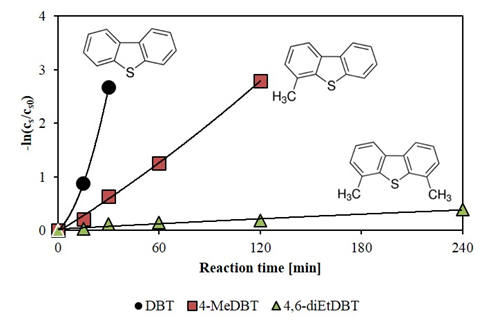
The change of concentration over reaction time for DBT was very fast in comparison with 4,6-diEtDBT. The content of DBT was significantly reduced during the first 30 minutes of the experiment. In contrast, the concentration of 4,6-diEtDBT did not significantly change over the total reaction time (to the end of the experiment = 240 minutes). 4,6-diEtDBT has alkyl substituents adjacent to the sulfur atom (sulfur heteroatom) and therefore it is referred as a sterically hindered with regard to access of the active sites for sulfur degradation [6, 10, 27, 28, 29, 30]. For the reasons mentioned above, only 4-MeDBT was used to monitor as well as to compare the inhibition effect of 2,6-Lutidine. The gradual desulphurization of 4-MeDBT was observed for the first 5 samples (from 0 to 120 minutes). The zero concentration of 4-MeDBT was found for the last sample (after 240 minutes).
The effect of 2,6-Lutidine presence was studied under different reaction conditions using feedstocks MF2 and MF3 in comparison with MF1. The effect of different reaction temperatures under the same pressure (4.5 MPa) on HDS using MF2 (200 mg∙kg-1 of 2,6-Lutidine) is illustrated in the Figure 2 (Table 1, reactions coded as 6; 7 and 8). The same feedstock was used for comparison of different reaction pressures under the same temperature 365 °C (Figure 3) for the experiments coded as 7; 9 and 10 in Table 1.
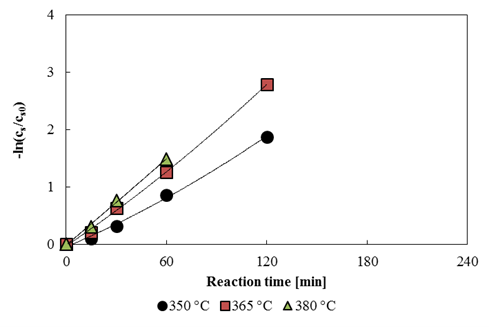
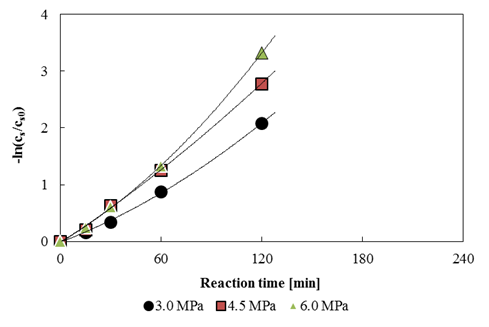
The greatest influence on the degradation of 4-MeDBT was achieved using the highest reaction temperature (380 °C) during the test number 8. In this case, zero concentration of 4-MeDBT was assessed after 120 minutes (5th sample). The degradation of 4-MeDBT was on the same level for first 15 minutes of the reaction under all tested pressures. After 15 minutes the reaction pressure started to appear, the highest differences were seen after 120 minutes of testing.
The same comparison was also made for feedstock coded as MF3 (800 mg∙kg-1 of 2,6-Lutidine). The effect of different temperatures (Figure 4) as well as different pressure (Figure 5) are demonstrated below.
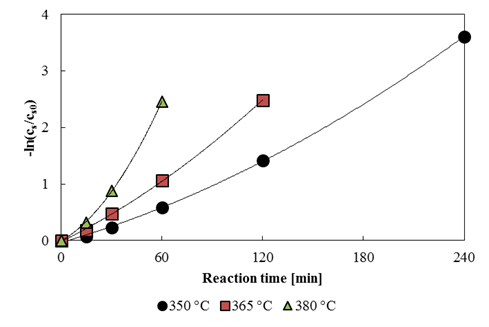
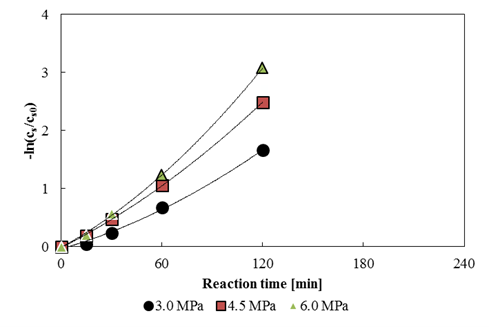
The negative (inhibition) effect of 2,6-Lutidine addition in higher concentration (800 mg∙kg-1) can be distinctly observed in the Figure 4. The reaction rate of HDS was decreased for degradation of 4-MeDBT under 350 °C and pressure of 4.5 MPa. In this case, 4-MeDBT was not totally removed up to 240 minutes. Overall, the HDS reaction rate is growing up with increasing of temperature or pressure but the reaction temperature indicated higher impact.
All the obtained results were used for characterization of the inhibition effect of nitrogen compounds content on HDS process of 4-MeDBT. The specific trends of inhibition effects are visualized in Figure 6.
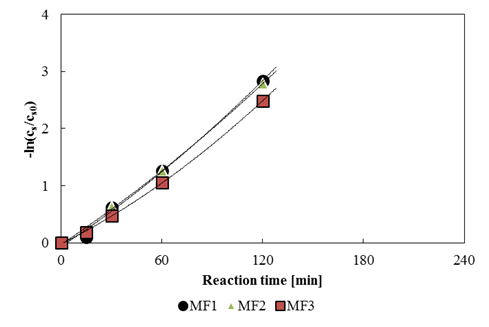
The presence of 800 mg∙kg-1 of 2,6-Lutidine (MF3) had an important inhibition effect on desulphurization of 4-MeDBT. The decrease of the reaction rate was identified. The course of desulphurization process using MF1 and MF2 was very similar according to the Figure 6. The calculated constants of HDS reaction rate are showed in the following Table 2. The constants were calculated for all the used sulfur species. The experiments with constant pressure at different reaction temperatures were used for the comparison because of the greater influence of the reaction temperature on the HDS process.
The values showed that there were not any significant differences in the reaction rates between processing of MF1 and MF2 which is consistent with the curves in the Figure 6. It has been also confirmed that the presence of the higher content of nitrogen compound (2,6-Lutidine) had greater impact on 4-MeDBT and 4,6-diEtDBT degradation. The reduction of HDS reaction rate constants due to presence of nitrogen compounds was calculated (Figure 7). HDS constants of 4-MeDBT and 4,6-diEtDBT were changed by more than 25 %. The differences in constants were increased in the row: DBT (7-15 %) → 4-MeDBT (8-29 %) → 4,6-diEtDBT (13-70 %).
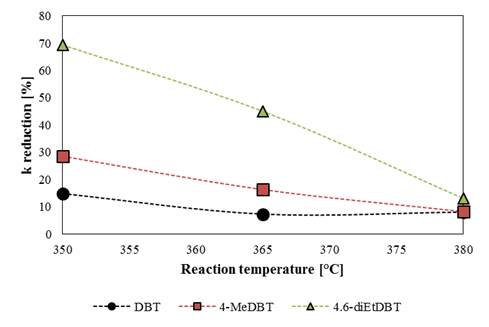
The above-mentioned dependence demonstrated that the highest differences between MF1 and MF3 were achieved under reaction temperature of 350 °C when the desulphurization process was the slowest. On the other hand at temperature of 380 °C (the fastest HDS reaction) the differences between MF1 and MF3 were not significant (8-13 %). The biggest change of reaction rate was registered for 4,6-diEtDBT at reaction temperature 350 °C.
| Experiment No. | 1 | 6 | 11 | 2 | 7 | 12 | 3 | 8 | 13 |
|---|---|---|---|---|---|---|---|---|---|
| Pressure [MPa] | 4.5 | ||||||||
| Temperature [°C] | 350 | 365 | 380 | ||||||
| Feedstock | MF1 | MF2 | MF3 | MF1 | MF2 | MF3 | MF1 | MF2 | MF3 |
| 2.6-Lutidine [mg∙kg-1] | 0 | 200 | 800 | 0 | 200 | 800 | 0 | 200 | 800 |
| k(DBT) [h-1] | 31.87 | 31.57 | 27.11 | 40.05 | 39.88 | 37.11 | 51.09 | 50.80 | 46.95 |
| k(4 MeDBT) [h-1] | 7.92 | 7.46 | 5.66 | 11.52 | 11.48 | 9.63 | 14.65 | 14.16 | 13.42 |
| k(4,6 diEtDBT) [h-1] | 0.98 | 0.89 | 0.30 | 1.11 | 0.98 | 0.61 | 1.14 | 1.12 | 0.99 |
Table 2: Calculated constants of HDS reaction rate.
The significant change between MF1 and MF3 in the curve slope was identified in the case of 4-MeDBT degradation. It should be noted that the comparison of the reaction rates for DBT / 4,6-diEtDBT could be affected by fast / slow speed of sulfur compounds degradation.
Conclusion
15 HDS experiments were performed in a batch reactor under different conditions (temperature and pressure). The inhibition effect of 2,6-Lutidine on the hydrodesulphurization process was studied using three levels of 2,6-Lutidine concentration in a model feedstock. There were no significant differences between model feedstock without 2,6-Lutidine addition (MF1) and model feedstock containing 200 mg∙kg-1 of 2,6Lutidine. The most suitable feedstock to monitor the inhibition effect of nitrogen specie contained 800 mg∙kg-1 of 2,6Lutidine (MF3). The reaction temperature had greater influence on the inhibition caused by nitrogen compared to the reaction pressure. 4-MeDBT was found to be a suitable representative as sulfur specie for monitoring the nitrogen inhibition for the HDS process. The highest degree of inhibition it means decrease in the reaction rate was determined for the lowest testing temperature 350 °C. The reaction rate constants for 4-MeDBT were decreased by 28.5 % at 350 °C using MF3. The influence of nitrogen can be eliminated by increasing the reaction temperature because no significant differences between the reaction constants at the reaction temperature 380 °C during processing the feedstocks MF1 and MF3 were found. The decrease of the reaction constant for 4-MeDBT was only 8.4 % at 380 °C.
Acknowledgement
The publication is a result of a project which was carried out under the financial support of the Ministry of Industry and Trade of the Czech Republic with institutional support for the long-term conceptual development of a research organization. The project has been integrated into the National Sustainability Programme I of the Ministry of Education, Youth and Sports of the Czech Republic through the Development of the UniCRE Centre project, Project Code LO1606. The result was achieved using the infrastructure of the project Efficient Use of Energy Resources Using Catalytic Processes (LM2018119) which has been financially supported by MEYS within the targeted support of large infrastructures.
Symbols
4,6-diEtDBT 4,6-diethyldibenzothiophene
4-MeDBT 4-methyldibenzothiophene CGO coker gas oil CS concentration of sulphur CS0 concentration of sulphur at beginning DBT dibenzothiophene FCC fluid catalytic cracking gas chromatography with pulsed flame photometric detection GC PFPD HDM hydrodemetallation HDN hydrodenitrogenation HDS hydrodesulphurization HGO hydrogenated gas oil HP/HT high pressure / high temperature LCO light cycle oil MF model feedstock ULSD ultra-low sulphur diesel
References
-
NSAI EN (2017) Automotive fuels-Diesel-Requirements and test methods, European Committee for Standardization. 590:2013+A1:2017, Brusel.
-
Furimsky E, Massoth FE (1999) Deactivation of hydroprocessing catalysts. Catalysis Today 52(4): 381- 495.
-
Laredo SGC, De los Reyes HJA, Luis Cano DJ, Jesús Castillo MJ (2001) Inhibition effects of nitrogen compounds on the hydrodesulfurization of dibenzothiophene. Applied Catalysis A: General 207(1): 103-112.
-
Sau M, Basak K, Manna U, Santra M, Verma RP (2005) Effects of organic nitrogen compounds on hydrotreating and hydrocracking reactions. Catalysis Today 109(1-4): 112-119.
-
Yang H, Chen J, Briker Y, Szynkarczuk R, Ring Z (2005) Effect of nitrogen removal from light cycle oil on the hydrodesulphurization of dibenzothiophene, 4-methyldibenzothiophene and 4, 6-dimethyldibenzothiophene. Catalysis Today 109(1-4): 16-23.
-
Alvarez A, Escobar J, Toledo JA, Pérez V, Cortés MA, et al. (2007) HDS of straight-run gas oil at various nitrogen contents. Comparison between different reaction systems. Fuel 86(9): 1240-1246.
-
Bauserman JW, Mushrush GW, Hardy DR, Willauer HD, Laskoski M, et al. (2014) The Removal of Organic Nitrogen Compounds from Unstable Diesel Fuels. Petroleum Science and Technology 32(6): 638-645.
-
Zepeda TA, Pawelec B, Obeso-Estrella R, de León JD, Fuentes S, et al. (2016) Competitive HDS and HDN reactions over NiMoS/HMS-Al catalysts: Diminishing of the inhibition of HDS reaction by support modification with P. Applied Catalysis B: Environmental 180: 569-579.
-
Rana MS, Al-Barood A, Brouresli R, Al-Hendi AW, Mustafa N (2018) Effect of organic nitrogen compounds on deep hydrodesulfurization of middle distillate. Fuel Processing Technology 177: 170-178.
-
Salazar N, Schmidt SB, Lauritsen JV (2019) Adsorption of nitrogenous inhibitor molecules on MoS2 and CoMoS hydrodesulfurization catalysts particles investigated by scanning tunneling microscopy. Journal of Catalysis 370: 232-240.
-
Peng C, Huang X, Duan X, Cheng Z, Zeng R, et al. (2016) Direct production of high octane gasoline and ULSD blend stocks by LCO hydrocracking. Catalysis Today 271: 149-153.
-
Stanislaus A, Marafi A, Rana MS (2010) Recent advances in the science and technology of ultra low sulfur diesel (ULSD) production. Catalysis Today 153(1-2): 1-68.
-
Egorova M, Prins R (2004) Hydrodesulfurization of dibenzothiophene and 4, 6-dimethyldibenzothiophene over sulfided NiMo/γ-Al2O3, CoMo/γ-Al2O3, and Mo/γ- Al2O3 catalysts. Journal of Catalysis 225(2): 417-427.
-
Chen J, Ring Z (2004) HDS reactivities of dibenzothiophenic compounds in a LC-finer LGO and H2S/NH3 inhibition effect. Fuel 83(3): 305-313.
-
Da Costa P, Manoli JM, Potvin C, Djéga-Mariadassou G (2005) Deep HDS on doped molybdenum carbides: From probe molecules to real feedstocks. Catalysis Today 107- 108: 520-530.
-
Abu II, Smith KJ (2007) HDN and HDS of model compounds and light gas oil derived from Athabasca bitumen using supported metal phosphide catalysts. Applied Catalysis A: General 328(1): 58-67.
-
Dominguez-Crespo MA, Torres-Huerta AM, Díaz-García L, Arce-Estrada EM, Ramírez-Meneses E (2008) HDS, HDN and HDA activities of nickel–molybdenum catalysts supported on alumina. Fuel Processing Technology 89(8): 788-796.
-
Yang H, Chen J, Fairbridge C, Briker Y, Zhu YJ, et al. (2004) Inhibition of nitrogen compounds on the hydrodesulfurization of substituted dibenzothiophenes in light cycle oil. Fuel Processing Technology 85(12): 1415-1429.
-
Carrado KA, Kim JH, Song CS, Castagnola N, Marshall CL, et al. (2006) HDS and deep HDS activity of CoMoS- mesostructured clay catalysts. Catalysis Today 116(4): 478-484.
-
Ding L, Zheng Y, Zhang Z, Ring Z, Chen J (2007) HDS, HDN, HDA, and hydrocracking of model compounds over Mo-Ni catalysts with various acidities. Applied Catalysis A: General 319: 25-37.
-
Wang H, Prins R (2009) Hydrodesulfurization of dibenzothiophene, 4, 6-dimethyldibenzothiophene, and their hydrogenated intermediates over Ni–MoS2/γ- Al2O3. Journal of Catalysis 264(1): 31-43.
-
Nava R, Infantes-Molina A, Castaño P, Guil-López R, Pawelec B (2011) Inhibition of CoMo/HMS catalyst deactivation in the HDS of 4, 6-DMDBT by support modification with phosphate. Fuel 90(8): 2726-2737.
-
Ali SA, Bdwi EA, Hossain MM (2018) Kinetics of simultaneous HDS of DBT and 4‐MDBT/4, 6‐DMDBT over CoMoP/γ‐Al2O3catalysts. The Canadian Journal of Chemical Engineering 96(3): 712-721.
-
Ledoux MJ, Puges PE, Maire G (1982) The HDN reaction mechanisms of cyclic amines on MoO3Al2O3 catalyst under normal H2 pressure. Journal of Catalysis 76(2): 285-293.
-
ASTM D6228-10 (2010) Standard Test Method for Determination of Sulfur Compounds in Natural Gas and Gaseous Fuels by Gas Chromatography and Flame Photometric Detection (Withdrawn 2019), ASTM International, West Conshohocken, USA.
-
ASTM D4629-17 (2017) Standard Test Method for Trace Nitrogen in Liquid Hydrocarbons by Syringe/ Inlet Oxidative Combustion and Chemiluminescence Detection, ASTM International, West Conshohocken, USA.
-
Solís D, Agudo AL, Ramírez J, Klimova T (2006) Hydrodesulfurization of hindered dibenzothiophenes on bifunctional NiMo catalysts supported on zeolite– alumina composites. Catalysis Today 116(4): 469-477.
-
Marafi A, Al-Hindi A, Stanislaus A (2007) Deep desulfurization of full range and low boiling diesel streams from Kuwait Lower Fars heavy crude. Fuel Processing Technology 88(9): 905-911.
-
Gutiérrez OY, Klimova T (2011) Effect of the support on the high activity of the (Ni) Mo/ZrO2–SBA-15 catalyst in the simultaneous hydrodesulfurization of DBT and 4, 6-DMDBT. Journal of Catalysis 281(1): 50-62.
-
Tuxen AK, Füchtbauer HG, Temel B, Hinnemann B, Topsøe H, et al. (2012) Atomic-scale insight into adsorption of sterically hindered dibenzothiophenes on MoS2 and Co– Mo–S hydrotreating catalysts. Journal of Catalysis 295: 146-154.
- Nigeria’s Vulnerability in the Face of Global Energy Policy
- A Simulation Study of Investigation of Optimum Oil Production Performance by Applying Various Gas Injection Methods in Oil Reservoir
- Characterization of Permo-Triassic Reservoirs through Thermal Maturity Assessment of Westphalian Source Rocks in the Cheshire Basin
- Influence of Microwax on the Rheological and Thermal Behaviour of a Wax Crude Oil
- Real-Time Monitoring and Performance Optimization of Steam Injection in Heavy Oil Reservoirs Using Fiber Optic Sensing and Integrated Predictive Simulation Models
- Rapid On-Site Determination of the Total Petroleum Hydrocarbon Content of Soils by Handheld Fourier Transform Near-Infrared Spectroscopy: Development of a Global, Site- and Scanner- Independent Calibration Model