
Estimation of Viscosity of the N-Alkane (C1-C 4) in Bitumen System Using Adaptive Neuro-Fuzzy Interference System (ANFIS)
One of the important mechanisms in solvent-aided thermal recovery processes is viscosity reduction. Light n-alkane hydrocarbons are among the potential solvents for solvent-aided thermal recovery processes. In this study, the viscosity of C1-C4 n-alkanes in bitumen was investigated. Adaptive neuro-fuzzy interference system (ANFIS) was used for this aim. The result obtained by the ANFIS model analyzed with the statistical parameters (i.e., MSE, MEAE, MAAE, and R2) and graphical methods. Results show that the ANFIS has high capability to the prediction of solvent/bitumen mixture viscosity.
Introduction
Recently, solvent-aided thermal recovery methods have more attention due to overcoming the associated disadvantages of thermal recovery methods. The commercial recovery procedures such as steam assisted gravity drainage (SAGD), (i.e a thermal in-situ method for recovery of bitumen) and cyclic steam stimulation (CSS), require many amounts of steam per unit volume of the produced oil [1, 2, 3, 4]. Solvent dissolution in bitumen at solvent-aided thermal recovery technique makes viscosity reduction of bitumen by co-injecting a mixture of saturated steam and solvent into bitumen [5]. Viscosity reduction has an important role in solvent-aided thermal recovery processes and it’s because of solvent dissolution in the bitumen. The condensed solvent at the edge of the steam chamber or with direct contact of gaseous solvent and bitumen makes of this dissolution. The n-alkane hydrocarbons (i.e., methane, ethane, propane, and butane) are among the potential solvents for solvent-aided thermal recovery processes [1].
There are a number of experimental studies based on the phase behavior of bitumen /solvent system [6]. Nourozieh, et al. [5] they were tested phase behavior experiments for propane/Athabasca bitumen mixtures over the temperature range of 323–473 k and at pressures up to 10 mpa. Badamchi- Zadeh measured the saturation pressure and solubility of propane in Athabasca bitumen, as well as the liquid phase densities and viscosities, for temperatures from 10 to 50 °c. Haddadnia, Sadeghi Yamchi, et al. [7] reported the viscosity and solubility data of methane-, ethane-, propane-, and butane-Athabasca bitumen systems at high temperatures (up to 260 c).
In order to estimates of such parameters, there are commonly two approaches i.e., the thermodynamic approaches and intelligence models. Intelligence method is usually divided into four-part, such as the Artificial Neural Network (ANN), Fuzzy Logic System (FLS), Adaptive Network-based Fuzzy Inference System (ANFIS), and Support Vector Machine (SVM) [8, 9, 10, 11, 12].
The aim of this article was evaluate the capability of Adaptive Network-based Fuzzy Inference System (ANFIS), to predicting solvent/bitumen mixture viscosity. To develop the model, 3 input values consisted of temperature, pressure, and carbon number of n-alkane considered. To the investigation of the accuracy of the proposed models the statistical parameters (i.e., MSE, MEAE, MAAE and R2) and the graphical method was employed.
Adaptive Neuro-Fuzzy Inference System (ANFIS)
Jang in 1993 introduced the Adaptive neuro-fuzzy interference system (ANFIS) as intelligent hybrid system [11, 13]. The ANFIS work on the rules of the fuzzy logic model which these rules developed with network learning [11]. Figure 1 shows the simplest structure of ANFIS with two inputs variable. The ANFIS consist of two if-then rules based on Takagi and Sugeno type which can be defined as follows [14]: Rule 1: If x1 is A1 and x2 is B1, then z1=p1x1+q1x2+r1 (1) Rule 2: If x1 is A2 and x2 is B2, then z2=p2x1+q2x2+r2 (2)
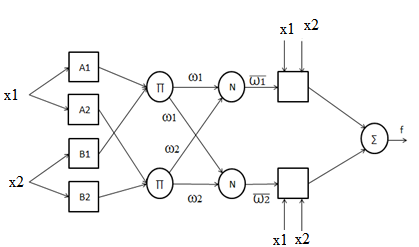
Layer 1: The first layer is fuzzification layer that converts the inputs into a fuzzy set by means of membership functions (µai) and (a, b and c) are premise parameters.
( ) , o x µ =
1, 1 i Ai
for i=1,2 (3) ( ) ,
o x µ =
1, 2 i Bi
x c x a µ − = −
ib for i =1,2 (4)
2 ( ) exp i Ai i Layer 2: The second layer is rule layer, which the outputs are obtained with the membership degrees.
2, 1 2 ( )* ( ) i Ai Bi o x x µ µ = for i=1,2 (5)
Layer 3: The third layer is normalization layer which in this part the ratio of firing strength of the ith rule to the sum of all rules firing strength is computed.
i i o ω ω ω ω = = +
3, 1 2 Layer 4: Layer four defined as defuzzification layer and eventually Output layer, the output of ANFIS was obtained from this layer.
4,i i i o f ω = for i=1,2
5,i i i i o f ω =∑
Data Processing
In this research, the dataset was collected using the supplied data in the work of Zirrahi M, Haddadnia A [1, 7]. The dataset was divided into two parts for test and train data with 30 and 70 ratio percent respectively. The dataset included temperature, pressure, and carbon number of n-alkane (Tables 1 & 2).
| Alkane | T(c) | P(MP) | Bitumen | Ref |
|---|---|---|---|---|
| 26-78 2.5-10.04 Cold lake 26.2-100.2 2.15-9.77 bitumen CH4 100-190 1.17-4.76 Athabasca 200-260 1.5-6 Mackey River 22.9-101.3 1.02-10.07 Cold lake C2H6 100-190 1.14-4.28 bitumen 200-260 1.5-6 Mackey River Athabasca 100-190 1.17-4.38 Mackey River C3H8 200-260 4-Jan Athabasca 100-190 0.88-3.52 Mackey River C4H10 200-260 1-3.7 Athabasca | [1,7,15] [1,7] [2,7] [1,7] | |||
| Mackey River Cold lake bitumen Mackey River Athabasca Mackey River Athabasca Mackey River Athabasca |
Table 1: Range of experimental data points collected from literature.
| Parameter | Description/ Value |
|---|---|
| Fuzzy structure | Sugeno-type |
| Initial FIS for training | Genfis 3 |
| Membership function type | Gaussian |
| Number of membership functions associated with each input | 15 |
| Number of input | 3 |
| Number of output | 1 |
| Optimal method | Hybrid |
| Training maximum epoch number | 200 |
| Initial step size | 0.001 |
| Step size decrease rate | 0.9 |
| Step size increase rate | 2 |
Table 2: Detailed parameters for training the ANFIS model.
Results and Discussion
In this study, an adaptive neuro-fuzzy interference system (ANFIS) was used to predict the viscosity of C1- C4 n-alkane at different condition operation in bitumen system. To this aim, a Sugeno-type of ANFIS structure was proposed by a Gaussian and linear membership function for input and output respectively. The detail parameters for training the ANFIS model are shown in Table 2. The dataset is divided into two part, 30%for test and 70%for the train. To evaluate the capability of the established model, the statistical parameters, mean squared error ,mean absolute error percent and maximum absolute error percent were employed (i.e., MSE, MEAE%,MAAE% and R2) which obtained as following formulations [11, 16, 17].
k = − = ∑ (6)
2
1 ( ) i a e MSE k a e MEAE k a =
− = ∑ (7)
1 % *100 k
1 i max % *100 e a MAAE a − = (8)
Where a is actual value and e is estimated value.
| Statistical Parameters | Train | Test | All data |
|---|---|---|---|
| R2 | 0.999 | 0.999 | 0.999 |
| MSE | 0.361 | 0.209 | 0.3154 |
| MEAE% | 0.075 | 0.023 | 0.035 |
| MAAE% | 0.77 | 0.26 | 0.36 |
Table 3: Statistical parameters of the developed ANFIS model to predicting solvent/bitumen mixture viscosity.
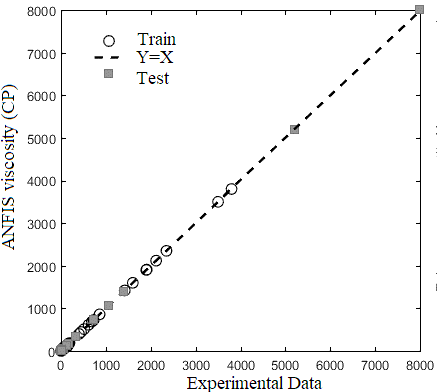
The capability of the proposed model was investigated for predicting the viscosity of light hydrocarbon in bitumen. The statistical parameters were used for this aim and represented in the Table 3. The result obtained shows the high performance of the established model. Figure 2 shows the predicted values versus experimental data for test and train data which indicated the good fitting for test and train data. The relative deviation for both training and testing dataset has been computed and showed in Figure 3. The relative deviation values were obtained from equation (9) [18].
e a D a − = (9)
R i i
i Where RD is relative deviations, ei is estimated values and ai is the actual value. The accumulation of relative values near the Y =0 line shows the appropriate performance of the ANFIS model.
As can be seen, the ANFIS model can predict the dynamic viscosity with high accuracy.
![Figure 3: The relative deviation values were obtained from equation (9) [18].](/fulltextimages/5854/fig_3.png)
In order to evaluate the results of this study, the statistical parameters are compared to other results of the published model in Table 4. Results from this comparison confirm the better performance of the ANFIS model for prediction both solubility and viscosity in bitumen system.
| Statistical Parameters | Viscosity (cp) | |
|---|---|---|
| ANFIS | [19] | |
| R2 | 0.999 | 0.97 |
| MSE | 0.3154 | 0.109 |
| MEAE% | 0.035 | 0.228 |
Table 4: Results from this comparison confirm the better performance of the ANFIS model for prediction both solubility and viscos
Conclusion
The purpose of this work was estimation of solvent/ bitumen mixture viscosity in solvent-aided thermal recovery processes. Statistical parameters such as R2, MSE, MEAE, and RD combined with graphical assessments were used in order to have a sensible comprehension about the accuracy and capability of the ANFIS model. Results show the high performance of ANFIS for predicted values. According to results, the ANFIS can be considered as a suitable tool for predicting solvent/bitumen mixture viscosity and solubility.
References
-
Zirrahi M, Hassanzadeh H, Abedi J (2017) Experimental and modelling studies of MacKay River bitumen and light n‐alkane binaries. The Canadian Journal of Chemical Engineering 95(7): 1417-1427.
-
Eghbali S, Dehghanpour H (2018) An experimental and modeling study of carbon dioxide/bitumen and C 4/ bitumen phase behavior at elevated temperatures using cold lake bitumen. SPE Journal 23(06): 1-991.
-
Eghbali S, Dehghanpour H (2017) An Experimental and Modeling Study of Solvent-Bitumen Phase Behavior at Elevated Temperatures Using Cold Lake Bitumen. SPE Annual Technical Conference and Exhibition. Society of Petroleum Engineers, USA.
-
Li H, Yang DT, Yang P (2013) Phase behaviour of CH4- C3H8-heavy oil systems under reservoir conditions. SPE Heavy Oil Conference-Canada. Society of Petroleum Engineers, Canada.
-
Kariznovi M, Nourozieh H, Abedi J (2012) Phase behavior and viscosity measurements of heavy crude oil with methane and ethane at high-temperature conditions. SPE Western Regional Meeting. Society of Petroleum Engineers, USA.
-
Li H, Yang DT (2013) Phase behaviour of C3H8/n- C4H10/heavy-oil systems at high pressures and elevated temperatures. Journal of Canadian Petroleum Technology 52(01): 30-40.
-
Haddadnia A, Sadeghi Yamchi H, Zirrahi M, Hassanzadeh H, Abedi J (2018) New solubility and viscosity measurements for methane–, ethane–, propane–, and butane–Athabasca bitumen systems at high temperatures up to 260° C. Journal of Chemical & Engineering Data 63(9): 3566-3571.
-
Baghban A, Rajabi H, Jamshidi N (2017) ANFIS modeling of carbon dioxide capture from gas stream emissions in the petrochemical production units. Petroleum Science and Technology 35(6): 625-631.
-
Baghban A, Namvarrechi S, Phung LTK, Lee M, Bahadori A, et al. (2016) Phase equilibrium modelling of natural gas hydrate formation conditions using LSSVM approach. Petroleum Science and Technology 34(16): 1431-1438.
-
Baghban A, Ahmadi MA, Shahraki BH (2015) Prediction carbon dioxide solubility in presence of various ionic liquids using computational intelligence approaches. The Journal of supercritical fluids 98: 50-64.
-
Sayyad Amin J, Rajabi Kuyakhi H, Kashiwao T, Bahadori A (2019) Development of ANFIS models for polycyclic aromatic hydrocarbons (PAHs) formation in sea sediment. Petroleum Science and Technology 37(6): 679-686.
-
Sayyad Amin J, Rajabi Kuyakhi H, Bahadori A (2019) Prediction of formation of polycyclic aromatic hydrocarbon (PAHs) on sediment of Caspian Sea using artificial neural networks. Petroleum Science and Technology 37(18): 1987-2000.
-
Jang JS (1993) ANFIS: adaptive-network-based fuzzy inference system. IEEE transactions on systems, man, and cybernetics 23(3): 665-685.
-
Rajabi Kuyakhi H, Tahmasbi Boldaji R (2019) A novel ANFIS model to prediction of the density of n-alkane in different operational condition. Petroleum Science and Technology 37(24): 2429-2434.
-
Svrcek WY, Mehrotra AK (1982) Gas solubility, viscosity and density measurements for Athabasca bitumen. Journal of Canadian Petroleum Technology 21(04).
-
Rajabi-Kuyakhi H (2019) Biodiesel Production with Supercritical Ethanol Estimation using RBF-ANN Approach. Pet Petro Chem Eng J 3(6): 1-5.
-
Rostami A, Shokrollahi A, Ghazanfari MH (2018) New method for predicting n-tetradecane/bitumen mixture density: correlation development. Oil & Gas Science and Technology-Revue d’IFP Energies nouvelles 73(35): 11.
-
Baghban A, Kardani MN, Mohammadi AH (2018) Improved estimation of Cetane number of fatty acid methyl esters (FAMEs) based biodiesels using TLBO-NN and PSO-NN models. Fuel 232: 620-631.
-
Al-Gawfi A, Zirrahi M, Hassanzadeh H, Abedi JJAO (2019) Development of Generalized Correlations for Thermophysical Properties of Light Hydrocarbon Solvents (C1–C5)/Bitumen Systems Using Genetic Programming. ACS Omega 4(4): 6955-6967.
- Nigeria’s Vulnerability in the Face of Global Energy Policy
- A Simulation Study of Investigation of Optimum Oil Production Performance by Applying Various Gas Injection Methods in Oil Reservoir
- Characterization of Permo-Triassic Reservoirs through Thermal Maturity Assessment of Westphalian Source Rocks in the Cheshire Basin
- Influence of Microwax on the Rheological and Thermal Behaviour of a Wax Crude Oil
- Real-Time Monitoring and Performance Optimization of Steam Injection in Heavy Oil Reservoirs Using Fiber Optic Sensing and Integrated Predictive Simulation Models
- Rapid On-Site Determination of the Total Petroleum Hydrocarbon Content of Soils by Handheld Fourier Transform Near-Infrared Spectroscopy: Development of a Global, Site- and Scanner- Independent Calibration Model