
Use of Measurement Uncertainty in Compliance Assessment in Custody Transfer Operations
Editorial
Starting from production until reaching the final consumer, at each stage, the oil and its derivatives can be can carried under the responsibility of a different company that, sequentially, transfers it to the next company, by means of processes called custody transfers. These measurement results, due to the large financial amounts involved in the oil and gas industry, must be reliable, considering that compliance must be assessed between suppliers and customers in custody transfer operations, avoiding unnecessary conflicts in these commercial relationships. This is why the results must be statistically compatible.
The compatibility between results and the decision- making concerning this process can be made based on the measurement uncertainty and guard band concept [1]. This new powerful approach that has been used to evaluate the conformity against regulatory limits [2, 3], also, can be used successfully to assess the compliance between two parties involved in custody transfer operations, client and supplier. A great challenge is to balance cost versus quality (measurement uncertainty). As the value of this quality parameter is minimized, more investments are required in better measurement conditions, that is, significant costs.
Based on the International Organization of Legal Metrology [4], the accuracy class of type of measuring system takes into consideration the field of application. Thus measuring systems on pipelines must have a maximum measurement uncertainty of 0.3 %, during custody transfer operations. On the other hand, the static measurement in storage tanks depends on the level of product transferred, the tank capacity tables, the density of the fluid and the temperature during the transfer custody operations, etc… Therefore, there is no single fixed uncertainty [5].
Let us suppose two different scenarios of custody transfer operations of diesel.
The first one, the supplier measured 100.1 m3 ± 0.3 m3 (k = 2; confidence level of 95.45) and the consumer measured 100.0 m3 ± 0.3 m3 (k = 2; confidence level of 95.45), both using a turbine fiscal oil metering station (Figure 1). Considering a risk of 5 % for the consumer, is there compliance between the parties?
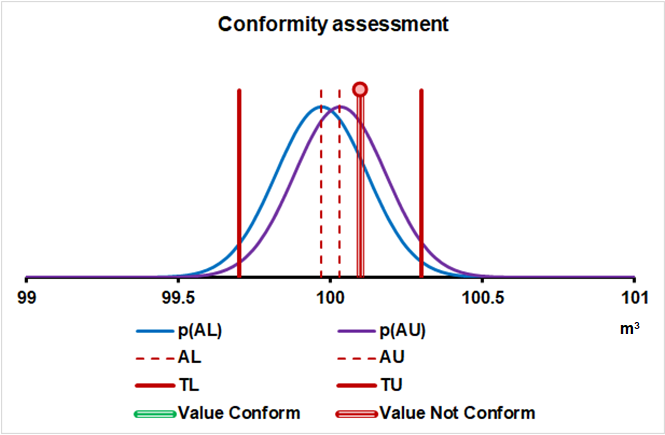
This item is not confirm to an effective Consumer’s Risk of 5 %.
The second one, the same supplier measured 100.1 m3 ± 0.3 m3 (k = 2; confidence level of 95.45) and the other consumer measured 100.0 m3 ± 1.0 m3 (k = 2; confidence level of 95.45). The supplier used a turbine fiscal oil metering station, but the consumer used a storage tank (Figure 2). Considering a risk of 5 % for the consumer, is there compliance between the parties?
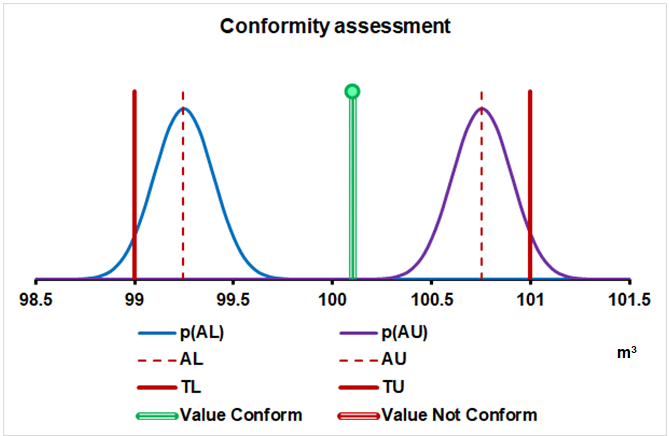
This item is conform to an effective Consumer’s Risk of 5 %.
Finally, one could notice that the use of guard bands based on measurement uncertainty is an interesting tool in compliance assessment in custody transfer operations. Moreover, the compliance assessment based on same measurement results between supplier and customers depends on the measuring systems (different measurement uncertainties) used and not only the transferred volume.
References
-
Williams A, Magnusson B (2021) Eurachem/CITAC Guide: Use of uncertainty information in compliance assessment. 2nd(Edn.), Eurachem.
-
Oliveira EC, Lourenço FR (2021) Risk of false conformity assessment applied to automotive fuel analysis: A multiparameter approach. Chemosphere 263: 128265.
-
Oliveira EC, Lourenço FR (2021) Data reconciliation applied to the conformity assessment of fuel products. Fuel 300: 120936.
-
OIML R 117-1, Edition 2007 (E), Dynamic measuring systems for liquids other than water. Part 1: Metrological and technical requirements, OIML.
-
Olivera EC, Queiroz CWT (2005) Metrological compatibility between dynamic and static measurement of oil, its liquid derivatives and alcohol. Rio Pipeline Conference & Exposition.
- Nigeria’s Vulnerability in the Face of Global Energy Policy
- A Simulation Study of Investigation of Optimum Oil Production Performance by Applying Various Gas Injection Methods in Oil Reservoir
- Characterization of Permo-Triassic Reservoirs through Thermal Maturity Assessment of Westphalian Source Rocks in the Cheshire Basin
- Influence of Microwax on the Rheological and Thermal Behaviour of a Wax Crude Oil
- Real-Time Monitoring and Performance Optimization of Steam Injection in Heavy Oil Reservoirs Using Fiber Optic Sensing and Integrated Predictive Simulation Models
- Rapid On-Site Determination of the Total Petroleum Hydrocarbon Content of Soils by Handheld Fourier Transform Near-Infrared Spectroscopy: Development of a Global, Site- and Scanner- Independent Calibration Model